Hawaii Vehicle Bill of Sale — What It Needs & Check First
Everything you need to complete a bill of sale in Hawaii: what information goes on it, which transfer documents change hands, and how it all flows to the Hawaii Department of Customer Services. Before you sign, run the 17-character VIN — it confirms the title is clean and the odometer reading checks out. It's free.
Check a Hawaii Car Before You Sign
Confirm the title is clean, lien-free, and the mileage matches — cars, trucks, SUVs, motorcycles
Free · No sign-up · Instant result
Hawaii Vehicle Sale Data at a Glance
- Hawaii registered vehicles
- 1.2M
- Hawaii population
- 1.4M
- Hawaii titling authority
- HI
- VIN check before signing
- Free
Hawaii Bill of Sale Rules
The specifics for Hawaii, taken from the Hawaii Department of Customer Services and Hawaii law. Every source is linked at the bottom of this page.
CS-L(MVR)40
Hawaii publishes its own vehicle bill of sale, Bill of Sale (City and County of Honolulu, Department of Customer Services, Division of Motor Vehicles) (CS-L(MVR)40). Using the state's form is the safest option — it already contains every field the Hawaii Department of Customer Services looks for.
Sometimes
Hawaii titling is run by the four counties and a bill of sale is not part of the normal document list when the Certificate of Title is properly endorsed by the seller; Honolulu requires a notarized bill of sale only when the Certificate of Title is not released by the recorded owner (its out-of-county and out-of-state transfer instructions).
Sometimes
When Honolulu does require a bill of sale (title not released by the recorded owner) that bill of sale must be notarized, and the county's own form CS-L(MVR)40 carries a notary block; notarization of the seller's signature on the Certificate of Title itself is expressly optional.
30 days
The 30 days run from the seller's date of transfer written on the Certificate of Title, not from the day the buyer takes delivery; missing it adds a $50 late-transfer penalty on top of the county transfer fee ($10 in Honolulu, $20 in Maui County). This is the BUYER's deadline - the SELLER separately has only 10 days to file the Notice of Transfer (Honolulu form CS-L(MVR)53) with the county where the vehicle was last registered.
Bill of Sale (City and County of Honolulu, Department of Customer Services, Division of Motor Vehicles) (CS-L(MVR)40)
This is the form Hawaii issues for a vehicle bill of sale. It already contains every field the Hawaii Department of Customer Services looks for, which is why it is worth using instead of a generic template.
Get CS-L(MVR)40 from www4.honolulu.govIs Hawaii Typical? The Rules Side by Side
Every figure below is counted from the same state-by-state research that produced the Hawaii answers above. It is here because "not required" reads very differently once you know how many other states say the same thing.
The official form
25 states hand you a form and 15 leave you to write your own. Hawaii hands you a form, which removes the most common reason a private-sale transfer gets sent back from the counter: a home-made document that left out a field the state expects to see filled in.
Whether the document is required
Here the answer genuinely is "it depends", and 23 states are in the same position. That is not a hedge on our part: the Hawaii Department of Customer Services requires the document for certain transfers only. Since signing one costs nothing and being sent home for the want of it costs an afternoon, the sensible default is to sign one regardless.
Notarization
Hawaii is one of 10 states where notarization is required for some transfers and not others. 2 require it across the board and 23 never do. Settle which case you are in before the meeting — a notary cannot retroactively witness a signature that has already been made.
The buyer's deadline to apply for title
Put beside the other 33 states with a published calendar deadline, Hawaii's 30 days sits toward the generous end — 10 days is the tightest anywhere and 60 the most relaxed. Miss it and the Hawaii Department of Customer Services usually adds a penalty rather than refusing the transfer, but the penalty grows with the delay.

What Goes on a Hawaii Bill of Sale
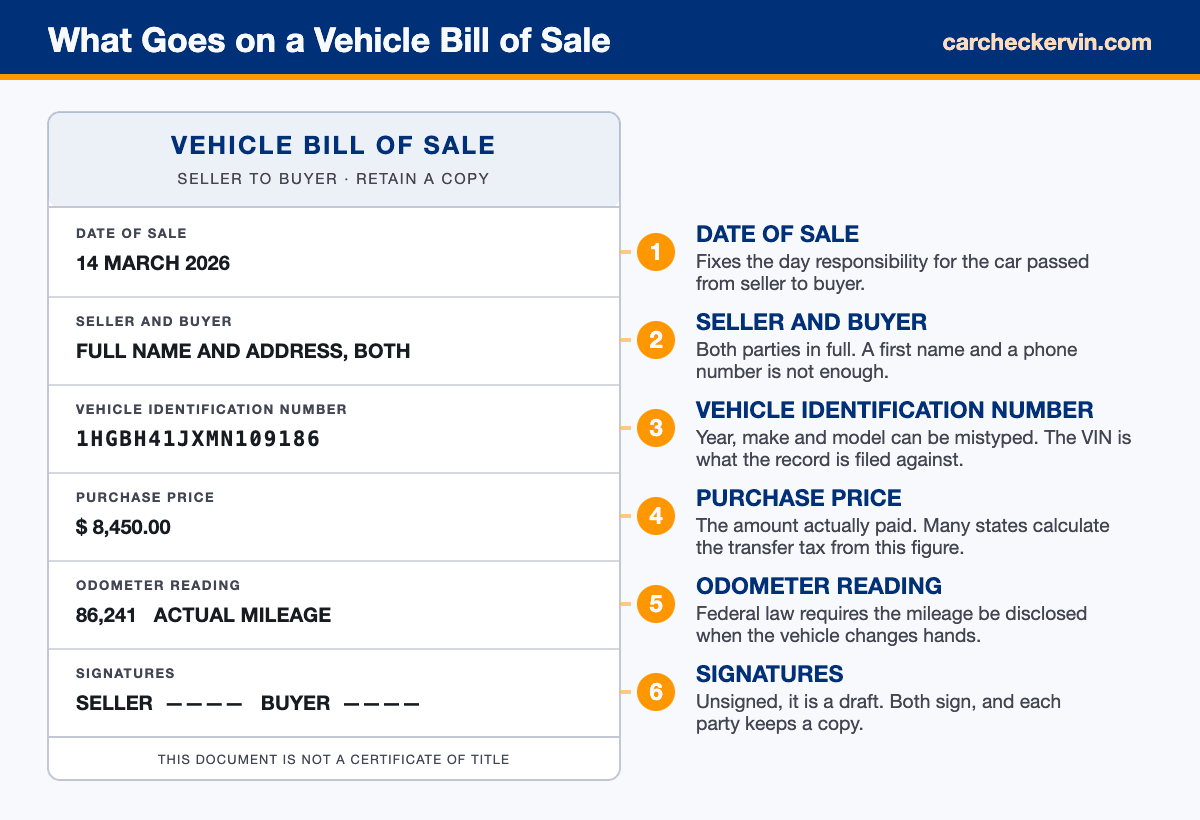
Hawaii issues CS-L(MVR)40, so start there — but whichever form you use, a complete bill of sale always captures these four things:
Buyer & seller details
Full legal names and addresses of both parties, so the Hawaii Department of Customer Services can tie the sale to real people.
Odometer reading
The exact mileage at the moment of sale — a legal disclosure that protects against rollback fraud.
Vehicle description & VIN
Year, make, model, body style, and the full 17-character VIN that ties everything to the car.
Price, date & signatures
The agreed price, the date of sale, and both signatures — notarized if Hawaii requires it.
How a Private Sale Transfer Works in Hawaii
Titling in Hawaii is handled by the Hawaii Department of Customer Services. Fees depend on the vehicle, but the paperwork flow in a private sale is always the same — here is how the bill of sale and the title move together.
- 1Complete the bill of saleFill in the buyer and seller details, sale price, date, odometer reading, and the full VIN. Use Hawaii's own form, CS-L(MVR)40 — it already has every field the Hawaii Department of Customer Services checks. Both parties sign.
- 2Sign over the titleThe seller signs the existing Hawaii title over to the buyer in the assignment section, recording the same sale price, date, and odometer reading shown on the bill of sale.
- 3File with the DMVThe buyer brings the bill of sale, signed title, odometer disclosure, and proof of identity to the Hawaii Department of Customer Services to transfer the title, pay any tax due, and register the vehicle. In Hawaii the buyer has 30 days from the date of sale to do this.
Hawaii Vehicle Transfer Documents
The bill of sale is one of several papers that change hands when a car is sold in Hawaii. These are the documents a private transfer usually involves:
Bill of sale
Proof of purchase the Hawaii Department of Customer Services uses to calculate sales tax: who, what, when, how much, and the VIN.
Signed-over title
The primary ownership document. The seller assigns the Hawaii title to the buyer in its assignment section.
Odometer disclosure
A required mileage statement, often built into the title or bill of sale, guarding against rollback fraud.
Lien release
If the car had a loan, the lender's release proving the lien is paid so a clean title can transfer.
Hawaii titling authority
Vehicle titles and transfers in Hawaii are handled by the Hawaii Department of Customer Services. About 1.2M vehicles are registered across the state, and every transfer is recorded against the VIN — so the documents you sign should always match the VIN on the car. See the Hawaii vehicle title guide for the title side of the transfer.
Why Check the VIN Before You Sign in Hawaii
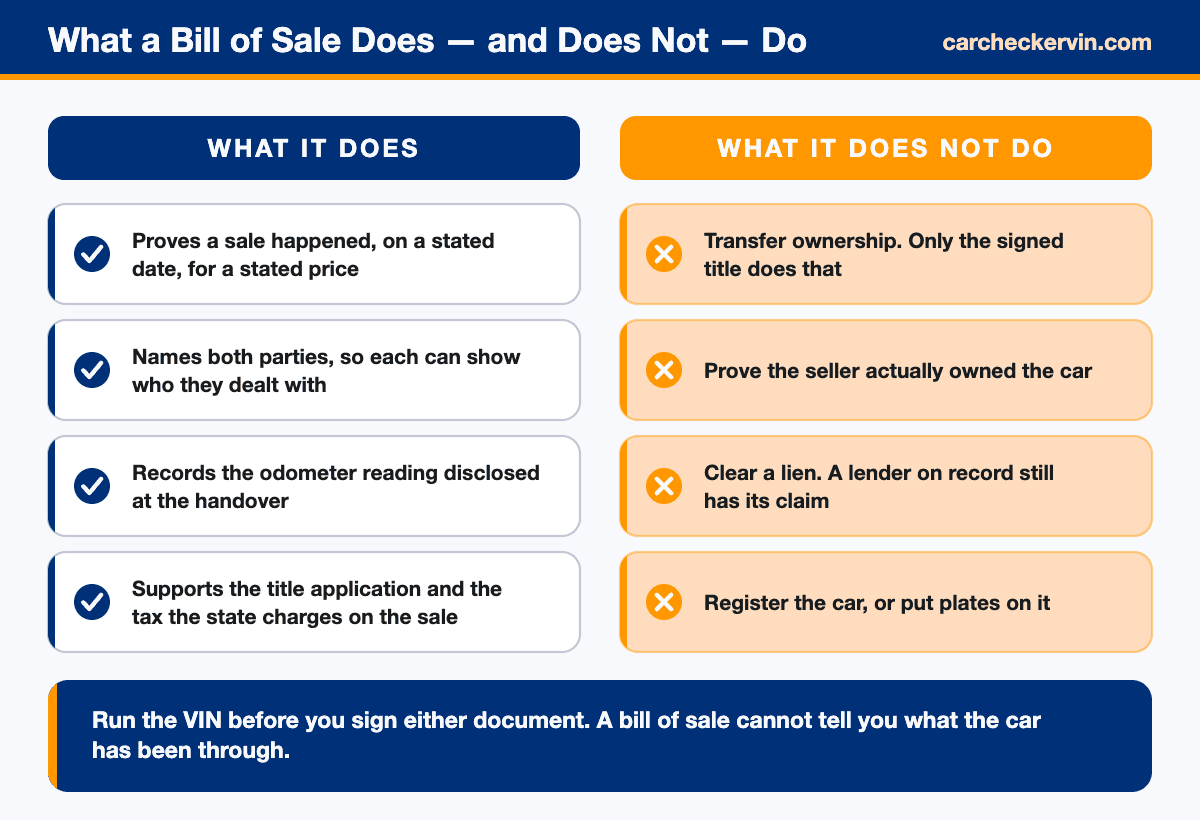
The bill of sale records what the seller claims. A free VIN check shows what actually happened to the car — before you put it in writing.
Confirm the odometer reading. The mileage you write on the Hawaii bill of sale is a legal disclosure. An odometer rollback means the figure the seller gave you is wrong — and the car is worth less.
Make sure the title is clean. A bill of sale can't undo a salvage brand. Check that the title has no hidden brand before you agree on a price.
Rule out an open lien. If a previous owner's loan was never paid off, the title can't pass to you cleanly. A Hawaii lien check surfaces it before money changes hands.
Check before you sign
Enter the 17-character VIN to confirm the title is clean, lien-free, and the mileage checks out — everything you want verified before the Hawaii bill of sale is signed.
Mistakes Worth Avoiding on a Hawaii Bill of Sale
A rejected transfer is almost always a document problem rather than a car problem. These are the ones that come up again and again in Hawaii, in rough order of how expensive they are to unpick.
- 1
Something has been crossed out
Alterations are read as tampering, especially on the title. A struck-through VIN, a corrected mileage figure or a whited-out name is usually enough for a clerk to reject the document outright, and on a Hawaii title it can mean applying for a duplicate before the transfer can go ahead at all. Start a fresh sheet instead. A bill of sale costs nothing to reprint and a duplicate title costs a fee and a wait.
- 2
The VIN was copied from the advert
A VIN is 17 characters and there is no way to tell a correct one from a wrong one by looking at it — which is exactly why transcription errors survive all the way to the Hawaii Department of Customer Services. Read it off the car, not off the listing: the plate at the base of the windscreen on the driver's side, and again on the sticker in the driver's door jamb. If those two disagree with each other, stop. That is not a typing mistake, and no bill of sale can fix it.
- 3
The price is a placeholder
Writing "$1" or "gift" on a sale that was neither is a bad idea in every state. The price on the bill of sale is what a tax assessment is calculated from, so an understated figure is not a clever saving — it is a document that contradicts the money that actually moved, signed by both of you. If the car genuinely was a gift, record it as one; that is a different transaction with its own paperwork, and the Hawaii Department of Customer Services handles it as such.
- 4
Only one copy exists
Both parties need one, and the seller needs theirs more. The buyer has the car; the seller has nothing but a document proving when they stopped being responsible for it — which is what answers a parking ticket, a toll bill, or a police enquiry six months later. Make two copies, sign both, and keep yours somewhere you will still be able to find it. Photographing it on the spot takes five seconds and has saved a great many arguments.
- 5
The two signatures were made at different times
A bill of sale is a record of a moment, and both parties are meant to be at it. In Hawaii some transfers must be notarized, which makes the order of events matter: a signature made before you reach the notary cannot be witnessed retrospectively. Sign the same piece of paper, at the same time, and make the second copy before you part.
- 6
The date is missing, or moved
The date of sale is what every subsequent clock runs from. In Hawaii the buyer has 30 days from it to apply for title, so backdating the document to cover a delay does not buy time — it spends it. It is also the line either party points at when a ticket, a toll or an insurance claim arrives for a day neither of them owned the car. Leave it blank and there is nothing to point at.
What the Bill of Sale Starts, and What Finishes It in Hawaii
The document you have just signed is one entry in a chain that ends with the car registered in your name at the Hawaii Department of Customer Services. Here is the rest of that chain, and what can go wrong in each link.
The title is the transfer; the bill of sale only records it. This is the single most expensive misunderstanding in a private sale — a signed receipt and a set of keys do not make you the owner in Hawaii, and a buyer who never completes the assignment finds out when they try to sell the car on. What the seller has to sign, where the odometer statement goes, and what to do when the title is lost are all covered in the Hawaii vehicle title guide.
Nothing moves while a lien is open. If the seller still owes money on the car, the lender holds the security interest and the Hawaii Department of Customer Serviceswill not print a clean title in your name until it is released. That release usually comes by post from the lender, which is why the buyer's deadline is rarely the real constraint. Establish whether a lender is on the record with a Hawaii lien check before you hand over cash, not after.
The mileage you write down is a legal statement. The odometer figure on the bill of sale and the one on the title have to agree, and both have to be true — a reading that is lower than a previously reported one is the signature of a rollback, and it is the buyer who carries the loss. Compare every reading ever filed against the VIN in the Hawaii odometer check.
A brand travels with the car, not with the seller. If the vehicle was written off at any point in its life, the brand is attached to the VIN and it follows the car into Hawaii whichever state applied it. No bill of sale can remove it, and no verbal assurance survives contact with the title. The Hawaii salvage title check shows what is recorded against it.
Then the plates. Titling and registering are two different transactions, and the second one is what puts the car legally on the road — with its own proofs, its own fees and, in some counties, its own inspection. The requirements are set out in the Hawaii vehicle registration guide.
Or do all of it at once. Title brands, reported mileage, theft records and open liens are all keyed to the same 17 characters, so there is no reason to check them one at a time. The Hawaii VIN check runs them together, before the bill of sale is signed rather than after.
Check a Hawaii Car Before You Sign
Confirm the title is clean, lien-free, and the mileage matches before money changes hands. Free, in seconds.
Bill of Sale in Other States
Titling and transfer rules are run state by state, with different agencies and forms. Compare Hawaii with these guides, or run any VIN nationwide.
Prüfen Sie die Fahrgestellnummer immer vor dem Kauf
Die kostenlose Vorschau zeigt Title Brands (US-Titel-Kennzeichnungen), Diebstahlstatus und offene Rückrufe in Sekunden und meldet, ob Unfall- und Tachodaten vorliegen. Die vollständige Historie kostet 19,95 € — einmalig, ohne Abo.
Hawaii Bill of Sale FAQ
The questions Hawaii buyers and sellers ask most about the bill of sale and the documents a private car sale needs.
What goes on a bill of sale in Hawaii?+
A Hawaii bill of sale records the full names and addresses of the buyer and seller, the sale date, the purchase price, the vehicle's year, make, model, and body style, the exact odometer reading, and the 17-character VIN. Both parties sign it. Hawaii publishes an official form, Bill of Sale (City and County of Honolulu, Department of Customer Services, Division of Motor Vehicles) (CS-L(MVR)40); using it is the safest option because it already has every field the Hawaii Department of Customer Services checks. Confirm the VIN on the bill of sale matches the title and the dashboard before signing — and run a free VIN check first to verify the title is clean and lien-free.
Do I need a bill of sale to transfer a car in Hawaii?+
In some transfers, yes. Hawaii titling is run by the four counties and a bill of sale is not part of the normal document list when the Certificate of Title is properly endorsed by the seller; Honolulu requires a notarized bill of sale only when the Certificate of Title is not released by the recorded owner (its out-of-county and out-of-state transfer instructions). The signed-over title remains the primary ownership document; the bill of sale is the dated proof of purchase the Hawaii Department of Customer Services uses to confirm the sale and calculate any tax due.
Does a Hawaii bill of sale need to be notarized?+
Sometimes. When Honolulu does require a bill of sale (title not released by the recorded owner) that bill of sale must be notarized, and the county's own form CS-L(MVR)40 carries a notary block; notarization of the seller's signature on the Certificate of Title itself is expressly optional.
How long do I have to transfer a title in Hawaii?+
30 days from the date of sale. The 30 days run from the seller's date of transfer written on the Certificate of Title, not from the day the buyer takes delivery; missing it adds a $50 late-transfer penalty on top of the county transfer fee ($10 in Honolulu, $20 in Maui County). This is the BUYER's deadline - the SELLER separately has only 10 days to file the Notice of Transfer (Honolulu form CS-L(MVR)53) with the county where the vehicle was last registered. This is the buyer's deadline to apply for title — a seller's duty to report the sale, where one exists, runs on a separate clock.
Is Hawaii unusual about bills of sale?+
Hawaii publishes its own form, which 25 states do and 15 do not. On whether the document is required at all, the country splits 8 always, 23 sometimes and 11 never, out of the 42 states publishing a rule. Notarization is the real outlier: 23 states say it is not needed, 10 require it in certain transfers, and 2 require it every time (Louisiana and West Virginia).
Does a car bill of sale have to be notarized?+
Not in most of the country. Of the 35 states where the rule is published, 23 do not require notarization, 10 require it for particular transfers, and 2 require it on every one — Louisiana and West Virginia. Hawaii is in the middle group: some transfers need it and some do not, so resolve which case applies before the meeting. The advice that "a bill of sale must always be notarized" is a rule from somewhere else, repeated without its state attached.
Is 30 days a long time to transfer a title?+
It is the commonest deadline in the country. Across the 34 states that publish a calendar-day deadline for the buyer, the figure runs from 10 days to 60, and 30 days is the commonest single answer — 18 states use it. 10 states give buyers less time than Hawaii does and 6 give more. The clock starts on the date written on the bill of sale, so do not backdate it to cover a delay: that shortens your own deadline. Where the car had a loan, the real constraint is usually how long the lender takes to send a lien release, not the Hawaii Department of Customer Services's deadline.
Can I use an out-of-state bill of sale in Hawaii?+
Usually yes for the document itself — a bill of sale is a record of a transaction, and Hawaii does not reject one because it was typed on another state's template. What does not travel is the procedure around it: 2 states require notarization and the rest largely do not, deadlines to apply for title range from 10 to 60 days, and 25 states publish a form with fields the other 25 never ask for. If you are buying across a state line, the rules that bind you are the ones where the car will be titled, not the ones where it was sold. Run the VIN before you cross the line either way — a brand applied in one state follows the car into the next.
What documents do I need to buy a used car in Hawaii?+
Besides the bill of sale, you'll typically need the Hawaii title signed over by the seller, an odometer disclosure (often part of the title or bill of sale), a lien release if the car had a loan, and your own proof of identity and insurance to register it with the Hawaii Department of Customer Services. A free VIN history check isn't legally required, but it's the smartest document to add — it confirms the title is clean before money changes hands.
Why check the VIN before signing a bill of sale in Hawaii?+
The bill of sale records what the seller claims; a VIN check shows what actually happened to the car. Running the 17-character VIN before you sign confirms the title is clean, the odometer reading is consistent with the car's history, and there's no open lien that would block the transfer at the Hawaii Department of Customer Services. It's free and takes seconds.
Are there any specific titling rules in Hawaii?+
Hawaii's salt-air corrosion is a key reason VIN-based history checks should always include past registration locations.
Sources for the Hawaii Rules on This Page
The Hawaii-specific rules above come from the following official government pages. Last checked 2026-08-22. Rules change — if you are relying on one for a sale, confirm it at the source before you sign.
- honolulu.gov — https://www.honolulu.gov/csd/vehicle-ownership-transfer/
- www4.honolulu.gov — https://www4.honolulu.gov/docushare/dsweb/Get/Document-325994/Bill%20of%20Sale.pdf
- www4.honolulu.gov — https://www4.honolulu.gov/docushare/dsweb/Get/Document-325997/CS-L(MVR)53.pdf
- mauicounty.gov — https://www.mauicounty.gov/1554/Ownership-Transfer---Buyer
Buying or Selling a Car in Hawaii? Check the VIN First.
Enter a 17-character VIN to confirm a clean, lien-free title and an honest odometer reading before you complete the Hawaii bill of sale.
Or get the full VIN history reportPassende VIN-Abfragen
Weitere Tools, um die Historie jedes Fahrzeugs zu prüfen