Can you return a car after buying it?
Almost everyone has heard there is a three-day right to change your mind. There is such a rule — and a car bought at a dealership sits outside it for two separate reasons, both written into the rule itself.
Still deciding? That is the moment that counts.
Walking away is free before you sign and expensive afterwards.
No account · Nothing stored · $14.99 only for the full report
Quick Answer
- Is there a three-day right to return a car?
- Not under the federal rule people are thinking of. That rule covers door-to-door style sales made away from the seller's own premises, and it separately exempts sellers of motor vehicles. A car bought at a dealership was never inside it.
- So the cooling-off rule is a myth?
- The rule is real and useful — it just covers a different situation. It exists for sales solicited at your home, your workplace, a hotel room or a fairground, above modest price thresholds. Buying a car in a showroom is none of those things.
- Then when can a car actually go back?
- When something gives you that right: a return policy the dealer wrote into the contract, a state law covering your specific situation, or a problem with the sale itself such as a misrepresentation. The paperwork you signed is the first place to look, not a federal rule.
What the three-day rule actually is
It exists, it is federal, and it is genuinely useful — for a situation that is not buying a car. Its subject is the door-to-door sale, and the definition is worth reading closely because the whole answer is inside it:
“A sale, lease, or rental of consumer goods or services in which the seller or his representative personally solicits the sale, including those in response to or following an invitation by the buyer, and the buyer's agreement or offer to purchase is made at a place other than the place of business of the seller (e.g., sales at the buyer's residence or at facilities rented on a temporary or short-term basis, such as hotel or motel rooms, convention centers, fairgrounds and restaurants, or sales at the buyer's workplace or in dormitory lounges).”
The operative phrase is at a place other than the place of business of the seller. The rule is about being sold something where you live, work or happen to be — not about buyer's remorse.
Why it fails twice on a car
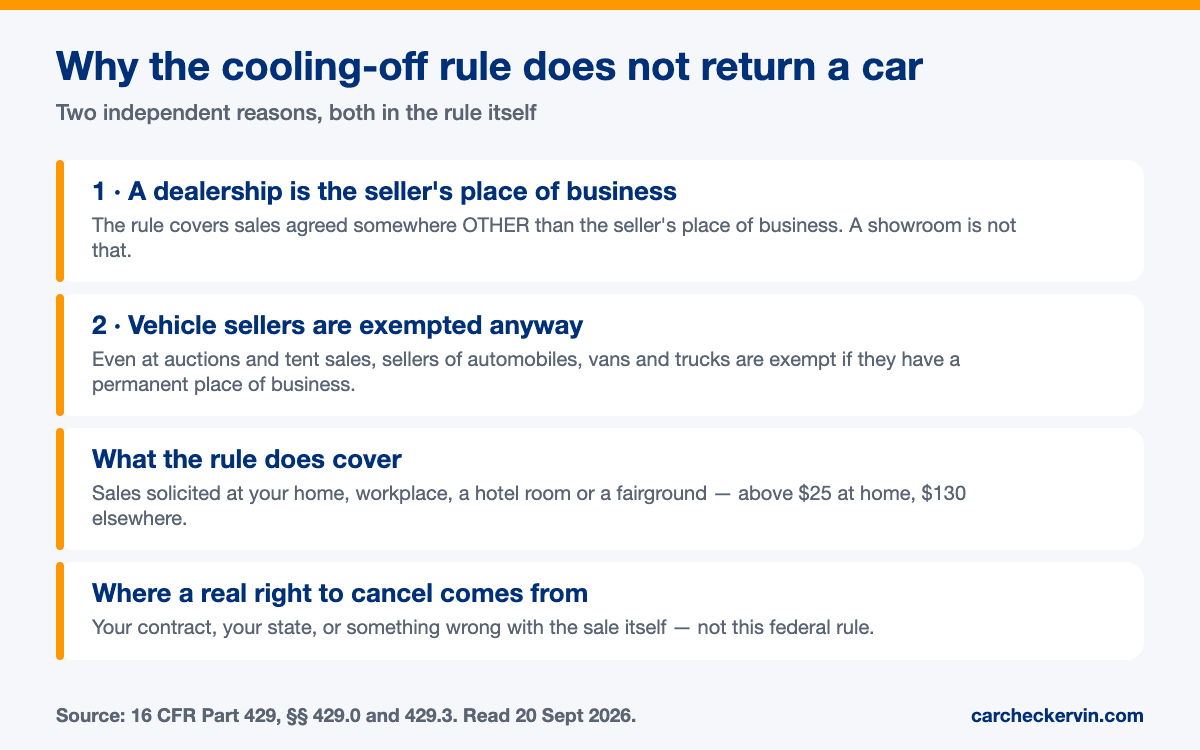
Most explanations give one reason. There are two, and they are independent — so even if you talked your way past the first, the second is still there.
1A dealership is the seller's place of business
The rule covers a door-to-door sale, defined as one where the buyer's agreement or offer to purchase is made somewhere other than the seller's place of business. Signing in a showroom or a finance office is signing at the seller's place of business, so the transaction is outside the rule from the start.
2Vehicle sellers are exempted even at temporary locations
Where a car IS sold somewhere temporary — an auction, a tent sale, an off-site event — the rule exempts sellers of automobiles, vans, trucks and other motor vehicles outright, so long as that seller has a permanent place of business.
“The requirements of this part do not apply for sellers of automobiles, vans, trucks or other motor vehicles sold at auctions, tent sales or other temporary places of business, provided that the seller is a seller of vehicles with a permanent place of business.”
16 CFR Part 429 — § 429.3, Exemptions
Check it while walking away is still free
Title brands, flood and salvage records, reported mileage and open recalls — $14.99, no account.
What the rule does cover
Worth knowing, because the protection is real and you may need it for something else entirely. Sales solicited by a seller away from their own premises — at your home, your workplace, a hotel or motel room, a convention centre, a fairground, a restaurant or a dormitory lounge — above the price thresholds.
“…which has a purchase price of $25 or more if the sale is made at the buyer's residence or a purchase price of $130 or more if the sale is made at locations other than the buyer's residence, whether under single or multiple contracts.”
Two different floors, depending on where the sale happened: $25 at your residence, and $130 at the other qualifying locations.
Where a real right to cancel would come from
None of this means a car can never go back. It means the federal cooling-off rule is not the thing that sends it back. Any right you have will come from your contract, your state, or something wrong with the sale itself — and we are describing a regulation here, not advising on your purchase. For a specific situation, take the paperwork to someone qualified in your state.
- 1
The contract you signed
A dealer can offer a return or exchange window, and some do. If it exists it is in the document — not in what anyone said across the desk.
- 2
Your state's own rules
This part is federal. States regulate vehicle sales too, and a few address specific situations. What applies depends on where you bought.
- 3
A conditional or 'spot' delivery clause
Some contracts let the deal be unwound if financing is not approved. That clause can cut both ways, so read what it actually says about who may cancel and when.
- 4
A misrepresentation about the car
Different ground entirely, and often stronger. If the documented history contradicts what you were told, that is a factual dispute rather than a change of mind.
- 5
The Buyers Guide on the window
Federal used-car rules put it there, and its terms become part of your contract — which makes it evidence about what you were promised.
Sources
- 16 CFR Part 429 — Cooling-Off Period for Sales Made at Homes or at Certain Other Locations
The definition of a door-to-door sale, the $25/$130 price thresholds, and the § 429.3(a) exemption naming automobiles, vans and trucks. 60 FR 54187, Oct. 20, 1995. Read 2026-09-20.
- FTC — Dealer's Guide to the Used Car Rule
Who counts as a dealer, where the Rule applies, and when the Buyers Guide must be posted. Read 19 September 2026.
- FTC Consumer Advice — Buying a Used Car From a Dealer
The consumer-facing companion to the Used Car Rule. Read 19 September 2026.
Prüfen Sie die Fahrgestellnummer immer vor dem Kauf
Die kostenlose Vorschau zeigt Title Brands (US-Titel-Kennzeichnungen), Diebstahlstatus und offene Rückrufe in Sekunden und meldet, ob Unfall- und Tachodaten vorliegen. Die vollständige Historie kostet 19,95 € — einmalig, ohne Abo.
Keep reading
Frequently asked questions
What is the cooling-off rule actually for?+
Sales solicited by a seller away from their own premises — at your home, your workplace, a hotel or motel room, a convention centre, a fairground, a restaurant or a dormitory lounge — above the price thresholds. The definition is specific: "A sale, lease, or rental of consumer goods or services in which the seller or his representative personally solicits the sale, including those in response to or following an invitation by the buyer, and the buyer's agreement or offer to purchase is made at a place other than the place of business of the seller (e.g., sales at the buyer's residence or at facilities rented on a temporary or short-term basis, such as hotel or motel rooms, convention centers, fairgrounds and restaurants, or sales at the buyer's workplace or in dormitory lounges)."
Why doesn't it cover a dealership purchase?+
Because of where you signed. The rule reaches a sale where the buyer's agreement or offer to purchase is made "at a place other than the place of business of the seller". A showroom or finance office is the seller's place of business, so the transaction falls outside the definition before any exemption is needed.
What about a car bought at an auction or a tent sale?+
Still exempt, and this time explicitly: "The requirements of this part do not apply for sellers of automobiles, vans, trucks or other motor vehicles sold at auctions, tent sales or other temporary places of business, provided that the seller is a seller of vehicles with a permanent place of business." So even a sale at a genuinely temporary location is outside the rule as long as that seller has a permanent place of business.
Are there price thresholds?+
Yes, for the sales the rule does cover. It applies to a purchase price of $25 or more where the sale is made at the buyer's residence, or $130 or more at other qualifying locations, whether under single or multiple contracts.
Does a private-seller purchase have a cooling-off period?+
No. Buying from a private individual is further from the rule, not closer to it — and a private sale generally comes with no warranty and no recourse of the kind a dealer sale can carry. That is precisely why the checking has to happen before the money moves.
Can a dealer offer a return window anyway?+
Yes, and some do. A return or exchange policy is a contractual promise the dealer chooses to make. If one was offered verbally, find it in writing in the contract before you rely on it — a promise that is not in the document is very hard to enforce afterwards.
What if the dealer misrepresented the car?+
That is a different question from cancellation rights, and a stronger one. Federal used-car rules require a Buyers Guide on the window, and its terms become part of the contract. If what you were told conflicts with the vehicle's actual documented history, that is the ground worth standing on — which is why the documented history matters so much.
Does financing change anything?+
It changes who you owe, not whether you can return the car. Signing a finance agreement does not create a federal right to unwind the purchase. Read the agreement itself: any right to cancel, and any condition attached to delivery, will be in there.
What should I do instead of relying on a cooling-off period?+
Do the checking before you sign, because that is the only moment when walking away is free. Run the VIN for title brands, flood and salvage records, reported mileage and open recalls — that is the $14.99 check — and read the Buyers Guide on the window before you agree to anything.
Check the car's history
Title brands, flood records and open recalls — $14.99.
Passende VIN-Abfragen
Weitere Tools, um die Historie jedes Fahrzeugs zu prüfen