Honda Accord Years to Avoid — the 2003 automatic and the 2018 turbo.
The 2003 Accord drew 2,013 complaints to NHTSA, the most of any year, and 848 name the transmission. The 2018 is next, at 1,900, with 374 describing head-gasket failure or coolant loss, mostly on the 1.5-liter turbo by owners' accounts.
Found an Accord You Like?
Enter its VIN for a free preview of title brands, salvage and total-loss records and odometer readings before the test drive.
Free preview · No sign-up · No owner or personal data
Quick Answer
- What Honda Accord years should you avoid?
- The 2002–2004 for the automatic transmission: 442, 848 and 310 complaints name it. The 2018, with 1,900 complaints, many about head gaskets and stalling. Check the brakes on a 2008, whose 1,521 complaints name the service brakes most.
- What is the best year for a used Accord?
- Leaving out years where one fault is a quarter or more of complaints, 2021 (247), 2011 (296), 2020 (370) drew the fewest from 1996 to 2021. Owners in the comments below favor the 2016–2017 and the eighth generation, and several would skip the 1.5-liter turbo.
- Does the 2018 Accord have engine problems?
- 374 of its 1,900 complaints describe a failed head gasket or coolant loss. Of those that name the engine, 116 on the 2018–2020 name the 1.5-liter turbo and 11 the 2.0. No recall on NHTSA's list covers it.
Five checks for a used Accord, whatever the odometer says
Owners in the comments below report Accords past 300,000 miles. The year tells you which weak spot to check.
- 1Read the year and generation from the VINCharacters 4–5 give the body code: CM is a 2003–2007, CR a 2013–2017, CV a 2018–2022.
- 21998–2005 automatic: drive it warmSlipping, flaring or harsh shifts are how owners describe it failing.
- 32008–2010: look at the rear brakesOwners describe rear pads wearing out early; check the pad thickness.
- 42018–2020 1.5T: check the coolantA falling coolant level with no leak is the head-gasket sign owners describe.
- 5Check title and mileage recordsHigh miles are normal on an Accord; a gap in the records is not.
Every Honda Accord Model Year Compared
NHTSA complaints and recall campaigns for every Accord from 1996 to 2026, read on 12 November 2026.
| Year | Generation | Complaints | Crash · fire reports | Recalls | Most-cited component |
|---|---|---|---|---|---|
| 1996 | 5th | 499 | 55 · 4 | 13 | Air Bags |
| 1997 | 5th | 484 | 42 · 10 | 15 | Air Bags |
| 1998 | 6th | 1,239 | 101 · 3 | 19 | Electrical System |
| 1999 | 6th | 1,154 | 78 · 5 | 17 | Electrical System |
| 2000 | 6th | 1,215 | 101 · 8 | 21 | Air Bags |
| 2001 | 6th | 943 | 146 · 3 | 19 | Air Bags |
| 2002 | 6th | 1,066 | 133 · 10 | 16 | Power Train |
| 2003 | 7th | 2,013 | 158 · 19 | 24 | Power Train |
| 2004 | 7th | 1,018 | 90 · 14 | 22 | Power Train |
| 2005 | 7th | 686 | 96 · 11 | 24 | Air Bags |
| 2006 | 7th | 433 | 52 · 8 | 17 | Air Bags |
| 2007 | 7th | 524 | 88 · 15 | 10 | Air Bags |
| 2008 | 8th | 1,521 | 62 · 13 | 9 | Service Brakes |
| 2009 | 8th | 727 | 49 · 5 | 11 | Service Brakes |
| 2010 | 8th | 581 | 38 · 6 | 13 | Air Bags |
| 2011 | 8th | 296 | 33 · 3 | 9 | Air Bags |
| 2012 | 8th | 381 | 47 · 4 | 8 | Seats |
| 2013 | 9th | 1,427 | 67 · 9 | 5 | Steering |
| 2014 | 9th | 982 | 52 · 9 | 4 | Electrical System |
| 2015 | 9th | 602 | 37 · 7 | 5 | Electrical System |
| 2016 | 9th | 613 | 32 · 5 | 4 | Electrical System |
| 2017 | 9th | 540 | 38 · 9 | 3 | Electrical System |
| 2018 | 10th | 1,900 | 35 · 4 | 6 | Engine |
| 2019 | 10th | 700 | 26 · 2 | 6 | Engine |
| 2020 | 10th | 370 | 14 · 2 | 5 | Forward Collision Avoidance |
| 2021 | 10th | 247 | 15 · 1 | 4 | Electrical System |
| 2022 | 10th | 266 | 6 · 0 | 4 | Electrical System |
| 2023 | 11th | 0 | 0 · 0 | 5 | — |
| 2024 | 11th | 0 | 0 · 0 | 3 | — |
| 2025 | 11th | 0 | 0 · 0 | 0 | — |
| 2026 | 11th | 0 | 0 · 0 | 0 | — |
Complaints are unverified owner reports and are not divided by sales. NHTSA returns no complaints under "Accord" for the 2023–2026. The Accord Hybrid is filed under its own name and is not in this table.
Avoid: the 2002–2004 Accord Automatic
The Accord's worst stretch in NHTSA's records is the automatic transmission around the turn of the century. Complaints naming it run between 172 and 224 a year on the 1998–2001, then jump to 442 on the 2002 and 848 on the 2003, the year that drew 2,013 complaints in all, the most of any Accord.
Owners describe slipping, harsh shifts and transmissions that fail outright. A Reddit commenter would avoid pre-2006 automatics, especially V6 ones, and says they get more durable after that. Recall 04V176000 covers 2003–2004 cars whose second gear could chip or break from heat, and 11V395000 updated the transmission software on 2005–2010 Accords.
A manual-transmission Accord from these years avoids the problem. With an automatic, records of a transmission replacement are the thing to ask for.
1998–2005 by the numbers
- 2,501 in all complaints naming the transmission across 1998–2005.
- 442 · 848 · 310 on the 2002, 2003 and 2004.
- 158 crash reports on the 2003, the most of any Accord year.
- Recall 12V222000: 2003–2007 V6 Accords, a power-steering hose that can leak onto the catalytic converter and start a fire.
Be Careful With: the 2018 Accord and Its 1.5-Liter Turbo
The 2018 was a new design with turbocharged engines only, and it drew 1,900 complaints, against 540 for the 2017. The engine is the component named most (560 complaints).
374 complaints describe a failed head gasket, coolant loss or coolant getting into the cylinders. Where owners name the engine, 116 complaints on the 2018–2020 name the 1.5-liter turbo and 11 the 2.0-liter. No recall on NHTSA's list covers it. The 2018 also drew 218 complaints about the collision-mitigation braking engaging with nothing ahead, and 165 mentioning the fuel pump.
Recall 20V314000 covers a low-pressure fuel pump that can fail and stall the engine on 2018–2019 Accords. The complaints fall sharply after 2018, to 700 for the 2019.
2018 by the numbers
- 374 complaints about head gaskets or coolant loss.
- 116 vs. 11 2018–2020 head-gasket complaints naming the 1.5-liter and the 2.0-liter.
- 218 about the collision braking engaging on its own.
- 165 mention the fuel pump.
Other Accord Years With a Known Weak Spot
Smaller clusters in NHTSA's records, and the recalls behind them.
2008: brakes
574 of the 2008's 1,521 complaints name the service brakes; 115 describe early pad or rotor wear.
2008–2010: oil use
72, 55 and 49 complaints describe the engine using oil.
2013–2014: starters
206 and 199 complaints mention the starter.
2013: steering and driveshafts
499 complaints name the steering; recall 20V769000 covers a driveshaft that can corrode and break on salt-belt cars.
2013–2016: battery sensor
Recall 17V418000: water can get into the battery sensor and short it.
1998–2012: airbag inflators
17 inflator recall campaigns name Accords from these years.
What Accord Owners Say on Reddit and YouTube
Accord owners lean toward the older, simpler cars and the last years of each generation. The 1.5-liter turbo comes up again and again as the engine to skip, which lines up with the 2018 complaint count.
In owners' words (paraphrased)
- r/accord, most dependable generation: a commenter picks the seventh and eighth generations and would avoid any Honda with the turbocharged 1.5-liter.
- r/Honda, faulty years: a commenter says manuals are fine, but would avoid pre-2006 automatics, especially the V6, which got more durable after that.
- r/accord, 2019–2020: a shopper says they had heard the 2018 is the worst year to buy because of its problems.
- YouTube, 2008 Accord: an owner reports 310,000 miles, nearing the end but still running.
- YouTube, on the engines: a commenter says the 1.5 turbo engines are not good, and would stick with the 2013–2017 non-turbo or the 10th-generation 2.0 turbo.
- YouTube, 2014 Accord: an owner says the starter failed at about 40,000 miles, just out of warranty, and cost about $600.
- YouTube, 2016 Sport: an owner at 182,000 miles calls it a great car and is shopping for another Accord.
- YouTube, 2018 Accord: an owner at 67,000 miles reports zero issues.
Checking an Accord for Sale?
Enter the VIN for a free preview: title brands, junk and salvage records, total-loss records and odometer readings.
The Accords Our Visitors Check
Between 11 June 2026 and 11 November 2026, visitors ran 1,619 different Honda Accord VINs through our free preview. 322 (20%) were 2018–2022 tenth-generation cars, the turbo years, and 254 (16%) were 2003–2007 seventh-generation cars. The most-checked single year was the 2017, at 129 VINs.
The VIN's characters 4–5 tell you the generation at a glance: CM for 2003–2007, CP for 2008–2012, CR for 2013–2017, CV for 2018–2022. They will not tell you which engine has been replaced since.
Fewest vs. Most Accord Complaints
Fewest is limited to 1996–2021 and leaves out years where one fault is a quarter or more of complaints (2002–2004).
Fewest complaints
- 2021: 247 complaints, 4 recalls
- 2011: 296 complaints, 9 recalls
- 2020: 370 complaints, 5 recalls
- 2012: 381 complaints, 8 recalls
- 2006: 433 complaints, 17 recalls
Most complaints
- 2003: 2,013 complaints, 24 recalls
- 2018: 1,900 complaints, 6 recalls
- 2008: 1,521 complaints, 9 recalls
- 2013: 1,427 complaints, 5 recalls
- 1998: 1,239 complaints, 19 recalls
Recall counts include multi-model campaigns.
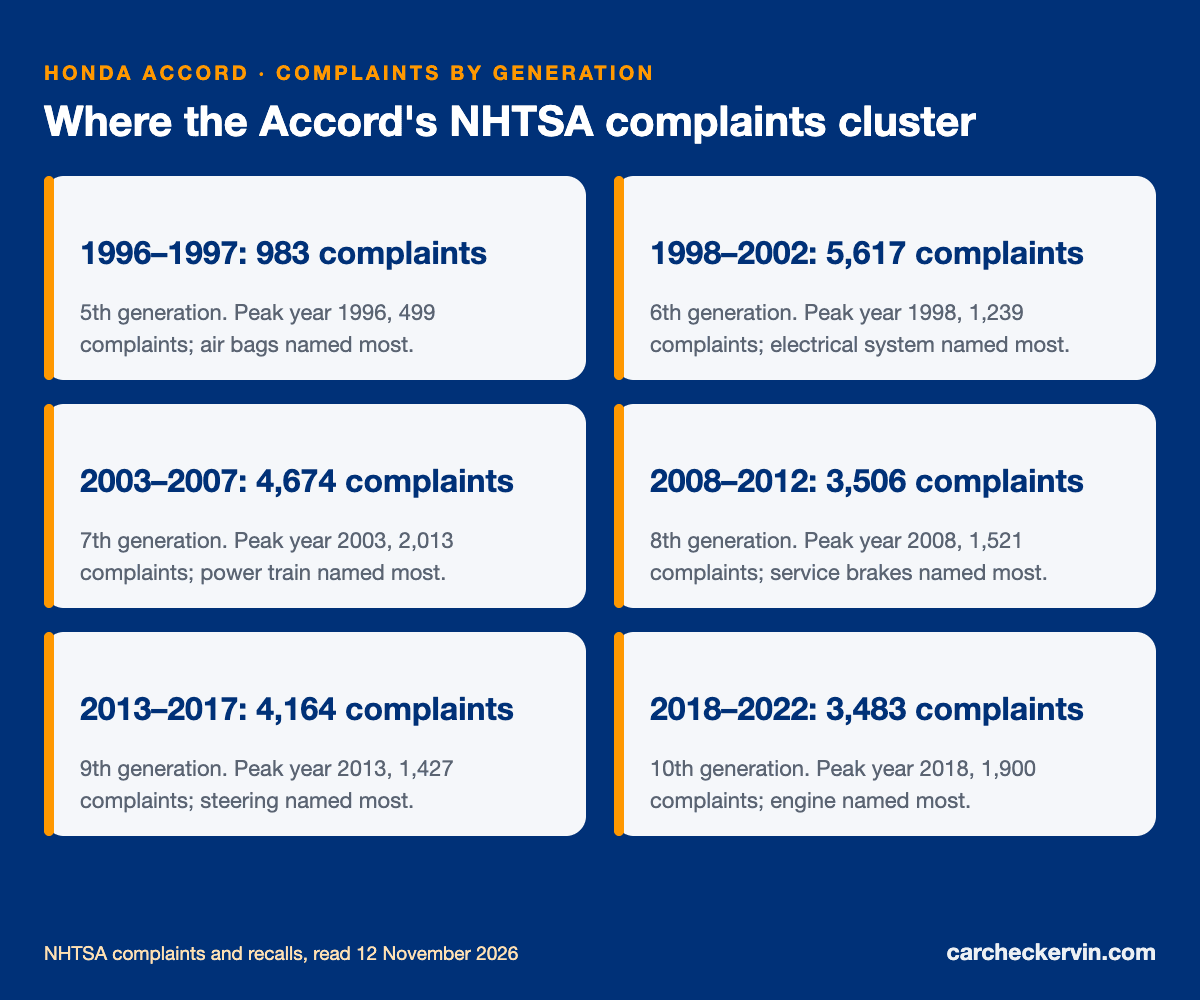
Accord Complaints by Generation
By generation, the sixth and seventh (1998–2007) carry the transmission complaints, the eighth (2008–2012) the brakes, and the tenth (2018–2022) the turbo engines. The last years of each generation are consistently quieter than the first.
What to Check on a Used Accord
By generation, the faults to look for.
1998–2005: the automatic
Drive it warm; no slipping, flare or harsh shifts.
2008–2010: rear brakes
Check pad thickness and ask when they were last replaced.
2008–2010: oil use
Ask how often it's topped up between changes.
2013–2014: the starter
Listen for a slow or grinding start from cold.
2018–2020 1.5T: coolant
Check the level cold; it should not drop between visits.
Any year: VIN records
Open recalls, title brands and odometer history.
Reading Accord Complaint Numbers
NHTSA complaints are owner reports, not verified and not divided by sales. Compare years with each other: 540 for the 2017 against 1,900 for the 2018 is the jump; 524 for the 2007 against 1,521 for the 2008 is another.
The fault counts come from searching the words owners used, so treat them as a minimum. Complaints on the newest Accords are thin, partly because they are new and partly because NHTSA returns none under "Accord" for the 2023–2026, which is why "fewest" stops at 2021.
Related Checks and Guides
Recalls, history checks and the Accord's rivals.
Where These Facts Come From
Complaint and recall figures are NHTSA's own records; owner experiences are linked so you can read them in full.
NHTSA records read 12 November 2026. Written by the CarCheckerVIN editorial team with AI assistance, from NHTSA's complaint and recall records, our own preview logs and the owner posts linked above; figures checked November 2026. CarCheckerVIN is not affiliated with Honda.
Honda Accord Years to Avoid — Frequently Asked Questions
Transmissions, brakes and the turbo years.
What is the worst year for the Honda Accord?+
By NHTSA complaint count, the 2003 (2,013), then the 2018 (1,900) and the 2008 (1,521).
Which Accord years have transmission problems?+
The 1998–2005 automatics, with 2,501 complaints naming the transmission, peaking at 848 on the 2003.
Should I avoid the 1.5-liter turbo Accord?+
Many owners do. On the 2018–2020, 116 head-gasket or coolant complaints name the 1.5-liter against 11 for the 2.0. If you buy one, check the coolant level and the service history.
Why do 2008 Accord brakes wear out?+
Owners describe the rear pads wearing out early. The service brakes are named in 574 of the 2008's 1,521 complaints, more than any other component, though no recall on NHTSA's list covers brake wear.
Are 2016–2017 Accords a good buy?+
They drew 613 and 540 complaints, well below the 2013 (1,427) and the 2018 (1,900), and owners recommend them.
Will your report show these problems?+
No history report can see inside a transmission. Ours lists title brands, NMVTIS junk and salvage records, insurance total-loss records, odometer readings, and auction records with the damage the auction recorded and its photos for the VIN. Recalls are free to check on NHTSA's site.
Check the Accord, Then the Year
The year tells you which weak spot to look at; the VIN and the records tell you the rest. Free preview first; the full report is $14.99 and lists title brands, NMVTIS junk and salvage records, insurance total-loss records, odometer readings, and auction records with the damage the auction recorded and its photos.
Complaint and recall figures are NHTSA's public records as read on 12 November 2026; complaints are unverified owner reports. Owner comments are paraphrased from the linked posts. CarCheckerVIN is not affiliated with Honda. Records in our reports reflect what was reported to our data providers. Our reports do not include police or repair-shop accident entries.
Passende VIN-Abfragen
Weitere Tools, um die Historie jedes Fahrzeugs zu prüfen