REG 227 — replacing a lost California title, or selling the car without it.
REG 227 does two jobs. Fill in Sections 1 to 3 and it replaces a California title that was lost, stolen, damaged or never arrived, for $28. Have the seller fill in Sections 1 to 4 and the buyer Sections 6 and 7, and it transfers the car with a replacement title in one step, without the original. The form has firm rules: an address change means applying in person, a title replaced in the last 90 days needs a CHP verification, and a lienholder's release must be notarized. Here is each section, from the DMV's own form.
Buying a Car on a REG 227?
The seller signing a REG 227 instead of a title is legal, but check the car first. Enter the VIN for a free preview of the title brands, salvage records and odometer readings on file.
Free preview · No sign-up · No owner or personal data
Quick Answer
- What is REG 227 used for?
- It's the California DMV's Application for Replacement or Transfer of Title (Rev 9/2024). On its own (Sections 1–3) it replaces a title that is lost, stolen, illegible or mutilated, or never received from the prior owner or the DMV. With Sections 4, 6 and 7 completed, it also transfers ownership to a new owner without the original title.
- How much does a replacement title cost in California?
- $28 for a replacement title, under Vehicle Code § 9265 on the DMV's fee schedule. A transfer to a new owner adds the $15 transfer fee, and a transfer filed late carries a $15 penalty.
- Does REG 227 need to be notarized?
- Only Section 5, the legal owner's (lienholder's) release of interest. If there's no lienholder on the record, there's no section to notarize. Section 5 can't be used for a non-ELT lien on a vehicle two model years old or newer; the lender must get a replacement title first and release on the actual title.
Two ways to use REG 227
Which sections you complete depends on whether the car is changing hands.
- 1Replacement only: Sections 1–3Registered owner, legal owner, and the missing title statement with the reason.
- 2Selling too: the seller adds 4Every registered owner releases interest; co-owners joined by AND all sign.
- 3Lienholder: Section 5The legal owner releases interest, and that signature must be notarized.
- 4Buyer: Sections 6 and 7New owner details, price or market value, and any new lender, within 10 days.
What REG 227 Does
REG 227, the Application for Replacement or Transfer of Title, is the California DMV's form for a title that has gone missing. The current version is Rev 9/2024. Its warning is blunt: "Issuance of a replacement title cancels the original title." Once you file it, the old one is void even if it turns up. The DMV's Vehicle Industry Registration Procedures Manual confirms that a properly endorsed REG 227 may be accepted for any transfer of a California-registered vehicle whose title is lost, stolen, missing, or illegible or mutilated.
The form has one hard limit up front: it "cannot be used to release a lien on a vehicle with an Electronic Lien Title (ELT)". Those are released electronically by the lender. And there's a second limit for newer cars: for a vehicle two model years old or newer, the manual says the California title "is the only document that can be used to release the lien", so a paper-title lender has to replace the title first and then sign the release on it.
REG 227 Section by Section
From the DMV's form, Rev 9/2024, read on 21 October 2026.
| Section | Who completes it | What it holds |
|---|---|---|
| Vehicle box | Everyone | License plate number, VIN, year and make, on both sides |
| 1. Registered owner(s) of record | The current owner | Names as on the title, license numbers, residence and mailing address |
| 2. Legal owner of record | The current owner | The lienholder or title holder, if any |
| 3. Missing title statement | The current owner | Why the title is missing, the indemnity, and a signature under penalty of perjury |
| 4. Release by registered owner(s) | The seller, when transferring | Each owner's release; all owners sign if joined by AND |
| 5. Release by legal owner | The lienholder | Release of interest, notarized |
| 6. New registered owner(s) | The buyer | Date, price or market value, names, address, signatures |
| 7. New legal owner | The buyer | Any new lienholder, with the ELT number for electronic lenders, or "None" |
| 8. Dealer's release | A dealer, if one handled it | Dealership, buyer, date sold, dealer and salesperson numbers |
All information on the form is mandatory, according to the DMV's privacy notice on page 3; missing information can get the application rejected.
The Missing Title Statement
Section 3 is the heart of a replacement. You tick why the title is gone: lost; stolen; illegible or mutilated, with the old title attached; not received from the prior owner; or not received from the DMV, in which case you're told to allow 30 days from the issue date before applying. Then you agree to "indemnify and save harmless the Director of Motor Vehicles" against any loss from issuing the replacement, and sign under penalty of perjury.
Two situations change how you file. If your address isn't the one in the DMV's records, the form says you must apply in person, bringing the original or a copy of your proof of ownership, such as the registration card or renewal notice, and your driver license or ID card. And if the title has already been replaced in the last 90 days, a CHP vehicle verification is required.
Reasons you can tick
- Lost or stolen: the common two.
- Illegible or mutilated: attach what's left of it.
- Never received: from the prior owner.
- Not received from DMV: wait 30 days first.
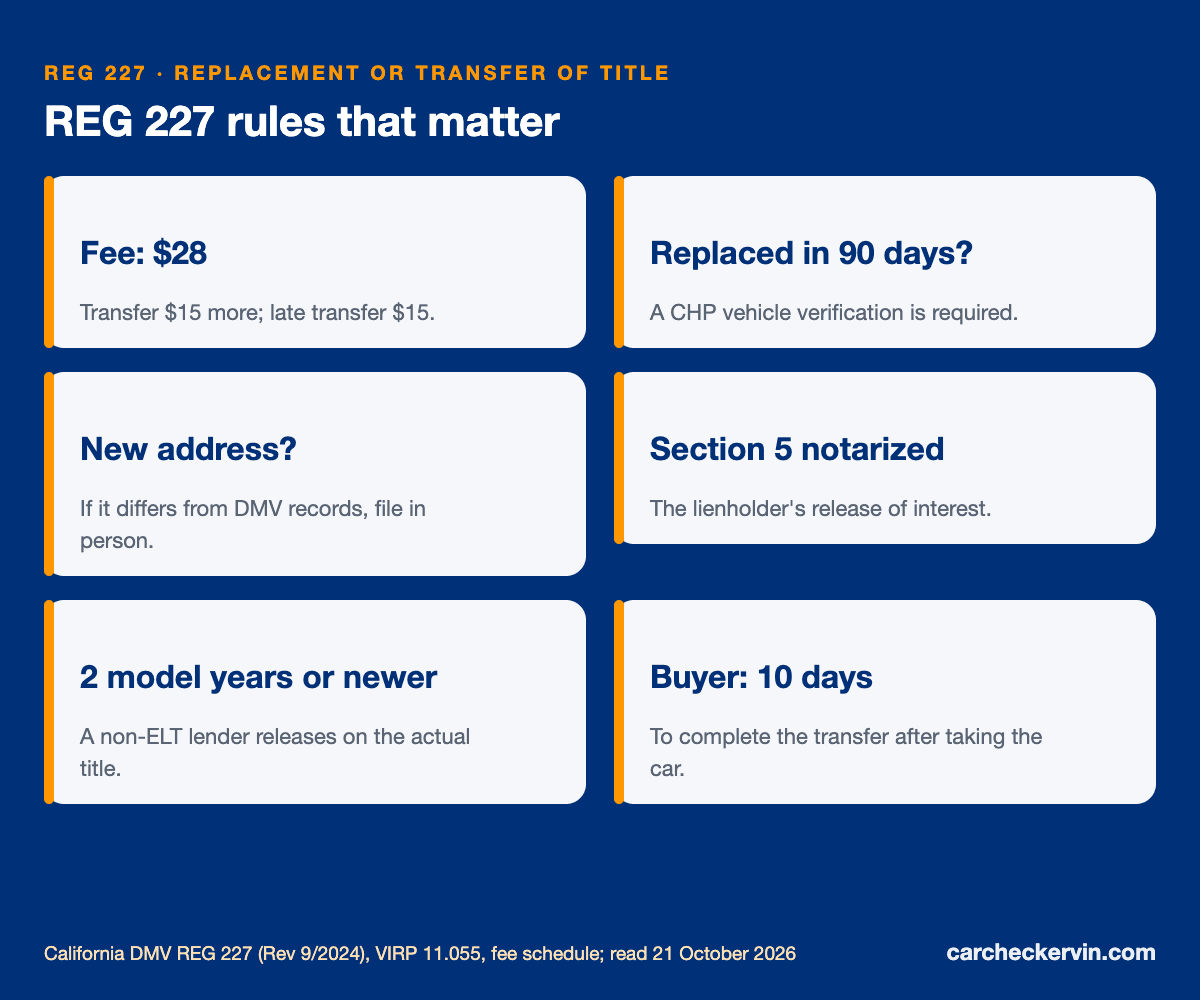
REG 227 at a Glance
The sections, the fees and the rules that trip people up, on one card.
From the California DMV's REG 227 (Rev 9/2024), its procedures manual and its fee schedule, read on the date shown.
Selling a Car on a REG 227
When the title is missing, the same form carries the sale.
Every owner signs
Section 4 needs the signature of each owner if co-owners are joined by AND (shown by a slash on DMV records).
Businesses countersign
A company's signature includes its printed name and an authorized representative's countersignature, like "ABC CO., by JOHN SMITH".
Lender releases, notarized
If there's a lienholder, Section 5 is its release, and it must be notarized.
Buyer: 10 days
The new owner completes the transfer within 10 days of taking possession of the vehicle.
Family? Attach REG 256
A car bought from or given by a qualified relative needs a Statement of Facts for the use tax exemption.
Price or market value
The buyer enters the purchase price, or ticks gift or trade and writes the market value.
The Seller Has No Title, Just a REG 227?
That's allowed, and it's also exactly when to look closer. Enter the VIN for a free preview of the title brands and junk and salvage records on file.
What It Costs
From the California DMV's registration fee schedule, read on 21 October 2026.
| Fee | Amount | Vehicle Code |
|---|---|---|
| Replacement title | $28 | § 9265 |
| Transfer of ownership | $15 | § 9255 |
| Late transfer penalty | $15 | § 9553.7 |
| Smog transfer fee | $8 | § 4000.1 |
Registration fees and use tax, where they apply, are separate. Use tax isn't charged on a qualifying family transfer claimed on REG 256.
Replacement Only or Transfer With Replacement
Same form, two outcomes.
Replacement only
- Sections 1 to 3.
- The title stays in your name.
- $28 replacement fee.
- Cancels the original title.
Transfer with replacement
- Seller: Sections 1 to 4 (and 5 if there's a lender).
- Buyer: Sections 6 and 7.
- Transfer fee on top; 10 days for the buyer.
- No need for the seller to get a replacement title first.
Either way, an ELT lien can't be released on REG 227.
Related Checks and Guides
The other California DMV form guides, and the title pages they connect to.
Where These Facts Come From
From the California DMV's REG 227, its Vehicle Industry Registration Procedures Manual and its fee schedule, read on 21 October 2026. Download the current form from dmv.ca.gov before you file.
CarCheckerVIN is not affiliated with the California Department of Motor Vehicles and does not file DMV forms. This page is general information, not legal advice.
REG 227 — Frequently Asked Questions
What California owners and buyers ask most.
Can I sell my car in California without the title?+
Yes, with REG 227. You complete Sections 1 to 4 (and the lienholder Section 5, notarized, if there's a lender), and the buyer completes Sections 6 and 7. The DMV's procedures manual accepts a properly endorsed REG 227 for any transfer when the title is lost, stolen, missing or illegible.
How long does the buyer have after a REG 227 sale?+
The form tells new owners to complete the transfer within 10 days of taking possession. A late transfer carries a $15 penalty on the DMV's fee schedule.
Why do I need a CHP verification for a replacement title?+
REG 227 requires one if the title was already replaced within the last 90 days. The form doesn't give the reason; it simply makes the CHP vehicle verification a condition of the replacement.
Can I mail REG 227 if I've moved?+
No. If your address differs from the DMV's records, the form says you must file in person, with your proof of ownership (such as the registration card or renewal notice) and your driver license or ID card.
Can my lender release its lien on REG 227?+
Not if it's an electronic lien (ELT), and not for a non-ELT lien on a vehicle 2 model years old or newer. In that case the lender applies for a replacement title first and releases interest on the actual title.
What happens to the old title after a replacement?+
It's cancelled. The form warns that issuing a replacement title cancels the original, so a found original is no longer valid.
Run the VIN Before You Sign Section 6
Enter any 17-character VIN for a free preview. The full report lists title brands, NMVTIS junk and salvage records, insurance total-loss records, odometer readings, and auction records with the damage the auction recorded and its photos.
CarCheckerVIN is an independent vehicle-history service and is not affiliated with the California Department of Motor Vehicles. This guide summarizes the DMV's published REG 227, procedures manual and fee schedule and is not legal advice. Records in our reports reflect what was reported to our data providers. Our reports do not include police or repair-shop accident entries.
Passende VIN-Abfragen
Weitere Tools, um die Historie jedes Fahrzeugs zu prüfen