Renault VIN Lookup — Decode a Car That Lives Abroad
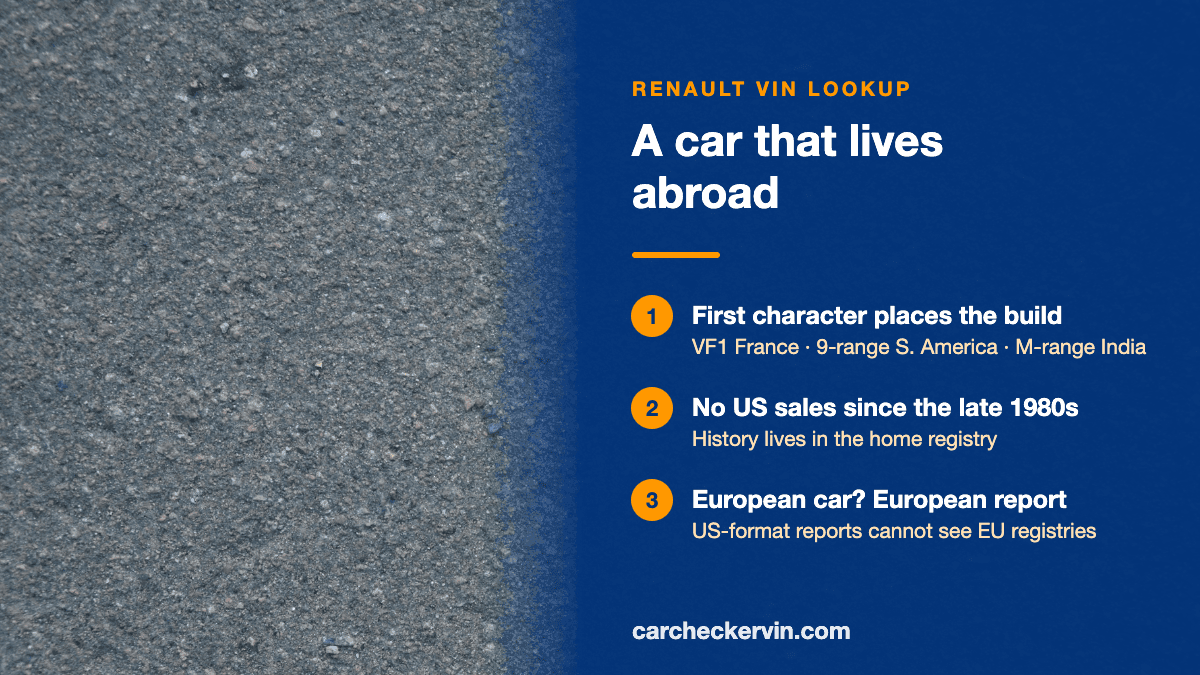
Renault has not sold a new car in the United States since the late 1980s, so the Renault you are checking is almost certainly registered somewhere else. The decode below reads any market's VIN — year, build country, engine, variant — and each model guide says where that car's real history lives.
Decode a Renault VIN
17 characters from the VIN plate, pillar label, or registration papers
256-bit encrypted · No sign-up · Instant
What a Renault VIN Can and Cannot Tell a US Searcher
The VIN itself is universal: seventeen ISO 3779 characters that decode identically whether the car sits in Lyon, São Paulo, or a container at a US port. The opening characters place the build — VF1 for Renault's French passenger-car plants per NHTSA's vPIC registry, other countries by their ISO ranges — and the rest read out year, engine, and variant.
History is where geography bites. US-format reports draw on NMVTIS, the federal title system, which records vehicles titled in US states — a fine source for the rare legally imported Renault, and silent about the millions that have only ever been registered abroad. For a European-registered car, the registries our European VIN report reads are the ones that actually hold the mileage and status trail.
And the check digit deserves a word: European VINs are not required to carry the North American position-nine check digit, so a genuine Renault VIN can fail a US-style validator. That is expected, not alarming.
Where Renaults Keep Their VINs
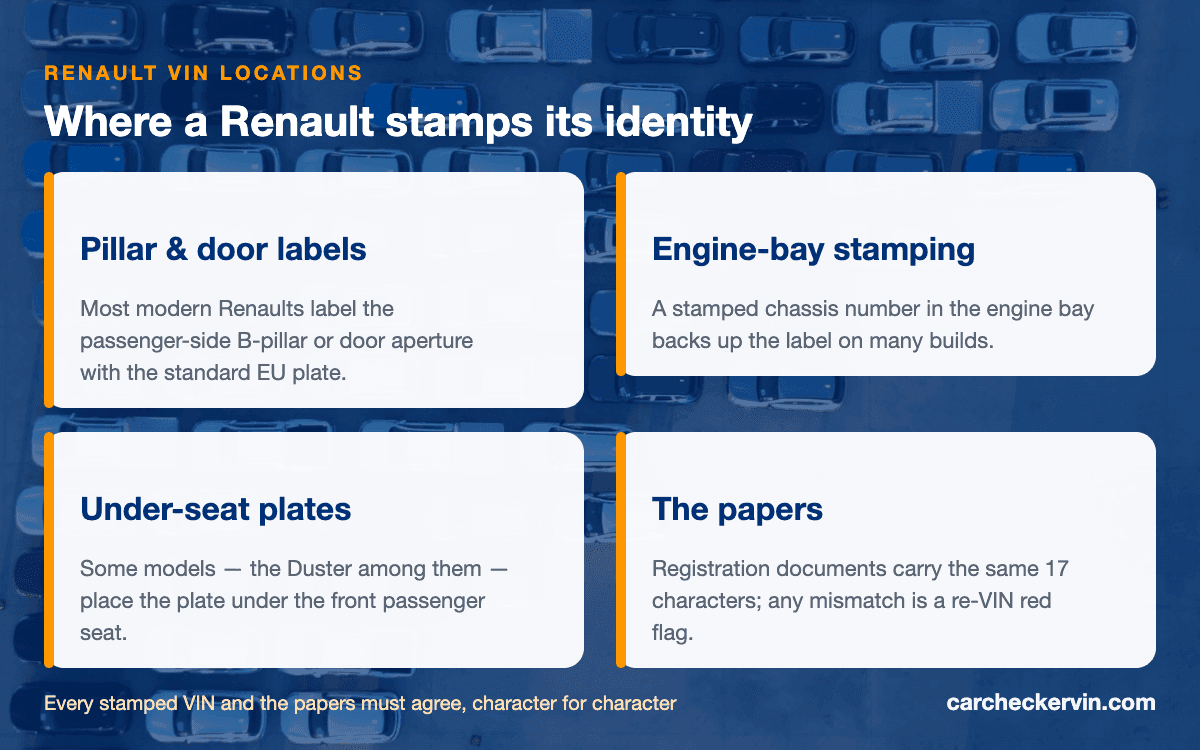
Placement varies by model and build country more than most makes — the model guides below give exact locations per car.
Pillar & door labels
Most modern Renaults label the passenger-side B-pillar or door aperture with the standard EU plate.
Engine-bay stamping
A stamped chassis number in the engine bay backs up the label on many builds — both must match.
Under-seat plates
Some models — the Duster among them — place the plate under the front passenger seat, a location that surprises first-time checkers.
Whatever the locations, the rule is single: every stamped VIN and the papers must agree, character for character.
Renault VIN Lookup FAQ
Can I look up a Renault VIN in the United States?+
You can decode it anywhere — a Renault VIN follows ISO 3779 like every modern vehicle, so the year, build country, engine, and variant read out normally. What a US-format report cannot usually give you is history: Renault stopped selling new cars in the US in the late 1980s, so unless the specific car was imported and titled in a US state, its records live in the registry of the country where it is registered.
Why does a Renault VIN start with VF1?+
VF1 is the World Manufacturer Identifier NHTSA's vPIC database lists for Renault passenger cars built in France. Renaults built elsewhere carry that country's ISO 3779 range instead — a 9-leading VIN places South America, an M-leading VIN places India — which is why the first character of a Renault VIN is the fastest answer to where the car actually comes from.
Why does my Renault VIN fail a US VIN checker?+
European-market VINs are not required to carry the North American check digit in position nine, so a perfectly genuine Renault VIN can fail a US-style validation. Treat a failed check digit on a European car as expected behaviour, not evidence of tampering — verify instead that every stamped location on the car and the papers carry identical characters.
How do I get history for a Renault registered in Europe?+
Through a service that reads European registries. Our European VIN report covers specification, mileage-relevant registry data, and market value for European-registered vehicles — records a US title system has no visibility into.
Can I import a Renault to the US?+
Vehicles at least 25 years old are generally exempt from federal motor-vehicle standards, which is why early-1990s Renaults — a Clio Williams, say — are now importable while any current model is not. Eligibility turns on the build date, and the VIN's year character is where verification starts.
Is a Renault Duster the same as a Dacia Duster?+
Mechanically yes — the Duster is engineered by Renault's Dacia arm and wears whichever badge the market strategy assigns: Dacia in Europe, Renault across much of Latin America and other regions. The VIN and the paperwork, not the grille badge, say what a specific car legally is.
Start With the Seventeen Characters
Identity is free; history costs only when a registry can actually see the car.
European-registered? Get the EU reportPassende VIN-Abfragen
Weitere Tools, um die Historie jedes Fahrzeugs zu prüfen