Repossessed Cars for Sale — where lenders sell them, and what you get.
When a borrower stops paying, the lender takes the car back and sells it to recover the loss, usually through an auto auction, as Copart describes the route. Copart itself runs a wholesale repo and impound auction twice a week, with cars from banks, credit unions and auto finance companies. Here is where they are sold, who can buy them, what the law says the buyer gets, and the title paperwork that follows.
Check a Repo's VIN
A repo was somebody's daily car until the payments stopped. Enter the VIN for a free preview of its title brands, odometer readings and earlier auctions.
Free preview · No sign-up · No owner or personal data
Quick Answer
- Can a regular person buy a repossessed car?
- Yes, with limits. Copart says the public can register as Members for its bank and repo auctions, but without a professional license they can only buy lots in the "No License Required" category. Otherwise a broker can buy any vehicle on your behalf.
- Do repossessed cars have clean titles?
- They can. Copart says repo vehicles can have clean titles, because they are sold over a missed loan, not damage. Salvage titles come from accident, flood, vandalism or fire damage, so the title depends on the car's history, not on the repossession. Check it before you bid.
- Where are repossessed cars sold?
- At auto auctions. Copart's wholesale repo and impound auction runs every Tuesday and Thursday at 11:00 AM CT, with vehicles from auto finance companies, credit unions and banks. Public buyers can bid on lots marked "No License Required", and brokers can bid on the rest.
Five steps to buying a repossessed car
The lender is selling to recover a loss, not to win a customer. Each step covers something the sale itself will not tell you.
- 1Find where the lender sellsAuctions such as Copart's repo sale, or a broker that bids there.
- 2Check you can buy the lotPublic buyers are limited to lots that need no license.
- 3Run the VINTitle brands, total losses, odometer readings and earlier auctions.
- 4Read the sale documentsLook for a title-warranty disclaimer and the repossession paperwork.
- 5Title it in your nameThe lender's affidavit or certificate goes to your DMV with the title.
How a Car Becomes a Repo for Sale
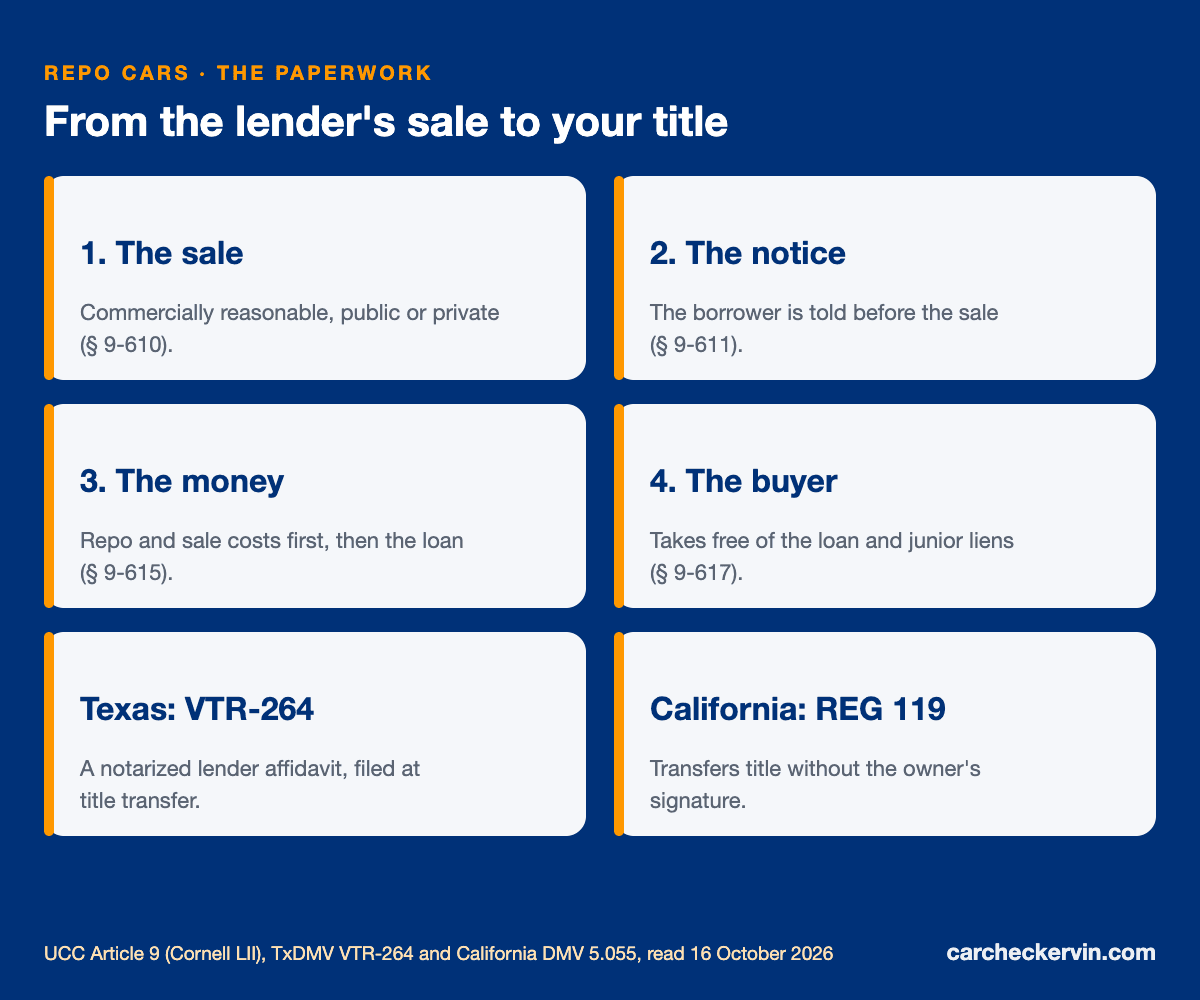
A car loan is a secured loan: the car is the collateral. Article 9 of the Uniform Commercial Code, which states adopt with their own changes, says that after a default the lender may sell the car in its present condition or after commercially reasonable preparation (§ 9-610). Every aspect of the sale, from the method to the time and place, must be commercially reasonable, and it can be public or private.
Before selling, the lender generally has to send the borrower a notification of the sale (§ 9-611), except for collateral that loses value quickly or sells on a recognized market. The money then goes first to the costs of repossessing, storing, preparing and selling the car, and only then to the loan (§ 9-615). If the sale falls short, the borrower owes the difference; if it brings in more, the borrower gets the surplus.
Where Repossessed Cars Are Sold
From Copart's repo page and the other sources listed below, read on 16 October 2026.
Copart repo auctions
Wholesale auctions every Tuesday and Thursday at 11:00 AM CT: repo, off-lease, bank-owned and impound vehicles from institutional sellers.
Brokers
For public buyers who need a lot that requires a license. AutoBidMaster, a Copart broker, charges $0 to $349 a year by tier.
Bank-owned and off-lease
Copart's same twice-weekly sale includes bank-owned inventory and off-lease units alongside repossessions.
Impound is not repo
Impound cars were towed by police or a tow company and never claimed. Different seller, different paperwork.
What the Law Says the Buyer Gets
Section 9-617 is the one that matters to a buyer. A lender's sale after default transfers all of the borrower's rights in the car to the buyer, and it discharges the lender's own lien along with any junior liens. A buyer acting in good faith takes the car free of those rights and liens even if the lender did not follow the rules for the sale.
There is a catch in § 9-610. A sale normally carries the warranties of title that come with any sale, but the lender may disclaim them, and the statute gives the exact wording that is enough: "There is no warranty relating to title, possession, quiet enjoyment, or the like in this disposition". If your sale documents contain that sentence, you are taking the title risk yourself.
Read the sale documents for
- The disclaimer: the title-warranty sentence quoted here, or something like it.
- Who sells: the lender, or the auction acting for it.
- Repossession paperwork: the affidavit or certificate your state requires.
- Odometer disclosure: California makes the lender report it.
Repo Title Paperwork in Texas and California
Two states' procedures, from their DMVs' own documents, read on 16 October 2026. The borrower does not sign the title over; the lender's paperwork replaces that signature.
| Texas (VTR-264) | California (REG 119) | |
|---|---|---|
| Document | Repossessed Motor Vehicle Affidavit | Certificate of Repossession |
| Who completes it | The lienholder's authorized agent, before a notary | The legal owner (lienholder) of record |
| What it does | Certifies the repossession; filed with the county tax assessor-collector at title transfer | Releases the lender's interest and transfers title without the registered owner's signature |
| If the lender is on the title | It may reassign the title to the buyer | It signs the REG 119 as legal owner of record |
| If the lender is not on the title | It must title the car in its own name first, with a certified copy of the security agreement | A separate section of the DMV manual covers it |
| Odometer | Not addressed on the form | The lender reports it, on the title's odometer section or on a REG 262 |
Falsifying a VTR-264 is a third-degree felony under Texas law, the form warns.
The Paperwork at a Glance
The image follows a repo from the lender's sale to your title: the sale under the UCC, the state's repossession document, and the title in your name.
If a seller cannot produce the repossession document your state requires, the title transfer stops there.
Repo, Impound or Off-Lease?
Copart sells all three in the same wholesale auction, and its own FAQ separates them. An impounded car was taken by police or a tow company over parking tickets, expired registration, no insurance or abandonment, and sold when the owner did not claim it. A repossessed car was taken by a bank, credit union or finance company after missed loan payments and sold to recover the loss. Off-lease cars are lease returns.
Each comes with a different seller and different paperwork, and none comes with the previous owner's account of the car, which is what the VIN history stands in for. Copart says its Green Light and Yellow Light lots in this sale come under a 21-day, 300-mile arbitration policy; read the policy for who can use it.
Check the Repo's History
Enter the VIN from the lot for a free preview of its title brands, odometer readings and earlier auctions.
What the Repo Listing Shows, and What It Doesn't
A lender's listing describes the car it took back. A report shows the car's life before that.
Repo auction listing
- Photos and a condition report
- Title type, often clean
- The VIN and the odometer reading
- Sale terms, usually as is
Our full report
- Title brands and NMVTIS junk and salvage records
- Insurance total-loss records and odometer readings
- Auction records with the recorded damage and photos, where the car was auctioned
- $14.99 after a free preview, or $9.00 each in a 10-pack
Our report does not include police or repair-shop accident entries.
Related Checks and Guides
More on buying repos and auction cars.
Where These Facts Come From
Everything on this page comes from the sources below, read on 16 October 2026. The UCC sections are the uniform text; your state's version may differ.
CarCheckerVIN is not affiliated with Copart, AutoBidMaster or any lender. This page is general information, not legal advice; repossession law varies by state.
Prüfen Sie die Fahrgestellnummer immer vor dem Kauf
Die kostenlose Vorschau zeigt Title Brands (US-Titel-Kennzeichnungen), Diebstahlstatus und offene Rückrufe in Sekunden und meldet, ob Unfall- und Tachodaten vorliegen. Die vollständige Historie kostet 19,95 € — einmalig, ohne Abo.
Repossessed Cars for Sale — Frequently Asked Questions
What buyers ask about repo cars.
Where can I buy a repossessed car?+
At auctions lenders use. Copart runs a wholesale repo and impound auction every Tuesday and Thursday at 11:00 AM CT; public Members can buy lots marked "No License Required", and brokers can bid on the rest.
Are repo cars cheaper?+
Sometimes, but nothing guarantees it. The law only requires the lender's sale to be commercially reasonable, and the car is sold in its present condition or after reasonable preparation. Price the repairs and fees into your bid.
Does a repo car still have the old loan on it?+
Not after a proper sale. Under UCC § 9-617, the lender's sale discharges its lien and any junior liens, and a good-faith buyer takes free of them. The title paperwork should show the lender's release.
Who signs the title on a repo?+
The lender, not the borrower. Texas uses the VTR-264 affidavit filed with the title transfer; California uses the REG 119 Certificate of Repossession, which transfers title without the registered owner's signature.
Is a repossessed car the same as an impound car?+
No. A repo was taken by a lender after missed payments. An impound car was towed by police or a tow company and never claimed. Both can end up at the same auction.
How do I check a repo car's history?+
Run the VIN from the listing. Our report lists title brands, NMVTIS junk and salvage records, insurance total-loss records, odometer readings, and auction records with the damage the auction recorded and its photos.
Check a Repossessed Car by VIN
Enter any 17-character VIN for a free preview. The full report lists title brands, NMVTIS junk and salvage records, insurance total-loss records, odometer readings, and auction records with the damage the auction recorded and its photos.
CarCheckerVIN is an independent vehicle-history service and is not affiliated with Copart, AutoBidMaster, any lender or state agency. Law and procedures are summarized from public sources for reference and are not legal advice. Records in our reports reflect what was reported to our data providers. Our reports do not include police or repair-shop accident entries.
Passende VIN-Abfragen
Weitere Tools, um die Historie jedes Fahrzeugs zu prüfen