California Vehicle Registration — Title, Renew & Check First
Everything you need to register or renew a vehicle with the California Department of Motor Vehicles (DMV): the documents to bring, how titling and inspections work, and what each step costs. Before you buy or transfer a used car, run the 17-character VIN — a clean title is what makes registration go smoothly. It's free.
Check A California VIN Before You Register
Confirm the title is clean and lien-free — cars, trucks, SUVs, motorcycles
Free · No sign-up · Instant result
California Registration Data at a Glance
- California vehicles registered
- 31M
- California population
- 39.5M
- state of registration
- CA
- pre-registration VIN check
- Free
How to Register a Vehicle in California
Registration in California is handled by the California Department of Motor Vehicles (DMV). The exact steps depend on whether the car is new, used, or arriving from another state, but the core process is the same — here is how it works.
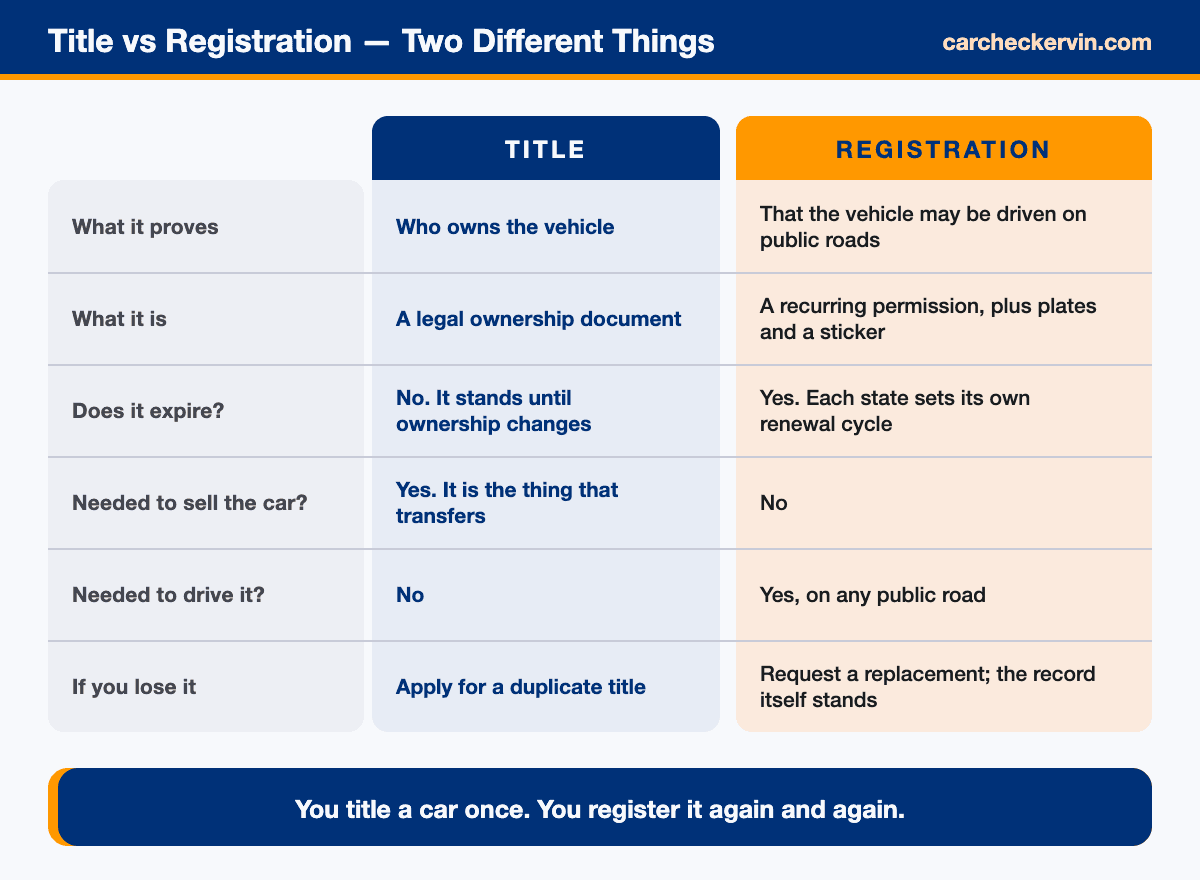
Gather your title & documents
Before the California Department of Motor Vehicles (DMV) will register a used vehicle, you need the signed-over title (or, for a new car, the manufacturer's certificate of origin), proof of identity, and proof of California insurance. Confirm the VIN on the title matches the dash and door-jamb stampings.
Complete inspections & VIN verification
Many California transactions require an odometer disclosure and, depending on the vehicle and county, a VIN verification, safety inspection, or emissions test before registration is issued. A salvage or rebuilt title typically triggers an additional inspection.
Pay fees & get your plate
Submit the paperwork to the California Department of Motor Vehicles (DMV), pay the registration fee and any applicable tax, and you receive your California license plate, registration card, and renewal sticker. Renewals are then handled online, by mail, or in person.
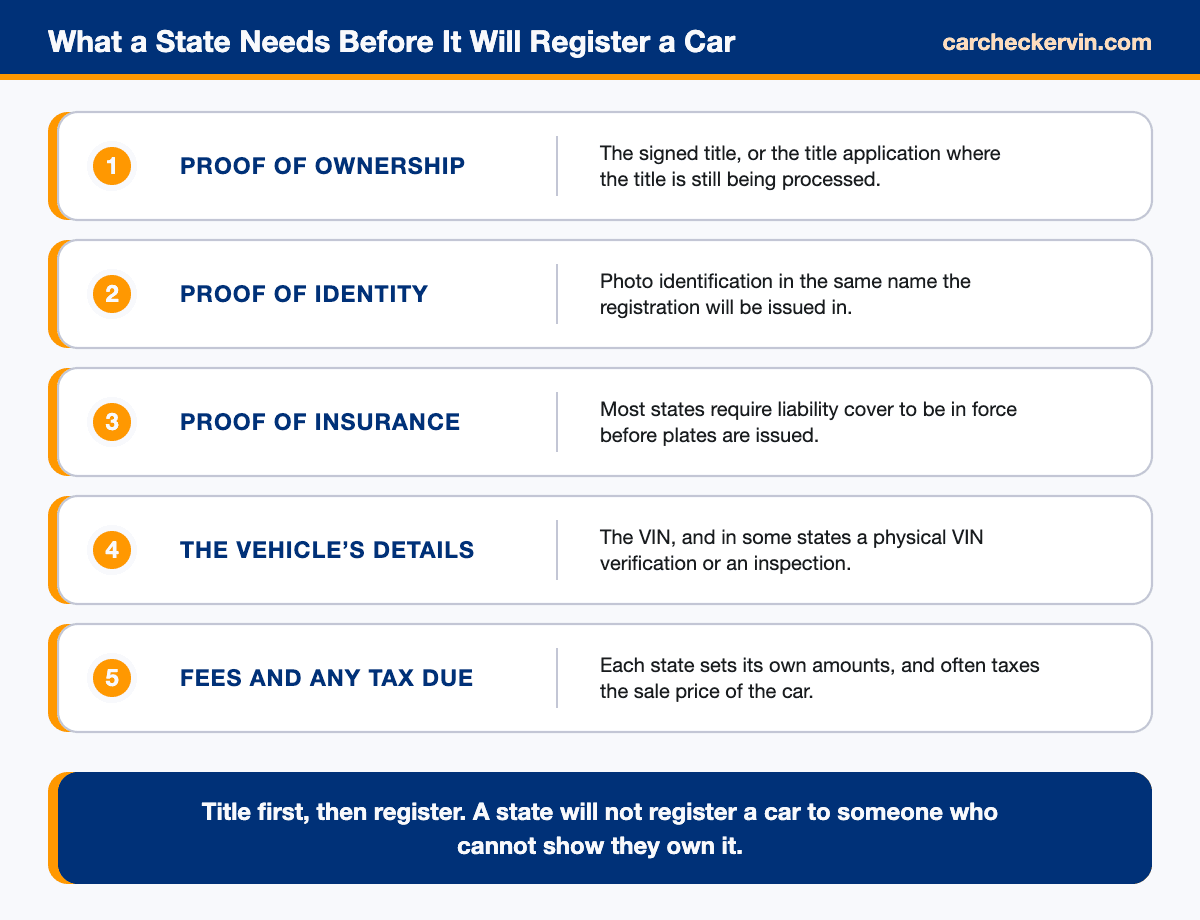
What You Need to Register a Car in California
Bring these to the California Department of Motor Vehicles (DMV) (or upload them if California offers online titling). The exact list varies by vehicle and county, so confirm with the agency before you go:
California registration authority
Vehicle titling and registration in California are administered by the California Department of Motor Vehicles (DMV). About 31M vehicles are registered across the state, and every title transfer is checked against the federal NMVTIS database — so a salvage or flood brand applied anywhere in the country shows up when you register.
Is California Normal? Its Registration Rules Against the National Picture
California is not free to write its own rules in a vacuum; it is one of 50 systems that mostly resemble each other and occasionally do not. These are the four points where the resemblance breaks down, and where California lands on each.
- Annual
- registration term
- Not published
- sets your expiry month
- Not published
- safety inspection
- Selected counties
- emissions testing
How long a California registration lasts
Twelve months is the California term. It is worth knowing that this is not universal: 8 states register ordinary cars for longer than a year as standard, so a driver arriving from one of them should expect to renew sooner than they are used to.
What decides the month it expires
California does not publish a simple rule for which month your registration expires in, so check the record itself rather than working from a pattern. Nationally, 21 of 50 states do publish one — 7 by the owner's birthday, 4 by the first letter of the surname.
Whether California inspects your car
California does not affirmatively publish a periodic safety-inspection rule in the sources behind this guide, and we will not fill that silence with a guess — telling you no inspection is needed when one is would cost you a trip. Nationally, 8 states inspect yearly and 6 state plainly that they do not.
An inspection is a check on the car in front of you, not on where it has been. That history lives with the VIN — a California salvage title check and the reported mileage record answer questions no inspector at the kerb can.
Whether California tests emissions
Whether you need an emissions test in California comes down to your county. This regional pattern covers 20 states — more than the 6 that test everywhere and the 7 that test nowhere combined — and it is why generic advice about emissions is usually wrong for somebody.
Source: every Californiarule on this page is taken from the state's own published guidance. Fees, exemptions and county boundaries change more often than the rules do, so confirm those against California DMV — Vehicle Registration before you travel.
Why Run a VIN Check Before Registering in California
The single thing that can stall a Californiaregistration is a problem hiding in the vehicle's history. A free VIN check catches it before money changes hands.
Three things block a transfer at the counter, and all three are visible in the VIN before you hand over money: a salvage, junk or non-repairable brand that California will not register until the car passes a rebuilt-title inspection; an open lien from a loan the last owner never cleared; and an odometer rollback that makes the mileage you certify to the California Department of Motor Vehicles (DMV) a false statement on a legal document.
Check before you pay
Enter the 17-character VIN to confirm the title is clean, lien-free, and the mileage checks out — everything California needs to register the vehicle without a hitch.
California Registration Fees & Taxes
Four charges make up the bill: a one-time title fee, the recurring registration fee, purchase or use tax, and whatever inspection and local surcharges apply where you live. Only the California Department of Motor Vehicles (DMV) can turn those into a number for your vehicle, because Californiaweights them by the car's value, age or weight and by county. Because the tax often tracks value, checking the market value is a useful sanity test on both the price you pay and the tax you owe.
California DMV — Vehicle RegistrationRenewing Your California Registration
Renewal is the easy half. The California Department of Motor Vehicles (DMV) sends a notice ahead of the expiry date and you are mostly confirming that nothing has changed: same owner, same address, still insured.
What can change is the vehicle's eligibility. Because the emissions requirement in California depends on the county, moving house inside the state can quietly add a step you did not have last year.
Driving on an expired registration means fines and a failed roadside check, and an expired plate is one of the few things that will get an otherwise unremarkable car pulled over. If you are unsure what is on the record, a California plate lookup explains what the state publishes and what privacy law keeps back.
Renewal channels in California
- Online via the state DMV portal
- By mail with the renewal notice
- In person at a DMV office
- Self-service kiosk (where available)
Bringing a Vehicle Into California From Another State
Out-of-state cars are where registration goes wrong most often, because two systems have to agree about one vehicle. California gives you 10 days, which is less time than it sounds like once a move is underway, and the paperwork the old state gave you is not automatically what the new one wants.
The title comes first, then the plate. California cannot register a vehicle it has not titled, so an out-of-state car is really two transactions in one visit. If the old title is held by a lender in the previous state, that has to be resolved before anything else can happen — which is the single most common reason a new resident leaves without plates. Our California title guide covers what the certificate has to say before the California Department of Motor Vehicles (DMV) will act on it.
Expect a VIN verification. Most states physically confirm the VIN on a vehicle arriving from elsewhere, because that is the moment the car joins their records and the last chance to catch a mismatch. California uniquely brands titles with 'Lemon Law Buyback' so buyers can identify previously repurchased lemon vehicles.
A brand from the old state travels with it. Salvage, flood and junk brands are recorded against the VIN in NMVTIS, so they are waiting for the car when it arrives. A vehicle that was cheap in its home state because of its history will not become clean by crossing a line on a map — the full California VIN report shows what will be there when you get to the counter.
Before you arrive
- The out-of-state title, in your name and free of liens
- Proof you now live in California
- California insurance already in force
- An odometer reading you have verified yourself
- Any inspection or emissions certificate the vehicle needs
- The VIN checked against NMVTIS before you commit
Common California Registration Mistakes — and How to Avoid the Second Trip
Almost none of these are about the car. They are about the paperwork describing the car, and every one of them is cheaper to catch in a seller's driveway than at the California Department of Motor Vehicles (DMV) counter with the money already gone.
- 1
The inspection or emissions certificate is missing or stale
Where a certificate is required it has to be current, and one obtained months before the visit may have expired. Confirm what your vehicle and location actually require before you queue — this is the requirement that varies most within California, so what a neighbour needed is not proof of what you need.
- 2
The VIN on the paperwork does not match the car
A single transposed character between the title and the dash plate will stop the transaction. Check the dash, the driver's door jamb and the title against each other before you go — and treat any sign that a VIN plate has been disturbed as a reason to walk away entirely, not a clerical issue.
- 3
The odometer disclosure was left blank or guessed
Mileage disclosure is a legal statement, not a formality, and an unsigned or obviously rounded figure gets the paperwork rejected. It is also the number most worth verifying independently — a rollback is the one defect that makes a car look better than it is rather than worse.
- 4
The title was never signed over properly
The single commonest reason a registration fails. If the seller signed in the wrong place, used a name that does not match the title, or left the buyer section blank, California Department of Motor Vehicles (DMV) cannot process it — and fixing it means finding the seller again, which is a great deal harder after the money has changed hands.
- 5
The title carries a brand nobody mentioned
Salvage, flood, junk and rebuilt brands follow the VIN nationwide through NMVTIS, so a car written off in another state arrives in California with that history intact. A branded vehicle generally cannot be registered for road use until it has been through the state's rebuilt inspection, whatever the seller told you.
Four of the six are visible in the VIN history before you hand over any money — the brand, the lien, the mileage and the identity of the car itself. A California lien check and a properly completed bill of sale between them close most of the gap.
Check A California VIN Before You Register
Confirm the title is clean and lien-free so registration goes through the first time. Free, in seconds.
Vehicle Registration in Other States
Registration is run state by state, with different agencies, fees, and inspection rules. Compare California with these guides, or run any VIN nationwide.
The rest of the California paper trail
Registration is one document in a stack that all describes the same vehicle. These cover the others, for California specifically.
Prüfen Sie die Fahrgestellnummer immer vor dem Kauf
Die kostenlose Vorschau zeigt Title Brands (US-Titel-Kennzeichnungen), Diebstahlstatus und offene Rückrufe in Sekunden und meldet, ob Unfall- und Tachodaten vorliegen. Die vollständige Historie kostet 19,95 € — einmalig, ohne Abo.
California Vehicle Registration FAQ
The questions California drivers ask most about titling, registering, and renewing a vehicle.
How much does it cost to register a vehicle in California?+
There is no flat price. California builds the bill from the vehicle's weight, value, age and your county, plus a one-time title fee and any purchase or use tax. Use the official California Department of Motor Vehicles (DMV) fee estimator for the exact figure before you budget.
Can I register a salvage or rebuilt vehicle in California?+
Only after it passes the California rebuilt-title inspection and is re-titled as rebuilt or reconstructed. A vehicle still branded salvage cannot go on the road. The brand is tied to the VIN in NMVTIS, so it follows the car across state lines and shows up in a check before you buy.
Do I need a VIN check before registering a car in California?+
It is not required, but it is the cheapest way to avoid a wasted trip. A free check surfaces salvage, flood and junk brands, odometer rollbacks and reported liens — each of which can stop California registering the vehicle to you.
Does California have any specific titling or registration rules?+
California uniquely brands titles with 'Lemon Law Buyback' so buyers can identify previously repurchased lemon vehicles.
Do I need to register my car every year in California?+
Yes — California registration runs twelve months at a time and there is no longer term to buy. That matches 30 of the 49 states with a published term, though 8 states register ordinary passenger vehicles for longer than a year as standard.
Does California require a vehicle inspection to register or renew?+
California does not affirmatively publish a periodic safety-inspection rule in the sources behind this guide, so we do not claim one either way; nationally 8 states inspect yearly and 6 state plainly that they do not. Emissions testing is separate and geographic: it applies in selected California counties only, the commonest arrangement in the country at 20 states.
How long do I have to register a car after buying it in California?+
California allows 10 days to get the title transferred into your name, and the registration follows the title — the state will not put plates on a vehicle it has not titled to you. The clock starts from the sale date written on the paperwork, not from the day you get round to visiting the California Department of Motor Vehicles (DMV), and a late transfer attracts a penalty on top of the ordinary fees.
Registering a Car in California? Check the VIN First.
Enter a 17-character VIN to confirm a clean, lien-free title before you head to the California Department of Motor Vehicles (DMV) — and avoid a wasted trip.
Or get the full VIN history reportPassende VIN-Abfragen
Weitere Tools, um die Historie jedes Fahrzeugs zu prüfen