What does a car title look like — field by field.
A car title is one state-issued sheet: VIN, owner, title number, odometer, lienholder, and a brand area. No two states print it the same way, so you read it by its fields — here is every one of them.
Check the VIN on that title — free to start
17-character VIN → brands on record, title chain and flags, before any payment.
Free preview · no card, no account
Quick Answer
- What does a car title look like?
- A single sheet issued by a state government — not a booklet, and not something a seller prints. Layouts differ by state, but every one carries the same core fields: the 17-character VIN, the year, make and model, the registered owner, a title number, an odometer reading, a lienholder line, and a brand area. The back holds the assignment section where a seller signs the car over.
- Do all states' titles look the same?
- No — and they are not meant to. Each state designs its own certificate, so colour, wording and field order all vary, and ten states issue titles from a county counter rather than a state DMV. What stays constant is the information, which is why you read a title by its fields rather than by its appearance.
- How do I know a title is genuine?
- Match it to the car and to the record. The VIN on the document must match the dashboard and door jamb exactly, and both must match the federal record — brands are carried nationally through NMVTIS, so a clean-looking certificate can still sit on a branded VIN. Enter the 17-character VIN above to read the record behind the paper.
Every field on a car title, and what it actually means
Layouts move these around, and states word the labels differently, but a certificate of title is built from the same handful of fields wherever it was printed. This is what each one is telling you:
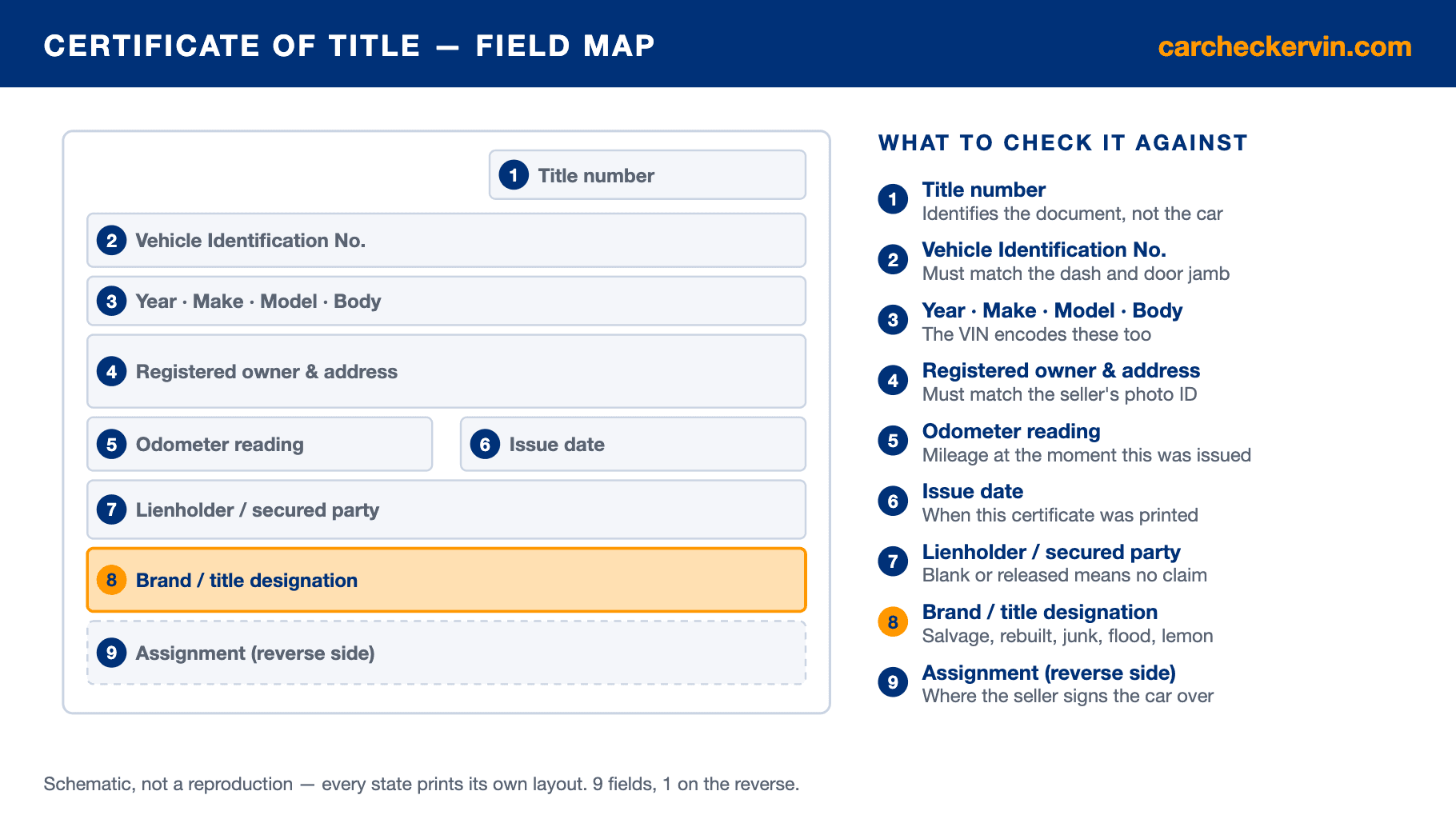
| The field | What it says | What to check it against |
|---|---|---|
| Vehicle Identification Number | The 17-character VIN — the only field tying this paper to that car | The dashboard plate and door-jamb sticker, character for character |
| Year, make, model & body | The vehicle description the state recorded when it issued the title | The car itself, and the VIN — which encodes these independently |
| Title number | The state's reference for this document — it identifies the certificate, not the car | Nothing on the vehicle; it changes each time a title is issued |
| Registered owner & address | Who the state records as owning the vehicle right now | The seller's photo ID — a name that doesn't match is the biggest red flag |
| Odometer reading | The mileage disclosed when this title was issued, sometimes with a status code | The car's current odometer, which must be higher, and earlier transfers |
| Lienholder / secured party | The lender holding a claim, if one does. Blank or released means none on record | The lien record — an unreleased lien follows the car, not the seller |
| Brand / title designation | Salvage, rebuilt, junk, flood, lemon — or nothing at all if the title is clean | The federal record, because brands are issued per state and can be lost between them |
| Issue date | When this certificate was printed, which is not when the car was bought | The title chain — a recent title on an older car is worth understanding |
| Assignment section (reverse) | Where the seller signs the car over, with the odometer disclosed again | Your state's rules — in seven states this signature must be notarized |
Two of these fields do the heavy lifting. The VIN is what makes the document belong to the car, and the brand area is what the document is willing to admit about it. Everything else is supporting detail — useful, but not what a buyer gets caught out by.
What the title number is — and what it isn't
This field confuses buyers more than any other, because it looks like an identifier for the car and isn't one. A title number is the state's reference for the certificate itself — the document, not the vehicle. Issue a duplicate title, transfer the car to a new owner, or move it to another state, and a new certificate is printed carrying a new title number, while the VIN stays exactly what it was the day the car was built. The practical consequence is that a title number tells you nothing about a car's history and cannot be used to look one up, which is why every check on this site is keyed to the VIN instead. It is also why a seller offering a title number in place of a VIN is, at best, misunderstanding what they are holding.
The title tells you what one state printed. The record tells you the rest.
Brands, title chain and odometer readings for any 17-character VIN — free, before you take a document at face value.
Why no two states' titles look alike
Every state designs, prints and issues its own certificate, which is why searching for a picture of "a car title" returns fifty different documents. The variation is not cosmetic — it reaches how the title is issued and how it is signed:
Ten states title at a county counter
In Georgia, Hawaii, Idaho, Iowa, Kentucky, Ohio, South Dakota, Tennessee, Texas and Wyoming the title is not issued by a state DMV at all. It comes from a county office — a Clerk of Courts in Ohio, a tax assessor-collector in Texas, a County Clerk in Kentucky — which is also where the paperwork gets filed.
Seven states notarize the seller's signature
In Kentucky, Louisiana, North Carolina, Ohio, Oklahoma, Pennsylvania and Wyoming the seller's assignment on the title has to be signed in front of a notary. Alabama, Delaware and Missouri state the opposite outright, Hawaii treats it as optional, and Washington notarizes the separate title application rather than the assignment.
Most states simply don't publish an answer
Only twelve of the fifty publish a clear position on notarizing the title assignment. For the rest, silence is not permission — it means the question has to be asked at the counter that will accept the document, before the signature happens rather than after.
This is why "does it look right?" is a weak test and "do the fields agree?" is a strong one. A title you have never seen before can be entirely genuine, and a familiar-looking one can be worthless.
When there is no title at all
Not every car has a certificate of title, and in two states that is by design rather than by loss. Connecticut does not title vehicles more than twenty model years old, and Maine titles only those whose model year falls within the last twenty-five — so an older car changing hands in either state transfers on its registration and a bill of sale, with no title in the picture. There, a missing title is not automatically a warning sign; it may simply be the rule. Everywhere else it is a question needing a real answer, because "it's in the mail", "the lender still has it" and "I never transferred it into my name" are three different situations and only one is routine. The check that settles it is the same in every state: read the VIN against the record and see whether the car carries a brand, an open lien, or a title chain that stops somewhere it shouldn't.
Reading a title critically
Forged and altered titles exist, and they are aimed at exactly the buyer who is checking whether a document looks convincing. These are the checks that don't depend on recognising a state's artwork:
Alterations around the VIN or odometer
The two fields worth faking are the two worth inspecting closely. Characters that are spaced unevenly, ink that differs from the surrounding text, or any sign of correction in the VIN or mileage boxes is a reason to stop, not a clerical quirk to work around.
Names that don't line up
The registered owner on the title should be the person selling you the car, with ID to match. If it isn't, you are being asked to buy from someone who never took title — a situation that can leave you unable to register the vehicle at all, however genuine the document is.
A brand area that disagrees with the record
A certificate showing no brand while the federal record shows one is the signature of a washed title, and the paper is the half that's wrong. This is the one check the document can never pass on its own, because it is a check on the document.
What the record shows that the paper can't
A title is a snapshot taken by one state on one day. These are the sections a VIN check adds — the same federal NMVTIS data and supporting feeds:
Brands across every state
The national brand record, so a clean-looking certificate can be checked against what the federal system carries for that VIN.
The full title chain
Which states have titled the car and in what order — the sequence that shows where a brand could have been dropped.
Odometer at each transfer
Every recorded reading in order, so the number printed on the title in your hand has something to be checked against.
Lien and total-loss filings
Lender claims and insurer write-offs from the federal feeds, in case the lienholder line and the record disagree.
Accident and auction entries
Reported damage and wholesale appearances with lane photos where available — none of which ever reaches a title.
Open recalls and specs
Manufacturer recall status and the build sheet for the exact VIN, decoded independently of what the title claims.
Reading titles on more than one car?
Every seller's document deserves the same two minutes, and the VIN behind it deserves the same check. Packs make that routine across a shortlist:
At $9.00 a report on the 10-pack, checking the record behind ten titles costs less than two single reports at Carfax's $44.99 retail.
The rest of the title vocabulary
What the document says, what the brands mean, and how the transfer works.
Prüfen Sie die Fahrgestellnummer immer vor dem Kauf
Die kostenlose Vorschau zeigt Title Brands (US-Titel-Kennzeichnungen), Diebstahlstatus und offene Rückrufe in Sekunden und meldet, ob Unfall- und Tachodaten vorliegen. Die vollständige Historie kostet 19,95 € — einmalig, ohne Abo.
Car titles — what buyers actually ask
The questions that come up once the document is in your hands.
What does a car title look like?+
It is a single sheet issued by a state government, not a booklet and not anything a seller produces themselves. Every version carries the same core information — the 17-character VIN, the year, make and model, the registered owner and address, a title number, an odometer reading, a lienholder line, an issue date, and a brand area where a designation such as salvage or rebuilt would be printed. The reverse carries the assignment section where the seller signs the vehicle over. Colour, wording and field order differ by state, so a title is read by its fields rather than by its appearance.
What is a car title number?+
It is the state's reference number for the certificate itself, not for the vehicle. Because it identifies the document, it changes whenever a new document is issued — a duplicate title, a transfer to a new owner, or a move to another state all produce a fresh title number, while the VIN never changes. A title number cannot be used to look up a vehicle's history, which is why record checks are keyed to the VIN instead.
Do car titles look the same in every state?+
No. Each state designs and issues its own certificate, so layout, colour and label wording all vary, and even the issuing office differs — in Georgia, Hawaii, Idaho, Iowa, Kentucky, Ohio, South Dakota, Tennessee, Texas and Wyoming, titles come from a county office rather than a state DMV. The information is broadly consistent even when the presentation isn't, so matching the fields is a far more reliable test than judging whether a document looks familiar.
Where is the VIN on a car title?+
It appears in the vehicle description area, usually near the year, make and model, and it is the field to read first. All 17 characters must match the VIN plate at the base of the windscreen and the sticker in the driver's door jamb exactly. If the document and the car disagree on even one character, the title does not belong to that vehicle and nothing else printed on it is meaningful.
Does the seller's signature on a title need to be notarized?+
It depends on the state, and most do not publish a clear answer. Kentucky, Louisiana, North Carolina, Ohio, Oklahoma, Pennsylvania and Wyoming require the seller's assignment on the title to be notarized. Alabama, Delaware and Missouri state it is not required, Hawaii treats it as optional, and Washington notarizes the separate title application instead. Only twelve states publish a position at all, so confirm with the office that will accept the document before anyone signs.
How can I tell if a car title is fake?+
Rather than judging a state's artwork, check what a forgery cannot fix. The VIN must match the car exactly and show no sign of alteration; the registered owner must be the person selling you the vehicle, with ID that agrees; the odometer box must be consistent with the readings recorded at earlier transfers; and the brand area must agree with the federal record. A certificate showing no brand while NMVTIS shows one is the classic washed title, and the document is the half that is wrong.
Is a title the same as a registration?+
No. The title is the ownership document, issued once per owner and kept rather than carried. The registration is permission to operate the car on public roads, renewed on a cycle and carried in the vehicle. A car can be titled to someone who has not registered it, which is why a registration document alone does not prove the person holding it owns the vehicle.
You can read the title. Read what's behind it.
Preview any 17-character VIN free — brands, title chain and flags — and read the full NMVTIS-backed file for $14.99 when a car matters.
Passende VIN-Abfragen
Weitere Tools, um die Historie jedes Fahrzeugs zu prüfen