Are car auctions worth it?
Often yes — but for a reason worth understanding. Many auction cars are there because an insurer wrote them off, and federal law makes the yards and insurers report exactly that. Which means you can check before you bid.
Run the VIN before the hammer falls
Salvage, junk and flood brands, reported by the yards themselves.
No account · Nothing stored · $14.99 only for the full report
Quick Answer
- Are car auctions worth it?
- They can be, if you know which auction you are at and check the VIN before you bid. The saving is real because most auction cars are sold without warranty, often without a test drive, and frequently because an insurer wrote them off. That last category is federally tracked — so it is checkable in advance rather than a gamble.
- What is the actual risk?
- Beyond buying unseen damage, the Justice Department names a specific fraud: it warns that salvage-pool vehicles have their VINs or titles used to create cloned vehicles, or to make stolen vehicles appear legitimate. That is a documented pattern, not a rumour.
- Can I even bid?
- It depends on the auction. Dealer-only and wholesale auctions require a licence; public and salvage auctions vary by operator and by state. Check the specific auction's rules before you plan around it.
Why auction cars are cheap
Not because the market is inefficient. Auction cars are cheaper because the buyer takes on things a retail buyer does not: usually no warranty, often no test drive, sometimes no way to start the car at all, and a settlement deadline measured in days.
A large share of that stock is there because an insurance company decided it was not worth repairing. That is not a secret — it is a federally reportable event, which is the whole reason this question has a checkable answer.
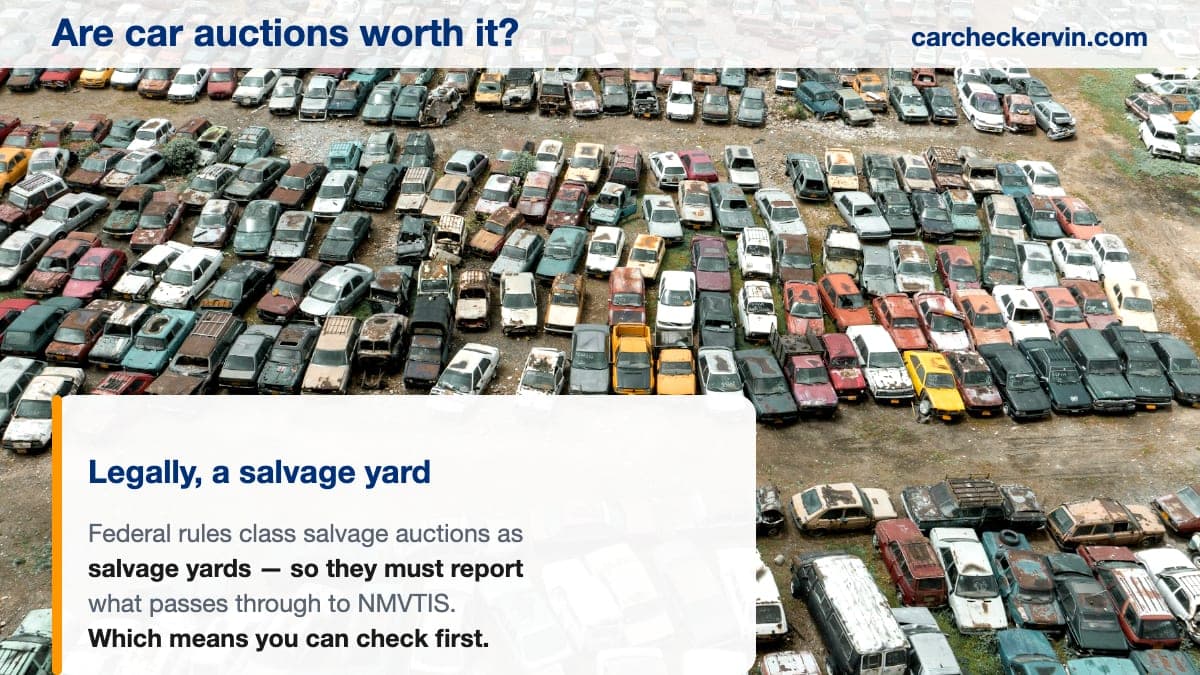
Federally, a salvage auction is a salvage yard
“Included in this definition are scrap-vehicle shredders and scrap-metal processors, as well as “pull- or pick-apart yards,” salvage pools, salvage auctions, and other types of auctions, businesses, and individuals that handle salvage vehicles (including vehicles declared a “total loss”).”
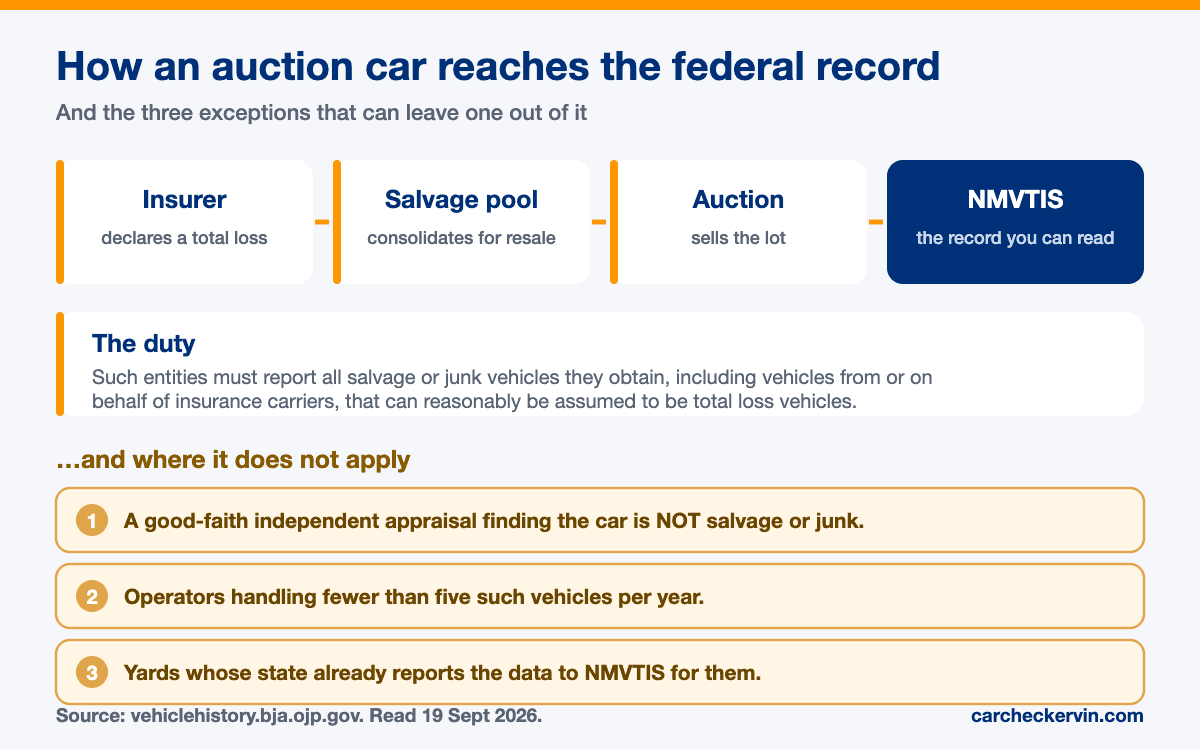
That classification carries a duty: Such entities must report all salvage or junk vehicles they obtain, including vehicles from or on behalf of insurance carriers, that can reasonably be assumed to be total loss vehicles.
And it is not one database among many. DOJ puts it plainly: NMVTIS is the only publicly available system in the United States to which all insurance carriers, auto recyclers, junk yards, and salvage yards, are required, under federal law, to report to on a regular basis.
Check the VIN before you bid
The yards and insurers already reported it. $14.99 to read it.
The fraud the Justice Department actually warns about
“Both the Department of Justice and the state and local law-enforcement community are concerned that a significant number of these junk and salvage automobiles purchased from salvage pools have their VINs or titles used to create cloned vehicles, or otherwise make stolen vehicles appear legitimate.”
This is worth reading twice, because it is a different risk from “the car might need work”. A cloned vehicle wears the identity of a legitimate car: the VIN checks out against a real record, the paperwork looks right, and the car in front of you is something else entirely.
The defence is cheap and physical. Read the VIN at the base of the windshield, on the driver's door jamb sticker, and on the paperwork, and confirm all three agree — and that the plate itself looks factory-fitted rather than riveted or disturbed.
Where the record has holes
A reporting duty is not the same as complete coverage, and a page that told you otherwise would be selling you false comfort. DOJ publishes the exceptions:
- A vehicle determined NOT to meet the definition of salvage or junk after a good-faith physical and value appraisal by qualified, independent appraisal personnel.
- Auto recyclers and junk and salvage yards that handle fewer than five such vehicles per year.
- Yards whose state already collects the required information and passes it to NMVTIS on their behalf.
So read a clean federal record as strong evidence rather than a guarantee, and pair it with the free theft and total-loss check at NICB, which draws on a different set of reporters again.
Which auction are you actually at?
| Type | Who can bid | What the stock is |
|---|---|---|
| Dealer / wholesale | Licensed dealers, generally | Trade-ins, lease returns and fleet cars moving between dealers. |
| Public | Open, with operator rules | Mixed. Often consignment, repossessions and municipal fleet. |
| Salvage | Varies by operator and state; some need a broker | Insurer write-offs and total losses — the category with the federal reporting duty. |
| Government / municipal | Usually open | Retired fleet vehicles, typically high mileage with maintenance records. |
Work out the landed cost, not the hammer price
The single most common way an auction “bargain” evaporates is arithmetic. Before you set a maximum bid, add:
- The buyer's premium, which is a percentage on top of your winning bid.
- Gate, documentation and storage fees, which accrue if you cannot collect immediately.
- Transport from the lot — a non-runner needs a truck, not a driver.
- Repairs on a car you could not start, drive or put on a lift.
- Title and registration work, which is slower and costlier on a branded car.
Compare that total against a retail car with a warranty and a test drive. If they are close, the auction has already spent your discount for you.
Sources
- NMVTIS — Reporting Entities (auto recyclers, salvage and junk yards)
Who must report to NMVTIS, what counts as a salvage yard, the exceptions, and DOJ's concern about cloned vehicles from salvage pools. Read 19 September 2026.
- NMVTIS — Understanding a Vehicle History Report
Where NMVTIS data comes from and why it is the only system all those entities must report into. Read 19 September 2026.
- NMVTIS — Used Car Buying Tips
The Justice Department's own checklist for used-car buyers, including its price guidance for NMVTIS reports. Read 19 September 2026.
- NMVTIS Glossary (title-brand definitions)
Federal definitions of brand, junk automobile, salvage automobile and total loss. Read 19 September 2026.
- NICB VINCheck
The National Insurance Crime Bureau's free lookup for theft and total-loss records reported by participating member insurers.
Siempre verifica el VIN antes de comprar
La vista previa gratis muestra marcas de título, estado de robo y recalls abiertos en segundos, e indica si existen registros de accidentes y odómetro. El historial completo cuesta $14.99 — pago único, sin suscripción.
Keep reading
Frequently asked questions
Are salvage auctions the same as salvage yards, legally?+
Yes, and that is the most useful thing to know. The federal definition of a salvage yard reads: "Included in this definition are scrap-vehicle shredders and scrap-metal processors, as well as “pull- or pick-apart yards,” salvage pools, salvage auctions, and other types of auctions, businesses, and individuals that handle salvage vehicles (including vehicles declared a “total loss”)." Because they fall inside that definition, they carry the reporting duty that comes with it.
Does that mean auction cars are always in the federal record?+
Mostly, but not always, and the exceptions matter. The duty is that "Such entities must report all salvage or junk vehicles they obtain, including vehicles from or on behalf of insurance carriers, that can reasonably be assumed to be total loss vehicles." There are carve-outs: a good-faith independent appraisal finding the car is not salvage or junk, operators handling fewer than five such vehicles a year, and yards whose state already reports on their behalf. Treat a clean record as strong evidence rather than proof.
What is a salvage pool?+
A salvage pool is an entity that acquires junk and salvage automobiles from a variety of parties and consolidates them for resale at a common point of sale. In plain terms, it is the middleman that gathers written-off cars from insurers and puts them in one place to be sold. It is the part of the chain the Justice Department flags for fraud risk.
What is the cloning risk the DOJ mentions?+
DOJ's published concern is that "Both the Department of Justice and the state and local law-enforcement community are concerned that a significant number of these junk and salvage automobiles purchased from salvage pools have their VINs or titles used to create cloned vehicles, or otherwise make stolen vehicles appear legitimate." A cloned car carries the identity of a legitimate vehicle, so the paperwork can look correct while the car in front of you is not what it claims. Matching the VIN in all three places on the car, and against the title, is the check that catches it.
Are dealer auctions open to the public?+
Generally not. Wholesale and dealer auctions typically require a dealer licence, which is why they are where trade stock moves. Public auctions and many salvage auctions have their own access rules that vary by operator and state, and some require a broker. Confirm with the specific auction rather than assuming.
How much does the federal title record cost?+
The Justice Department's own buying tips tell consumers: "Expect to pay up to $4 per report." That price is for NMVTIS data alone from an approved provider. A fuller commercial report bundles more sources — our $14.99 report is NMVTIS-backed and adds the rest. Both are worth less than one wrong bid.
Can I inspect a car before bidding?+
Often only visually, and sometimes not at all. Many auction lots cannot be driven, started or lifted, which is precisely why the written record does the work the test drive normally would. If you cannot inspect and cannot check the VIN, you are not buying at a discount — you are buying a lottery ticket.
Is an auction car always cheaper?+
Not once you add everything up. Buyer's premiums, gate and storage fees, transport from the lot, and repairs on a car you could not test all sit on top of the hammer price. Work out your total landed cost before you bid, and compare it against a retail car with a warranty.
When is an auction genuinely a good idea?+
When you can inspect or at least check the VIN first, when you can absorb repairs you did not plan for, when you know the total cost including fees and transport, and when you are not depending on the car being ready the day you collect it. If all four are true, the discount is real money. If any is false, the discount is a deposit against a bill you have not seen.
Check the lot before you bid
Salvage, junk and flood brands across state lines — $14.99, no account.
Verificaciones VIN relacionadas
Más herramientas para verificar el historial de cualquier vehículo