Florida Salvage Title — and the certificate of destruction that ends a car for good.
Florida has two documents for a wrecked car. A salvage certificate of title says the vehicle was a total loss but may be rebuilt and retitled after inspection. A certificate of destruction says it may never be titled again: the department "may not issue a certificate of title for that vehicle". Section 319.30 decides which one a car gets, using the vehicle's age, its retail value and the cost of the repairs, and gives the insurer or owner 72 hours to apply. Here is how the thresholds work, and how to see them on a car you are about to buy.
Check a Florida Car for a Salvage Record
Salvage titles and certificates of destruction are reported to NMVTIS, so they follow the VIN even after a car crosses the state line. Enter the VIN for a free preview.
Free preview · No sign-up · No owner or personal data
Quick Answer
- What is a salvage title in Florida?
- Under § 319.30 a vehicle is "salvage" when it is a total loss: an insurer paid to replace it (or paid a theft claim), or it was uninsured and repairing it would cost 80% or more of replacing it with one of like kind and quality. The owner or insurer must then obtain a salvage certificate of title, or a certificate of destruction, within 72 hours.
- What is a certificate of destruction in Florida?
- The document issued instead of a salvage title when the department declares a vehicle unrebuildable: a late-model vehicle (model year 7 years or newer) worth at least $7,500 whose repair estimate is 90% or more of its retail value, or an older or cheaper car whose only remaining value is parts or scrap. It authorizes dismantling or destruction, can be reassigned at most 2 times, and the department may never issue a title for that vehicle again.
- Can a Florida salvage title car be driven?
- No. A salvage vehicle must be repaired, pass a rebuilt inspection and be retitled with the Rebuilt stamp before it can be registered or driven. A vehicle under a certificate of destruction cannot be rebuilt at all.
Five decisions § 319.30 makes about a wrecked car
From the moment of loss to the document the car ends up with.
- 1Is it a total loss?Insurer pays to replace it or pays a theft claim; or uninsured and repairs cost 80%+ of replacement.
- 2Repair instead?Not a total loss if insurer and owner agree to repair, unless the actual repair cost passes 100% of replacement: then a brand request within 72 hours.
- 3File within 72 hoursThe insurer, or an owner who keeps the car, applies for a salvage title or certificate of destruction with a repair estimate.
- 4Rebuildable or not?Late model, worth $7,500+, repairs 90%+ of retail: certificate of destruction. Otherwise a salvage title.
- 5What followsSalvage: rebuild, inspect, Rebuilt stamp. Destruction: parts or scrap, no title ever.
What Makes a Vehicle a Total Loss in Florida
Section 319.30(3)(a) gives two routes to "total loss". The first is the insurer's: the vehicle is a total loss when an insurance company pays the owner to replace it with one of like kind and quality, or pays the owner after a theft. The second is for uninsured vehicles: a total loss when the cost of repairing or rebuilding it, at the time of the loss, is 80% or more of what it would cost the owner to replace it with one of like kind and quality.
There is an escape hatch. A vehicle is not a total loss if the insurer and the owner agree to repair it rather than replace it. But if the actual repair cost ends up above 100% of the replacement cost, the owner has 72 hours after the agreement to ask the department to brand the title. "Salvage", in the statute's one-line definition, simply means a motor vehicle or mobile home that is a total loss under this paragraph.
The 72-Hour Clock
An insurer that pays a total-loss claim must obtain the certificate of title and, within 72 hours after receiving it, apply to the department for a salvage certificate of title or a certificate of destruction. If the owner keeps the wreck as part of the settlement, the owner must apply within 72 hours after the vehicle becomes salvage. Neither may dispose of the vehicle before the salvage title or certificate of destruction is issued.
The application has to include an estimate of the cost of repairing the physical and mechanical damage, because that estimate is what decides which document the department prints. If an insurer cannot get the title from the owner or lienholder, it may receive the salvage title or certificate of destruction in its own name thirty days after paying the claim, by attesting that the claim was paid and that it asked for the title.
Who files, and when
- Insurer: 72 hours after receiving the title.
- Owner keeping the car: 72 hours after it becomes salvage.
- Repair over 100%: brand request within 72 hours of the agreement.
- Before filing: the vehicle may not be sold or scrapped.
Florida's Total-Loss Thresholds
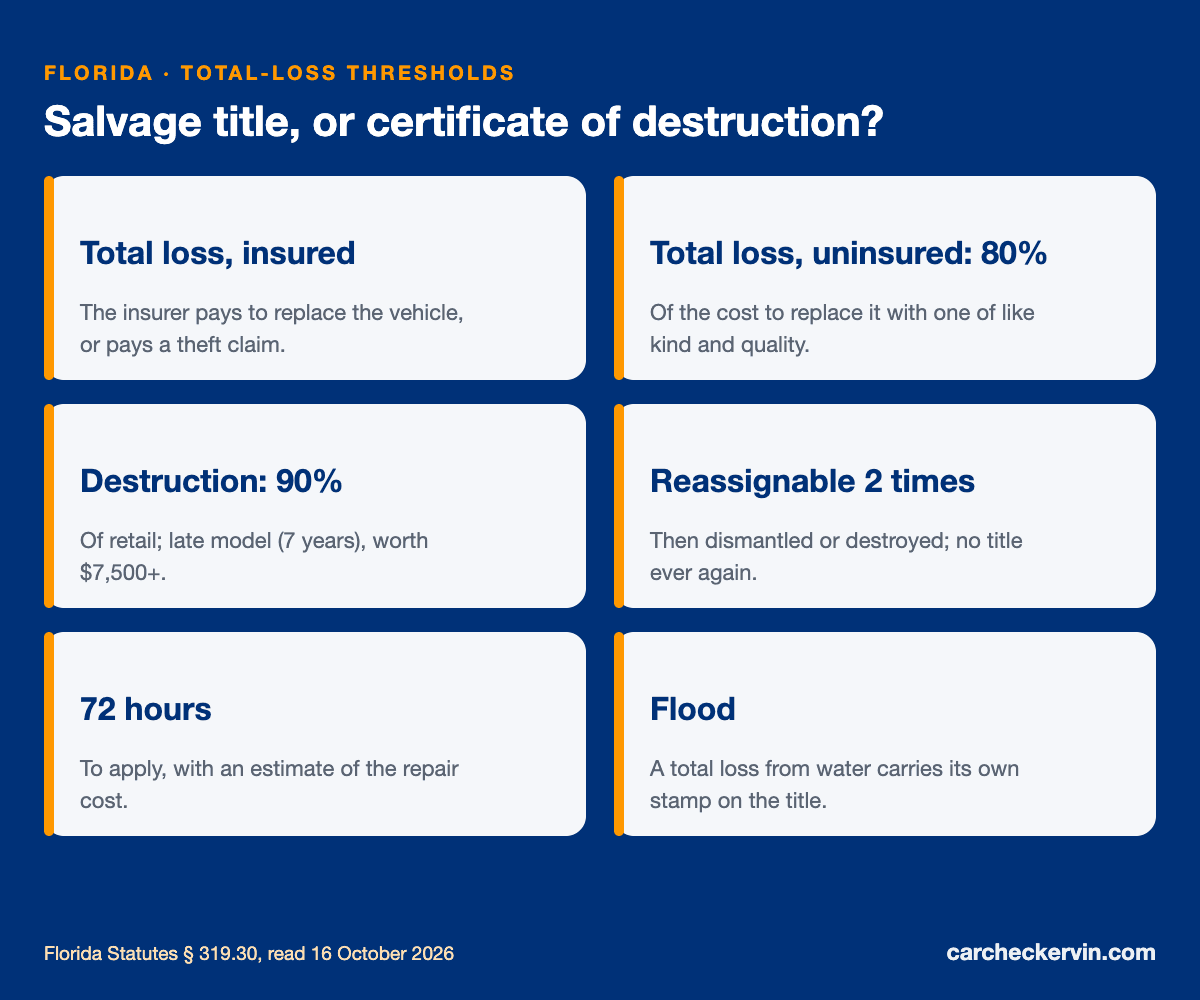
The two percentages that decide a Florida wreck's fate: 80% of replacement cost for the total-loss line on an uninsured car, and 90% of retail value for the certificate of destruction on a late-model car worth at least $7,500.
Every figure is read from § 319.30 on the date shown.
Salvage Title or Certificate of Destruction
Section 319.30(3)(c) sorts total-loss vehicles by age, value and repair estimate. The result decides whether the car has a future on the road.
Late model, high value, heavy damage
Model year 7 years or newer, retail at least $7,500 just before the loss, repair estimate 90% or more of retail: the department declares it unrebuildable and prints a certificate of destruction.
Late model, damage under 90%
A salvage certificate of title. The vehicle can be rebuilt, inspected and retitled with the Rebuilt stamp.
Older or under $7,500
A certificate of destruction only if the vehicle is damaged, wrecked or burned to the point that its only residual value is parts or scrap, or if it arrives in Florida under a document that says not repairable, junk or parts only. Otherwise a salvage title.
Mobile homes
A certificate of destruction when the repair estimate is 80% or more of the current retail value; not applicable below $1,500 retail.
Recovered thefts
A stolen vehicle recovered substantially intact and readily resalable without extensive frame or engine repair is not pushed into a certificate of destruction.
The wheelchair exception
A vehicle with custom-lowered floors or a wheelchair lift that would otherwise be destroyed may be reissued a salvage rebuildable title with the brand "insurance-declared total loss", if the insurer finds it repairable to a safe condition.
What a Certificate of Destruction Forbids
A certificate of destruction "authorizes the dismantling or destruction of the motor vehicle". It may be reassigned at most 2 times before the vehicle must be dismantled or destroyed, it travels with the vehicle in place of a title when the vehicle is sold for those purposes, and the department "may not issue a certificate of title for that vehicle". There is no inspection that brings such a car back. A listing that offers a Florida car "with certificate of destruction, runs and drives" is offering parts.
Florida also defines a "derelict": a motor vehicle at least 10 model years old, valued under $1,000, whose highest value is as scrap or parts. Derelicts move to salvage dealers and metal recyclers under a separate certificate process in the same section, with their own felony penalties for skipping the paperwork.
See the Salvage Record Before You Travel
Enter the VIN for a free preview of the total-loss, salvage and rebuilt brands reported for the car.
Flood Vehicles and the Brands a Buyer Sees
Section 319.14 defines a "flood vehicle" as a motor vehicle declared a total loss under § 319.30 because of water damage. Like a rebuilt vehicle it cannot be sold until the department stamps the title, and the seller must disclose the flood history in writing before the sale and in every advertisement. After a hurricane season, that stamp is the one Florida buyers look for first.
On a Florida title the brands are printed. Once the car is retitled in another state, the Florida record survives only in NMVTIS, where salvage titles and certificates of destruction are reported. A vehicle history report built on NMVTIS data shows a Florida salvage or destruction record on a car now wearing a clean title from Georgia or Texas, which is the reason to run the VIN before the deposit.
Florida brands to know
- Salvage: total loss, rebuildable after inspection.
- Certificate of destruction: unrebuildable; parts or scrap only.
- Rebuilt: repaired, inspected and retitled.
- Flood: total loss from water damage.
Related Checks and Guides
The Florida title pages, the salvage checks and the auctions where total-loss cars are sold.
Where These Facts Come From
From the Florida Statutes as published by the Florida Senate, read on 16 October 2026. Thresholds change by statute; confirm with FLHSMV or your tax collector before relying on them.
CarCheckerVIN is not affiliated with FLHSMV or any insurer. This page is general information, not legal advice. FLHSMV's own site could not be read when this page was written, so its form numbers are not quoted here.
Siempre verifica el VIN antes de comprar
La vista previa gratis muestra marcas de título, estado de robo y recalls abiertos en segundos, e indica si existen registros de accidentes y odómetro. El historial completo cuesta $14.99 — pago único, sin suscripción.
Florida Salvage Title — Frequently Asked Questions
What Florida owners and buyers ask most.
What percentage is a total loss in Florida?+
For an uninsured vehicle, repairs costing 80% or more of the replacement cost make it a total loss. For an insured vehicle the test is whether the insurer paid to replace it. A separate 90%-of-retail test decides whether a late-model total loss gets a certificate of destruction instead of a salvage title.
Can you rebuild a car with a certificate of destruction in Florida?+
No. The certificate authorizes only dismantling or destruction, may be reassigned at most twice, and the department may not issue a title for the vehicle afterwards.
How long do I have to get a salvage title in Florida?+
72 hours: for the insurer, after it receives the certificate of title; for an owner who keeps the vehicle, after it becomes salvage. The vehicle cannot be disposed of before the document issues.
What is a late model vehicle in Florida?+
Section 319.30 defines it as a motor vehicle with a manufacturer's model year of 7 years or newer. The certificate-of-destruction threshold applies to late-model vehicles worth at least $7,500 just before the loss.
Does a Florida salvage title follow the car to another state?+
Yes. Salvage titles and certificates of destruction are reported to NMVTIS, and a vehicle history report built on that data shows the Florida record even after the car is retitled elsewhere.
Is a flood title the same as a salvage title in Florida?+
A flood vehicle is a total loss caused by water, so it is salvage, but it also gets its own flood stamp on the title under § 319.14 and must be disclosed as a flood vehicle when sold or advertised.
Run the VIN on a Florida Car
Enter any 17-character VIN for a free preview. The full report lists title brands, NMVTIS junk and salvage records, insurance total-loss records, odometer readings, and auction records with the damage the auction recorded and its photos.
CarCheckerVIN is an independent vehicle-history service and is not affiliated with the Florida Department of Highway Safety and Motor Vehicles. Thresholds are summarized from the Florida Statutes and are not legal advice. Records in our reports reflect what was reported to our data providers. Our reports do not include police or repair-shop accident entries.
Verificaciones VIN relacionadas
Más herramientas para verificar el historial de cualquier vehículo