Ford Escape Years to Avoid — the coolant years, counted by engine.
Avoid the 2017–2019 Escape with a turbo engine and the 2013–2014 with the 1.6-liter. 1,589 of the 2017's 2,707 complaints describe coolant loss or overheating, and the 2013 drew 2,757, the most of any Escape. The non-turbo 2.5-liter is the one owners trust.
Checking an Escape for Sale?
Run its VIN for a free preview of title brands, salvage and total-loss records and odometer readings, then check the coolant.
Free preview · No sign-up · No owner or personal data
Quick Answer
- What Ford Escape years should you avoid?
- The 2017–2019 with the 1.5- or 2.0-liter turbo, and the 2013–2014 with the 1.6-liter. 1,589 of 2,707 complaints on the 2017 and 1,213 of 1,829 on the 2018 describe coolant loss or overheating. The 2013 drew 2,757 complaints, the most of any year, and 3 engine recalls cover its 1.6-liter.
- What is the best year for a used Escape?
- Leaving out the coolant years, 2021 (356), 2007 (393), 2004 (499) drew the fewest complaints from 2001 to 2021. Owners in the comments below single out the non-turbo 2.5-liter in 2013–2019 Escapes as the engine that stays out of trouble.
- Which Escape engines have coolant problems?
- On the 2017–2018, the coolant complaints that name an engine name the turbos: 244 the 1.5-liter and 166 the 2.0-liter, against none for the non-turbo 2.5. On the 2013–2014, recalls cover the 1.6-liter, whose cylinder head can overheat and crack.
Five checks for a used Escape, starting under the hood
Which engine it has matters more on an Escape than on most cars. Start there.
- 1Read the engine from the VINOn a Ford, the 8th character is the engine code; the listing may not say which.
- 22013–2019 turbo: check the coolant coldA reservoir that keeps dropping with no visible leak is what owners describe.
- 3Smell the exhaustOne owner first noticed coolant through the exhaust; a sweet smell is the clue.
- 42008–2011: steer at parking speedA warning light and heavy steering means the assist dropped out (recall 14V284000).
- 5Look up open recallsThe 2020 alone has 23 recall campaigns; each is free at a dealer.
Avoid: the 2017–2019 Escape With a Turbo Engine
The 2017 Escape drew 2,707 NHTSA complaints against 1,191 for the 2016, and the engine is named in 1,587 of them. 1,589 describe coolant loss, a low-coolant warning or overheating; on the 2018 it is 1,213 of 1,829, and on the 2019 304 of 604.
The owners who name an engine point at the turbos. On the 2017–2018, 244 coolant complaints mention the 1.5-liter EcoBoost and 166 the 2.0-liter, while none mention the non-turbo 2.5. Owners describe coolant disappearing with no puddle under the car, a flashing check-engine light, and a dealer finding coolant in the cylinders. 892 complaints on the 2017 describe a head gasket, cylinder head or engine replacement.
No recall on NHTSA's list for the 2017–2019 covers coolant getting into the engine; the nearest, 26V011000, is for 2.0-liter engine block heaters that can crack and leak coolant on the outside. Owners in the comments below describe engines replaced under warranty, sometimes twice. If you are set on one, ask for proof of any engine replacement and check the coolant level cold.
2017–2019 by the numbers
- 1,589 · 1,213 · 304 complaints on the 2017, 2018 and 2019 about coolant loss or overheating.
- 244 vs. 166 vs. none 2017–18 coolant complaints naming the 1.5-liter, the 2.0-liter and the 2.5-liter.
- 1,551 on the 2017–18 describe a head gasket, cylinder head or engine replacement.
- Recall 22V413000: 2013–2019 Escapes, a shifter-cable bushing that can let the car roll after Park is selected.
Also Avoid: the 2013–2014 Escape With the 1.6-Liter
The 2013 was a new design, and it drew 2,757 complaints, the most of any Escape, with 91 owners reporting a fire. The 2014 drew 2,091, and 104 fire reports. 870 and 619 complaints on the two years describe coolant loss or overheating.
Ford recalled the 1.6-liter turbo more than once. Recall 12V431000 covers a cylinder-head plug that can pop out and dump coolant, 13V583000 a cylinder head that can overheat and crack on the 2013, and 17V209000 the same risk on the 2014 if it is driven low on coolant. In each case, NHTSA's summary warns that leaking fluid can start an engine fire.
The transmission is the other complaint: 396 on the 2014 mention it. A 2013–2014 with the 2.5-liter avoids the 1.6-liter's recalls, though not the transmission.
2013–2014 by the numbers
- 2,757 · 2,091 complaints on the 2013 and 2014.
- 91 · 104 of those report a fire.
- 18 · 16 recall campaigns on the two years.
- 396 on the 2014 mention the transmission.
Every Ford Escape Model Year and Its NHTSA Record
Complaints and recall campaigns for every Escape from 2001 to 2026, read from NHTSA's public records on 12 November 2026.
| Year | Generation | Complaints | Crash · fire reports | Recalls | Most-cited component |
|---|---|---|---|---|---|
| 2001 | 1st | 1,052 | 78 · 60 | 15 | Engine And Engine Cooling |
| 2002 | 1st | 1,079 | 68 · 108 | 10 | Engine And Engine Cooling |
| 2003 | 1st | 598 | 44 · 29 | 9 | Structure |
| 2004 | 1st | 499 | 29 · 14 | 8 | Suspension |
| 2005 | 1st | 1,584 | 44 · 20 | 5 | Suspension |
| 2006 | 1st | 720 | 23 · 10 | 5 | Service Brakes |
| 2007 | 1st | 393 | 16 · 3 | 4 | Service Brakes |
| 2008 | 2nd | 2,417 | 72 · 7 | 5 | Steering |
| 2009 | 2nd | 1,693 | 34 · 2 | 3 | Steering |
| 2010 | 2nd | 2,130 | 32 · 3 | 5 | Vehicle Speed Control |
| 2011 | 2nd | 1,320 | 38 · 7 | 3 | Steering |
| 2012 | 2nd | 604 | 38 · 3 | 2 | Steering |
| 2013 | 3rd | 2,757 | 50 · 91 | 18 | Engine |
| 2014 | 3rd | 2,091 | 47 · 104 | 16 | Engine |
| 2015 | 3rd | 1,147 | 31 · 20 | 9 | Power Train |
| 2016 | 3rd | 1,191 | 39 · 10 | 4 | Power Train |
| 2017 | 3rd | 2,707 | 39 · 15 | 4 | Engine |
| 2018 | 3rd | 1,829 | 26 · 6 | 4 | Engine |
| 2019 | 3rd | 604 | 24 · 3 | 3 | Engine |
| 2020 | 4th | 1,550 | 20 · 4 | 23 | Structure |
| 2021 | 4th | 356 | 9 · 9 | 19 | Structure |
| 2022 | 4th | 238 | 7 · 4 | 19 | Fuel System |
| 2023 | 4th | 102 | 2 · 3 | 11 | Electrical System |
| 2024 | 4th | 78 | 5 · 0 | 8 | Electrical System |
| 2025 | 4th | 0 | 0 · 0 | 9 | — |
| 2026 | 4th | 0 | 0 · 0 | 2 | — |
Complaints are unverified owner reports and are not divided by sales. NHTSA lists no complaints yet for the 2025–2026. Hybrids NHTSA files under a separate model name are not included, nor are the Mercury Mariner and Mazda Tribute.
Older Escapes: Rust, Steering and Throttles
Before the turbo years, the Escape's complaints clustered around a few faults.
2005: rust
631 of the 2005's 1,584 complaints describe rust; many say the rear wheel wells rotted through at the shock mounts.
2001–2004: frame recall
Recall 14V165000, for salt-belt Escapes: corrosion can separate a lower control arm.
2001–2004 V6: stuck throttle
Recall 12V353000: the speed-control cable can catch on the engine cover and hold the throttle open.
2008: steering
1,237 of the 2008's 2,417 complaints name the steering; recall 14V284000 covers 2008–2011.
2010: stalling
779 of the 2010's 2,130 complaints mention the throttle; owners describe it stalling at speed.
2020: doors and liftgate
742 of the 2020's 1,550 complaints mention a door, hinge or liftgate.
What Escape Owners Say on Reddit and YouTube
Escape owners split largely along engine lines. The happy ones, many with 200,000-plus miles, tend to have the non-turbo 2.5-liter or a well-kept early EcoBoost; the unhappy ones describe coolant leaks, replaced engines and transmissions.
One Reddit commenter warns off the 2021 for overheating and head gaskets. NHTSA's record for that year is light: 356 complaints, 12 about coolant or overheating.
In owners' words (paraphrased)
- r/fordescape: a commenter says to avoid the 2021, citing its reliability ratings and reports of overheating and bad head gaskets.
- YouTube, 2019 AWD: an owner says coolant was leaking into the cylinders; Ford replaced the engine under warranty at 38,000 km with an updated design.
- YouTube, 2017 Titanium 2.0L: an owner says the engine was rebuilt at 28,000 miles and replaced at 58,500 for coolant intrusion, and now the transmission is going at 95,000.
- YouTube, on the engines: a commenter says the 2.5 has no major problems; most trouble is on the 1.5 and 2.0 EcoBoost.
- YouTube, 2014 2.5L S: an owner who bought it new says it is still in the family at 125,000 miles and has dodged the turbo engines' problems.
- YouTube, 2018 1.5L: an owner nearing 100,000 miles is very happy, changes the oil every 3,000–4,000 miles, and has replaced only wear items.
- YouTube, 2013 and 2018: an owner says they can't recommend any used 2013–2018; the 2013 lost its transmission and transfer case, and the 2018 needed a new engine for coolant intrusion.
- YouTube, 2014 bought at 97,000: an owner reports 224,000 miles with regular oil changes and no major repairs.
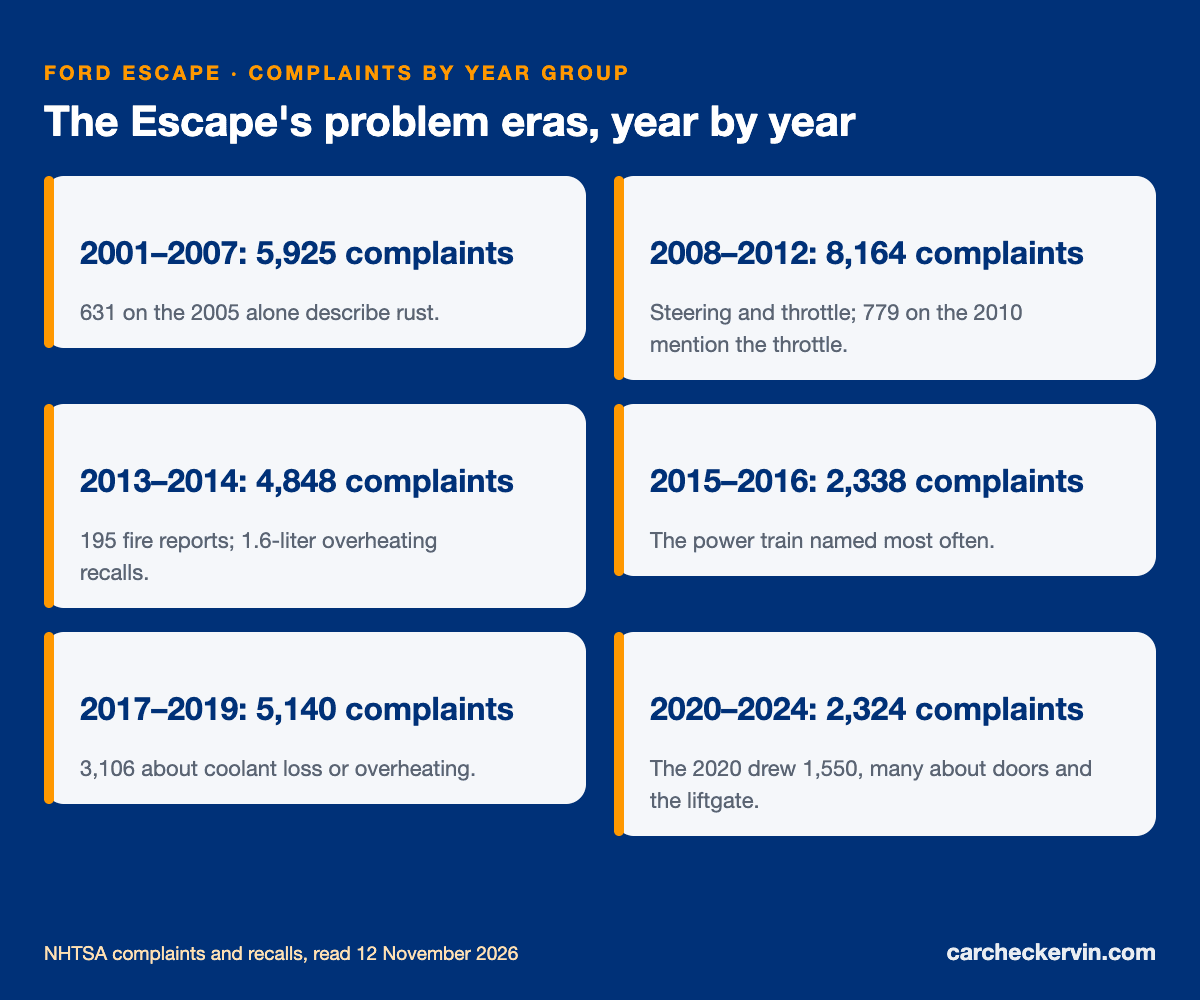
Escape Complaints by Year Group
Two peaks stand out: the 2008–2010, led by steering and throttle complaints, and the 2013–2018 turbo years. The 2021–2024 Escapes sit far lower, though they have had less time on the road.
Got an Escape VIN?
Run it for a free preview: title brands, junk and salvage records, total-loss records and odometer readings.
The Escapes Our Visitors Look Up
Between 11 June 2026 and 11 November 2026, visitors ran 1,399 different Ford Escape VINs through our free preview. 608 (43%) were 2013–2019 models, and 322 (23%) were 2017–2019, the years with the most coolant complaints. The most-checked single year was the 2020 (150).
Some of those cars will have the non-turbo 2.5-liter, and some will have had an engine replaced already. The VIN tells you which engine was fitted at the factory; only the paperwork tells you what happened after.
Fewest vs. Most Escape Complaints
Fewest is limited to 2001–2021 and leaves out the years where a quarter or more of complaints are about coolant (2013–2014 and 2017–2019).
Fewest complaints
- 2021: 356 complaints, 19 recalls
- 2007: 393 complaints, 4 recalls
- 2004: 499 complaints, 8 recalls
- 2003: 598 complaints, 9 recalls
- 2012: 604 complaints, 2 recalls
Most complaints
- 2013: 2,757 complaints, 18 recalls
- 2017: 2,707 complaints, 4 recalls
- 2008: 2,417 complaints, 5 recalls
- 2010: 2,130 complaints, 5 recalls
- 2014: 2,091 complaints, 16 recalls
Recall counts include multi-model campaigns.
What to Check on a Used Escape
By year and engine, the faults to look for.
2013–2019 turbo: coolant
Check the level cold, then again after a drive. It shouldn't drop.
2017–2019: engine records
Ask whether the engine was replaced, and by whom.
2020–2023 1.5L: injectors
Recall 22V859000: a fuel injector may crack and leak fuel.
2001–2007: underneath
Look at the rear wheel wells and shock mounts for rust.
2008–2011: the steering
Confirm recall 14V284000 was done.
Any year: VIN records
Open recalls, title brands and odometer history.
Reading Escape Complaint Numbers
NHTSA does not divide complaints by sales, so a year that sold more collects more complaints. Compare Escape years with each other: 1,191 for the 2016 against 2,707 for the 2017 is the signal.
The coolant counts come from searching the words owners used. Only some owners name their engine, so the 1.5-liter and 2.0-liter figures are small next to the total, but the 2.5-liter's absence is the point. Recall 25V372000 shows newer Escapes are not clear of engine recalls either: it covers 2023–2025 cylinder heads that may leak oil.
Related Checks and Guides
Recalls, history and the Escape's rivals.
Where These Facts Come From
Complaint and recall figures are NHTSA's own records; owner experiences are linked so you can read them in full.
NHTSA records read 12 November 2026. Written by the CarCheckerVIN editorial team with AI assistance, from NHTSA's complaint and recall records, our own preview logs and the owner posts linked above; figures checked November 2026. CarCheckerVIN is not affiliated with Ford.
Ford Escape Years to Avoid — Frequently Asked Questions
The worst years, the engines and what to check.
What is the worst year for the Ford Escape?+
By NHTSA complaint count, the 2013 (2,757), then the 2017 (2,707) and the 2008 (2,417).
Is the 2.5-liter Escape reliable?+
It is the engine owners trust most. Of the 2017–2018 coolant complaints that name an engine, none name the 2.5-liter, against 244 for the 1.5-liter and 166 for the 2.0-liter.
What is Escape coolant intrusion?+
Owners use it for coolant leaking into the cylinders of the turbo engines. They describe the coolant level falling with no outside leak, misfires and a dealer replacing the engine. 892 complaints on the 2017 describe a head gasket, cylinder head or engine replacement.
Is the 2020 Escape a good used buy?+
Its 1,550 complaints are mostly about doors and the liftgate (742), and it has 23 recall campaigns, the most of any Escape year. Check that every recall is done.
Are 2008–2012 Escapes worth buying?+
At the right price, with checks. The 2008 drew 2,417 complaints, mostly steering, covered by recall 14V284000; the 2010 drew 2,130, many about the throttle. The 2012 is the quietest of the group (604).
Will your report show these problems?+
No history report can see coolant in an engine. Ours lists title brands, NMVTIS junk and salvage records, insurance total-loss records, odometer readings, and auction records with the damage the auction recorded and its photos for the VIN. Recalls are free to check on NHTSA's site.
Check the Engine Before the Year
On an Escape, the engine and its paperwork matter most. Free preview first; the full report is $14.99 and lists title brands, NMVTIS junk and salvage records, insurance total-loss records, odometer readings, and auction records with the damage the auction recorded and its photos.
Complaint and recall figures are NHTSA's public records as read on 12 November 2026; complaints are unverified owner reports. Owner comments are paraphrased from the linked posts. CarCheckerVIN is not affiliated with Ford. Records in our reports reflect what was reported to our data providers. Our reports do not include police or repair-shop accident entries.
Verificaciones VIN relacionadas
Más herramientas para verificar el historial de cualquier vehículo