How to sell a car privately — including with a loan.
Listing and haggling are the easy parts. Private sales go wrong on two things: a lender still holding the title, and a buyer's history report saying something you didn't know.
See what buyers will see — check your own VIN free
17-character VIN → records on file, brands and flags, before you list.
Free preview · no card, no account
Quick Answer
- Can I sell a car privately if I still owe money on it?
- Yes — it's routine, but the sequence matters. The lender holds the title until the loan is paid, so you get a written payoff letter, the buyer's money clears the lienholder directly, and you close at the lender or the DMV where the release is recorded and a clear title is issued on the spot.
- What paperwork do I need?
- The title(or the lender's payoff and release if there's a loan), a bill of sale, the odometer disclosure that gets recorded at transfer, and whatever release-of-liability form your state requires so the car stops being yours the day it leaves.
- Should I run a history report on my own car?
- Before you list, yes — because every serious buyer will. Running it first is how you find the mis-keyed odometer entry or the accident a previous owner never mentioned, while there's still time to fix or explain it rather than lose the sale over it.
The sale, in the order it actually happens
Most guides start at photographs. Start here instead — the two paperwork questions decide whether the sale can close at all, so settle them before anyone books a viewing:
| Step | What you do | Why it's in this position |
|---|---|---|
| 1 · Find out where the title is | In your drawer, or held by a lender until the loan clears | Everything downstream changes depending on the answer — settle it first |
| 2 · Read your own record | Run the VIN and check every entry against what you know | Errors take time to dispute; find them now, not during a negotiation |
| 3 · Price it | Set an asking price the records support | A documented history defends a price; an undocumented one invites haggling |
| 4 · List and screen | Photos, honest description, disclose what the record shows | Disclosure up front costs less than a buyer discovering it themselves |
| 5 · Close where the paperwork is | Lender or DMV if there's a loan; bill of sale and odometer disclosure either way | The release must be recorded — a promise to pay the loan later is not a release |
Steps one and five are the same question asked twice: who holds the title now, and who will hold it when the buyer drives away. Get those right and the rest is negotiation.
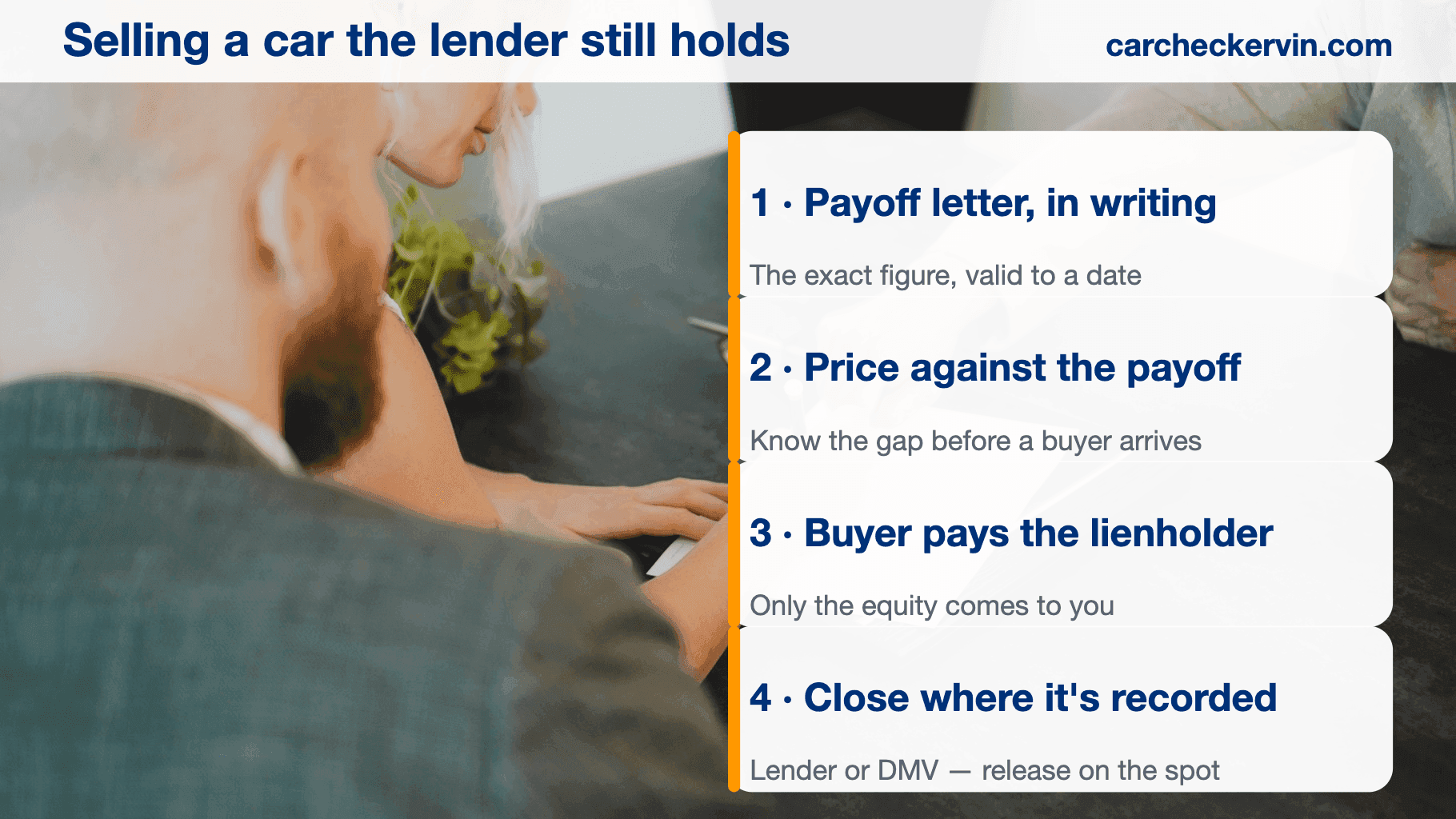
Selling a car you still owe money on
This is the case the marketplace guides skip, and it's the one that strands sales. Four moves, in order:
Get the payoff letter in writing
Ask your lender for the exact amount to clear the loan, valid to a stated date. "About what I owe" is not a number you can close on, and the figure moves with interest.
Price against the payoff, honestly
If the car is worth less than the balance, the gap is yours to cover at closing — better to know that before a buyer is sitting across from you with cash.
Send the buyer's money to the lienholder
The payoff amount goes to the lender directly and only the remaining equity to you. This is the step that protects the buyer, which is exactly why it also closes the sale.
Close where the release gets recorded
At the lender's office or the DMV counter, so the lien release is filed and a clear title is issued while everyone is present. Only a recorded release clears a title.
Read your car's record before a buyer reads it to you.
Records on file, title brands and odometer flags for your own 17-character VIN — free, before the listing goes up.
What the buyer's report will say about your car
Assume the buyer runs one, because the serious ones do — and for around the price of a tank of fuel, they will. That report reads the same federal record you can read today: the title chain and any brand on it, reported accident and damage entries, the odometer captured at each transfer, total-loss filings, and any wholesale auction appearance with photographs taken before anyone detailed the car. None of that is negotiable and none of it is a surprise you want delivered by a stranger in your driveway. Two things follow. First, if the record holds something you didn't know — a prior owner's accident, a reading a clerk mis-typed — you want to find it while there is time to gather paperwork or start a correction, not while a buyer is deciding whether you're honest. Second, if the record is clean, that is an asset: a documented history is the difference between defending your asking price and discounting it because the buyer can't verify anything you've said.
The documents, and what each one does
Requirements vary by state, so confirm with your own DMV — but these are the pieces nearly every private sale turns on:
The certificate of title
The document that transfers ownership. If a lender is listed on it, they hold it until the loan is paid and a release is filed.
Lien release or payoff letter
Proof the loan is settled and the lender's claim is gone. A seller's assurance is not this document.
Bill of sale
Who sold what to whom, for how much, on what date — the record both sides keep when a question surfaces later.
Odometer disclosure
The reading recorded at transfer. It joins the federal trail, which is why the number must be accurate.
Release of liability
The state filing that ends your responsibility for the car. Skip it and the tickets can still find you.
Your service records
Not required, and worth more than most sellers realise: documentation is what turns an asking price into a defended one.
Selling one and buying the next?
Most private sellers become private buyers within the month, and credits don't expire with the listing:
At $9.00 a report on the 10-pack, checking your own car and screening the shortlist you replace it from costs less than two single reports at Carfax's $44.99 retail.
The rest of the private sale
Each step of the paperwork, on its own page.
Siempre verifica el VIN antes de comprar
La vista previa gratis muestra marcas de título, estado de robo y recalls abiertos en segundos, e indica si existen registros de accidentes y odómetro. El historial completo cuesta $14.99 — pago único, sin suscripción.
Selling privately — what sellers ask
Including the loan question the marketplace guides skip.
How do I sell a car privately if I still have a loan on it?+
Get a written payoff letter from your lender, then structure the sale so the buyer's payment clears the lienholder directly and only the remaining equity comes to you. Close at the lender's office or the DMV so the lien release is recorded and a clear title is issued on the spot. Never ask a buyer to pay you in full and trust you to settle the loan afterwards — no informed buyer will agree, and they shouldn't.
What paperwork do I need to sell my car privately?+
The certificate of title (or the lender's payoff and release if there's a loan), a bill of sale, an odometer disclosure, and your state's release-of-liability filing. Requirements vary, so confirm with your own DMV before the day of sale. Service records aren't required but do real work: documentation is what lets you hold your asking price.
Should I get a vehicle history report before selling?+
Yes, because the buyer will. Running it first is how you find a mis-keyed odometer reading or a prior owner's reported accident while there's still time to gather paperwork or start a correction. A clean report attached to your listing also removes the uncertainty buyers otherwise price into their offer.
How do I take payment safely in a private sale?+
Complete the transaction somewhere the paperwork can be processed — your lender or the DMV if there's a loan, since the release has to be recorded anyway, and many banks and police departments accommodate private sales otherwise. The principle underneath: money, title and signatures should change hands in the same place at the same time.
What if my car has a branded title?+
Disclose it plainly and price for it. Salvage and rebuilt brands are permanent, carried federally, and trade roughly 30–50% below clean-title equivalents — a buyer's report will show the brand whatever the listing says. Sellers who lead with the brand and the repair documentation do markedly better than sellers whose buyers discover it themselves.
Do I need to tell the DMV I sold the car?+
In most states yes, through a release-of-liability or notice-of-transfer filing, and it's in your interest to do it the same day. Until the state knows the car changed hands, the registration trail still points at you — which is how former owners end up receiving tickets and toll notices for cars they no longer own.
Is selling privately worth it versus trading in?+
Privately usually nets more money in exchange for more of your time and all of the paperwork — the trade-off this page exists to make manageable. The gap narrows if your car has a branded title or a complicated history, since the private market prices uncertainty harshly, while a dealer prices it once and moves on.
Know your car's record before your buyer does.
Preview your own 17-character VIN free — and read the full NMVTIS-backed report for $14.99 before you set an asking price.
Verificaciones VIN relacionadas
Más herramientas para verificar el historial de cualquier vehículo