MVR-1 — North Carolina's title application, and why it needs a notary.
MVR-1 is the one-page form North Carolina uses to put a vehicle's title in a new owner's name. Unlike many states' title applications, it has to be notarized, and so does the seller's signature on the back of a North Carolina title. It asks which service you want, then the vehicle, the owners, any liens, your insurance, the purchase and a records-disclosure choice, before each owner signs in ink in front of a notary. Here's what each part asks, the highway-use tax that replaces sales tax, and the companion forms a private sale needs.
Buying a Car in North Carolina?
Before you meet the notary, enter the VIN for a free preview of the title brands, salvage records and odometer readings on file.
Free preview · No sign-up · No owner or personal data
Quick Answer
- What is the MVR-1 form?
- The North Carolina Division of Motor Vehicles' Title Application, Rev. 04/26, one page. NCDMV requires a title transfer whenever a vehicle is bought, sold, gifted or donated, and lists the MVR-1 for private, dealer and new-resident titling alike. New residents title their vehicles in North Carolina before registering them, after getting an NC driver license.
- Does the MVR-1 need to be notarized?
- Yes. NCDMV's forms page marks it "Notarization is required," and its MVR-106 requirements sheet says the application must be witnessed by a notary public. The seller's assignment on the back of a North Carolina title must be notarized too, and with more than one owner every signature on the required documents is notarized.
- How much is tax and title in North Carolina?
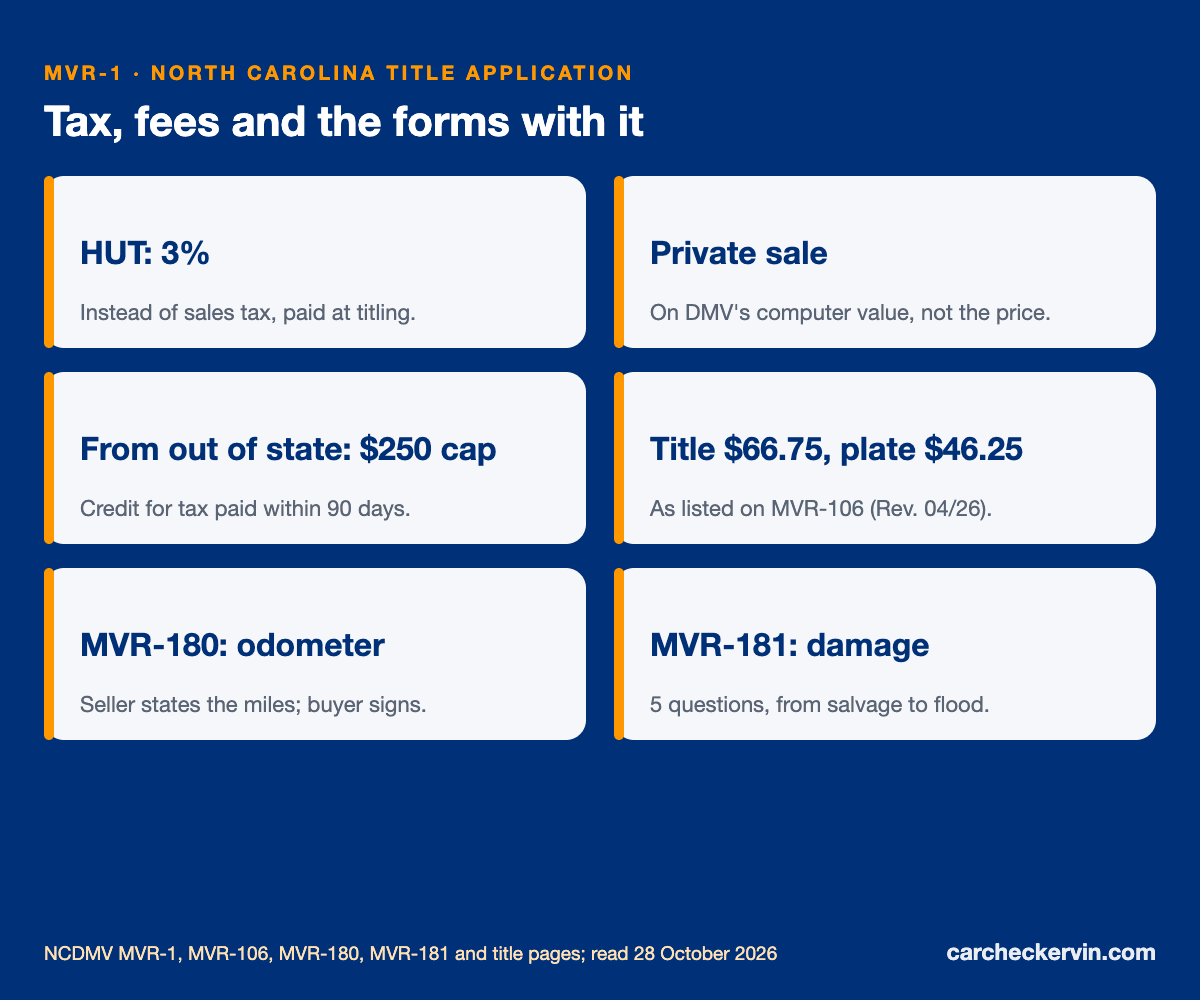
- North Carolina charges a 3% highway-use tax instead of sales tax. From a dealer it's on the price plus any doc fee, less a trade-in; in a private sale it's 3% of DMV's "computer value," not the price you paid. A vehicle coming from another state is capped at $250. NCDMV's MVR-106 lists a $66.75 title fee and a $46.25 passenger plate fee.
Four steps to title a car bought from a private seller
Two signatures need a notary in North Carolina: the seller's on the title and yours on the MVR-1.
- 1The seller signs the title before a notaryBuyer's name and address, the date, the seller's signature and printed name.
- 2Add the MVR-180 and MVR-181The odometer statement and the damage disclosure, where they apply.
- 3Complete and notarize the MVR-1Tick the services you want; every owner signs in ink before a notary.
- 4File at a license plate agencyOr by mail to Raleigh; standard titles take 10 to 15 business days.
What's on the MVR-1, Top to Bottom
From MVR-1 (Rev. 04/26), read on 28 October 2026.
| Part | What it asks |
|---|---|
| Services | The services you want, including title only, title and license plate, inoperable vehicle and a limited registration plate; you initial it, and NCDMV can't process the form without it |
| Vehicle | Year, make, body style, series, model, VIN, fuel type and odometer reading |
| Owners | ID number and full legal name for up to two owners, a joint tenants with right of survivorship box, residence, mailing and vehicle-location addresses, and tax county |
| Liens | First and second lien: account number, date of lien, lienholder ID, name and address |
| Insurance | An insurer authorized in North Carolina and the policy number |
| Purchase | New or used, purchase date, seller's name and address, NC dealer number, and whether it's leased (attach MVR-330 if so) |
| Disclosure | Your DMV records stay closed to marketing unless you tick the box |
| Signatures and notary | Each owner signs in ink; the notary adds a signature, printed name, seal and commission expiry |
NCDMV's MVR-106 adds: the name should match your driver license, initials aren't accepted unless they stand in for a name, the address must be your North Carolina residence rather than a PO box, and liens are declared in priority order.
What You'll Pay: Highway-Use Tax and Fees
North Carolina charges highway-use tax (HUT) instead of sales tax whenever a title is transferred, and it's paid when you title the car. MVR-106 sets it at 3%. From a dealer, that's on the sale price plus any administrative or document fee, less a trade-in. In a private sale it's 3% of the vehicle's "computer value" from DMV's schedule, not the price on the bill of sale. A vehicle coming from another state is capped at $250, with credit for tax paid to another jurisdiction within 90 days if you can prove it.
Gifts between spouses, a parent and child, or a stepparent and stepchild are exempt with form MVR-613, but only for North Carolina residents transferring a North Carolina title. NCDMV's HUT page lists other exemptions too, including transfers by will or intestacy, under a separation or divorce agreement, the removal of a co-owner, and a transfer to a revocable trust whose only beneficiary is the owner.
For fees, MVR-106 (Rev. 04/26) lists a $66.75 certificate of title fee and a $46.25 plate fee for a private passenger vehicle; Wake, Durham and Orange counties add an $8 regional transit tax and a $7 county registration tax. Property tax can be paid at registration or deferred 60 days on a limited registration plate. NCDMV's live fee table didn't load when we checked, so confirm current amounts at the agency. Since October 1, 2026, North Carolina registration is all electronic, with no plate stickers or printed registration cards.
MVR-1 at a Glance
The tax, the fees and the companion forms on one card.
From NCDMV's MVR-1, MVR-106, MVR-180, MVR-181 and its title and tax pages, read on 28 October 2026.
The Two Companion Forms: MVR-180 and MVR-181
MVR-180 (Rev. 04/26) is the odometer disclosure statement. The seller states the mileage without tenths, or certifies that it exceeds the odometer's mechanical limits or isn't the actual mileage, then signs and prints a name; the buyer signs to acknowledge it. NCDMV's forms page says it's required only for vehicles less than 10 years old, but the MVR-180's own exemption list follows the federal rule: model year 2010 and older are exempt, newer models stay covered until they're 20 years old, and vehicles over 16,000 lb or not self-propelled are exempt.
MVR-181 (Rev. 04/2026) is the seller's damage disclosure. It asks 5 questions: collision damage over 25% of the vehicle's value, whether it was a salvage vehicle, a flood vehicle, a recovered theft or reconstructed. Two of the questions apply only to vehicles 5 model years old or newer. The form warns sellers that not disclosing can bring civil or criminal liability, and tells buyers they'll have to disclose the same things when they sell.
What stops an MVR-1
- No service ticked: NCDMV can't process the form.
- No notary: the form ends in a notary block.
- A PO box: give your North Carolina residence address.
- An altered MVR-180 or 181: alterations or erasures void them.
Check the Damage Disclosure Against the Records
MVR-181 is the seller's word on salvage, flood and reconstruction. Enter the VIN for a free preview of the title brands and junk and salvage records on file.
What to Bring for a Private-Sale Title
From NCDMV's Vehicle Documents & Forms page and its MVR-106 requirements sheet.
The title, assigned
The seller's signature notarized, and a lien release if any lien is shown.
MVR-1
Completed, signed in ink by each owner and notarized.
MVR-180
The odometer disclosure, unless the vehicle is exempt.
MVR-181
The seller's damage disclosure statement.
NC license or ID
By mail, a black-and-white copy of your NC driver license.
NC insurance
Only if you're registering it too: an NC-licensed insurer, no out-of-state policies.
Bought From a Dealer or From a Person
The same MVR-1, a different tax base.
From a dealer
- Title (or the certificate of origin for a new car), bill of sale, MVR-1, MVR-180 and MVR-181.
- HUT: 3% of the price plus any doc fee, less a trade-in.
- The dealer's NC dealer number goes on the MVR-1.
From a person
- Title with the seller's notarized assignment, a lien release if needed, MVR-1, MVR-180 and MVR-181.
- HUT: 3% of DMV's computer value, not the price paid.
- Gifts within the immediate family are exempt with MVR-613.
Moving to North Carolina? Get an NC driver license first; tax on a vehicle coming from another state is capped at $250.
Related Checks and Guides
The other DMV form guides, and the North Carolina pages they connect to.
Where These Facts Come From
From NCDMV's MVR-1, MVR-106, MVR-180 and MVR-181 and its title, tax and mailing-address pages, read on 28 October 2026. North Carolina's statutes site blocked us, so nothing here is quoted from the General Statutes.
CarCheckerVIN is not affiliated with the North Carolina Division of Motor Vehicles. This page is general information, not legal or tax advice.
MVR-1 — Frequently Asked Questions
What North Carolina buyers ask most.
Where do I file or mail the MVR-1?+
At a North Carolina license plate agency, or by mail to NCDMV's Vehicle Titles/Liens unit at 3148 Mail Service Center, Raleigh, NC 27697-3148. By mail, include a black-and-white copy of your NC driver license.
How long does a North Carolina title take?+
NCDMV says standard title applications take 10 to 15 business days. Some license plate agencies issue an "instant title" the same or next business day, though not for antique vehicles, court orders, indemnity bonds, salvage titles, or titles from states that don't report to NMVTIS.
Do I need an odometer statement for an older car in North Carolina?+
NCDMV's forms page says the MVR-180 is required only for vehicles less than 10 years old, but the MVR-180's own exemption list follows the federal rule: model year 2010 and older are exempt, and 2011 and newer models stay covered until they're 20 years old. For a newer car past 10 years, complete the MVR-180.
Is giving a car to a family member taxed in North Carolina?+
Gifts between spouses, a parent and child, or a stepparent and stepchild are exempt from highway-use tax with form MVR-613, as long as both are North Carolina residents and the vehicle has a North Carolina title.
What if the title is lost?+
The owner applies for a duplicate on MVR-4, which must be notarized and completed exactly as the original; NCDMV says duplicate requests wait 15 days before processing. A corrected or substituted title is the MVR-5.
Can I pay NCDMV online?+
Where online payment is offered, NCDMV's fee page says it goes through PayIt, which charges $3 per transaction plus a 1.85% card fee that the State doesn't collect.
Run the VIN Before the Notary Stamps Anything
Enter any 17-character VIN for a free preview. The full report lists title brands, NMVTIS junk and salvage records, insurance total-loss records, odometer readings, and auction records with the damage the auction recorded and its photos.
CarCheckerVIN is an independent vehicle-history service and is not affiliated with the North Carolina Division of Motor Vehicles. This guide summarizes NCDMV's published forms and title, tax and fee pages and is not legal or tax advice. Records in our reports reflect what was reported to our data providers. Our reports do not include police or repair-shop accident entries.
Verificaciones VIN relacionadas
Más herramientas para verificar el historial de cualquier vehículo