Paid VIN check: $14.99 once, nothing recurring.
A paid VIN check should be a one-time decision, not a subscription you forget to cancel. Free tools tell you whether records exist; the paid report is the line-by-line detail. Run the free preview below first — pay $14.99 only when a car earns it.
Start with the free check — pay only if the car deserves it
17-character VIN → records on file, title flags, odometer signals. Free.
Free preview · no card, no account
Quick Answer
- Is a paid VIN check worth it over the free ones?
- When money is about to change hands, yes.Free tools answer “do records exist?” — a paid report answers “what do they say?”. Title brands, the odometer sequence, salvage and total-loss entries, auction photos: the detail that changes a price lives behind the paid line. Both draw on the same federal NMVTIS system; paying buys the line-by-line reading, not a different truth.
- Can I pay for one check, once — no subscription?
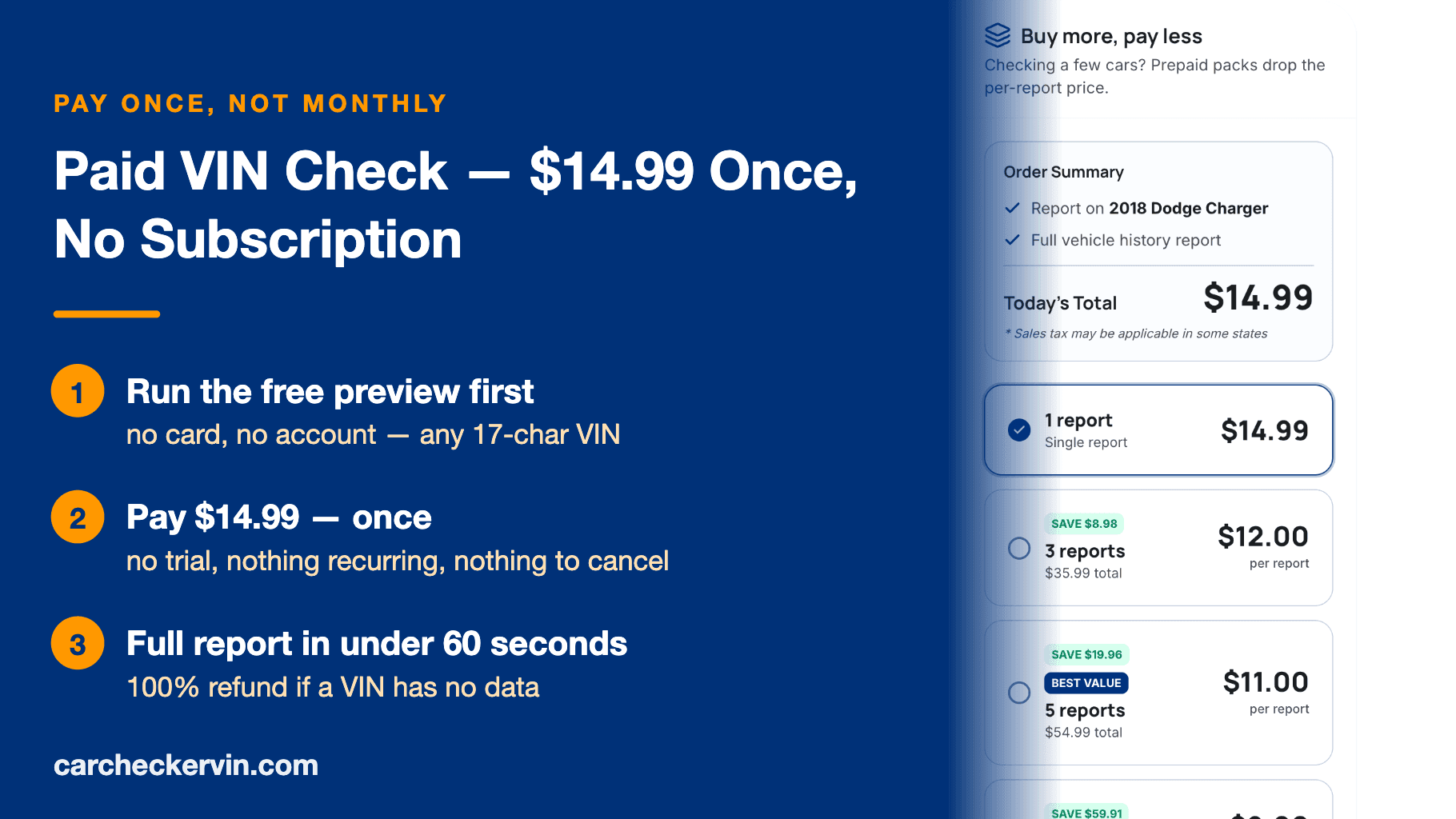
- Yes. A single CarCheckerVIN report is $14.99, charged once. No trial that rolls into a monthly plan, no account required for a one-off, nothing to cancel afterwards. If your shortlist grows, prepaid credits exist — paid up front once, and they simply sit there until you spend them.
- How much should a paid VIN check cost?
- The brand-name ceiling is Carfax at $39.99–$44.99 for one report. The same federal title, brand and odometer data costs $14.99here — and the free preview shows what's on file before you decide. Anything dramatically cheaper than that is usually a gray-market resale with no refund desk behind it.
Free check vs paid report — where the line actually sits
Nothing in the free column is a trick, and nothing in the paid one is padding — decisions simply need detail, not just flags.
| What you're asking | Free check answers | The $14.99 report answers |
|---|---|---|
| Has this car been through something? | Yes/no signals: records exist, a title brand is present, odometer flags | Which records, from which states, on which dates — the full sequence |
| Was it stolen or written off? | Theft and salvage flags from insurer-reported databases | The total-loss and salvage entries themselves, with the title trail that followed |
| Is the mileage honest? | A flag when something looks inconsistent | Every recorded reading in order, so the math is yours to verify |
| What did it look like before the detail shop? | Nothing — photos are never free | Auction lane photos where the car crossed one, plus full factory specs |
The pattern: free answers are booleans, paid answers are the evidence — and evidence is what you negotiate with.
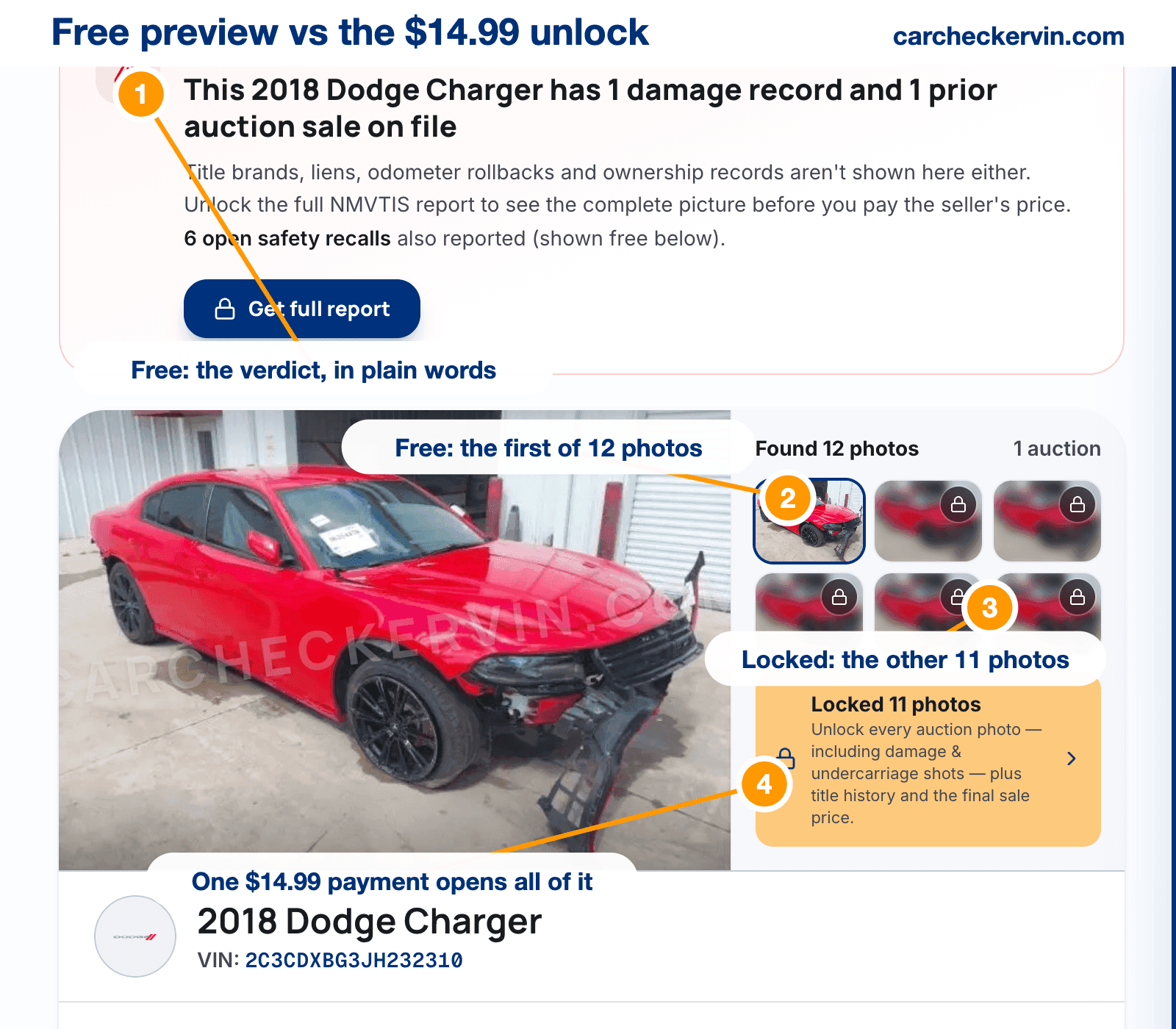
Why every “free VIN check” search ends at a checkout page
Run any free-VIN-check site to its end and you meet a paywall — including ours. That's not a scandal, it's the economics of the data. What separates the honest version from the trap is when the price appears.
Detailed records cost money upstream
Flags and counts can be given away. The line-by-line records — titles, losses, auction entries — are licensed data that sellers pay for per pull. Every “free” site either stops at flags or charges at the detail line.
The price that appears after your card
The pattern to avoid isn't paying — it's discovering the terms late. Trial offers that quietly renew monthly, checkouts that add a subscription line under the report you wanted once. If the recurring charge shows up after the card field, leave.
The price before the VIN
Here the number is on this page: $14.99, once. The free preview runs first, no card, no account — you see what's on file, then decide whether paying is worth it at all.
Pay once, get the report — the whole flow
Three steps, one of them optional. Nothing renews, nothing needs cancelling.
Run the VIN through the preview
Type the 17-character VIN above. The preview shows how many records are on file, whether a title brand is present, and whether odometer signals look off — no card, no account, no follow-up email chain.
Unlock the full report when it matters
One payment of $14.99 opens the complete NMVTIS-backed report. You buy it the way you'd buy anything once — no trial period converting to a plan, no line item surfacing on a statement two months from now.
Read it before you call the seller
The report arrives in under 60 seconds. Check the odometer sequence, the title trail, and the auction photos against the listing — then negotiate from what the records say, not from what the ad claims.
What the one payment actually buys
Every block below comes from the federal NMVTIS system and its supporting sources. This is the detail layer — the part no free tool hands over.
The full title trail
Each state title issued, in order, with any salvage, rebuilt, flood or lemon brand attached along the way. Re-titling in a looser state shows up as a paper trail, not a clean slate.
Odometer readings in sequence
Every recorded mileage figure, oldest to newest. You do the subtraction yourself — which is exactly why rolled-back numbers have nowhere to hide.
Total-loss and salvage entries
Insurance write-offs and salvage-yard records, including cars declared totaled in one state and quietly re-registered in another.
Reported accident records
Accident entries with severity where the reporting state recorded it — read next to the auction photos, they explain each other.
Auction appearances, with photos
When the car crossed an auction lane, the report shows it — often with the lane photos. Eighteen months of body shop work can't retouch last year's auction picture.
Open recalls and factory specs
Unrepaired safety recalls from the manufacturer feed, plus the build specs for this exact VIN — engine, trim, options as delivered.
One caveat stated up front: dealer service-visit logs are Carfax's proprietary layer, and no NMVTIS report carries them. If workshop stamps decide your purchase, that's the case for paying retail.
See what's on file before spending a cent
The free preview shows record counts, title flags and odometer signals for any 17-character VIN — the paid decision can wait until after you've looked.
The free checks worth running first — all of them
A paid report is the last step of the homework, not the first. These cost nothing and settle real questions before any $14.99 decision.
NICB's theft and salvage check
The insurance industry's nonprofit lets you check whether participating insurers reported a car stolen or as salvage. Narrow, but authoritative — and free from the source.
NHTSA's recall lookup
The federal safety agency lists open, unrepaired recalls for any VIN at no charge. Every car you're serious about should pass through it.
Our preview, on any VIN
The form on this page: record counts, title-brand presence and odometer signals from NMVTIS data, free. It's the same database as the paid report — stopped at the flag layer.
If all of those come back quiet and the car checks out in person, you may never need to pay anyone. The paid report is for the moment the flags aren't quiet — or the money is big enough that silence isn't reassurance.
The three-line subscription test before you pay anyone
Whoever you end up paying — us, a competitor, anyone — run their checkout past these three lines before the card comes out:
Find the recurring price
Somewhere on the page there is either a one-time price or a monthly one. If you can't tell which, that ambiguity is the product — a flat price sits in plain sight; a subscription hides behind a trial.
Find the cancellation path
Legitimate one-time purchases don't need one — there's nothing to cancel. If the FAQ's longest answer explains how to stop being charged, you've learned what the business model is before spending anything.
Find who's accountable
A legal footer, a refund policy, a support address that answers. The $14.99 here carries a 100% refund when a VIN returns no data — a promise only a storefront that plans to exist next month can print.
Shortlisting several cars? Credits, not a membership
Two singles already cost $29.98, so the packs exist for shortlist season — a bulk price paid once, never a plan. Credits sit on your account for 12 months and get spent per VIN as cars come and go:
The arithmetic, since a paid page should show its work: five singles would run $74.95, so the 5-pack keeps $19.96 in your pocket; ten would run $149.90, so the 10-pack saves $59.91. Unused credits simply wait — no calendar runs against you.
Worth reading before you pay for anything
The rest of the pay-or-don't-pay question, answered without a sales script.
Siempre verifica el VIN antes de comprar
La vista previa gratis muestra marcas de título, estado de robo y recalls abiertos en segundos, e indica si existen registros de accidentes y odómetro. El historial completo cuesta $14.99 — pago único, sin suscripción.
Paying for a VIN check — the questions that matter
Including the ones whose honest answer is “don't pay.”
Is a paid VIN check worth it?+
It depends on where you are in the purchase. For early browsing, the free layer — record counts, title flags, theft and salvage checks — is genuinely enough. Once you're negotiating real money, the paid report's detail is what protects you: the odometer sequence you can verify yourself, the title trail across states, auction photos from before the resale prep.
Can I buy just one VIN check without a subscription?+
Yes — that's exactly what this is. One report costs $14.99, charged once, delivered in under 60 seconds, with no trial converting to a monthly plan and no account required. If you later want more, the prepaid credit packs are a one-time bulk purchase too.
How much does a paid VIN check cost?+
Carfax retail sits at $39.99–$44.99 for a single report, with a 3-pack around $84.99 and a 30-day unlimited plan near $99.99. A CarCheckerVIN report on the same federal NMVTIS backbone is $14.99 single, or $12.00, $11.00 and $9.00 per report in the 3, 5 and 10 packs. Sites advertising brand-name reports for a few dollars are typically gray-market resellers — cheaper for a reason our cheap-VIN-check page explains in full.
What does a paid report show that the free checks don't?+
Free checks return flags: records exist, a brand is present, something looks off. The paid report returns the records themselves — every state title with its brand and odometer at issue, each recorded mileage reading in sequence, total-loss and salvage entries, reported accidents, auction appearances with photos, open recalls and the factory build specs. Same database, different depth.
Do I need an account to buy one report?+
No. A single $14.99 report runs through an anonymous one-off checkout — enter the VIN, pay, get the report. Accounts only enter the picture with credit packs, because the unused credits need somewhere to live for their 12-month validity.
What happens if the report finds nothing on my VIN?+
You get a 100% refund. Some VINs — very new cars, some imports — simply have no records on file. The free preview shows the record count before you pay, so an empty result rarely comes as a surprise.
What's the cheapest way to check several cars?+
The credit packs: three reports for $35.99, five for $54.99, ten for $89.99 — $9.00 each at the top tier, versus $149.90 if you bought ten singles at $14.99. Credits stay valid for 12 months and apply to any VIN, so a shortlist that changes weekly costs nothing extra.
Look first. Pay $14.99 once — or not at all.
The preview costs nothing and answers the first question free. The full report is there for the car that's worth real money — one payment, no strings trailing after it.
Verificaciones VIN relacionadas
Más herramientas para verificar el historial de cualquier vehículo