VIN Decoder API — what vPIC gives you free, and what it cannot
Decoding a VIN through an API costs nothing. NHTSA's vPIC batch decoder answers at https://vpic.nhtsa.dot.gov/api/vehicles/DecodeVINValuesBatch/, accepts up to 50 VINs in a single request, and requires no API key — it is the decoder CarCheckerVIN calls in production.
Decode a VIN now, no integration needed
Free VIN decode and recall check. Full NMVTIS-sourced history report $14.99.
No account needed. We never sell your data.
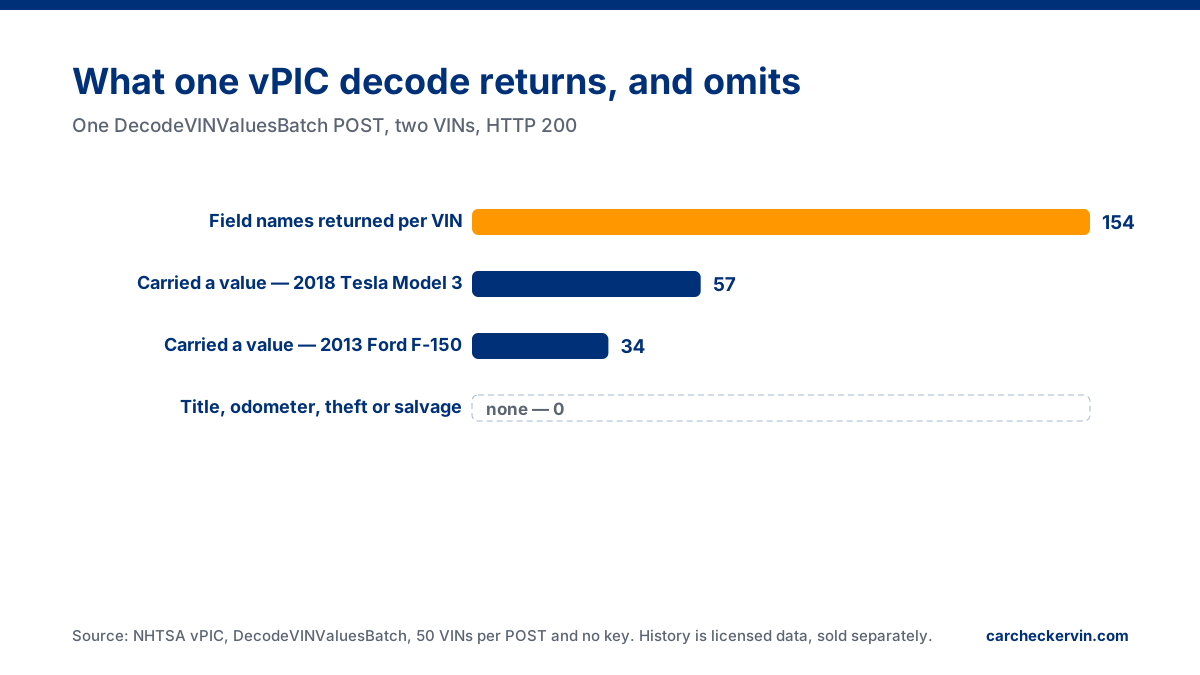
What it gives back is factory specification. It cannot tell you whether a state later branded the car junk, salvage or flood, what the most recent odometer reading on record says, or whether it carries historical theft data. That layer is licensed, and the federal part of it reaches buyers through data providers approved by the Bureau of Justice Assistance — twelve of them serve public customers. This page covers both halves and shows exactly where the line falls.
Quick Answer
- Is there a free VIN decoder API?
- Yes. NHTSA's vPIC batch decoder is at https://vpic.nhtsa.dot.gov/api/vehicles/DecodeVINValuesBatch/. It accepts up to 50 VINs in one request and requires no API key, so there is no signup and nothing to bill. It is the decoder we call in production.
- What does a free VIN decoder API not return?
- Anything a state wrote down afterwards. BJA describes the federal history layer this way: "Prior to purchasing a vehicle, NMVTIS allows consumers to find information on the vehicle's title, most recent odometer reading, brand history, and, in some cases, historical theft data." None of that is encoded in the seventeen characters, so no decoder can derive it.
- Where does the history data come from, then?
- For the federal title and brand layer, from NMVTIS, which reaches the public through data providers approved by the Bureau of Justice Assistance. Under the BJA heading covering both commercial and public customers, twelve approved providers are listed.
- Can I build a consumer product on Carfax or Experian NMVTIS data?
- No. BJA states it plainly: "Consumers CANNOT receive NMVTIS Vehicle History Reports from Carfax, DMVDesk, or Experian; these entities provide information only to car dealerships." Three entities, named by BJA, supply dealerships only for NMVTIS reports.
- Is CarCheckerVIN an approved NMVTIS data provider?
- No, and we will not claim to be. CarCheckerVIN is not on the BJA list. Our reports are sourced from ClearVin (clearvin.com), which is listed among the approved providers serving public customers.
- What does the CarCheckerVIN API cost and how do I get keys?
- An on-demand API report is $5, and the same $5 per report at committed bulk volume. Access is by request — there is no self-serve signup — and sandbox and production keys are issued on request. A single consumer report on the site is $14.99.
Two different jobs wearing one search term
Decode and history share an input string and nothing else.
"VIN decoder API" gets typed by developers solving two problems that have almost nothing in common. The first is decoding: take seventeen characters and read back what the plant built. That information is carried by the characters themselves, which is why a decoder is fundamentally a lookup rather than a database of individual cars.
The second problem is history: what happened to this specific car after it left the line. None of that is in the VIN. BJA sets out what the federal history layer holds — "Prior to purchasing a vehicle, NMVTIS allows consumers to find information on the vehicle's title, most recent odometer reading, brand history, and, in some cases, historical theft data." Those records are written later, by states, in response to titling events, and they live in the systems the states feed.
That difference decides your architecture and your budget. The first job costs nothing and can run over every row of an inventory feed. The second is licensed, billed per report, and worth pulling only at the moment a decision depends on it.
- Decode answers: what is this vehicle, as the plant built it — year, make, model.
- History answers: what has happened since — title, brand history, most recent odometer reading, and in some cases historical theft data.
- Decode is free and needs no key. History is licensed and metered.
- A VIN that decodes cleanly tells you nothing about the title that car is carrying.
The free half: NHTSA vPIC, no key, 50 VINs a call
The endpoint we actually call, and what "no key" does and does not buy you.
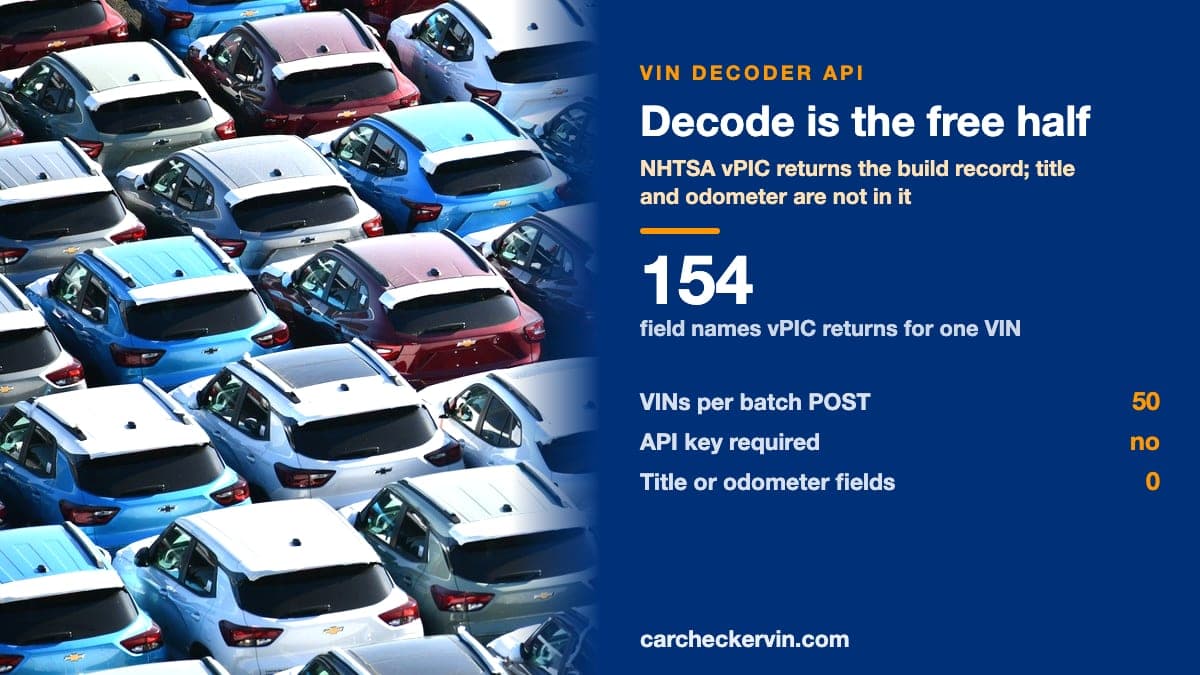
NHTSA publishes vPIC as an open service. The batch decoder lives at https://vpic.nhtsa.dot.gov/api/vehicles/DecodeVINValuesBatch/ and caps a single request at 50 VINs. No API key is required. There is no account to create, no plan to pick, and no invoice at the end of the month.
That is the appeal, and it is also the shape of the risk. A keyless public endpoint is a dependency you do not own and have no commercial relationship with — there is no contract behind it and nothing to escalate through. Treat it accordingly: your own retry and back-off behaviour is the only lever you have, so build it deliberately rather than hammering a public service when something goes wrong.
Two habits follow directly from the cap. Batch to it instead of issuing one request per VIN — fifty VINs in one call is the difference between a handful of requests and thousands for the same inventory feed. And cache what comes back, keyed by VIN: a decode describes how the car was built, which is precisely the part of the story that does not change afterwards.
What a decode cannot answer
The questions a buyer actually asks all sit outside the seventeen characters.
Brands are not a manufacturer concept at all. BJA defines one as follows: "A “brand” is a descriptive label that states assign to a vehicle to identify the vehicle's current or prior condition, such as “junk,” “salvage,” “flood,” or another designation." A state assigns it, after the fact, in response to a titling event. No decoder can derive it from a VIN, and any product that implies otherwise is misleading its users.
The same holds for the rest of what BJA says NMVTIS lets a consumer find before a purchase — the vehicle's title, the most recent odometer reading, brand history, and in some cases historical theft data. Every one of those is a record about this individual car, not a property of its build.
So if your feature is "normalise this inventory feed into year, make and model", vPIC is the entire answer and you can stop reading here. If your feature is "tell the user whether this car is worth buying", the decode is the cheap part and the expensive part is still ahead of you.
Where the licensed half comes from
NMVTIS, and the twelve approved providers BJA lists for public customers.
The National Motor Vehicle Title Information System is described by BJA as a system "designed to serve as a national repository of vehicle brand information". Reselling from it is not open: providers are approved, and BJA publishes the list. The page introduces it with this sentence — "The following is a list of ALL businesses approved to provide NMVTIS vehicle history reports to public and commercial consumers. Some businesses are affiliated with a primary Approved NMVTIS Data Provider."
Under the heading covering both commercial and public customers, BJA lists twelve approved providers. Read on 2026-09-12, they are:
Tooling that assumes every entry on that page ends in .com will mangle this list: Titlecheck.us carries an uncommon suffix, and VinReport is printed with no suffix at all. One further uncommon suffix appears on the page, VinCheck.Info — but that one belongs to the owned-site group in the next section, not to this list.
- Bumper.com
- Carsforsale.com
- Carvertical.com
- Checkthatvin.com
- Clearvin.com
- EpicVin.com
- GoodCar.com
- Titlecheck.us
- Vinaudit.com
- Vindata.com
- VinReport
- Vinsmart.com
The counting trap that ruins vendor shortlists
Eight of the names on that page are owned websites, not approved providers.
The BJA page nests owned websites underneath the provider that owns them. Flatten the HTML to plain text and the nesting vanishes — every name becomes a sibling, and owned sites get promoted into the provider list. The count comes out too high, and a shortlist built from it contains entries that are not separately approved at all. Earlier drafts of this page were built from a flattened copy and came out with the wrong count, which is why the list above was parsed from the page's actual structure.
There are eight such websites, owned between five of the twelve providers. BJA records each as an additional website owned by an approved provider; they sell reports containing NMVTIS data under the parent's approval, which is a legitimate arrangement and simply not the same thing as being approved:
VinGurus.com, Vininspect.com, Recordsfinder.com, StateRecords.org and VinCheck.Info are the ones most often miscounted, so check them by name before a vendor list goes anywhere. And never add the groups together: twelve approved providers, eight owned websites, and the commercial-only links in the next section are three different things printed on one page. A total built by summing them describes nothing that exists.
- BeenVerified.com — owned by Bumper.com
- VehicleHistoryReport.com — owned by Carsforsale.com
- VinGurus.com — owned by EpicVin.com
- Vininspect.com — owned by EpicVin.com
- InfoTracer — owned by GoodCar.com
- Recordsfinder.com — owned by GoodCar.com
- StateRecords.org — owned by GoodCar.com
- VinCheck.Info — owned by Vinaudit.com
The commercial-only heading, and the consumer rule
Six links filed under a heading that changes who you are allowed to serve.
BJA keeps a second, separate heading for commercial customers only. Six links sit under it: OneAIB.com, add123.com, CARFAX.com, Vitu.com, Experian.com and Yassi.com. Beside CARFAX.com the page prints a parenthetical — "CARFAX offers NMVTIS data to commercial customers in California only".
For anyone building a consumer-facing product, the governing sentence is this one, verbatim from BJA: "Consumers CANNOT receive NMVTIS Vehicle History Reports from Carfax, DMVDesk, or Experian; these entities provide information only to car dealerships." Three entities, named by the agency, supplying dealerships only.
Read that sentence for exactly what it says. It is about who may receive an NMVTIS report, not about whether those companies hold NMVTIS data — Carfax participates in NMVTIS. What it cannot do is sell you, a consumer, that report. Paraphrasing this into "Carfax has no NMVTIS data" is false, and it is the kind of claim that gets a page taken down.
The practical consequence for architecture is concrete: if your product serves the public, the links filed under the commercial-customers-only heading are not a route to your users, however good the integration looks.
Why the brand layer has to come from the record
Title washing, in the agency's own words.
BJA is blunt about the problem NMVTIS exists to solve: "Vehicles that incur significant damage are often branded “junk” or “salvage.” Currently, motor vehicles with brands on their titles can without much difficulty have their brands “washed” (i.e., removed) from the titles." It cites Experian Automotive reporting that "in just the first six months of 2008 there were more than 185,000 titles that were initially branded in one state, and then transferred and re-titled in a second state in a way that resulted in issuance of a purportedly clean title."
The agency's own illustration is Hurricane Katrina, after which "authorities reported truckloads of flooded vehicles being taken out of Louisiana to other states as far away as the upper Midwest, where they were dried out, cleaned, and readied for sale to unsuspecting consumers in states that do not brand flood vehicles."
The fix is permanence across state lines: "Through NMVTIS, once a vehicle is branded by a state motor vehicle titling agency, that brand becomes a permanent part of the vehicle's NMVTIS record." That permanence is the reason the brand layer is worth licensing rather than approximating — a clean-looking title in the second state is exactly the failure mode the record is there to catch.
State terminology, and what it does to your schema
The federal system collects state records; it does not standardise the words in them.
There is a data-modelling lesson sitting in the BJA text that is easy to miss. NMVTIS is "designed to collect information from states, but not to change the nomenclature used in, or standards created by, state motor vehicle laws or by state motor vehicle titling agencies", and "Each state has its own laws, standards, and terminology that are unaffected by NMVTIS."
So do not flatten brand strings into a tidy enum and throw the original away. Store what the record actually says, along with the state that said it, and let your interface group loosely rather than letting your database discard the detail. A label your code did not anticipate is information, not a parsing error.
This matters most at the join. If you are mapping brand text onto your own condition taxonomy, that mapping is a display concern and belongs in a layer you can revise. The stored record should stay as it arrived.
When a paid history call is warranted
A decision rule, not a sales pitch.
Pay for history when a decision rides on it. If your software helps someone appraise, price, buy, list or arbitrate a specific used vehicle, the title and odometer layer is the part that changes the answer, and the decode is just the label on the row.
Stay free when the job is cataloguing. Normalising a feed, populating a filter, rendering a spec sheet, grouping inventory by model year — the decode covers all of it, at no cost, for as many VINs as you can batch.
The middle case is the one people get wrong: pulling history for every vehicle in a feed at ingest. Decode is free and history is not, so treating them as one pipeline stage means paying for reports on cars nobody ever looked at. Split the stages, and fire the paid call at the point of decision.
- Decision rides on the car's past → paid history.
- Display, search or normalisation only → the free decode alone.
- Serving the public → the commercial-customers-only links are not available to you.
- Every row at ingest → almost always the wrong trigger for a metered call.
What the CarCheckerVIN API returns, and how access works
Fields, price and provisioning, stated plainly.
A call returns structured JSON: the decode, title brands, odometer readings, theft records and open recalls, plus a link to a downloadable PDF of the report. That is the shape you build against — the JSON for your product's own interface, the PDF for the document a buyer or a customer expects to be handed.
Pricing is $5 for an on-demand report, and the same $5 per report at committed bulk volume. The single consumer report on the site is $14.99.
Access is by request. There is no self-serve signup — you tell us your expected volume and what you are integrating, and sandbox and production keys are issued on request, so you can build against the sandbox before anything is billed.
Where our data comes from, and what we are not
One sentence we repeat on every page that touches this subject.
CarCheckerVIN is not an approved NMVTIS data provider. We are not on the BJA list and we do not claim to be. Our reports are sourced from ClearVin (clearvin.com), which is listed by BJA among the twelve providers serving both commercial and public customers.
That distinction is legal rather than stylistic, and it is the single most useful question to put to any vendor you are evaluating. A reseller is not an approved provider; an owned website is not an approved provider either, though it sells under its parent's approval. Both arrangements are legitimate. What is not legitimate is a vendor blurring which one it is.
If a vendor is vague about that relationship, ask them to name their upstream approved provider in writing, then check the name against the list yourself.
Integration notes for dealer inventory tools
Where the two data sources sit in a real pipeline.
The pattern that holds up is a two-stage pipeline. Decode at ingest, batched to the 50-VIN cap, and store the result keyed by VIN — you never need to decode the same VIN a second time. Then pull history on demand, at the appraisal or listing step, where a person is about to act on it.
History does not behave the way a decode does. Records are added as states write them, so a report you pulled months ago is a snapshot rather than a permanent answer. Decide deliberately how long a stored report stands before you re-pull it, and show the buyer the date it was run.
Two smaller things that cause support tickets later. Keep the PDF link attached to the deal record rather than regenerating it, so the document a customer was shown is the document you can produce afterwards. And handle rows that came back incomplete explicitly at ingest, rather than letting a half-filled row flow into a join and match the wrong vehicle quietly.
- Batch decodes to the 50-VIN cap; never loop one call per VIN.
- Cache decodes by VIN; the build a decode describes does not change.
- Trigger the paid history call at the decision point, not at ingest.
- Treat a stored report as dated, and surface the run date.
- Store the PDF reference with the record it belongs to.
What to check before you commit to any vendor
A short diligence pass, run before the integration rather than after it.
Most of the questions worth asking are answered on one government page, free, before you talk to anybody. The rest are answered by a sandbox key. Work through them in this order.
Then re-read the source page yourself. We read it on 2026-09-12 and the counts on this page reflect that reading. Approvals are added and removed over time, and a list you copied a year ago is a list to re-check before you cite it.
- Which heading is the vendor under — both commercial and public customers, or commercial customers only?
- Is it one of the twelve approved providers, or one of the eight websites those providers own? If it is an owned site, whose approval does it sell under?
- If your users are the public, does the consumer restriction rule this vendor out entirely?
- If the vendor is a reseller rather than a provider, will it name its upstream approved provider in writing?
- Does the response shape match what your product renders — and do you get a document, not just fields?
- Can you build and test against a sandbox before any billing starts?
- Is the paid call separable from the free decode, so you are not metered on rows nobody read?
Sources
The rest of the developer and dealer tooling
The licensed half: pricing tiers, response fields, sandbox and production keys.
Run a CSV of VINs without writing an integration first.
Volume pricing, white-label PDFs and the dealer dashboard.
Who the Bureau of Justice Assistance licenses to sell the federal record.
Siempre verifica el VIN antes de comprar
La vista previa gratis muestra marcas de título, estado de robo y recalls abiertos en segundos, e indica si existen registros de accidentes y odómetro. El historial completo cuesta $14.99 — pago único, sin suscripción.
Questions developers ask about VIN decoding
Is the NHTSA VIN decoder API really free, and does it need a key?+
Yes and no respectively. vPIC's batch decoder at https://vpic.nhtsa.dot.gov/api/vehicles/DecodeVINValuesBatch/ requires no API key, so there is no account, no plan and no invoice. The trade-off is that you have no commercial relationship with it either — nothing to escalate through when something goes wrong. Build your retry and back-off behaviour deliberately, and cache decodes so you are not re-asking a question you already answered.
How many VINs can I send in one vPIC batch request?+
Fifty. The batch endpoint caps a single request at 50 VINs. Chunk your input to that size rather than issuing one call per VIN — batching is the difference between a handful of requests and thousands for the same inventory feed, and it is the single biggest thing you can do to stay a well-behaved client of a free public service.
Why can't a free decoder API return title brands or odometer readings?+
Because none of it is encoded in the VIN. BJA defines a brand as "a descriptive label that states assign to a vehicle to identify the vehicle's current or prior condition, such as “junk,” “salvage,” “flood,” or another designation" — assigned by a state, after a titling event, long after the plant stamped the VIN. Decoders read the factory's characters; title, brand history, the most recent odometer reading and historical theft data are records about the individual car.
How many companies are approved to sell NMVTIS reports to the public?+
Twelve. BJA lists them under the heading covering both commercial and public customers. Nested beneath five of those twelve, the same page records eight additional websites those providers own — they sell under their parent's approval, are not separately approved, and must not be counted as providers. A separate heading lists six links for commercial customers only. The three groups are distinct and must never be added together.
Can I build a consumer-facing product on Carfax or Experian NMVTIS data?+
No. BJA states verbatim: "Consumers CANNOT receive NMVTIS Vehicle History Reports from Carfax, DMVDesk, or Experian; these entities provide information only to car dealerships." Carfax appears under the commercial-customers-only heading with the parenthetical "CARFAX offers NMVTIS data to commercial customers in California only". Note what the rule governs: who may receive an NMVTIS report. Carfax participates in NMVTIS — it simply cannot sell that report to a consumer.
What does the CarCheckerVIN API return, what does it cost, and how do I get keys?+
Each call returns JSON with the decode, title brands, odometer readings, theft records and open recalls, plus a link to a downloadable PDF report. An on-demand report is $5; committed bulk volume is also $5 per report. Access is by request — there is no self-serve signup — and sandbox and production keys are issued on request so you can build and test before anything is billed.
Is CarCheckerVIN itself an approved NMVTIS data provider?+
No. CarCheckerVIN is not on the BJA list and does not claim to be. Our reports are sourced from ClearVin (clearvin.com), which is one of the twelve approved providers listed for both commercial and public customers. That distinction is a legal one, and it is the question to put to any vendor whose position on the list you cannot verify yourself.
Decode is free. The history is the part you buy.
Run a VIN here to see both halves in one place, or take the API route and wire them into your own tooling.
Or get the full VIN history reportVerificaciones VIN relacionadas
Más herramientas para verificar el historial de cualquier vehículo