What is title washing, and how do you spot it?
Title washing is moving a car between states so a brand gets lost in translation. Before a shared national record, it often worked. Defeating it is the specific reason the federal title system exists, which is also why the defence is simple.
Check this VIN now
Free decode. Full title history when you need it.
No account · Nothing stored · $14.99 only for the full report
The short answer
Title washing is moving a car between states so a brand gets lost in translation. Before a shared national record, it often worked. Defeating it is the specific reason the federal title system exists, which is also why the defence is simple.
Looking for the tool rather than the explanation? Title washing explained runs the lookup directly.
The detail that matters
Read the federal record
Title brands across state lines — $14.99, no account.
Where the limits are
No record captures a repair somebody paid for in cash. Reporting duties have carve-outs, and older vehicles have thinner records. Read a clean result as strong evidence rather than proof, and pair it with an independent inspection on a lift.
Step by step
- 1
Check the record across states, not one state
The entire fraud depends on one state not knowing what another did. A federal check is the direct answer to it.
- 2
Look at the timing of transfers
A retitling shortly after a damage event, or several state moves in a short window, is the pattern.
- 3
Compare the title's age to the car's history
A document that looks newer than the car's story suggests is worth questioning.
- 4
Read the mileage across transfers
Washing often travels with odometer problems. Readings that do not progress sensibly are a second signal on the same car.
- 5
Treat a clean single-state search as incomplete
One state's database cannot tell you what another state recorded. That is the whole point.
Sources
- NMVTIS — U.S. Department of Justice
The Justice Department's consumer entry point for the National Motor Vehicle Title Information System. Read 19 September 2026.
- NMVTIS Glossary (title-brand definitions)
Federal definitions of brand, junk automobile, salvage automobile and total loss. Read 19 September 2026.
- NHTSA Recalls by VIN
The federal safety-recall lookup: free, by VIN, covering unrepaired recalls.
- NICB VINCheck
The National Insurance Crime Bureau's free lookup for theft and total-loss records reported by participating member insurers.
Vérifiez toujours le VIN avant d’acheter
L’aperçu gratuit affiche les mentions au titre, le statut de vol et les rappels ouverts en quelques secondes, et signale s’il existe des dossiers d’accident et d’odomètre. L’historique complet est à 21,99 $ CAD — paiement unique, sans abonnement.
Keep reading
Frequently asked questions
What is title washing in plain terms?+
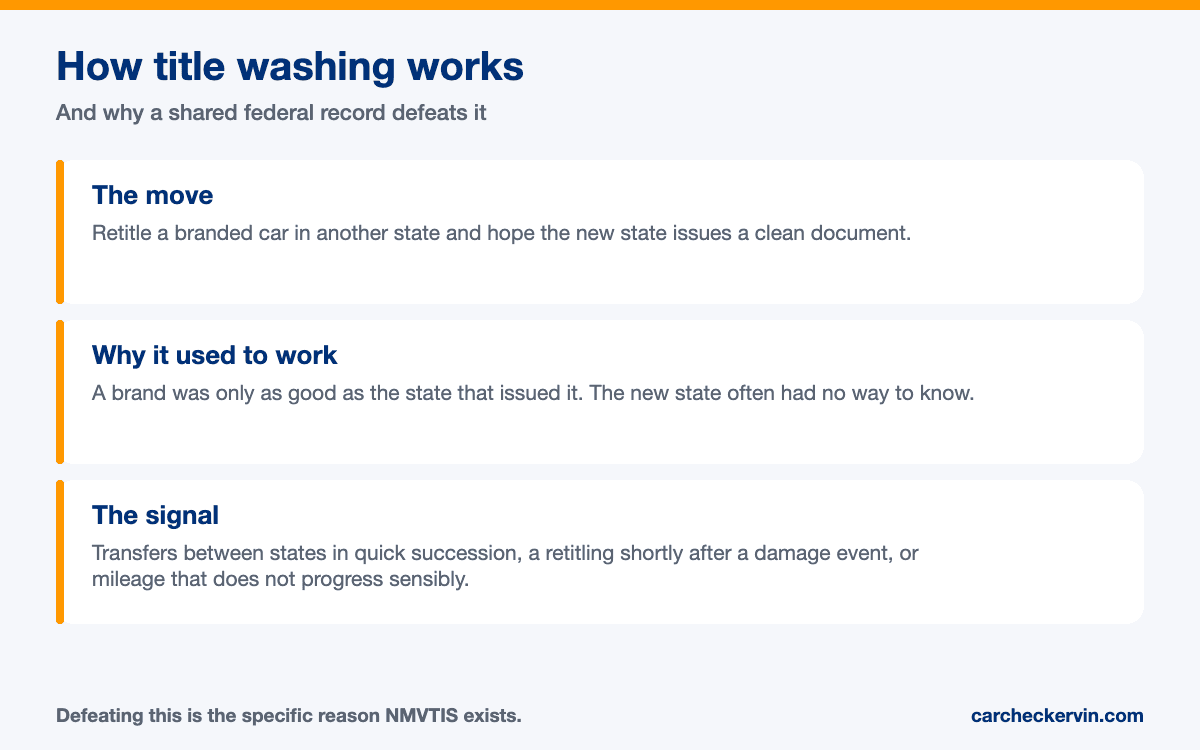
Taking a car that carries a brand in one state and retitling it in another, hoping the new state issues a clean document. The car does not change; only the paperwork does.
Why did it used to work?+
Because a brand was only as good as the state that issued it. Move the car, apply fresh, and the new state might have no way of knowing. A shared national record is the answer to exactly that problem.
Does it still work now?+
Far less well, which is the point of the federal system. But the reporting duties have carve-outs, and older records are thinner, so it is defeated rather than impossible.
What does it look like in a history?+
Transfers between states in quick succession, especially with a retitling shortly after a damage event; a title that looks newer than the car's history suggests; and mileage that does not progress sensibly across transfers.
Is a car from another state a red flag?+
No — most cross-state cars are entirely ordinary. The signal is the pattern and the timing, not the fact of a move.
How is this different from a title jump?+
A jump hides a seller by never registering the car. Washing hides a brand by moving the car. Both are paperwork frauds, and both show up as anomalies in a transfer record.
Can a washed title be undone?+
The record is what it is — a brand reported into the federal system stays in it. What varies is what a particular state prints on its own document, which is why reading the federal record beats reading the paper in the seller's hand.
What is the single best defence?+
Check the VIN against the federal record rather than a single state's database. The whole fraud depends on one state not knowing what another did.
Run the VIN
Free decode; $14.99 for the NMVTIS-backed title history.
Vérifications VIN connexes
Plus d'outils pour vérifier l'historique de tout véhicule