The best time of year to buy a used car
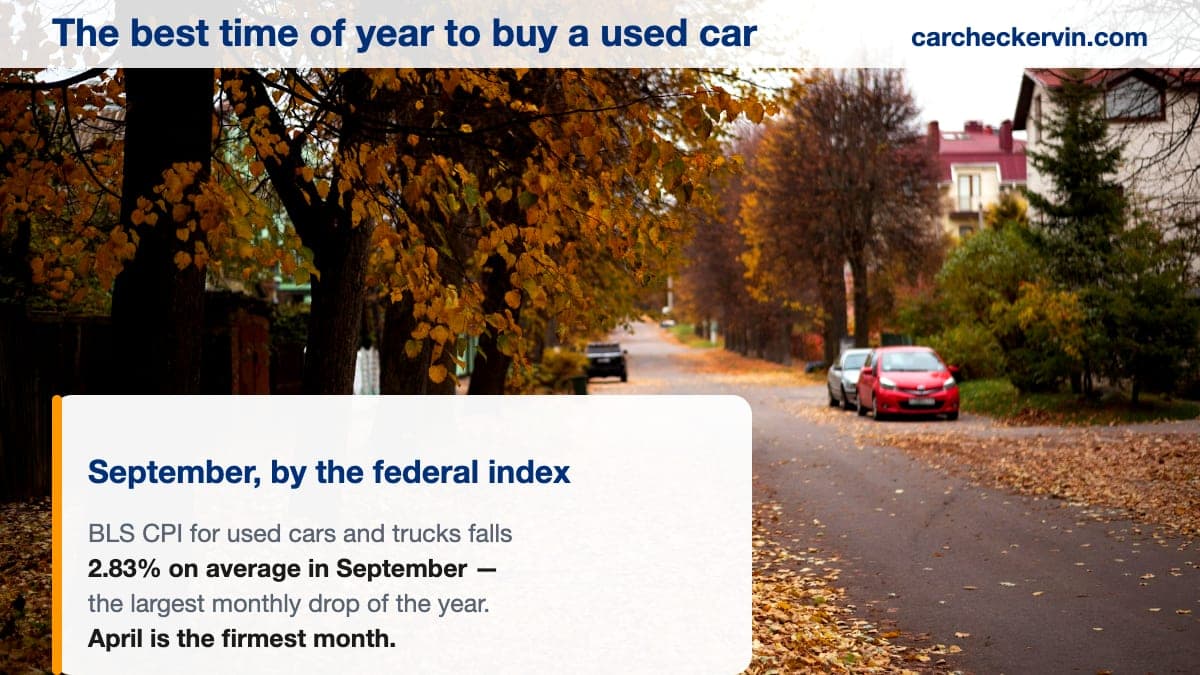
September. In the federal price index for used cars and trucks it is the softest month of the year, and April is the firmest. Here is the month-by-month figure, and the check that matters more than timing.
Timing is the tiebreaker — the VIN is the decision
A branded title costs more than any month of the year saves.
No account · Nothing stored · $14.99 only for the full report
Quick Answer
- What is the best time of year to buy a used car?
- September. In the federal CPI index for used cars and trucks, September is the single softest month of the year — prices fall 2.83% on average month-over-month, and autumn as a whole gives back 4.85%. Spring is the opposite: March through May adds 2.99%.
- What is the worst time to buy?
- Spring. April is the firmest month in the series at +1.7%, with March close behind. Tax-refund season puts buyers into the market and prices follow them.
- Is this just the pandemic distorting the numbers?
- No — we checked. Excluding 2020, 2021 and 2022 entirely, September is still the softest month and the effect gets slightly stronger, not weaker. Both windows are published in the table below.
Where this answer comes from
Almost every article on this question answers it from folklore — buy at the end of the month, buy at the end of the quarter, buy when the salesperson needs one more unit. None of that is testable, and none of it is about the price of used cars; it is about somebody's sales target.
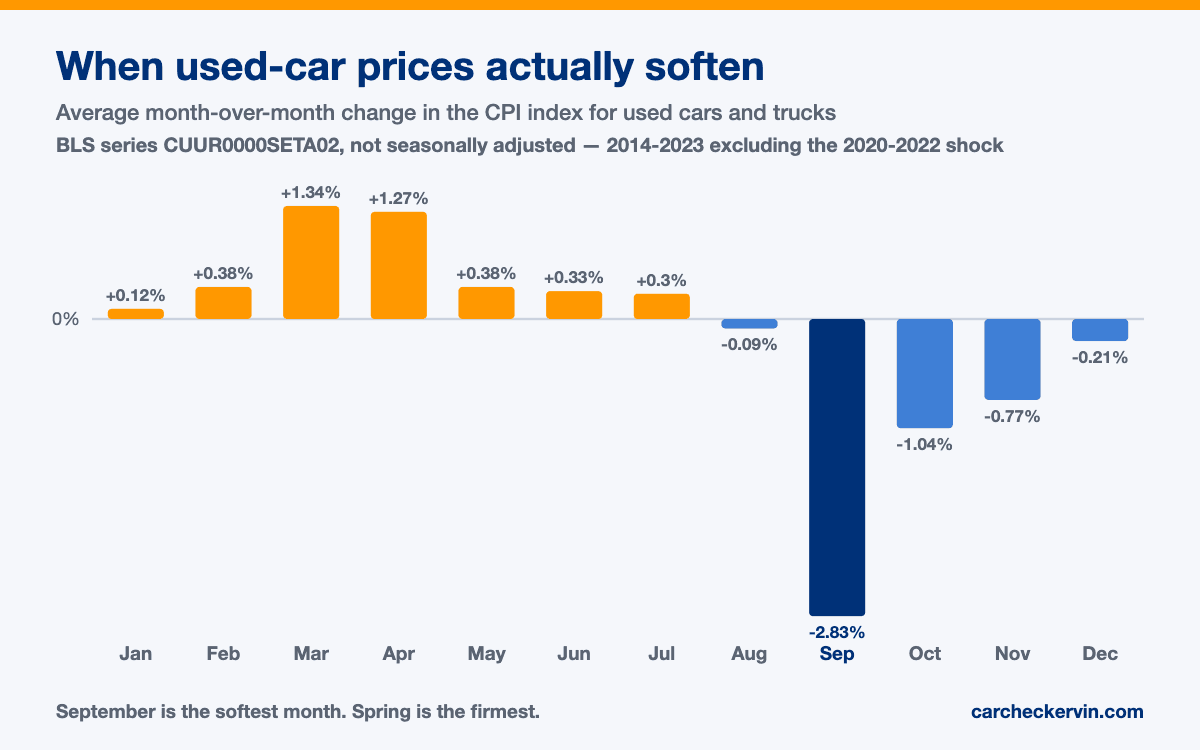
So we used the price index instead. The Bureau of Labor Statistics publishes a monthly CPI series for used cars and trucks (CUUR0000SETA02). We took 120 monthly observations covering January 2014 – December 2023, calculated the change from each month to the next, and averaged those changes by calendar month.
Every month, ranked cheapest first
Both columns are published deliberately. Used-vehicle prices moved violently in 2020–2022, so a seasonal average that included only that window could easily be an artifact of one shock. It is not: removing those three years makes September's lead slightly larger.
| Month | All years | Excluding 2020–2022 |
|---|---|---|
| September | -2.56% | -2.83% |
| October | -0.60% | -1.04% |
| November | -0.70% | -0.77% |
| December | -0.14% | -0.21% |
| August | +0.34% | -0.09% |
| January | -0.12% | +0.12% |
| July | +0.65% | +0.30% |
| June | +1.42% | +0.33% |
| February | +0.49% | +0.38% |
| May | +0.91% | +0.38% |
| April | +1.70% | +1.27% |
| March | +1.23% | +1.34% |
Source: U.S. Bureau of Labor Statistics, CPI series CUUR0000SETA02 — CPI — Used cars and trucks, U.S. city average, all urban consumers, not seasonally adjusted. 120 observations, January 2014 – December 2023. Average month-over-month percentage change, by calendar month.
The month is worth a few percent. The title is worth thousands.
Check the VIN for salvage, junk and flood brands before you worry about the calendar. $14.99, no account.
Why autumn is soft and spring is firm
The pattern is not mysterious once you see it. Two things move together in the autumn:
- The new model year arrives, so dealers take trade-ins against new stock and need the outgoing inventory gone.
- The summer buying season ends, and demand thins out with it.
- Weather turns, which takes convertibles and sports cars out of the market entirely in much of the country.
Spring runs the other way. Tax refunds land, which puts a large number of cash buyers into the market at once, and the index records it: March through May adds 2.99% between them. If you have any flexibility at all, that is the stretch to avoid.
What this data cannot tell you
A monthly index cannot see within-month timing, so it says nothing about whether the last day of the month is cheaper than the first. It is a market-wide category average, so it says nothing about one specific car. And it is a price index, not an inventory one — the softest month is not necessarily the month with the best selection.
Most importantly, a few percent of seasonal movement is smaller than the gap between a good example and a bad one, and far smaller than the cost of discovering a salvage brand after you have paid. Timing is a tiebreaker between two cars you would happily own.
How to use the season without being ruled by it
- 1
Shortlist in spring, buy in autumn
If your car is not urgent, do the research when prices are firm and commit when they soften. Nothing about looking costs money.
- 2
Check the VIN before you travel
A federal title brand does not care what month it is. $14.99 answers it before you spend a Saturday.
- 3
Run the free federal checks
NHTSA for open safety recalls, NICB VINCheck for theft and total-loss records. Both free, both by VIN.
- 4
Buy the right car, not the right month
A well-kept example in April beats a neglected one in September every time. The calendar is the last input, not the first.
Sources
- U.S. Bureau of Labor Statistics — CUUR0000SETA02
CPI — Used cars and trucks, U.S. city average, all urban consumers, not seasonally adjusted. 120 monthly observations, January 2014 – December 2023. Pulled from the BLS public API on 19 September 2026.
- NMVTIS — U.S. Department of Justice
The Justice Department's consumer entry point for the National Motor Vehicle Title Information System. Read 19 September 2026.
- NHTSA Recalls by VIN
The federal safety-recall lookup: free, by VIN, covering unrepaired recalls.
- NICB VINCheck
The National Insurance Crime Bureau's free lookup for theft and total-loss records reported by participating member insurers.
Prüfen Sie die Fahrgestellnummer immer vor dem Kauf
Die kostenlose Vorschau zeigt Title Brands (US-Titel-Kennzeichnungen), Diebstahlstatus und offene Rückrufe in Sekunden und meldet, ob Unfall- und Tachodaten vorliegen. Die vollständige Historie kostet 19,95 € — einmalig, ohne Abo.
Keep reading
Frequently asked questions
Why September specifically?+
September is when the new model year lands. Dealers take trade-ins against new stock and need to move the outgoing inventory, and the summer buying season is over. In the CPI index for used cars and trucks it is the largest single monthly fall of the year — 2.83% on the pandemic-excluded window, 2.56% across all years.
How much is the seasonal swing actually worth?+
Across September to December the index gives back 4.85%, while March to May adds 2.99%. That is a spread of roughly 7.84 percentage points between the firmest and softest stretches of the year — on a $20,000 car, in the region of a four-figure difference for the same vehicle.
Is 'end of the month' real?+
It may well be, but it is not what this data measures. The CPI is a monthly index, so it cannot see within-month timing. Treat end-of-month and end-of-quarter advice as untested folklore rather than something anyone has shown you with numbers — and note that it is advice about a salesperson's target, not about the market price of used cars.
Why use the not-seasonally-adjusted series?+
Because the seasonally adjusted version has this exact pattern statistically removed from it by construction. Asking a seasonally adjusted series about seasonality returns approximately nothing, by design. The unadjusted index is the one that still contains the effect.
Does this hold for every kind of car?+
The CPI series covers used cars and trucks as a category, so it is a market-wide signal rather than a model-level one. Convertibles and four-wheel drives have their own weather-driven cycles that run against the average — a convertible is cheapest in winter, when the category as a whole is only mildly soft.
Should I wait until September if I need a car in April?+
Probably not. A few percent of seasonal movement is smaller than the difference between a good example and a bad one, and it is much smaller than the cost of a car with a branded title or an undisclosed accident. Timing is a tiebreaker, not a strategy — the checks on the individual car matter more.
Do interest rates matter more than the season?+
For a financed purchase, usually yes. A change in the rate you are offered can move the total cost of a car by more than the entire seasonal swing. Seasonality is worth knowing when you have flexibility about when to buy; it does not override financing terms.
Where can I check this myself?+
The series is public. It is CPI series CUUR0000SETA02, "used cars and trucks in U.S. city average, all urban consumers, not seasonally adjusted", and you can pull it from the BLS site or its public API without an account.
Check the car, whatever the month
Free decode. $14.99 for the NMVTIS-backed title history.
Passende VIN-Abfragen
Weitere Tools, um die Historie jedes Fahrzeugs zu prüfen