Car value calculator — the number, and how it was built
Most valuation tools hand you a number and hide the math. This one shows every step — the depreciation curve, the brand and condition adjustments, and what each of the four selling channels typically pays — so you can argue with it, which is what a good estimate is for.
The car
Baseline
Condition
Normal wear. May need minor repairs. No major issues.
Quick Answer
- How does this car value calculator work?
- It runs a transparent model: your car's original MSRP is reduced by an age-based depreciation curve, adjusted for brand retention, condition, and mileage against a 12,000-mile-per-year average, then for title brands, accidents, and owner count. Every step is shown in the “How was this calculated?” table — these are the model's stated assumptions, not a live market feed, which is exactly why we show them instead of hiding them.
- Why four different values for one car?
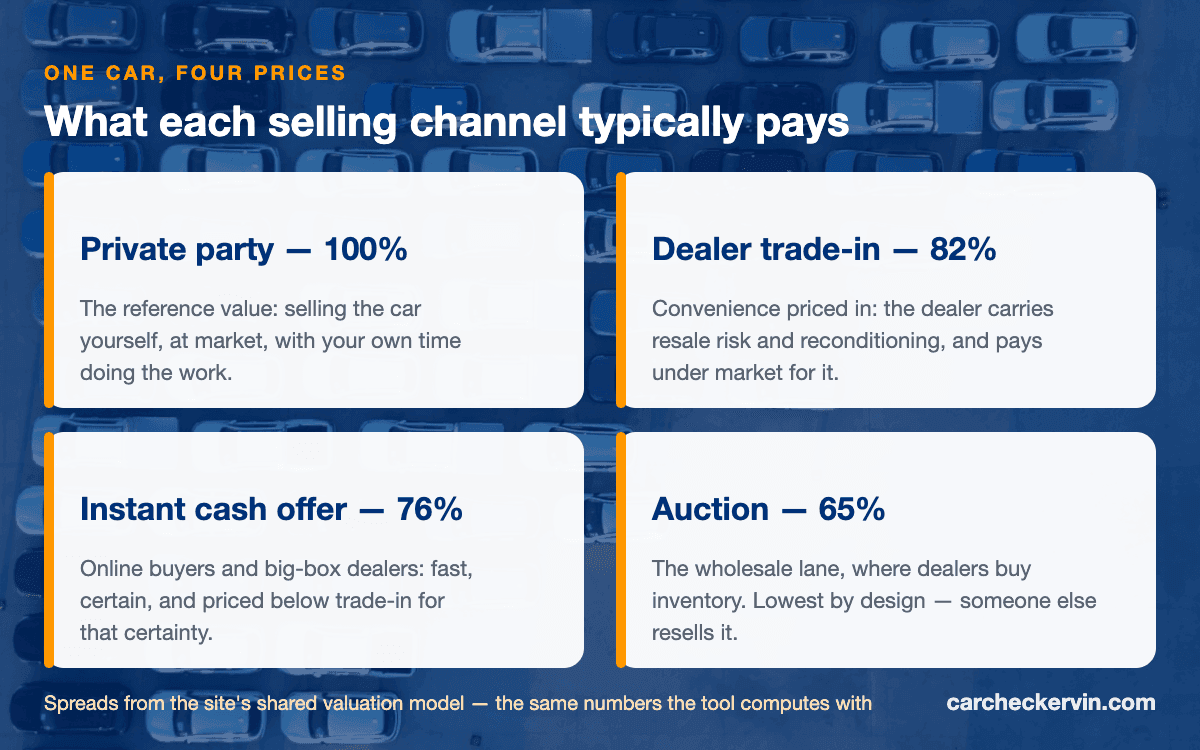
- Because there is no single “the value” — there are channels. The model prices the private-party sale as the reference, then applies its channel spreads: a dealer trade-in at 82% of it, an instant cash offer at 76%, auction at 65%. The gap between channels is your negotiating information.
- What moves the number most?
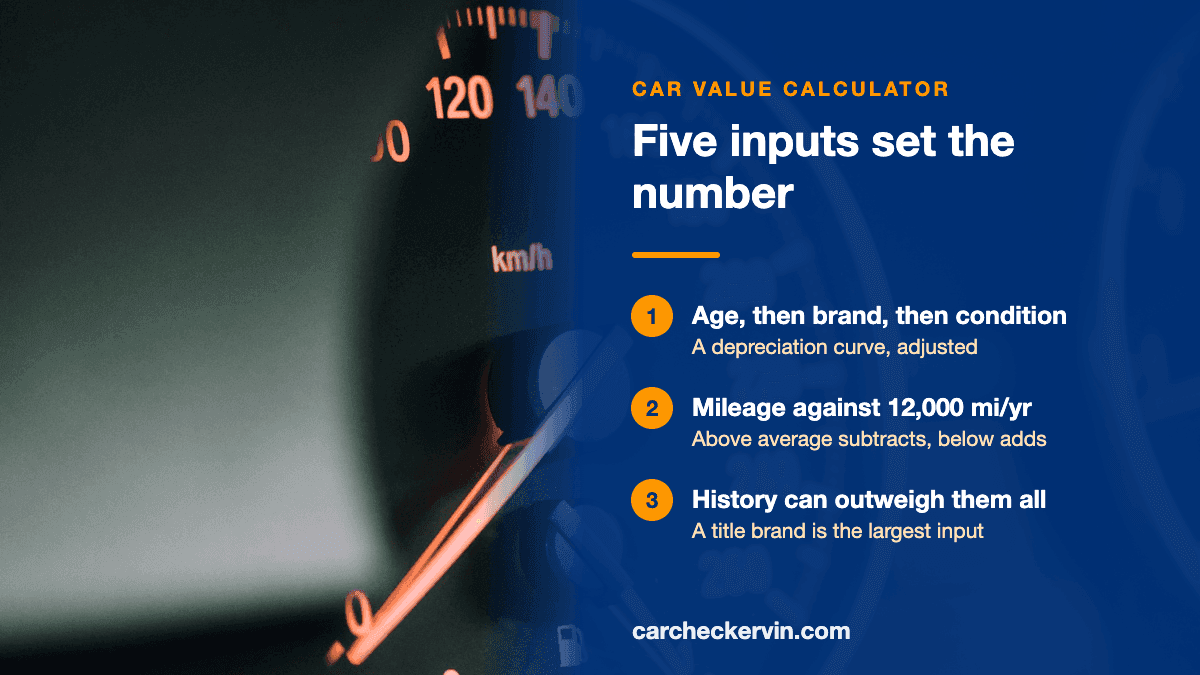
- Title status, for a car in otherwise ordinary shape: in this model a flood brand halves the estimate and a salvage brand cuts it by 45% — more than any accident or owner adjustment, and more than mileage in any realistic range. Which is the catch with every calculator, ours included: it prices the history you claim. The federal record on the VIN is how you verify the claim before money moves.
What the model weighs, in order
Age does the heavy lifting: the curve retains a large share of MSRP in year one and glides down from there, because that is the shape used-car depreciation actually takes. Brand retention tilts the result — makes with strong resale reputations hold more of their sticker. Condition and mileage refine it. And then history can overrule the refinements: a flood brand halves the estimate at a stroke, and a salvage brand cuts it by 45% — larger than any accident or ownership adjustment the model makes.
Those weights are editorial assumptions, published on purpose. A tool that shows its assumptions can be argued with and improved; a black box can only be believed.
One car, four prices
The same vehicle is worth different amounts depending on who is buying and why. The model expresses that as channel spreads off the private-party value: the dealer trade-in at 82%, the instant cash offer at 76%, the auction lane at 65%. None of those is a rip-off — each buyer prices their own risk and resale work — but knowing the spread is what turns an offer from a verdict into a starting point.
The depreciation curve, year by year
This is the exact age table the calculator applies — the share of original MSRP the model retains at each birthday. The steepest loss is the first year; by year five roughly half the sticker is gone; past year ten the model glides down two points a year to a floor.
| Vehicle age | MSRP retained | On a $30,000 car |
|---|---|---|
| New | 100% | $30,000 |
| 1 year | 81% | $24,300 |
| 2 years | 70% | $21,000 |
| 3 years | 62% | $18,600 |
| 4 years | 55% | $16,500 |
| 5 years | 49% | $14,700 |
| 6 years | 44% | $13,200 |
| 7 years | 39% | $11,700 |
| 8 years | 35% | $10,500 |
| 9 years | 31% | $9,300 |
| 10 years | 28% | $8,400 |
Rendered from the model itself, before brand, condition, mileage, and history adjustments move a specific car off the curve.
Brand retention: the model's tilt table
Identical cars from different badges resell differently, and the model expresses that as a multiplier around 1.0. These are its current assumptions — published so you can argue with them:
Holds value
- Toyota+12%
- Porsche+10%
- Honda+9%
- Subaru+7%
- Lexus+6%
- Mazda+5%
- Tesla+3%
- Acura+2%
Near average
- Ram+1%
- GMC-1%
- Jeep-1%
- Ford-2%
- Hyundai-3%
- Kia-3%
- Chevrolet-4%
- BMW-5%
- Nissan-5%
- Volvo-5%
- Volkswagen-6%
- Genesis-6%
Depreciates faster
- Mercedes-Benz-7%
- Buick-7%
- Audi-8%
- Infiniti-8%
- Cadillac-9%
- Dodge-10%
- Lincoln-10%
- Mitsubishi-12%
- Chrysler-13%
- Land Rover-15%
A worked example, end to end
Take a 2021 Toyota, $30,000 MSRP when new, 65,000 miles, good condition, clean title. Here is the entire computation, produced by the same function the tool above runs:
| Age retention (5 years) | 49% of MSRP | $14,700 |
| Toyota brand retention | +12% | $16,464 |
| Good condition | -25% | $12,348 |
| 65,000 miles vs average | -1.3% | $12,194 |
| Private-party result | rounded to $100 | $12,200 |
The same car at a dealer's desk: $10,000. As an instant cash offer: $9,300. Through the auction lane: $7,900. One car, four prices — and every dollar above traceable to a stated assumption.
The five condition grades, honestly graded
Condition is where sellers grade generously and buyers grade harshly. The model's multipliers are blunt on purpose — and most cars on the road are honestly “good”, not “excellent”:
Excellent
×1.00
Showroom-adjacent. Rare in the wild — grade here only if a detailer would agree.
Very Good
×0.88
Serviced, straight, minor wear a photo would miss.
Good
×0.75
The honest default: normal wear, drives right, nothing urgent.
Fair
×0.58
Visible issues, deferred repairs, high miles for its age.
Poor
×0.38
Major mechanical or body problems. Price accordingly or part ways.
Where to find your original MSRP
The calculator's baseline is the sticker price when the car was new — not what anyone paid, but what the window sticker said. Three places to recover it: the original window sticker by VIN where available, the build sheet that lists the car's factory equipment, or the brochure pricing for the year and trim the VIN decodes to. Guessing low understates every number that follows; the five minutes of lookup is worth it.
And why calculators disagree with each other: different curves, different comps, different assumptions — all defensible, none gospel. That is why collecting two or three estimates beats hunting the “right” one, and why this page shows its assumptions where others bury theirs.
The calculator prices the story. The VIN checks it.
Title status and accidents swing the estimate hardest — and they are the two inputs a listing can shade. Free preview of the federal record first.
The rest of the value toolkit
Prüfen Sie die Fahrgestellnummer immer vor dem Kauf
Die kostenlose Vorschau zeigt Title Brands (US-Titel-Kennzeichnungen), Diebstahlstatus und offene Rückrufe in Sekunden und meldet, ob Unfall- und Tachodaten vorliegen. Die vollständige Historie kostet 19,95 € — einmalig, ohne Abo.
Car value calculator — frequently asked
Is this car value calculator really free?
Yes — the calculator runs entirely on this page with no sign-up, no email, and no limit. The site earns when someone who needs the vehicle's actual history buys the VIN report; the valuation tool itself costs nothing and never asks who you are.
How accurate is a car value calculator?
As accurate as its inputs and honest about its method — no calculator, ours or anyone's, is a market quote. This one shows its whole computation: an age-depreciation curve, brand retention, condition, mileage, and history adjustments, all listed step by step. For a transaction-grade number, collect two or three estimates and let an in-person appraisal settle the rest; the calculator's job is to anchor the conversation and expose the channel spreads.
Why does it ask for original MSRP?
Depreciation needs a starting point. The sticker price when new is the cleanest baseline the owner actually knows — the model applies its age-retention curve to it, which is both simpler and more transparent than pretending to know current comps for every trim in every city. If you don't know the MSRP, the window-sticker lookup on this site can help recover it.
How is this different from the trade-in value page?
Same engine, different question. The trade-in estimator leads with what a dealer hands you when you trade the car in; this calculator leads with the car's market value and treats the dealer number as one of four channels. Because both tools run the site's one shared valuation model, they will always agree about the same car.
Does a salvage or rebuilt title really change value that much?
The model applies -45% for salvage, -30% for rebuilt, and -50% for flood — deliberately blunt assumptions that reflect how hard branded titles are hit in practice, shown openly so you can disagree with them. The deeper point survives any quibble with the exact percentage: a brand reprices the whole car, and it follows the VIN through the federal system even when the paper title looks clean.
How much does mileage change the number?
In this model, 2.5% for every 10,000 miles away from the 12,000-mile-per-year average — in either direction. A 5-year-old car with 85,000 miles sits 25,000 over average, so it gives up 6.25%; the same car at 35,000 miles gains the same amount back. That deliberately makes mileage a moderate lever: real markets price condition and history harder than odometer deltas of ordinary size.
Do modifications or new tires add value?
The calculator has no input for them, on purpose. Modifications rarely return their cost at sale — they narrow the buyer pool, and appraisers tend to value the car as if it were stock — while consumables like fresh tires are a negotiating point rather than a line item. Spend that attention on the inputs that do move the model: documented condition and a verified clean history.
Should I check the VIN before trusting a value?
Before trusting a seller's inputs, yes. The two inputs that swing this calculator hardest — title status and accidents — are exactly the two a listing can misstate. The free VIN preview shows what is on file; the full report opens the federal title and odometer record. Value the car the record describes, not the car the ad describes.
An estimate you can argue with beats a number you must believe
Run the calculator, read the breakdown, then verify the history half by VIN — the order that keeps the negotiation yours.
No sign-up · No limit · Every step shown
Passende VIN-Abfragen
Weitere Tools, um die Historie jedes Fahrzeugs zu prüfen