Blue Book value? You have three of them.
Kelley Blue Book publishes a trade-in, a private-party and a dealer-retail value for the same car — and the one you'll be offered is the lowest. Here's which number applies to you, and what moves it.
See the history behind your car's number
17 characters in — the records a buyer or dealer checks before they agree with any Blue Book figure.
Free preview · no card, no account
Quick Answer
- What is the Kelley Blue Book value of my car?
- There isn't one — there are three.Blue Book publishes a trade-in value, a private-party value and a dealer-retail value for the same car, and they can differ by thousands. Which one applies depends entirely on who you're selling to, or buying from.
- Why is the dealer offering less than Blue Book?
- Because they're quoting the trade-in column and you probably read the retail one. Trade-in is what a dealership pays when you trade a car in — the lowest of the three by design, since they still have to recondition and resell it. The gap is their margin, not an insult.
- Why is my car worth less than the number I looked up?
- Usually condition and history. Blue Book asks you to grade the car, and most owners grade generously — the spread between condition grades runs to thousands. Then the buyer pulls the records: a salvage brand alone cuts value 20–40%. See what they'll see for $14.99.
The three numbers, and who each one is for
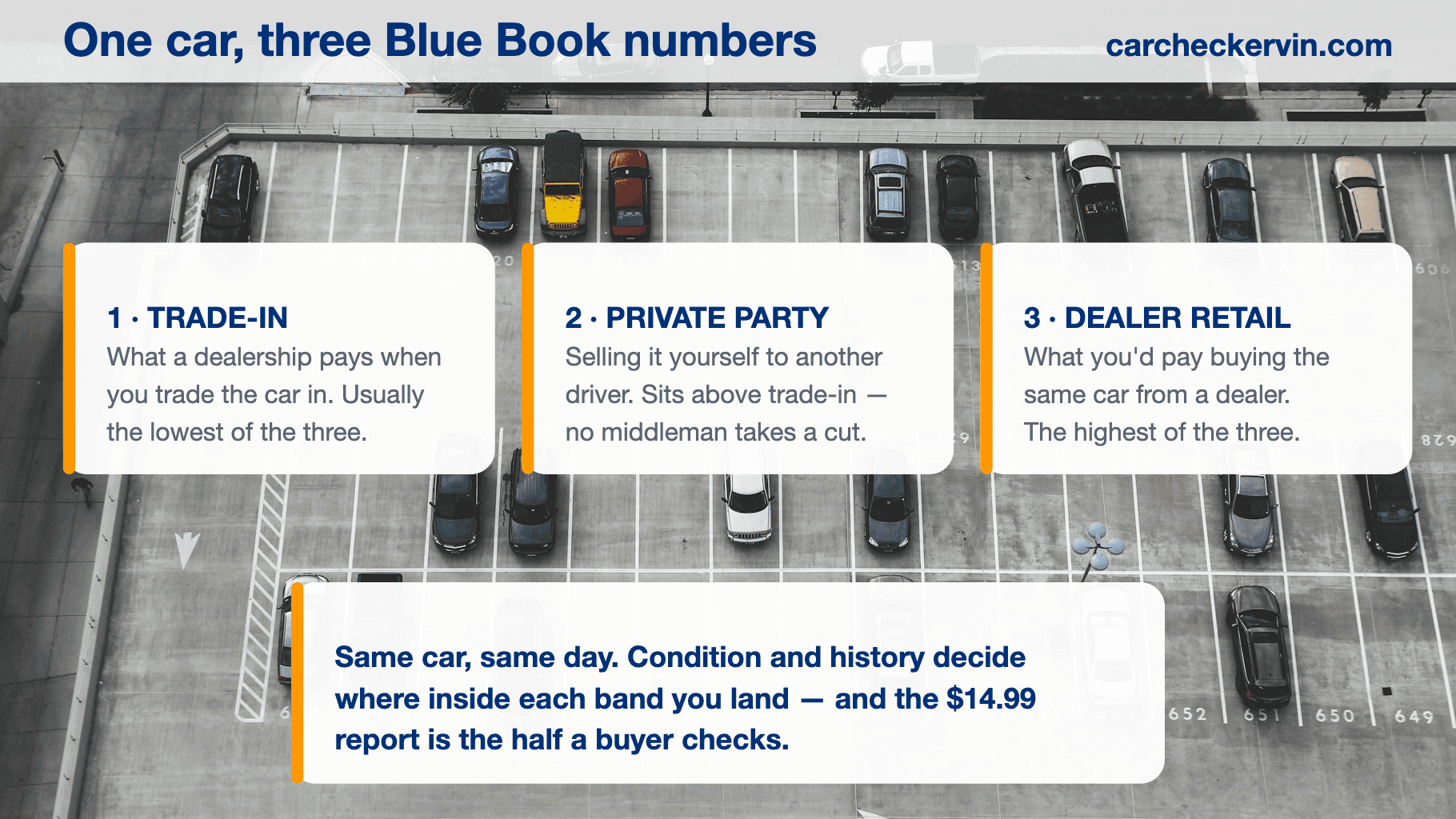
Most Blue Book confusion is one mismatch: reading the retail column while standing at a trade-in desk. The ladder runs low to high:
| The value | What it means | When it's your number |
|---|---|---|
| Trade-in | What a dealership pays when you trade the car in — usually the lowest of the three | You're trading in at a dealer |
| Private party | Selling the car yourself to another driver; sits above trade-in because no middleman takes a cut | You're selling it yourself |
| Dealer retail | What you'd expect to pay buying the same car from a dealer — higher than both of the above | You're buying from a lot |
| The gap between them | Reconditioning, overhead, warranty and the dealer's margin | It's a business model, not a swindle |
Quote the right column and the conversation gets shorter. Ask a dealer for retail money on a trade-in and you'll be told no — correctly.
How Blue Book builds the number
The figure isn't an opinion. It's modelled from transaction data and then adjusted for your specific car:
Real sales, four ways
Blue Book draws on wholesale auctions, independent dealers, franchised dealers and private-party transactions — a wide net across how cars actually change hands, not asking prices from listings.
Condition, mileage, equipment, region
Those four criteria move the number. Blue Book asks specific condition questions rather than assuming, which is why its figures sit lower than guides that presume a car is in good shape.
Built for consumers, and free
Blue Book is the book buyers and sellers actually use, because it's free and public. That popularity is also why dealers hear it quoted daily — and why they'll cheerfully point out which column you're reading.
Condition is the step you're most likely to get wrong
Every valuation asks you to grade the car, and grading is where honest people lose money in both directions:
The grades span thousands
Valuation guides run condition from Excellent down to Poor, and the spread between neighbouring grades can be several thousand dollars. Choosing one notch too high doesn't raise your car's worth — it just makes the eventual offer feel like an insult.
Almost nobody is “Excellent”
Excellent describes a car that needs nothing: no cosmetic flaws, complete records, everything working. Most well-kept daily drivers are a grade or two below that, and pricing them there is what makes a listing sell.
The buyer grades it too
Your assessment is the opening bid; theirs decides the close. They'll walk the panels, read the tyres, and pull the VIN's records — so the grade that matters is the one that survives their inspection.
Grade it the way the buyer will
Free preview first: title brands, accident records and odometer flags for any 17-character VIN — the $14.99 report is the full file.
What the guide can't see
Blue Book prices a year, make, model and trim in a stated condition. It doesn't know what happened to your specific car — and that's the half a buyer checks:
Title brands
Salvage, rebuilt, flood or lemon in any state the car was titled. A brand alone cuts value 20–40%, and no condition grade compensates for it.
Accident records
Reported collisions follow the VIN. They rarely stop a sale outright; they reliably move the price, and a buyer who finds one you didn't mention discounts twice.
Odometer timeline
The guide adjusts for the mileage you type in. Recorded readings in sequence are what make that number credible to someone else.
Owner and usage history
How many owners, and whether the car was personal, fleet, rental or commercial. All of it sits in the records and all of it moves real-world price.
Open recalls
Free to fix, free to look up, and awkward to discover mid-negotiation. Clearing them before listing costs nothing and removes a bargaining chip.
Auction photographs
Cars that crossed a salvage lane were photographed there. A clean-looking car with lane photos in its file is a very short negotiation.
None of this replaces the Blue Book number — it decides where inside the band the car actually lands, and whether the person across the table believes you.
Get a number you can defend, in three steps
Free first — the expensive part is arguing from a figure you can't support.
Look up all three values
Pull the trade-in, private-party and dealer-retail figures for your exact year, make, model and trim, rather than only the one that flatters the car. Knowing the whole ladder is what stops a lowball feeling like one.
Pull the records first
Every state title and brand, accident and total-loss records, the odometer timeline, owner history and open recalls — in under 60 seconds. Whatever a buyer finds, you should find it first.
Grade honestly, then position
Set the condition grade you'd defend to a stranger, place the car in the right column for your situation, and hold the clean history in reserve as the reason your asking price stands.
Related value guides and checks
The rest of the what's-it-worth homework, in the same plain terms.
Prüfen Sie die Fahrgestellnummer immer vor dem Kauf
Die kostenlose Vorschau zeigt Title Brands (US-Titel-Kennzeichnungen), Diebstahlstatus und offene Rückrufe in Sekunden und meldet, ob Unfall- und Tachodaten vorliegen. Die vollständige Historie kostet 19,95 € — einmalig, ohne Abo.
Blue Book values — the questions people ask
Straight answers, including where the dealer is right and you aren't.
What is the Kelley Blue Book value of my car?+
Blue Book doesn't publish one figure — it publishes three. Trade-in is what a dealership pays when you trade the car in and is usually the lowest. Private party is what you'd get selling it yourself, and sits higher because no middleman takes a cut. Dealer retail is what you'd pay buying the same car from a lot, and is the highest of the three. Which is 'your' number depends on the transaction you're actually in.
Why is the dealer's offer below Blue Book value?+
Almost always because the offer is a trade-in figure and the number you read was private party or retail. The dealership has to recondition, warranty, floor-plan and resell the car, and the gap between those columns is where that work is paid for. Compare like with like — trade-in against trade-in — before deciding an offer is unfair.
How does Kelley Blue Book calculate its values?+
From transaction data across wholesale auctions, independent dealers, franchised dealers and private-party sales, then adjusted for condition, mileage, equipment level and regional demand. Blue Book asks specific questions about condition rather than assuming a car is in good shape, which is one reason its figures often read lower than guides that do assume it.
Is Blue Book value accurate?+
It's an accurate model of what comparable cars trade for — it is not a quote for your specific car. Two identical models can deserve very different money once condition, a title brand or an odometer discrepancy is factored in. Treat the number as the band and the records as the position inside it.
What condition should I choose for my car?+
The one you could defend to a stranger standing next to the car. Excellent means it needs nothing — no cosmetic flaws, full records, everything working — and genuinely few used cars qualify. Since the spread between grades can run to thousands, grading generously doesn't raise the car's worth; it just sets you up to be disappointed by every offer.
Does an accident on the record change the Blue Book value?+
The guide's own figure is condition-based, but the price you'll actually achieve moves — buyers discount for reported accidents, and lenders and dealers see the same records you do. A salvage or rebuilt brand is more severe again, cutting value by roughly 20–40%. Know what's in the file before you set an asking price.
Blue Book, Black Book or NADA — which should I use?+
Use them for what each is: Blue Book is the free consumer book and the one buyers quote; Black Book is the trade's wholesale view and closest to predicting a dealer's offer; NADA at J.D. Power is wholesale-anchored and used by lenders to size loans. Read the one that matches your situation, then let the VIN's records decide the final number.
The book prices the model. The records price your car.
Title brands, accident records, odometer history and open recalls for any VIN — in under a minute, for less than a tank of fuel.
Passende VIN-Abfragen
Weitere Tools, um die Historie jedes Fahrzeugs zu prüfen