Hyundai Santa Fe Years to Avoid — the 2013–2018, the 2017 most of all.
The 2017 Santa Fe drew 1,334 NHTSA complaints, more than any other year: 388 describe engine failure or knocking and 247 burning oil. The engine is the component owners name most on every year from 2012 to 2020, and NHTSA's list has no engine recall for the 2015–2016 or 2018–2020.
Found a Santa Fe You Like?
Enter its VIN for a free preview of title brands, salvage and total-loss records and odometer readings, then ask whether the engine was ever replaced.
Free preview · No sign-up · No owner or personal data
Quick Answer
- What Hyundai Santa Fe years should you avoid?
- The 2013–2018, Santa Fe Sport included, and the 2017 above all: 1,334 complaints, 388 about engine failure or knocking. The 2013–2018 drew 1,050 engine-failure complaints in all. Of the older years, the 2008 drew 226 complaints about the fuel gauge.
- What is the best year for a used Santa Fe?
- Leaving out years where one fault is a quarter or more of complaints, the 2020 drew the fewest of the 2019–2021 (218), and 2002 (171), 2011 (181), 2001 (212) the fewest from 2001 to 2021.
- Did Hyundai recall the Santa Fe engine?
- For some years: recall 17V226000 covers bearing wear on the 2013–2014 Santa Fe Sport, 20V746000 connecting-rod bearings on the 2012, and 17V578000 the 3.3-litre V6 on the 2017. NHTSA's list has no engine recall for the 2015–2016 or 2018–2020, which drew 365 engine-failure complaints.
Five checks for a used Santa Fe, by year
The Santa Fe's weak spot moves from rusting springs to fuel gauges to engines to gearboxes, depending on the year.
- 1Read the year and plant from the VINCharacter 10 is the model year; KM8 at the start means built in South Korea, 5NM or 5XY in the US.
- 22012–2020: ask about the engineHas it been replaced, and is there paperwork? Owners describe knocking, oil burning and a check-engine light before failure.
- 32013–2018: check the oil levelA low dipstick between changes is the early sign owners report on the 2017–2018.
- 42021–2024: drive it in trafficHesitation or a transmission warning is the most common complaint on the 2024.
- 5Check title and mileage recordsA salvage brand or a mileage gap shows up by VIN; an engine swap usually does not.
Avoid: the 2013–2018 Santa Fe and Santa Fe Sport
From 2013 to 2018 Hyundai sold two Santa Fes, the five-seat Santa Fe Sport and the longer Santa Fe, and owners file both under either name. Counted together, the 2013–2018 drew 3,886 complaints; 1,305 were filed under the Sport name.
The engine dominates: 1,050 complaints describe engine failure or knocking. The 2017 is the worst, with 1,334 complaints, 388 about engine failure and 247 about burning oil.
Recall 17V226000 covers bearing wear from machining errors on the 2013–2014 Sport, and 17V578000 the 2017's 3.3-litre V6. The 2015–2016 and the 2018 have no engine recall on NHTSA's list.
The 2013–2018 by the numbers
- 3,886 complaints, Santa Fe and Santa Fe Sport together.
- 1,050 about engine failure or knocking.
- 247 2017 complaints about burning oil.
- 114 2017 complaints mention fire, smoke or melting.
Every Hyundai Santa Fe Model Year Compared
NHTSA complaints and recall campaigns for every Santa Fe from 2001 to 2026, read on 13 November 2026. The 2013–2018 rows include complaints filed as Santa Fe Sport, and the 2019 row the Santa Fe XL.
| Year | Generation | Complaints | Crash · fire reports | Recalls | Most-cited component |
|---|---|---|---|---|---|
| 2001 | 1st | 212 | 4 · 4 | 4 | Suspension |
| 2002 | 1st | 171 | 9 · 2 | 4 | Suspension |
| 2003 | 1st | 308 | 26 · 5 | 4 | Suspension |
| 2004 | 1st | 303 | 32 · 7 | 3 | Suspension |
| 2005 | 1st | 216 | 18 · 0 | 3 | Air Bags |
| 2006 | 1st | 106 | 11 · 3 | 1 | Air Bags |
| 2007 | 2nd | 684 | 30 · 8 | 9 | Fuel/Propulsion System |
| 2008 | 2nd | 541 | 17 · 7 | 6 | Fuel/Propulsion System |
| 2009 | 2nd | 359 | 27 · 5 | 3 | Fuel/Propulsion System |
| 2010 | 2nd | 260 | 8 · 6 | 3 | Power Train |
| 2011 | 2nd | 181 | 12 · 8 | 3 | Engine |
| 2012 | 2nd | 355 | 25 · 17 | 1 | Engine |
| 2013 | 3rd | 809 | 15 · 56 | 7 | Engine |
| 2014 | 3rd | 658 | 16 · 46 | 7 | Engine |
| 2015 | 3rd | 339 | 10 · 19 | 4 | Engine |
| 2016 | 3rd | 310 | 12 · 13 | 3 | Engine |
| 2017 | 3rd | 1,334 | 19 · 30 | 7 | Engine |
| 2018 | 3rd | 436 | 13 · 13 | 5 | Engine |
| 2019 | 4th | 234 | 17 · 13 | 3 | Engine |
| 2020 | 4th | 218 | 14 · 9 | 2 | Engine |
| 2021 | 4th | 170 | 4 · 2 | 7 | Power Train |
| 2022 | 4th | 204 | 9 · 1 | 5 | Power Train |
| 2023 | 4th | 217 | 11 · 4 | 1 | Power Train |
| 2024 | 5th | 165 | 12 · 1 | 7 | Power Train |
| 2025 | 5th | 140 | 6 · 0 | 5 | Electrical System |
| 2026 | 5th | 39 | 0 · 0 | 4 | Electrical System |
Complaints are unverified owner reports and are not divided by sales. A complaint filed under both names is counted once. Complaints NHTSA files under the Santa Fe Hybrid name are not included.
Other Santa Fe Years With a Known Weak Spot
Smaller clusters in NHTSA's records, and the recalls behind them.
2001–2006: coil springs
142 complaints describe broken springs or a rusting frame; recall 14V435000 covers the springs in salt-belt states.
2003–2009: airbags
79 of the 2005's 216 complaints mention airbags; recall 12V354000 recalibrates the 2007–2009's passenger-seat sensor.
2007–2009: fuel gauge
436 complaints describe a gauge reading empty or jumping, 226 of them on the 2008.
2010: transmission
110 of the 2010's 260 complaints name the transmission, many describing a bang or lurch between gears.
2012: engine
85 complaints describe engine failure or knocking; recall 20V746000 covers connecting-rod bearings that wear early.
2021–2024: transmission
55 of the 2024's 165 complaints; recalls 22V746000 (2021–2022 loss of drive) and 24V529000 (2024 roll-away in Park) cover it.
What Santa Fe Owners Say on Reddit and YouTube
Santa Fe owners describe the same pattern again and again: an engine that knocks or burns oil, then a dealer replacing it, often at no charge.
In owners' words (paraphrased)
- r/HyundaiSantaFe: one owner would avoid any 2024 gas model, used or new, because of the transmission issue.
- r/HyundaiSantaFe, 2021: a bit underpowered, but no issues in 30,000 miles.
- YouTube, 2018 Santa Fe Sport: started burning oil at 70,000 miles; the dealer confirmed it with an oil-consumption test and replaced the engine.
- YouTube, 2013: the knock sensor tripped months after purchase; metal flakes from a machining error, and a new engine under the recall.
- YouTube, 2017: burns oil so fast that the owner says to check and top it up every two weeks, as there is no oil-level sensor.
- YouTube, 2017 Santa Fe Sport: almost 200,000 miles of ride-share driving with proper maintenance.
- YouTube, Santa Fe XL V6: very reliable and cheap to repair, the owner says.
Checking a Santa Fe for Sale?
Enter the VIN for a free preview: title brands, junk and salvage records, total-loss records and odometer readings.
Fewest vs. Most Santa Fe Complaints
Fewest is limited to 2001–2021 and leaves out years where one fault is a quarter or more of complaints (2005–2006, 2008–2010, 2014–2017 and 2021).
Fewest complaints
- 2002: 171 complaints, 4 recalls
- 2011: 181 complaints, 3 recalls
- 2001: 212 complaints, 4 recalls
- 2020: 218 complaints, 2 recalls
- 2019: 234 complaints, 3 recalls
Most complaints
- 2017: 1,334 complaints, 7 recalls
- 2013: 809 complaints, 7 recalls
- 2007: 684 complaints, 9 recalls
- 2014: 658 complaints, 7 recalls
- 2008: 541 complaints, 6 recalls
Recall counts include multi-model campaigns.
The Santa Fes Our Visitors Check, and Where They Were Built
Between 15 June 2026 and 12 November 2026, visitors ran 664 different Santa Fe and Santa Fe Sport VINs through our free preview. By the first three characters, 582 (88%) were built in the US and 82 (12%) in South Korea.
249 (38%) were 2013–2018 models, the engine-failure years, 192 of them the Santa Fe Sport. The most-checked year was the 2017, at 95 VINs, the same year with the most complaints.
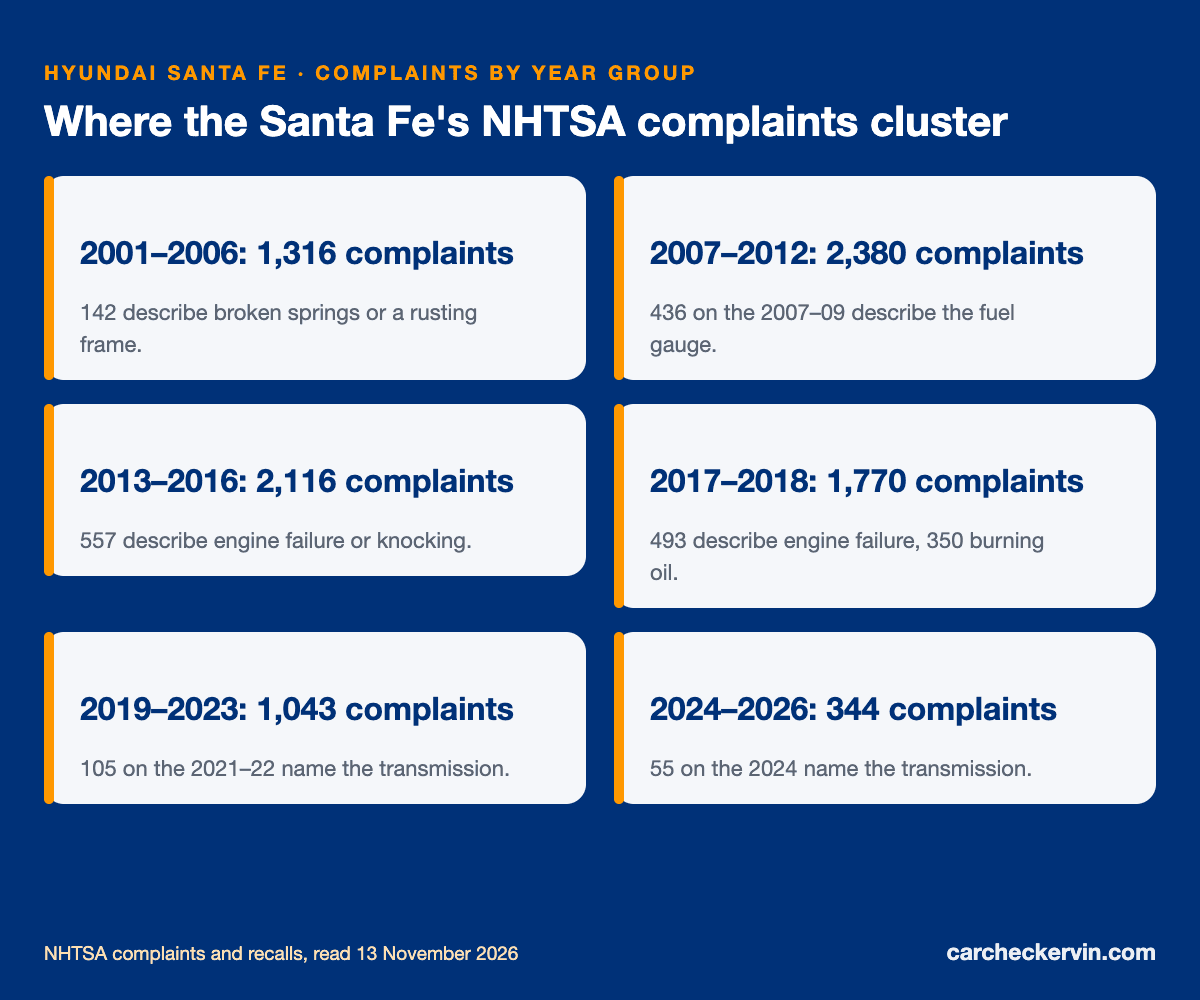
Santa Fe Complaints by Generation
The third generation (2013–2018) carries 3,886 complaints, more than the first (1,316), fourth (1,043) and fifth (344) combined; the second drew 2,380.
What to Check on a Used Santa Fe
By year, the faults to look for.
2012–2020: engine history
Ask whether the engine was replaced under a recall or warranty, and get the paperwork.
2013–2018: oil level
Check the dipstick; a low level a few thousand miles after a change means it is burning oil.
2013–2019: ABS recalls
Confirm recall 21V303000 on a 2013–2015 Sport or 22V056000 on a 2016–2019; both cover ABS modules that can short.
2021–2024: transmission
Confirm recall 22V746000 or 24V529000, whichever applies; drive in stop-and-go traffic.
2001–2006: springs and frame
Look under the car for broken coil springs and rust, especially in salt-belt states.
Any year: VIN records
Open recalls, title brands and odometer history.
Reading Santa Fe Complaint Numbers
NHTSA complaints are owner reports, not verified and not divided by sales. NHTSA files the 2013–2018 Santa Fe Sport and the 2019 Santa Fe XL under their own names; this page counts them with the Santa Fe because owners use the names loosely, and a complaint filed twice is counted once.
The fault counts come from searching the words owners used, so they are a minimum. Newer years have had less time: the 2026 has 39 complaints so far, and recall 25V549000 covers connecting-rod bolts on some 2025–2026s. On the 2023, 23 of 217 complaints describe the emergency braking.
Related Checks and Guides
Recalls, history checks and the Santa Fe's rivals.
Where These Facts Come From
Complaint and recall figures are NHTSA's own records; owner experiences are linked so you can read them in full.
NHTSA records read 13 November 2026. Written by the CarCheckerVIN editorial team with AI assistance, from NHTSA's complaint and recall records, our own preview logs and the owner posts linked above; figures checked November 2026. CarCheckerVIN is not affiliated with Hyundai.
Hyundai Santa Fe Years to Avoid — Frequently Asked Questions
Engines, the Santa Fe Sport and the newest Santa Fes.
What is the worst year for the Hyundai Santa Fe?+
By NHTSA complaint count, the 2017 (1,334), then the 2013 (809) and the 2007 (684).
Is the Santa Fe Sport the same car?+
Nearly: for 2013–2018 the Sport is the shorter five-seat version with four-cylinder engines, and the longer Santa Fe has a V6. NHTSA files the Sport separately, 1,305 complaints in those years, but owners of both use either name, so this page counts them together.
Why do 2013–2018 Santa Fe engines fail?+
Recall 17V226000 blames machining errors that cause early bearing wear on the 2013–2014 Sport. Owners of later years describe the same knocking and oil burning: 103 2018 complaints mention burning oil.
What about the 2024 Santa Fe?+
55 of its 165 complaints name the transmission, and recall 24V529000 covers software that can let it roll away in Park.
Is a Santa Fe with a replaced engine a good buy?+
It can be: owners describe dealers replacing engines under recall and the SUV running well afterwards. Get the paperwork, and check the oil level on any 2013–2018.
Will your report show these problems?+
No history report can tell you an engine is about to fail. Ours lists title brands, NMVTIS junk and salvage records, insurance total-loss records, odometer readings, and auction records with the damage the auction recorded and its photos for the VIN. Recalls are free to check on NHTSA's site.
Ask About the Engine, Then Check the Title
On a 2012–2020 Santa Fe, an engine replaced with paperwork can be a better buy than an original one burning oil. Free preview first; the full report is $14.99 and lists title brands, NMVTIS junk and salvage records, insurance total-loss records, odometer readings, and auction records with the damage the auction recorded and its photos.
Complaint and recall figures are NHTSA's public records as read on 13 November 2026; complaints are unverified owner reports. Owner comments are paraphrased from the linked posts. CarCheckerVIN is not affiliated with Hyundai. Records in our reports reflect what was reported to our data providers. Our reports do not include police or repair-shop accident entries.
Passende VIN-Abfragen
Weitere Tools, um die Historie jedes Fahrzeugs zu prüfen