Mechanic's Lien on a Car — how the shop sells it, and what the buyer actually gets.
A shop that repaired a car, a yard that towed it or a lot that stored it holds a possessory lien: it may keep the car until it is paid. When the bill goes unpaid the lien becomes a sale, under a procedure each state writes in detail: who must be notified, how many days must pass, where the sale is advertised, and what document the buyer walks away with. Here are the Texas, California and Florida procedures from the statutes, for the shop deciding whether to file and for the buyer deciding whether to bid.
Check a Lien-Sale Car Before You Bid
A lien sale clears the shop's claim, and in Florida the title is discharged of recorded liens, but the car's brands and odometer history follow the VIN. Enter it for a free preview.
Free preview · No sign-up · No owner or personal data
Quick Answer
- How does a mechanic's lien on a car work?
- The shop may retain the vehicle until the repair bill is paid (Texas Property Code § 70.001). To sell it, the shop sends certified-mail notice to the owner and every lienholder on the title; in Texas it also files a copy with the county tax assessor-collector for $25 within 30 days. The owner may redeem by paying before day 31; from day 31 the shop may sell at public sale and apply the proceeds to the bill, paying any excess to the person entitled to it.
- What is a DMV lien sale in California?
- The procedure in Civil Code §§ 3071 and 3072 by which a garage, tow or storage lienholder sells a vehicle. Over $4,000 the lienholder applies to the DMV for authorization and the DMV notifies the owners; at $4,000 or less the lienholder requests the owners' names and sends the notices itself, with the sale 31 to 41 days from mailing. Owners may file a Declaration of Opposition within 10 days and force the lienholder to court.
- Does a lien sale give the buyer a clean title?
- It gives the buyer title: California lienholders deliver the DMV's lien sale documents to the buyer, and Florida's § 713.78 says the title issued after a towing-storage sale "must be discharged of all liens unless otherwise provided by court order". It does not clean the history: salvage, rebuilt and flood brands and odometer readings stay on the VIN.
Five steps every lien sale shares
The Texas repair-lien sequence under Property Code § 70.006; California and Florida add the DMV and the clerk of court.
- 1The lien arisesRepairs completed and unpaid, or towing and storage charges accruing, with the car in the lienholder's possession.
- 2Notice to owner and lienholdersCertified mail with the charges and a request for payment; Texas gives 5 days for a Texas-registered car, 14 for an out-of-state one.
- 3File with the authorityTexas: the county tax assessor-collector, $25. California: the DMV. Florida: a certificate of compliance with the clerk of court, $10.
- 4The waiting periodTexas: sale no earlier than day 31 after filing. California: 31–41 days. Florida: not before 60 days after the repair.
- 5Public sale, then paperworkProceeds to the charges, excess to the owner or the county; the buyer receives the documents the DMV needs to title the car.
Two Liens: Repairs and Keeping
Texas separates the two. A worker who "by labor repairs an article, including a vehicle" may retain possession until the contract price, or reasonable compensation, is paid (Property Code § 70.001). A garageman with whom a vehicle "is left for care" has a lien for the charges for the care, including reasonable towing to the garage but excluding repairs (§ 70.003(c)). Both are possessory: the lien is released when the shop lets the car go, unless the customer paid with a check or card that bounced, in which case the shop may repossess the car if the customer signed a conspicuous notice allowing it (§ 70.001(b), (c)).
California folds the same claims into Civil Code chapter 6.5, "Liens on Vehicles", and Florida gives repair liens their own enforcement section (§ 713.585) and towing-storage liens another (§ 713.78). In every state the shop's lien competes with the lender's recorded lien, and the notices exist to let the lender pay the shop and take the car. Texas adds a sanction: a repair shop that skips the detailed notice to a recorded lienholder loses priority to that lienholder (§ 70.006(b-2)).
Texas: Property Code § 70.006
A Texas lienholder keeping a car must give written notice to the owner and each holder of a lien recorded on the title, by certified mail with return receipt, stating the charges and requesting payment. A garageman who obtained the car under state law or city ordinance has 5 days to send it for a Texas-registered vehicle and 14 for one registered elsewhere (§ 70.004). A repair shop, unless it is a franchised dealer, also files a copy of the notice with the county tax assessor-collector where the repairs were made, with a $25 administrative fee, within 30 days after the charges accrue for a vehicle under 16,000 pounds GVWR; the county forwards it to the owner and lienholders within 15 business days.
The repair shop's notice to a recorded lienholder must include the repair location's address, the shop's legal name and taxpayer number, a signed copy of the work order and the proposed sale date, and the shop must let the owner or lienholder inspect the repairs before the sale. The owner may redeem by paying all charges before the 31st day after the filing; from that day the lienholder may sell at public sale and apply the proceeds to the charges, or, if the car is worth only parts or scrap, dispose of it through the Chapter 683 demolisher route. Excess proceeds go to the person entitled to them, or to the county treasurer, who holds them 2 years (§ 70.007). Storage fees are limited to 5 days before the notice is sent, and charging for more is a misdemeanor.
The Texas checklist
- 5 / 14 days: notice after taking possession (garageman).
- $25, 30 days: copy filed with the county tax assessor-collector.
- Day 31: redemption ends, public sale allowed.
- Inspection: owner and lienholders may verify the repairs first.
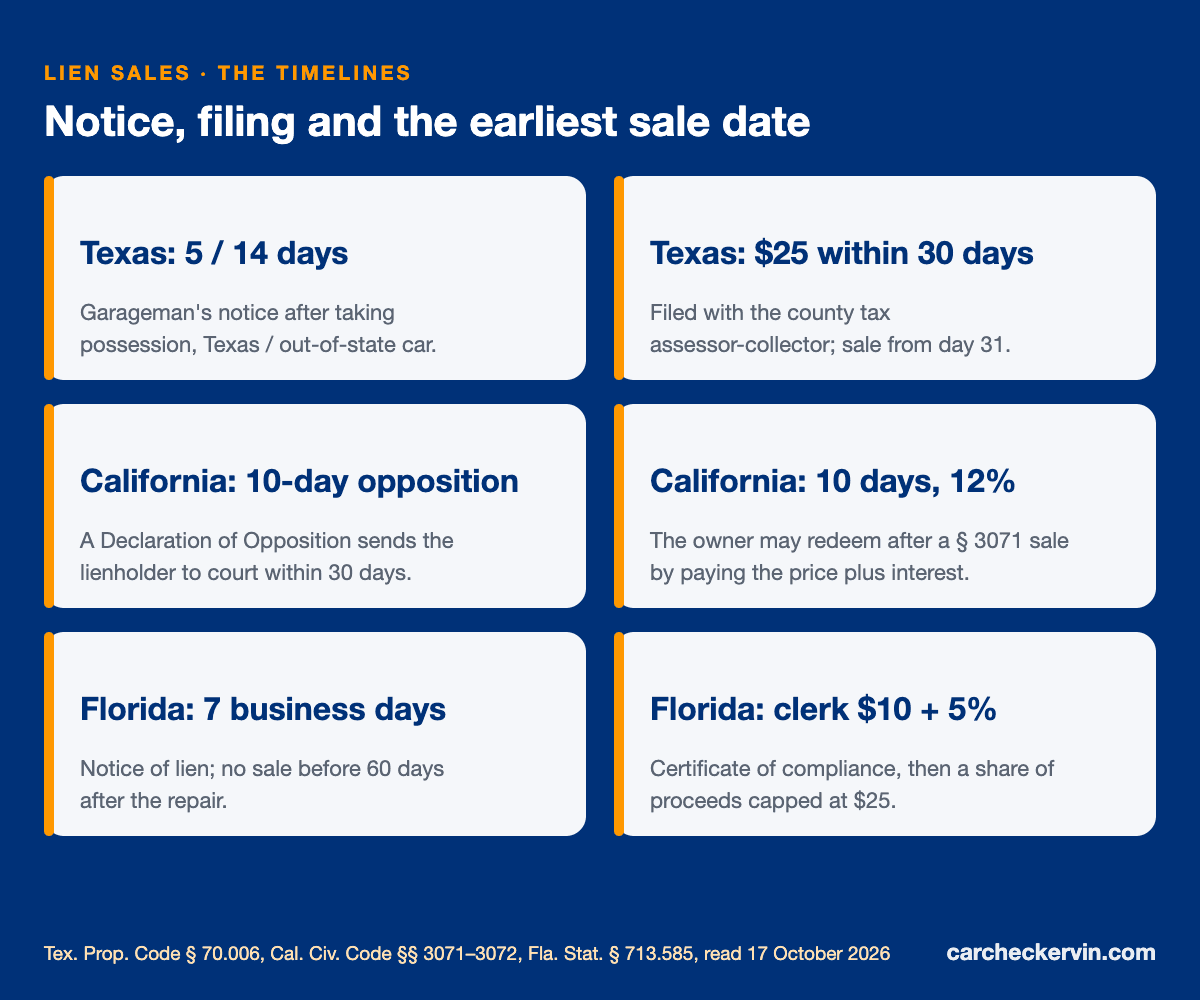
Lien-Sale Timelines in Three States
The notice days, filing fees and earliest sale dates from each statute, side by side.
Every figure is read from the section cited beside it on the date shown.
California: Two Tracks Divided at $4,000
Civil Code §§ 3071 and 3072, with the forms the DMV names in its lien-sale handbook.
Over $4,000: DMV authorization
Apply with REG 656 and the filing fee within 30 days of the lien arising. The DMV notifies the owners by certified mail and tells any out-of-state registry. If no one opposes, it sends the authorization.
$4,000 or less: owner lookup
Request the record with INF 1126 within 15 days, then mail the Notice of Pending Lien Sale (REG 668) with a blank Declaration of Opposition; set the sale 31–41 days from mailing and post the notice for 10 days.
The Declaration of Opposition
An owner who returns it within 10 days stops the sale; the DMV tells the lienholder within 16 days, and the lienholder must sue within 30 days and win, or obtain a release, or prove the declarant could not be served.
Advertising the sale
High track: a newspaper ad 5–20 days before and a Notice of Pending Lien Sale 20 days before to owners and the DMV. Both tracks: the car on view for 1 hour before, no sealed bids.
10-day redemption
Under § 3071 the owner may redeem within 10 days after the sale by paying the sale amount and costs with 12% interest; only then are the lien sale documents delivered to the buyer.
After the sale
The seller destroys the plates and files a Notice of Release of Liability within 5 days; the DMV keeps it 2 years. A sale that skips any step is void.
Florida: § 713.585 for Shops, § 713.78 for Tow Yards
A Florida repair shop enforcing its lien sends notice by certified mail to the registered owner, the customer named on the repair order and every lienholder shown in FLHSMV's records or those of the state where NMVTIS says the car is titled, within 7 business days after storage charges begin and never less than 30 days before the sale. The envelope carries the last 8 digits of the VIN. The vehicle may not be sold earlier than 60 days after the repair was completed; if the sale date was not in the notice of lien, a separate notice of sale goes out at least 15 days before. The shop files a certificate of compliance with the clerk of the circuit court for a $10 charge, and the owner may post a bond or demand a hearing at any time before the sale.
After the sale the clerk receives 5% of deposited proceeds, capped at $25, and the certified certificate of compliance, report of sale, notices and NMVTIS proof together "constitute satisfactory proof for application to the Department of Highway Safety and Motor Vehicles for transfer of title". Tow yards follow § 713.78 instead: a sale free of prior liens 35 days after storage for an older-model vehicle or 57 for a newer one, notice at least 30 or 52 days before, a title discharged of all liens, and, if the car is only scrap, a certificate of destruction for $3 plus a $4.25 service charge after reporting it to NMVTIS.
Florida's numbers
- 7 business days: to send the repair-lien notice.
- 60 days: after the repair before a sale.
- $10 + 5%: clerk's certificate and share, capped at $25.
- 35 / 57 days: tow-yard sale, older / newer model.
Run the VIN on a Lien-Sale Car
Enter the VIN for a free preview of its title brands and odometer readings. The lien sale settles the shop's bill; it does not settle the car's history.
For Buyers: What Comes With the Car
A lien-sale buyer gets the right to a title, not a history. In Texas the buyer at a § 70.006 public sale takes the car with the lienholder's documents and applies to the county for title; a car worth only scrap never reaches a buyer because the shop may route it to a demolisher instead. In California the lienholder completes the DMV's lien sale documents and delivers them to the buyer, who titles the car; the sale is void if the lienholder skipped a step, so ask for the authorization or the mailed notices. In Florida the title after a tow-yard sale is discharged of liens, and the shop's certified clerk documents are the proof FLHSMV accepts.
Three things survive every one of those sales: the title brands recorded against the VIN, the odometer readings reported at earlier title events, and any theft record the police hold. Read the VIN plate at the base of the windshield, compare it with the sale notice, and run it. A car that reached a lien sale because its owner stopped paying for repairs is a car whose maintenance stopped too; the price has to reflect that.
Related Checks and Guides
The abandoned-vehicle pages, the lien checks and the auctions where lien cars are sold.
Where These Facts Come From
From the Texas, California and Florida statutes and the California DMV's handbook, read on 17 October 2026. Procedures change; confirm with the agency before you file or bid.
CarCheckerVIN is not affiliated with any state agency, repair shop or lien-sale service. This page is general information, not legal advice; other states run different procedures.
Prüfen Sie die Fahrgestellnummer immer vor dem Kauf
Die kostenlose Vorschau zeigt Title Brands (US-Titel-Kennzeichnungen), Diebstahlstatus und offene Rückrufe in Sekunden und meldet, ob Unfall- und Tachodaten vorliegen. Die vollständige Historie kostet 19,95 € — einmalig, ohne Abo.
Mechanic's Lien on a Car — Frequently Asked Questions
What shops, owners and buyers ask most.
How long before a mechanic can sell my car in Texas?+
After notice to you and your lienholders and the $25 county filing, you may redeem by paying all charges before the 31st day after the filing. From day 31 the shop may hold a public sale. The county must forward you a copy of the filed notice within 15 business days.
Can a mechanic keep my car if I do not pay?+
Yes. A Texas worker who repairs a vehicle may retain possession until the amount due is paid (Property Code § 70.001), and a garageman has the same lien for storage and towing. The lien ends when the shop releases the car, unless your check or card payment bounced and you signed the repossession notice.
What is a Declaration of Opposition?+
The California form an owner or lienholder returns within 10 days of the lien-sale notice. It blocks the sale until the lienholder sues within 30 days and wins, obtains a release, or shows the declarant could not be served.
Does a Florida lien sale clear the lender's lien?+
For a towing-storage sale under § 713.78 the title must be discharged of all liens unless a court orders otherwise. For a repair-lien sale under § 713.585 the shop's certified clerk documents are the proof FLHSMV accepts for a transfer of title; the lender was notified and could have paid the shop to protect its claim.
Can a shop scrap a car instead of selling it?+
In Texas, yes: if the car's only residual value is parts or scrap, or a public sale is uneconomical, the lienholder may dispose of it through the Chapter 683 demolisher route after the notice period (§ 70.006(f-1)). In Florida a tow yard applies for a certificate of destruction ($7.25 in fees) after reporting the car to NMVTIS.
Should I buy a car at a lien sale?+
Only after reading the notices and running the VIN. The sale settles the shop's bill and, depending on the state, the recorded liens; it does not remove salvage or flood brands or odometer history, and a car its owner abandoned at a repair shop has usually gone without maintenance.
Run the VIN Before the Lien Sale
Enter any 17-character VIN for a free preview. The full report lists title brands, NMVTIS junk and salvage records, insurance total-loss records, odometer readings, and auction records with the damage the auction recorded and its photos.
CarCheckerVIN is an independent vehicle-history service and is not affiliated with any state motor vehicle agency, repair shop or towing company. Procedures are summarized from public statutes and are not legal advice. Records in our reports reflect what was reported to our data providers. Our reports do not include police or repair-shop accident entries.
Passende VIN-Abfragen
Weitere Tools, um die Historie jedes Fahrzeugs zu prüfen