Is There a Carfax for Boats? What to Check Instead.
There is no Carfax for boats. Carfax covers cars, SUVs and light trucks, and a boat has no VIN to run. What it has is a 12-character hull identification number stamped twice on the hull, paperwork from the Coast Guard or the state, and often a trailer with a VIN of its own. Here is how to check each one.
Check the Boat Trailer's VIN Free
Enter the trailer's 17-character VIN for a free preview of the records on file. Hull numbers (HINs) are not VINs and will not run here; decode those on our HIN lookup.
Free preview · No sign-up · No owner or personal data
Quick Answer
- Is there a Carfax for boats?
- No. Carfax says its reports cover used cars, SUVs and light trucks from model year 1981 on. Boats are not in it. A boat is identified by a 12-character hull identification number (HIN), not a VIN, and its records sit in different places.
- How do I check a used boat's history?
- Start with the HIN on the transom and the hidden duplicate inside the hull; they must match. Then match it to the paperwork: a Coast Guard Certificate of Documentation or the state title or registration. Have the boat surveyed before you pay.
- Can I run the boat trailer's VIN?
- Yes. A road trailer carries its own 17-character VIN, so it can be checked like a car. Our full report on the trailer VIN is $14.99 after a free preview.
Five checks that stand in for a boat's Carfax
No single report pulls a boat's history together, so you assemble it: the number on the hull, the paper that should match it, the trailer, and a surveyor.
- 1Find the HIN on the transomFederal rules put the primary HIN on the outside of the transom, starboard side, within two inches of the top. On boats without a transom it goes on the starboard side near the stern.
- 2Find the hidden duplicateEvery hull carries a second, identical HIN somewhere unexposed inside the boat or under a fitting. Ask the seller where it is. Two numbers that differ are the clearest warning a boat can give.
- 3Match it to the paperworkThe HIN on the hull should appear, character for character, on the Coast Guard documentation or the state title or registration the seller hands you.
- 4Run the trailer’s VINIf the boat comes on a road trailer, the trailer has a 17-character VIN of its own. That one can be checked like a car, for title brands and salvage records.
- 5Get the boat surveyedPaper tells you who owned it and what it is. A marine surveyor tells you what shape the hull, the engine and the wiring are in.
Why Carfax Has No Boat Reports
Carfax is explicit about what it covers: used cars, SUVs and light trucks, from the 1981 model year onward. Its Buyback Guarantee is written the same way, defining a vehicle as an automobile or light truck. A boat does not fit either definition, so there is nothing to look up.
The deeper reason is the identifier. Every car report is keyed on the 17-character VIN, and the records behind it come from motor-vehicle agencies, auctions, police and repair shops. A boat hull is identified under a separate Coast Guard rule by a 12-character HIN, and a boat's paperwork comes from Coast Guard documentation or a state boating registration.
Search results will show services selling HIN-based “boat history” reports. Before paying for one, ask which sources it actually searches, and do the physical checks below either way, because they are the ones no report can do for you.
Why a boat doesn't run
- It is not a car. Carfax says its reports cover cars, SUVs and light trucks from model year 1981 on. Its Buyback Guarantee defines a vehicle the same way.
- It has no VIN. Car history is indexed by the 17-character VIN. A boat's hull carries a 12-character HIN under a separate federal rule.
- Its paperwork lives elsewhere. A boat's records come from Coast Guard documentation and state boating registrations, not from the motor-vehicle agencies a car report draws on.
The Hull Identification Number Is the Boat's VIN
Federal rules set its format: 12 characters, no slashes, hyphens or spaces, split into four parts. To decode a specific one, use our HIN lookup.
Manufacturer code
A code identifying the builder or, for imports, the importer.
Serial number
Letters or numbers chosen by the builder. The letters I, O and Q are never used.
Month and year
Of manufacture or certification: a letter for the month, A for January through L for December, then the last digit of the year.
Model year
Two digits for the model year.
Two rules make the HIN more useful than it looks. No two boats may be given the same number, and someone who builds a boat for their own use has to get a HIN from the issuing authority in the state where it mainly operates. So a hull with no HIN at all is itself a question for the seller.
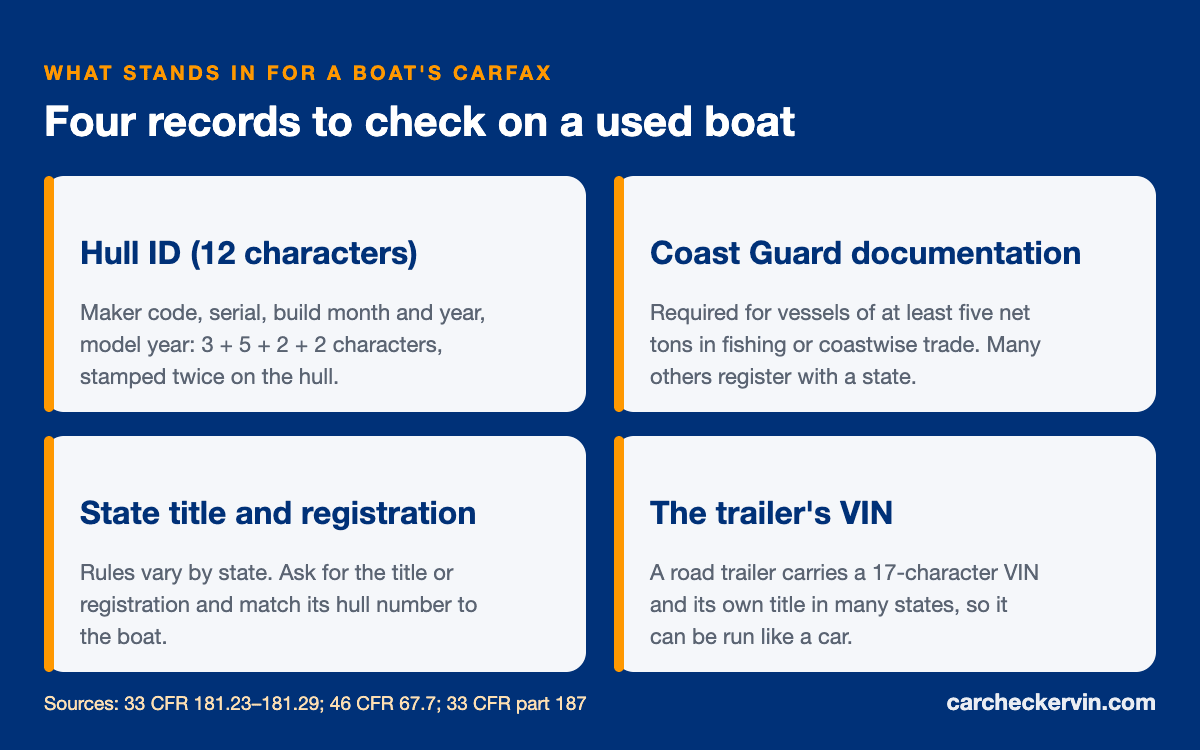
Four Records That Stand In for a Boat's Carfax
The HIN is the key; the records are what it unlocks. Larger working boats are documented with the Coast Guard: vessels of at least five net tons in the fisheries or coastwise trade must carry a Certificate of Documentation. Other boats carry state paperwork, such as a title, a registration or both depending on the state, and the Coast Guard runs a Vessel Identification System that states can elect to join.
Whichever paper the seller has, the check is the same: the HIN on the document must match the HIN on the hull, every character. And if the boat sits on a road trailer, the trailer is a separate vehicle with its own VIN and its own history.
Buying the Trailer Too? Check Its VIN
The trailer is the part of the deal that can be run like a car. Enter its 17-character VIN for a free preview of title brands, salvage records and total-loss records on file.
Signs a Boat's HIN Has Been Tampered With
Each of these follows from the federal HIN rules. None proves a boat is stolen, and each one deserves a straight answer before you pay.
The two HINs differ
Federal rules require 2 identical numbers on every hull. Any difference between the transom and the hidden one needs an explanation before money changes hands.
Signs of grinding or a new plate
The HIN must be fixed so that altering, removing or replacing it would be obvious. Filler, fresh gelcoat or a new plate over the transom number are the obvious signs.
An I, O or Q in the serial
Characters four to eight never use those letters. One of them in the serial means the number was misread, mistyped or made up.
Dates that don't add up
Character nine is a month letter from A to L. A letter past L, or a model year that contradicts the seller's story, is worth questioning.
The Trailer Is the Part You Can Run Like a Car
When a boat is sold with its trailer, it is easy to treat the trailer as an accessory. It is a road vehicle with a 17-character VIN, a title where the state titles trailers, and a history of its own. A trailer that was stolen or written off travels with the boat unless someone checks.
That VIN runs through a vehicle history report like any other. Ours lists title brands, junk and salvage records reported to the federal NMVTIS system, and insurance total-loss records. Our trailer VIN lookup has more on trailer VINs.
What Our Report Covers on a Boat Purchase
Plainly: the trailer, not the boat. We would rather say so here than after you pay.
What it does
- Runs on the trailer's 17-character VIN, not the hull
- Title brands and NMVTIS junk and salvage records
- Insurance total-loss records
- Free preview before you pay
- $14.99 full report, or $9.00 each in a 10-pack
What it does not
- No hull identification number (HIN) search
- No Coast Guard documentation lookup
- No state boat registration records
- No engine hours or maintenance history
- No marine survey: that takes a surveyor
Related Checks and Guides
This page covers why there is no Carfax for boats. These cover the hull number, the trailer and the paperwork.
Where These Facts Come From
The HIN and documentation rules are federal regulations, read from the Electronic Code of Federal Regulations. What Carfax covers comes from Carfax itself.
Boat titling and registration rules differ by state; check with your state's boating agency before you buy. CarCheckerVIN is not affiliated with Carfax or the US Coast Guard.
Siempre verifica el VIN antes de comprar
La vista previa gratis muestra marcas de título, estado de robo y recalls abiertos en segundos, e indica si existen registros de accidentes y odómetro. El historial completo cuesta $14.99 — pago único, sin suscripción.
Carfax for Boats — Frequently Asked Questions
Why Carfax does not cover boats, and how to check a used boat without it.
Is there a Carfax for boats?+
No. Carfax says its reports are available on used cars, SUVs and light trucks from model year 1981 or later, and boats are not among them. A boat is identified by a 12-character hull identification number rather than a VIN, and its records come from Coast Guard documentation and state registrations.
How do I check the history of a used boat?+
Find the HIN on the transom and the hidden duplicate inside the hull, and make sure they match. Match the HIN to the seller's Coast Guard Certificate of Documentation or state title or registration. Run the trailer's VIN if it comes with one, and have a marine surveyor inspect the boat.
What is a HIN on a boat?+
A hull identification number: 12 characters with no spaces or dashes. The first three identify the manufacturer, the next five are the serial number, the ninth and tenth give the month and year of manufacture or certification, and the last two give the model year. Federal rules require two identical HINs on every hull.
Where is the HIN on a boat?+
The primary HIN is on the outside of the transom, starboard side, within two inches of the top of the transom, gunwale or hull-deck joint, whichever is lowest. Boats without a transom carry it on the starboard side near the stern. A duplicate is fixed somewhere unexposed inside the boat.
Can you run a VIN check on a boat trailer?+
Yes. A road trailer has its own 17-character VIN, so it can be checked like a car for title brands, salvage records and insurance total-loss records. Our preview is free and the full report on the trailer VIN is $14.99.
Which boats have Coast Guard documentation?+
Vessels of at least five net tons engaged in the fisheries or coastwise trade must have a Certificate of Documentation. Where a boat is not documented, ask for the state title or registration and check that its HIN matches the hull.
What if the two HINs on a boat don't match?+
Stop and ask why. Federal rules require two identical HINs, fixed so that alteration or replacement would be obvious, and forbid assigning one HIN to more than one boat. A mismatch may have an explanation, but it should come with paperwork.
Check the Trailer by VIN
Enter the trailer's 17-character VIN for a free preview. The full report lists title brands, NMVTIS junk and salvage records and insurance total-loss records.
CarCheckerVIN is an independent vehicle-history service and is not affiliated with Carfax or the US Coast Guard. Carfax is a trademark of its respective owner and is referenced here for comparison only. Our reports run on 17-character VINs and do not search hull identification numbers or boat registration records.
Verificaciones VIN relacionadas
Más herramientas para verificar el historial de cualquier vehículo