Carfax My Garage — Free for the Car You Own
My Garage is Carfax's free vehicle-management feature: add a car you own and it keeps a service log, sends maintenance and recall reminders, and shows a value estimate. What it is not is a route to a free report on a car someone else is selling — and that distinction is what most people searching for it actually need.
Free VIN Preview — Any Car, Owned or Not
Enter the 17-character VIN to see how many title, brand, odometer and salvage records exist for it — with no vehicle registered to any account
Free preview · No sign-up · Instant result
Quick Answer
- Is Carfax My Garage free?
- Yes. My Garage is a free feature of a Carfax account — you add a vehicle by VIN or license plate and the profile costs nothing to keep. The free tier is scoped to cars you ownand register, not to cars you are thinking of buying. A full history report on someone else's car is still a paid product.
- Can I use My Garage to check a car before I buy it?
- No. Adding a stranger's VIN to your account does not open up a free history report on it. For a car you do not own, CarCheckerVIN shows the record counts free — no card, no account — and the full NMVTIS-backed report is $14.99.
- How do I add a car to My Garage?
- Create a free Carfax account, then add the vehicle by its 17-character VIN or by its license plate and state. Once it is in the account, the profile starts collecting service records, maintenance reminders and recall notices tied to that VIN.
What Carfax My Garage Actually Is
My Garage is the vehicle-management side of a Carfax account, and it is a genuinely different product from the report Carfax is famous for. A report is a one-time document you buy about a car, usually one you are considering. A garage profile is an ongoing record you keep for a car that is already yours. The two get confused constantly, because both start with typing a VIN into a box on the same website.
The mental model that helps: a report answers what happened to this car before I met it. A garage profile answers what is happening to my car now, and what is coming up. One looks backward at a vehicle you do not own yet. The other looks forward at a vehicle sitting in your driveway.
Carfax is a legitimate market leader in vehicle history, and My Garage is a reasonable free perk built on top of that position. The friction is that searches for it come from two very different people — owners who want to manage a car, and buyers hoping they have found a shortcut to a free report. Only one of those groups is going to leave satisfied, and it is worth knowing which one you are before you start typing. We weighed up when a paid Carfax earns its price here.
Is Carfax My Garage Free? The Plain Answer
Yes, the garage itself is free. Creating a Carfax account costs nothing, adding a vehicle costs nothing, and keeping the profile costs nothing. There is no trial that quietly expires into a charge for the management features.
What is not free is the vehicle history report. That has always been a paid product and it remains one — a single Carfax report currently runs about $44.99. Owning a car and registering it to your garage does not turn a paid report into a free one, and it certainly does not do so for a car belonging to somebody else. Here is what a report costs across the market.
So the honest summary is short: free to manage a car you own, paid to investigate a car you do not. Our position sits in the second half of that sentence. A free VIN preview here shows how many title, brand, odometer, salvage and total-loss records exist for any VIN, with no account and no card. The full NMVTIS-backed report is $14.99, or $35.99 for three, $54.99 for five and $89.99 for ten if you are shopping several cars at once.
What costs what
- Garage profile
Free - Carfax report
Paid - Our VIN preview
Free - Our full report
$14.99
The free preview returns record counts with no card. You only pay if you want the records themselves. What is actually free at Carfax.
How to Add a Car to My Garage
Four steps, none of them complicated. The one worth pausing on is the third, because that is where the free tier draws its boundary.
Create a free Carfax account
You need an email address and a password. The account itself carries no charge and no card is required to open one. This is also the step that starts the relationship between your inbox and a specific vehicle, so it is worth doing deliberately rather than on autopilot.
Add the vehicle by VIN or plate
Enter the 17-character VIN, or give the license plate and state and let the site resolve it. Every VIN from the 1981 model year onward is 17 characters, and a genuine one never contains the letters I, O or Q — they were dropped so nobody confuses them with 1 and 0.
Confirm it is a car you own
The garage is designed around ownership. You are telling the account that this vehicle is yours, which is what makes the reminders and the service log worth anything. Adding a car you are only considering does not make the profile behave like a history report.
Set mileage and notification preferences
Reminders are driven by mileage and elapsed time, so the profile needs a current odometer reading to produce sensible prompts. Set your notification preferences at the same time rather than after the third message you did not want.
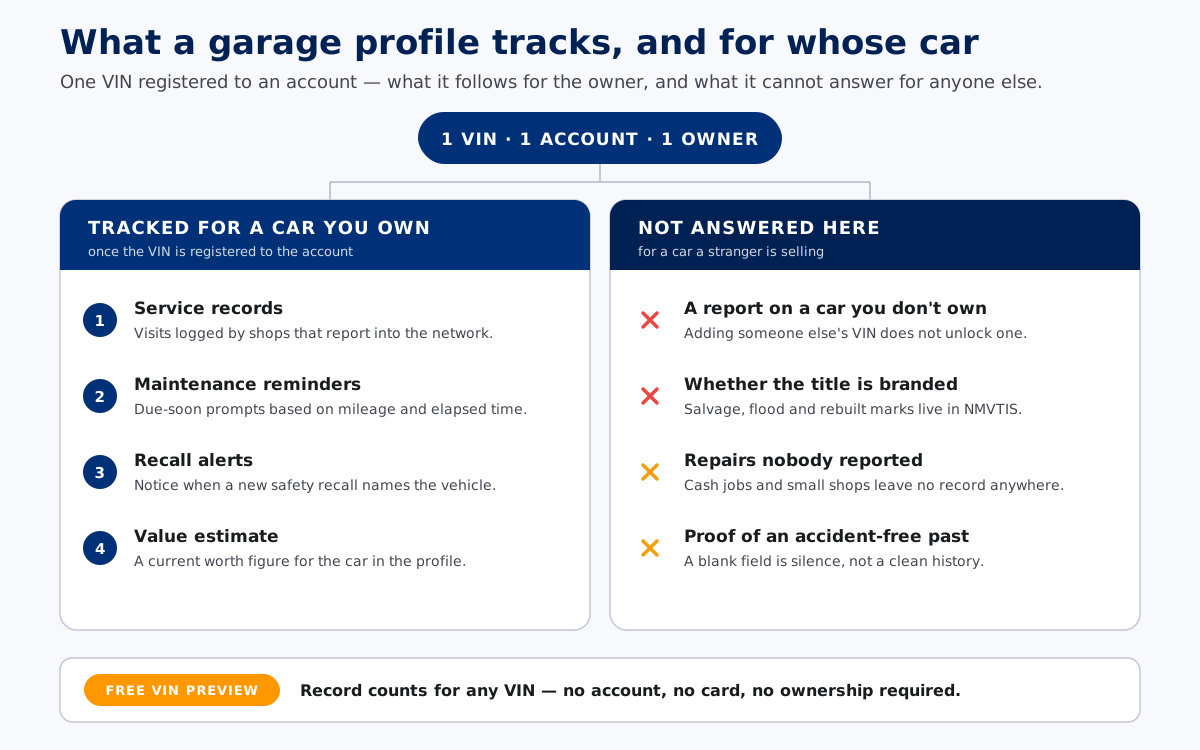
What a Garage Profile Does for a Car You Own
Used for the job it was built for, this is a decent free tool. Here is what an owner gets out of keeping a vehicle in it.
A running service log
Maintenance visits reported by shops in the network get attached to your VIN and accumulate over time. After a few years that becomes a maintenance record you did not have to keep in a shoebox in the garage.
Maintenance reminders
Prompts for oil changes, rotations and scheduled items, timed against your mileage and how long it has been since the last one. Genuinely useful if you are the sort of owner who forgets; redundant if you already keep a calendar.
Recall alerts
A notification when a new safety recall names your make, model and year. Recall repairs are performed free of charge by franchised dealers, so this one costs nothing and occasionally matters a great deal.
A value estimate
A current worth figure for the car in your profile, which is handy when you are weighing whether to sell it, trade it, or run it another year. Treat it as a starting point rather than an appraisal.
Something to hand a buyer
When you eventually sell, a documented service history is a real negotiating asset. Being able to show what was done and when beats telling a stranger you looked after the car.
Several vehicles in one place
Households running more than one car get a single screen for all of them instead of a scattering of paper folders, glovebox receipts and dealer text messages.
None of this requires a payment, and none of it depends on anyone else's car. That is precisely why it cannot do the job people most often hope it will.
Checking a Car You Don't Own Yet?
Enter the 17-character VIN for a free preview of the title, brand, odometer and salvage records on file. No account, no card, and nothing registered to your name.
The Limit That Matters: Cars You Own, Not Cars You're Shopping
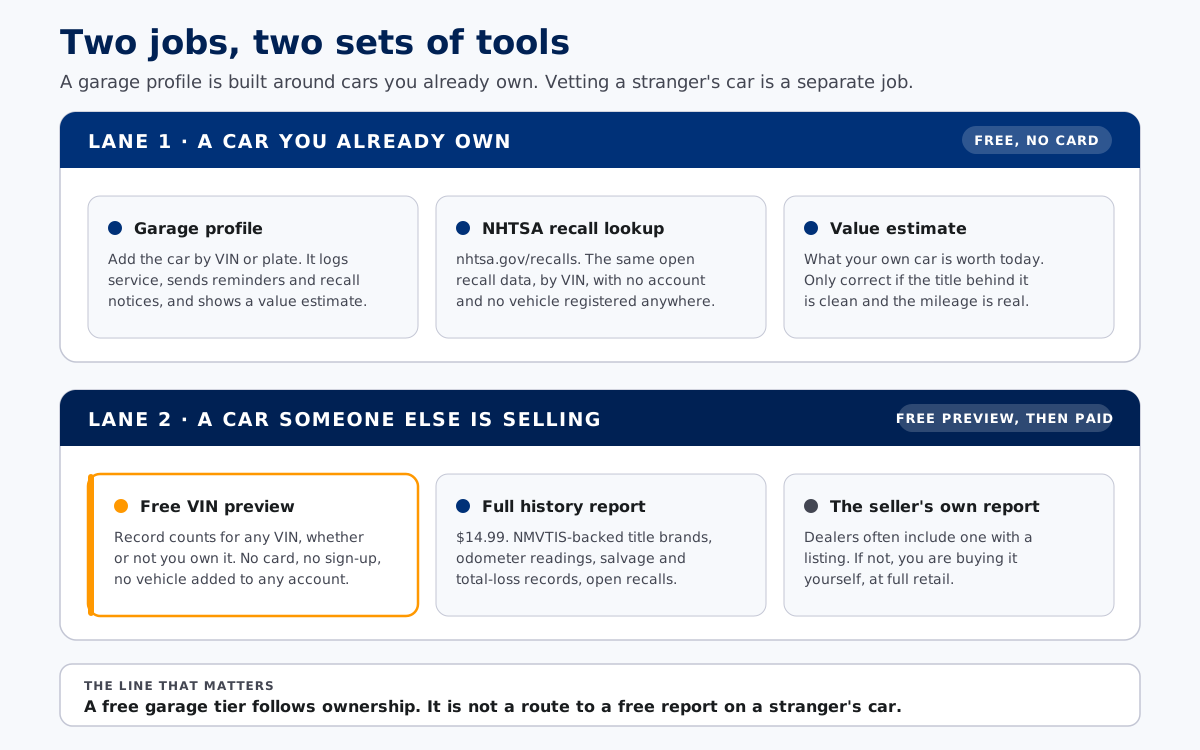
This is the section most people came for, so here it is without hedging. The free garage tier is built around vehicles you own and have registered to your account. It is not a mechanism for pulling a free history report on a car you are thinking of buying.
People try it anyway, and it is easy to see why. The box asks for a VIN, you have the seller's VIN written on your phone, and it seems worth a shot. What comes back is a profile shell — a vehicle identified, reminders offered, a generic value for that model — rather than the title, brand, odometer and salvage record you actually need before handing over money. The paid report is still the paid report.
There is a second reason not to try it. Registering someone else's vehicle attaches a car you have no relationship with to your name and your email, and leaves you managing a profile for something you did not buy. That is clutter at best. The clean way to vet a car you do not own is to run the VIN somewhere that never asks you to claim it.
If the car is not yours yet, you are in the wrong tool. Start with a free VIN check instead — it asks for a number, not a claim of ownership.
Service History — How Records Get Attached to a VIN
Service records reach a garage profile the same way they reach a history report: a shop reports the visit, keyed to the VIN. Franchised dealers and larger service chains commonly participate in that reporting. Independent garages, mobile mechanics and the neighbour who does your brakes generally do not. Nobody is obliged to report anything.
That mechanism explains both the strength and the gap in one breath. A car maintained at a participating dealer its whole life can show a dense, convincing service timeline. The same car maintained by an excellent independent shop two streets away can show almost nothing — and it is the same car, looked after just as carefully.
So read a thin service history as thin evidence rather than as proof of neglect, and read a full one as encouraging rather than conclusive. This cuts both ways when you sell, too. If your shop does not report, the profile will understate how well the car was kept, and your own folder of receipts is worth more than you think.
Recall Reminders in My Garage vs Checking NHTSA Directly
Recall alerts are the strongest thing in the garage feature, and also the thing you can get free without any account at all. Both routes read the same manufacturer recall data. What differs is whether the information comes to you or you go and get it.
| Route | What it gives you | What it asks of you |
|---|---|---|
| My Garage alerts | A notification when a new recall names your vehicle, without you having to remember to check | A free Carfax account, an email address, and the vehicle registered as yours |
| NHTSA lookup | Open recalls for any VIN on demand, straight from the federal source at nhtsa.gov/recalls | Nothing. No account, no email, and it works for cars you do not own |
| Our recall check | Open NHTSA recalls alongside the title, brand and odometer picture for the same VIN | Nothing for the free check itself |
| The dealer | The definitive answer for your exact VIN, plus the repair, performed free of charge | A phone call and an appointment |
If you own the car, the alert is worth having because it arrives without you thinking about it. If you are checking a car you do not own, go straight to the federal lookup or run a recall check — neither asks you to register anything to anybody. Run a recall check on any VIN.
Value Estimates for a Car You Own — and What a Branded Title Does to Them
A value estimate inside a garage profile is a starting point, not an appraisal. Four things move it further than most owners expect.
A branded title takes a large bite
Once a state brands a title salvage, junk, flood or rebuilt, the mark follows the car through every later sale in every state. Buyers discount branded vehicles heavily, some lenders decline to finance them, and some insurers will not write full coverage on one.
The mileage has to be real
Every valuation leans hard on the odometer. If the reading in the profile is wrong — through an honest slip, or through a rollback that happened before you ever owned the car — the estimate is describing a vehicle that does not exist.
You grade the condition yourself
Most owners rate their own car a grade higher than a stranger with cash would. Grading it the way a buyer would grade it produces a number you can actually defend across a table instead of one that makes every offer feel insulting.
Trade-in, private party and retail differ
The same car is worth least to a dealer taking it in, more to a private buyer, and most sitting on a dealer's lot. Quoting the wrong one of those three is the usual reason a perfectly fair offer lands badly.
If you are pricing a car to sell it, confirm the title and the mileage sequence before you settle on a number. Value the exact car by VIN and check the mileage sequence before you settle on a price.
Privacy: What You Share When You Register a VIN
Registering a vehicle to an account is a small trade rather than a frightening one, but it is worth naming what changes when you do it.
The VIN gets linked to you
Your email address becomes associated with a specific vehicle in a commercial database. That association is exactly what makes reminders possible, and it is durable — ignoring the account later does not unpick it.
You are opting into contact
Reminders, alerts and offers arrive by email or push notification. Set your preferences when you create the account rather than working out how to turn them down after the fact.
Ownership signals have commercial value
Knowing which specific vehicle a person owns, and roughly when it will next need work, is useful to dealers, service chains and insurers. Reading the privacy policy of any service before you register a car to it is ordinary caution, not an accusation.
A lookup asks for none of this
Running a VIN through a check does not create a profile, register a vehicle, or attach a car to your name. If you only want to know something about a car, a lookup is by far the smaller ask.
What to Use When You're Checking Someone Else's Car
Different job, different sequence. Three moves, and the first one costs nothing.
Preview the VIN before you drive across town
Enter the 17-character VIN and read the free record counts — how many title, brand, odometer, salvage and total-loss entries exist for that specific car. No account, no card, and no vehicle claimed to your name. Do this before you fall in love with the photos.
Pull the full record if anything shows
If brand, salvage or total-loss counts come back above zero — or the car is expensive enough that you want certainty either way — the full NMVTIS-backed report is $14.99 and gives you the dates, the states, the readings and the specific brand applied.
Then inspect it in person
No database is complete, and none of them can hear a wheel bearing. A report tells you what was reported. A mechanic tells you what is true today. Buyers who skip the second half are the ones who get surprised in month three.
Run in that order, the free preview does the filtering, the $14.99 report does the confirming, and the inspection catches what no record ever held. See what a reported-accident check covers.
Free Tools That Cover the Same Jobs
Almost everything a garage profile does for free has a free equivalent that never asks you to register a vehicle. Stack them and you get a long way for nothing.
NHTSA recall lookup
Enter a VIN and see open safety recalls that have not yet been repaired. It works for any vehicle, yours or not, with no account and no email address. Recall work is performed free of charge at a franchised dealer, so this check can save you a repair bill and a real safety risk.
NHTSA vPIC decoder
The federal decoder returns the manufacturer, model year, body style, engine and assembly plant encoded in a VIN, at no cost. It confirms a VIN is structurally valid and describes the car it belongs to. It holds no history records at all.
NICB VINCheck
The National Insurance Crime Bureau runs a free lookup that flags whether a VIN was reported stolen and not recovered, or reported as a salvage or total loss by a participating insurance member. Coverage is limited to participating members, so a clean result is not a guarantee — but a hit is decisive.
Our free VIN preview
Record counts for any VIN before any payment: how many title, brand, odometer, salvage and total-loss entries are on file. A car with salvage entries is not one you need a paid report to walk away from.
What none of the free tools gives you is the detail — the dates, the states, the specific brand applied, the reading recorded at each title transfer. That is what a paid NMVTIS-backed report is for, and it is why ours is $14.99 rather than the price of a full commercial report. Cheaper ways to get the same core facts.
Tools That Pair With a Garage Profile
Manage the car you own in a garage. Vet the car you are buying with these.
Siempre verifica el VIN antes de comprar
La vista previa gratis muestra marcas de título, estado de robo y recalls abiertos en segundos, e indica si existen registros de accidentes y odómetro. El historial completo cuesta $14.99 — pago único, sin suscripción.
Carfax My Garage — Frequently Asked Questions
The questions people ask most when they search for My Garage.
Is Carfax My Garage free?+
Yes. Creating a Carfax account is free, adding a vehicle to My Garage is free, and keeping the profile is free — there is no trial that expires into a charge for the management features. What is not free is the vehicle history report, which has always been a paid product sold at its own retail price. The free tier covers managing cars you own and register to the account, not investigating cars you are considering buying.
Can I use My Garage to get a free Carfax on a car I want to buy?+
No. This is the single most common misunderstanding about the feature. My Garage is built around ownership: you add a vehicle that is yours, and the profile then tracks service, reminders and recalls for it. Adding a seller's VIN to your account does not hand you a history report on that car, and it leaves you managing a profile for a vehicle you never bought. For a car you do not own, run the VIN through a check that does not ask you to claim it — CarCheckerVIN shows the record counts free with no card, and the full NMVTIS-backed report is $14.99.
How do I add a car to Carfax My Garage?+
Create a free Carfax account with an email address and a password, then add the vehicle by its 17-character VIN or by its license plate and state. Every VIN from the 1981 model year onward is 17 characters, and a genuine one never contains the letters I, O or Q. Once the vehicle is in the account, set a current odometer reading so the mileage-based reminders make sense, and check your notification preferences before the first alerts start arriving.
Does having my car in My Garage give me a free history report on it?+
What an owner sees about their own registered vehicle varies, and we are not going to guess at the specifics of any particular account. What is not in doubt is the boundary, and the boundary is the part that matters: whatever is shown is scoped to the vehicle registered as yours. It does not extend to a car a stranger is selling, which is the case people are usually asking about. For that car, a full history report is a paid product wherever you buy it.
Where do the service records in My Garage come from?+
Shops report the visit, keyed to the VIN. Franchised dealers and larger service chains commonly participate in that reporting; independent garages and mobile mechanics frequently do not, and no shop is obliged to report anything. That is why a car serviced at a participating dealer can show a dense timeline while an identically well-maintained car serviced by a good independent shop shows almost nothing. Read a thin service history as thin evidence rather than as proof of neglect — and keep your own receipts, because they may be the only record of work that was genuinely done.
Is the value estimate in My Garage accurate?+
It is a reasonable starting point for a normal car with an honest title and a truthful odometer reading, which describes most vehicles. It stops being accurate the moment one of those assumptions fails. A branded title — salvage, junk, flood or rebuilt — takes a large bite out of resale value and follows the car through every subsequent sale. A rolled-back odometer inflates every input at once. Before you price a car to sell, confirm the title is unbranded and the mileage sequence climbs the way it should.
Do I need an account to check recalls on a car?+
No. NHTSA's free recall lookup at nhtsa.gov/recalls returns open safety recalls for any VIN with no account, no email address and no vehicle registered anywhere — and it works for cars you do not own, which a garage profile does not. The advantage of a garage alert is that it comes to you rather than requiring you to remember to look. If you own the car, the alert is worth having; if you are checking someone else's, go straight to the federal source.
What should I use instead when I'm buying a used car?+
Run the VIN before you spend a Saturday on the car. A free preview here returns the record counts — how many title, brand, odometer, salvage and total-loss entries exist for that specific vehicle — with no account and no card, which is often enough to walk away at no cost. If anything shows, or the car is expensive enough that you want certainty either way, the full NMVTIS-backed report is $14.99, with $35.99 for three, $54.99 for five and $89.99 for ten if you are looking at several cars. Then pair whatever you find with a pre-purchase inspection, because no database can hear a wheel bearing.
Run the VIN Without Registering the Car
Keep the car you own in a garage if you find it useful. For the car you are about to buy, check the VIN here — free record preview first, full NMVTIS-backed report for $14.99 only if you want it.
Title, brand, odometer and salvage records are sourced from NMVTIS via a licensed provider; recall data from NHTSA, and specifications from NHTSA vPIC. No history database is complete; pair any report with a pre-purchase inspection. CarCheckerVIN is not affiliated with Carfax; Carfax and My Garage are trademarks of their respective owner.
Verificaciones VIN relacionadas
Más herramientas para verificar el historial de cualquier vehículo