Carfax Red Flags — What to Look For Before You Buy.
Most people open a Carfax, look for the words "no accidents" and stop. The entries that cost buyers money are usually elsewhere: a title brand from another state, a mileage reading lower than the one before it, four owners in three years, a VIN that belongs to a different car. Here are the 7 entries that should stop a purchase, the ones that only need a question, and what the labels mean.
Check the Title and Mileage Lines Yourself
Enter the VIN for a free preview of title, brand and odometer records from every state, then compare them with the report you were shown.
Free preview · No sign-up · No owner or personal data
Quick Answer
- What is a red flag on a Carfax report?
- A branded title (salvage, rebuilt, flood, fire, hail, lemon or buyback), any odometer reading lower than an earlier one, a mileage brand such as True Mileage Unknown, structural damage or an airbag deployment, an insurance total loss, and any detail that doesn't match the car or the seller's story. Each of these is a reason to walk away or to price the risk in.
- What is considered a bad Carfax?
- One with a branded title, mileage that goes backwards, damage reaching the structure, or a history that contradicts what the seller told you. A single minor damage entry, a lease or fleet history, or a gap in service records is not bad by itself; those are questions to ask, not reasons to leave.
- What does corporate fleet vehicle mean on Carfax?
- A company owned or leased the car rather than a person. AutoCheck's glossary gives a company car provided for an executive as the example of a fleet vehicle and says fleet and leased vehicles are often in good condition. Look at the miles per year and the service record rather than the label.
Five passes through a Carfax before you trust it
The order matters: the first two passes can end the deal in a minute, so do them before you read the service history.
- 1Match the report to the carCompare the VIN, engine and trim on the report with the dashboard VIN and the door-jamb sticker. A mismatch ends the read.
- 2Read the title sectionAny brand, in any state the car has been titled in. A brand from an earlier state still counts.
- 3Read the odometer readings by dateEvery reading should be higher than the one before it, and the last one lower than the dash shows today.
- 4Count the owners and the usesHow many owners, how long each kept it, where it was registered, and whether it was personal, fleet, rental or commercial.
- 5Then the damage and service linesWhere the damage was and how severe, then whether the service record has long gaps.
The Red Flags That Should Stop the Deal
These are the entries that change what the car is, not just what it's worth. A brand on the title follows the VIN for life and cuts resale value; a broken mileage history means nobody can tell you how worn the engine really is; structural damage means the crash reached the parts that protect you in the next one.
None of them is automatically a reason never to buy. A rebuilt car at a rebuilt price, inspected by your own mechanic, can be a fair deal. But each one should either end the conversation or change the price by a lot, and a seller who didn't mention it has told you something else about the sale.
7 entries to stop on
- A branded title. Salvage, rebuilt, junk, flood, fire, hail, or lemon / manufacturer buyback anywhere in the title section, in any state.
- Mileage that goes backwards. Any odometer reading lower than an earlier one. AutoCheck calls a DMV reading below a previous one an odometer rollback.
- A mileage brand. Not Actual Miles, True Mileage Unknown or Exceeds Mechanical Limits: the record itself says the number on the dash is wrong or unknowable.
- Structural damage or an airbag deployment. Carfax groups these with total loss in its accident and damage section. They mean a crash serious enough to reach the car's structure or its restraints.
- An insurance total loss. An insurer paid the car out. Check whether the title was branded afterwards; if not, ask why.
- A report that doesn't match the car. Different engine, trim, color or VIN from the car in front of you. Carfax names VIN cloning as one of the top scams experts warn about.
- A report that doesn't match the story. One owner on the seller's lips and four on the report, or "never in an accident" against a damage entry.
Yellow Flags: Entries That Need a Question, Not a Walk-Away
These show up on plenty of good cars. Each one has an innocent explanation and a bad one, and the rest of the report usually tells you which.
Several owners in a short time
A young car that changed hands every year or so may have a problem people keep passing on. Ask why the last owner sold it, and check whether the sales were to dealers or to private buyers.
Repeated trips through auction
Wholesale auctions are normal for trade-ins and lease returns. The same car going back to auction again and again is the pattern to ask about.
Gaps in the service record
Dealer service departments are more likely than independent garages to report maintenance, and owners who change their own oil leave no record at all. Ask for receipts before you assume neglect.
A minor damage entry
Reported damage is not the same as a serious crash. Where it was and how bad it was matter more than the fact that it was reported.
Fleet, rental or lease use
Fleet and lease cars are often well kept. Rental, taxi and livery use mean many drivers and hard miles. Read the use label next to the miles per year.
Registered in a flood area
A registration or service entry in an area hit by a major flood around the date of the storm is a reason to inspect for water damage, even with no flood brand.
A failed emissions or safety inspection
Carfax's timeline can include emissions and safety test results. A failure followed by a pass is normal. A failure followed by a sale is a question.
A loan or lien entry
Carfax's detailed history can track vehicle loans. Make sure any lien is released before money changes hands, or the lender may still have a claim on the car.
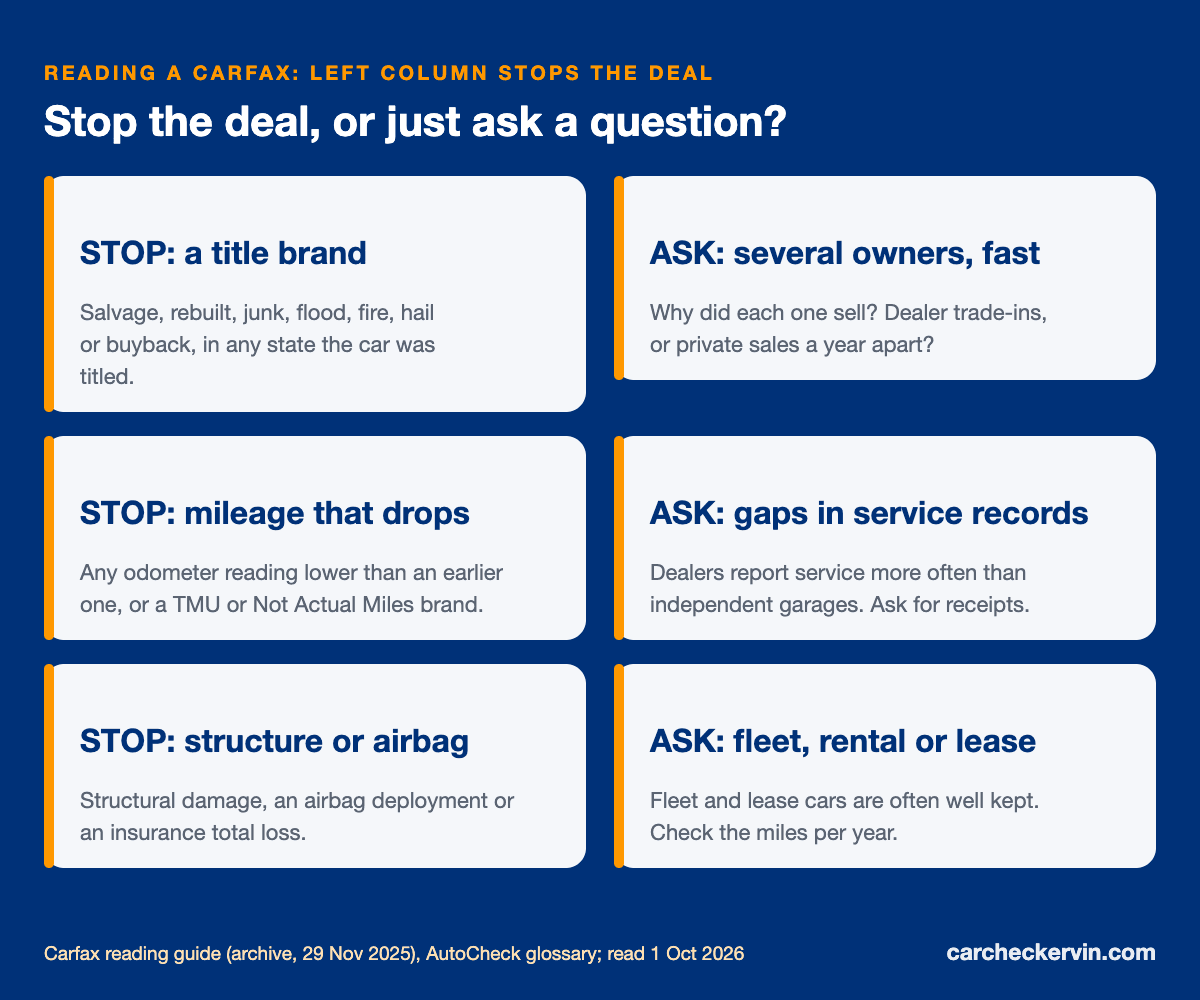
Deal-Breakers vs Questions, Side by Side
Sort every entry into one of two piles as you read. The left pile changes what the car is: a brand, a broken mileage history, structural damage, a VIN that doesn't match. The right pile changes what you ask: why the last owner sold it, where the service records are, what the damage estimate was.
If an entry lands in the left pile, stop and decide whether you still want the car at a price that reflects it. If everything is in the right pile, get your answers in writing and book an independent inspection before you pay.
What the Odometer Terms on a Report Mean
An odometer rollback flag means a reading reported on a later date was lower than one reported earlier. AutoCheck's glossary defines it exactly that way for DMV readings. One low reading can be a typo at a service desk, and the next reading will usually be back on track; a run of low readings after a sale is the pattern that matters. Compare the last reading on the report with the dash: the dash should never show less.
Not Actual Miles and True Mileage Unknown are title brands, not data glitches. They say the mileage on the odometer is known to be wrong, or that nobody can say what it is. Exceeds Mechanical Limits means the car has done more miles than the odometer can display, usually a five-digit odometer that has passed 99,999. All three mean the number on the dash cannot be used to price the car.
Exempt from odometer reporting is different, and usually harmless. Under 49 CFR 580.17, a car from model year 2010 or earlier stops needing a mileage disclosure 10 years after January 1 of its model year, so every one of them was exempt by January 2020. A model-year 2011-or-newer car needs a disclosure for 20 years; the first of them leave the rule in January 2031. "Exempt" on an older car means the paperwork stopped asking, not that someone hid the mileage, but it also means the last few readings were never certified, so check wear against the dash.
Vehicle-Use Labels: Fleet, Rental, Lease, Commercial
Carfax's ownership section shows whether each owner used the car for personal or commercial purposes. AutoCheck publishes definitions for the same labels; this is what they mean, and whether to care.
Fleet / corporate fleet / lease
Owned or leased by a company. AutoCheck's example is a company car provided for an executive and notes fleet and leased cars are often in good condition. Usually fine.
Rental
AutoCheck counts car rental under commercial use. Many drivers, often high miles in a short time. Check the miles per year and the tires and brakes.
Commercial
Registered and used for business, such as a delivery truck, taxi or rental, by AutoCheck's definition. Expect harder use than a personal car.
Taxi, livery or police
Taxi use, livery use ("for hire", carrying passengers) and police use are separate labels. Long idle hours and heavy duty cycles. Price them accordingly.
Government use
Used by a federal, state or local agency. Often maintained on a schedule; check what kind of agency and how many miles.
Driver education
Used to teach people to drive, by AutoCheck's definition. Many novice drivers. Look closely at the clutch, brakes and body corners.
Check the Title and Odometer Lines Against Another Source
Enter the VIN for a free preview of title brands and odometer records from every state. Compare it with the report you were shown.
Reading the Damage Section Without Over- or Under-Reacting
Carfax's own guide says the accident and damage section runs "from airbag deployment to structural damage to total loss", and that the detailed history may include a Damage Severity Scale: a drawing of where the car was hit and a scale of how bad the damage was. Those two pieces of information matter far more than the bare fact that damage was reported.
A light hit to one corner with no airbag deployment is the kind of entry many good used cars carry. Damage to several sides, structural damage, or an airbag deployment is the kind that should send the car to a body shop for inspection before you go further. Our page on accident and damage wording on Carfax goes through the severity terms one by one.
The Red Flags a Report Can't Show You
Carfax is clear that its reports are built only from information supplied to it and that it does not have the complete history of every vehicle. A crash paid in cash, a repair at a shop that doesn't report, or a flood that never reached an insurer leaves no entry at all. A clean report narrows the risk; it doesn't remove it.
The FTC makes the same point from the other side: a vehicle history report may list accidents and flood damage, but typically it won't list mechanical problems, and it is not a substitute for an independent inspection. Paint that doesn't match, uneven panel gaps, a damp carpet and a worn pedal on a low-mileage car are red flags you find with your own eyes.
What a Second Report Can Confirm
Two reports from different sources won't hold identical records. Use a second one to confirm the parts of the first that matter most: the title and the mileage.
Check on the report you were given
- The VIN, engine and trim match the car
- Owner count and how long each kept it
- Damage location and severity
- Service record and gaps
Confirm with our $14.99 report
- Title brands from every reporting state
- Odometer readings by date
- Insurance total-loss and salvage records
- Auction records with the auction's photos
Our report does not include police or repair-shop accident entries; use the first report for those.
Related Checks and Guides
More on reading a history report, and the checks that go with it.
Where These Facts Come From
Definitions on this page come from the report publishers' own guides and federal rules, read on 1 October 2026.
Report formats change. The labels above are the publishers' own; a given report may word an entry differently.
Siempre verifica el VIN antes de comprar
La vista previa gratis muestra marcas de título, estado de robo y recalls abiertos en segundos, e indica si existen registros de accidentes y odómetro. El historial completo cuesta $14.99 — pago único, sin suscripción.
Carfax Red Flags — Frequently Asked Questions
The questions buyers ask most about what they're seeing on a report.
What is a red flag on a Carfax report?+
A branded title (salvage, rebuilt, junk, flood, fire, hail, lemon or buyback), an odometer reading lower than an earlier one, a mileage brand such as Not Actual Miles or True Mileage Unknown, structural damage or an airbag deployment, an insurance total loss, and any detail that doesn't match the car or the seller's story.
What's considered a bad Carfax?+
A report with a branded title, mileage that goes backwards, damage reaching the structure, or a history that contradicts the seller. A minor damage entry, a lease history or a gap in service records on its own is a question to ask, not a bad report.
What does corporate fleet vehicle mean on Carfax?+
A company owned or leased the car. AutoCheck's glossary uses a company car provided for an executive as its example of a fleet vehicle and says fleet and leased vehicles are often in good condition. It is not a red flag by itself; check the miles per year.
Is a rental car on Carfax a red flag?+
It is a yellow flag. AutoCheck counts car rental as commercial use: many drivers and often high miles in a short time. Check the mileage per year, the tires and brakes, and whether the service record is complete before you pay a personal-use price.
What does exempt from odometer reporting mean on Carfax?+
The car is old enough that federal law no longer requires a mileage disclosure when it is sold. Under 49 CFR 580.17 that is 10 years after January 1 of the model year for model year 2010 and older, and 20 years for model year 2011 and newer. It is normal on an older car, but it means recent readings were never certified.
What does TMU mean on Carfax?+
TMU is True Mileage Unknown: the actual mileage is unknown and the reading on the dash can't be relied on. It appears as a title brand in some states and as an auction announcement in AutoCheck's glossary. Treat the dash reading as meaningless and price the car on its condition.
Should I worry about minor damage on Carfax?+
Look at where the damage was and how severe the report says it was. A light hit to one corner with no airbag deployment is common on good used cars. Damage to several sides, structural damage or an airbag deployment calls for a body-shop inspection before you buy.
Is a gap in service records a red flag?+
Not on its own. Dealer service departments are more likely than independent garages to report maintenance, and owners who do their own oil changes leave no record. Ask for receipts; a long gap with no explanation on a car with a known maintenance-sensitive engine is worth more concern.
Check the Title and Mileage Before You Trust the Rest
Enter the VIN for a free preview of title brands and odometer records from every state, then open the full report if the car is still worth it.
CarCheckerVIN is not affiliated with Carfax, Inc. or with AutoCheck/Experian; Carfax and AutoCheck are trademarks of their owners and are named here only to explain their reports. Definitions are quoted from the publishers' pages as read on 1 October 2026. Records in our reports reflect what was reported to our data providers. Our reports do not include police or repair-shop accident entries.
Verificaciones VIN relacionadas
Más herramientas para verificar el historial de cualquier vehículo