How to check a VIN before you buy
Most people buy a report first and look at the car afterwards. Reverse it. Four of the five checks below are free, and any one of them can end the deal before the paid step is worth taking.
Start with the free decode
Seventeen characters in, the factory build out. No account.
No account · Nothing stored · $14.99 only for the full report
Quick Answer
- How do I check a VIN before buying a car?
- Read the 17 characters in three places — the windshield base, the driver's door jamb sticker and the title — and confirm they match. Then decode it free, check NHTSA recalls free, check NICB VINCheck free, and buy the title history last, for $14.99.
- Why does the order matter?
- Because four of the five steps cost nothing and any one of them can end the deal. Running them first means you never pay for a report on a car a free check would have rejected.
- Where is the VIN on a car?
- At the base of the windshield on the driver's side, visible from outside; on a sticker in the driver's door jamb; and printed on the certificate of title. Some cars also stamp it on the firewall or strut tower.
Where to find the number
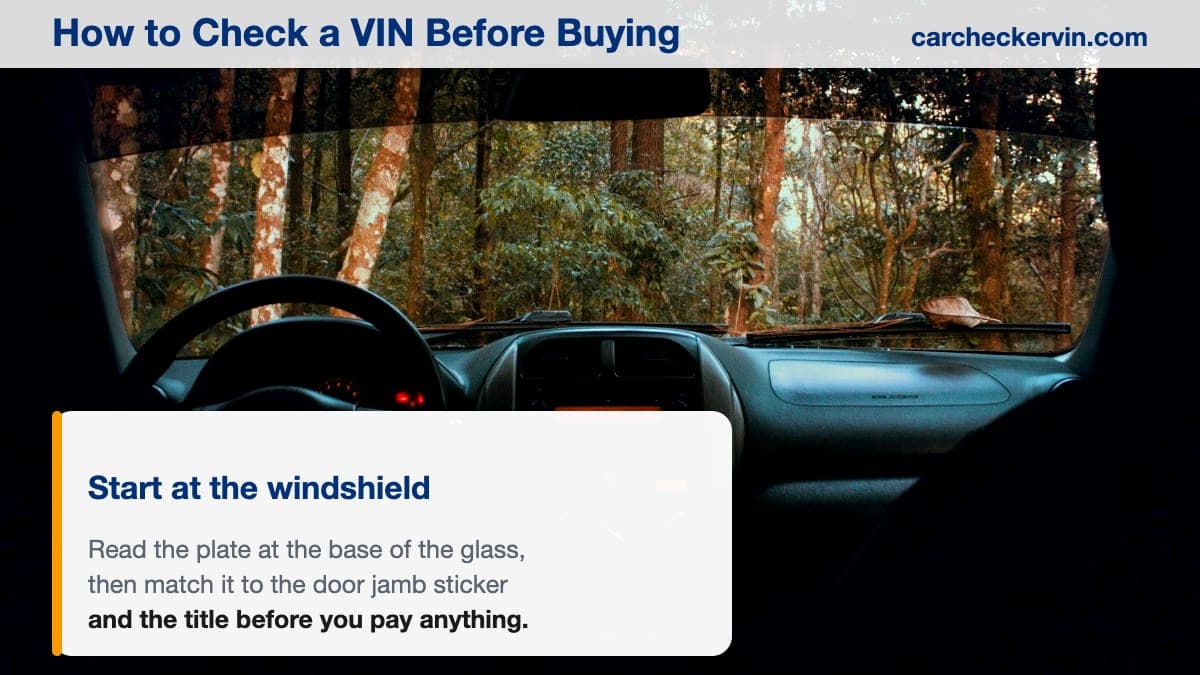
49 CFR Part 565 states that each VIN shall consist of seventeen characters, and fixes what each position carries. On a modern car that number appears in at least three places, and they must all agree:
- At the base of the windshield on the driver's side, readable from outside the car.
- On a sticker in the driver's door jamb, usually alongside tyre pressures and the build date.
- Printed on the certificate of title, which is the one the seller has to show you.
Many cars also stamp it on the firewall, a strut tower or the chassis rail. A windshield plate that looks riveted, disturbed or differently finished from the rest of the trim is worth a second look — factory plates are not replaced casually.
The five checks, in order
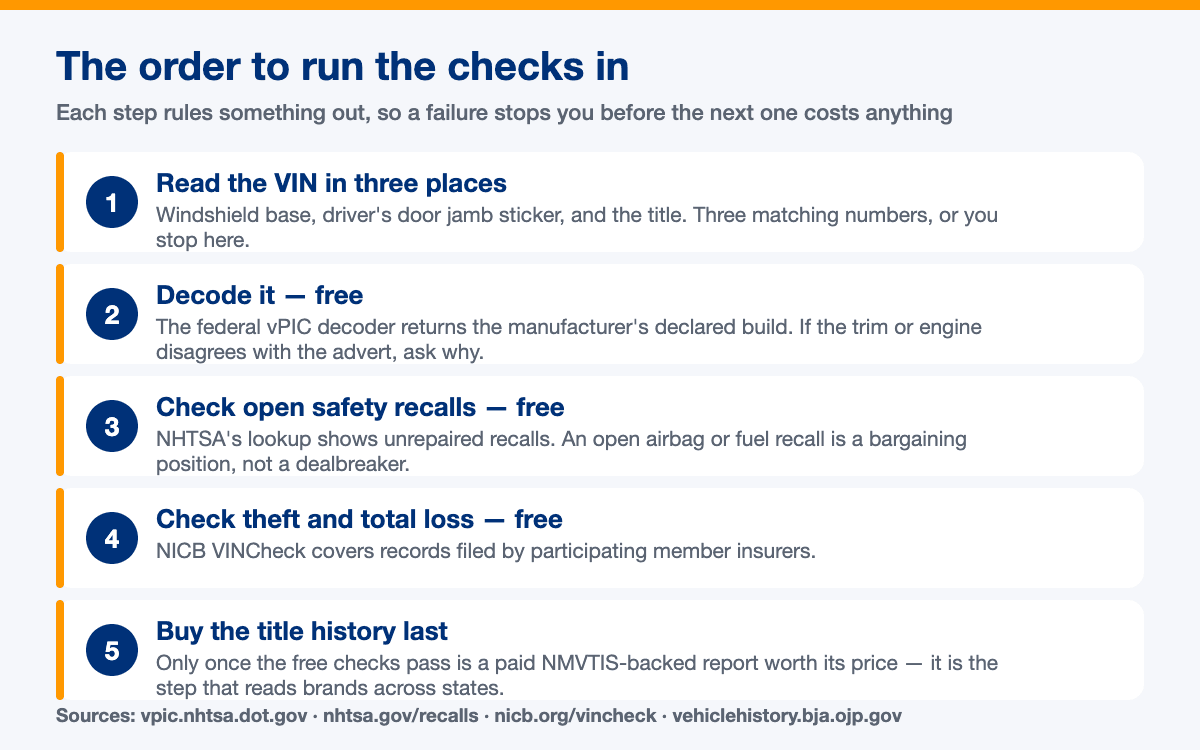
- 1
Read it in three places — free
Windshield, door jamb, title. A mismatch is one of the very few signals that cannot be talked away, and it is the check that catches a re-tagged car.
- 2
Decode it — free
The federal vPIC decoder returns the manufacturer's declared build. If the advert says one engine or trim and the decode says another, you have a question to ask before anything else.
- 3
Check open safety recalls — free
NHTSA's lookup returns unrepaired recalls. A franchise dealer must fix a safety recall at no cost, so this is leverage rather than a dealbreaker.
- 4
Check theft and total loss — free
NICB VINCheck covers records filed by participating member insurers. Not universal coverage, but a different dataset from any commercial report.
- 5
Buy the title history — $14.99
Only now. An NMVTIS-backed report reads salvage, junk and flood brands across state lines, which is the thing none of the free steps does.
Decode it now, free
Step two of five. The title history is $14.99 when you are ready for it.
What each position in the VIN means
| Positions | What they carry |
|---|---|
| 1 – 3 | World Manufacturer Identifier: who built it and where. |
| 4 – 8 | Vehicle descriptor: model line, body style, engine, restraint system. |
| 9 | Check digit — a calculated value that validates the other sixteen. |
| 10 | Model year. |
| 11 | Assembly plant. |
| 12 – 17 | Sequential serial number for that plant and year. |
Structure defined by 49 CFR Part 565. The check digit at position 9 is why a single mistyped character usually fails validation rather than silently returning somebody else's car.
What a VIN check cannot tell you
No VIN check reports a crash that was repaired privately for cash, wear that has not failed yet, or how the car has been driven. The VIN tells you what is on the record. A lift and an independent mechanic tell you about the car.
Sources
- NHTSA vPIC VIN Decoder
The federal decoder that turns a VIN into the manufacturer's declared build.
- 49 CFR Part 565 — Vehicle Identification Number Requirements
The federal rule fixing the VIN at 17 characters and defining each position. Read 19 September 2026.
- NHTSA Recalls by VIN
The federal safety-recall lookup: free, by VIN, covering unrepaired recalls.
- NICB VINCheck
The National Insurance Crime Bureau's free lookup for theft and total-loss records reported by participating member insurers.
- NMVTIS — U.S. Department of Justice
The Justice Department's consumer entry point for the National Motor Vehicle Title Information System. Read 19 September 2026.
Siempre verifica el VIN antes de comprar
La vista previa gratis muestra marcas de título, estado de robo y recalls abiertos en segundos, e indica si existen registros de accidentes y odómetro. El historial completo cuesta $14.99 — pago único, sin suscripción.
Keep reading
Frequently asked questions
How many characters should a VIN have?+
Seventeen. 49 CFR Part 565 states plainly that "each VIN shall consist of seventeen (17) characters", and it fixes what each position carries — including the check digit, which the rule places at position nine. The regulation's year-code table runs from 1980 onwards. A number of a different length on a modern car is either a typo or not a VIN.
What does a free VIN decode tell me?+
The manufacturer's declared build: model year, assembly plant, make, model line, body style, engine and restraint system. It describes what the car was when it left the factory, which is exactly what you need to catch an advert describing a different trim.
Why check the VIN in three places?+
Because a mismatch is one of the few signals that is nearly impossible to explain away. Cloned and re-tagged cars usually fail here first, and the check costs nothing but a minute of daylight.
Is the NHTSA recall check worth running separately?+
Yes. It is free, it is run by the safety regulator itself, and it returns recalls that have not been repaired. A franchise dealer must fix an open safety recall at no cost to you, so finding one before you buy is useful leverage rather than a reason to walk.
What does NICB VINCheck cover?+
Theft records and total-loss records filed by participating member insurers. Because participation is not universal, a clean result narrows the risk without eliminating it — which is why it is a step rather than the answer.
What can only the paid report tell me?+
Title brands — salvage, junk and flood — including brands issued in another state and carried across a title transfer, plus odometer readings captured at each transfer and the number of owners. That is the NMVTIS-backed layer and it is what the $14.99 buys.
Can a VIN be cloned?+
Yes. A stolen car can be re-tagged with the VIN of a legitimate car of the same specification. That is precisely why the three-places check and the title-name check exist, and why a plate that looks disturbed or riveted rather than factory-stamped matters.
Should I run the VIN before I go to see the car?+
Run the free decode and the recall check before you travel. They take a minute and they have ended plenty of viewings before anybody wasted a Saturday.
Run the VIN
Free decode now; $14.99 for the title history when the free checks have passed.
Verificaciones VIN relacionadas
Más herramientas para verificar el historial de cualquier vehículo