Buying from a private seller
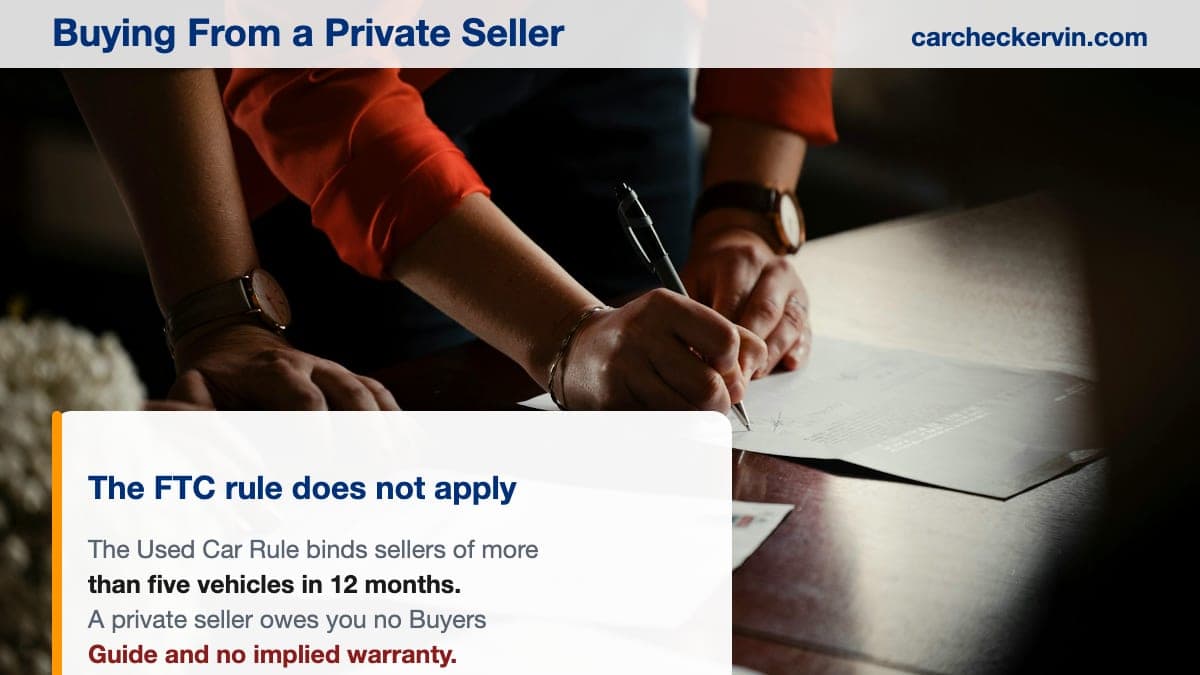
A dealer must hand you a Buyers Guide before you even inspect the car. A private seller owes you nothing of the kind. Your inspection and the VIN are the whole of your protection — so run both properly.
Check the title record before you meet
A federal brand is worth finding before you drive across town.
No account · Nothing stored · $14.99 only for the full report
Quick Answer
- What should I check before buying from a private seller?
- Three things, in order: that the name on the title matches the person's ID, that the VIN matches in all three places on the car, and that the federal title record shows no salvage, junk or flood brand. A private seller owes you none of the FTC disclosures a dealer must give.
- Does the FTC Used Car Rule protect a private sale?
- No. The Rule applies to sellers of more than five used vehicles in a 12-month period. A private individual selling their own car is outside it — no Buyers Guide, no written warranty terms, no “as is” disclosure duty.
- What is the single biggest red flag?
- A title that is not in the seller's own name. It means you are dealing with an unlicensed reseller or worse, and it is the one thing that should end a viewing immediately.
What you give up by buying privately
Most advice about private sales is about haggling. The more useful starting point is legal: the Federal Trade Commission's Used Car Rule creates a set of disclosures that a covered dealer must give you, and a private seller is simply not covered by it.
The Rule binds anyone who sells or offers for sale more than five used vehicles in a 12-month period. Below that, you are dealing with a private individual and the FTC's protections do not attach. That is not a loophole — it is the deliberate boundary of the rule, and it is why the private price is lower.
Dealer protections versus private sale
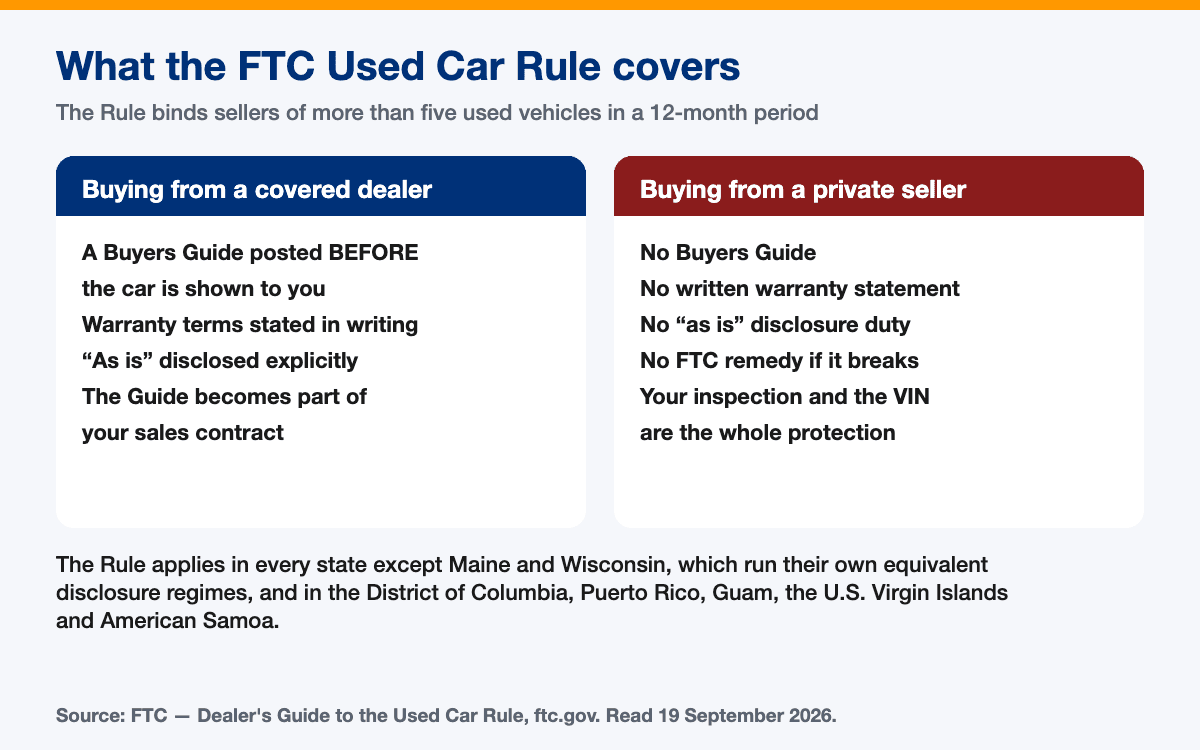
The Rule applies in every state except Maine and Wisconsin, which run their own equivalent disclosure regimes, and in the District of Columbia, Puerto Rico, Guam, the U.S. Virgin Islands, American Samoa.
Run the VIN before you go
Salvage, junk and flood brands — including ones carried in from another state. $14.99, no account.
Curbstoning: the seller who is not what they claim
A curbstoner is an unlicensed dealer posing as a private seller, which lets them skip the disclosures, the licensing and often the tax. It is the specific fraud the private-sale format enables, and it announces itself fairly reliably:
- The title is not in their name, or is signed but blank where the seller should be — an open title.
- They want to meet in a parking lot rather than at the address on the registration.
- The same phone number appears on several other listings.
- They are vague about how long they have owned it and cannot name the last workshop that touched it.
- They decline to show identification that matches the title.
The order to work through
- 1
Match the title to the ID
The name on the certificate of title must be the person in front of you. This is the check that catches curbstoning, and it costs nothing.
- 2
Match the VIN in three places
Windshield base, driver's door jamb sticker, and the title itself. Three matching numbers or you stop.
- 3
Check the federal title record
An NMVTIS-backed report reads salvage, junk and flood brands across state lines. $14.99, and worth running before you travel.
- 4
Check open safety recalls
NHTSA's lookup is free and by VIN. Open recalls are common and repairable at a franchise dealer at no cost.
- 5
Book your own inspection
At a garage you chose. A seller who refuses has told you something useful.
- 6
Write the bill of sale
Price, date, VIN, both parties, plus the signed title and the odometer disclosure. Check your state DMV for local requirements.
What to ask, and which answers end it
| Ask | A good answer | Walk away if |
|---|---|---|
| Is the title in your name? | Yes, and here it is with my ID. | It is in someone else's name, or signed and blank. |
| Is there a lien on it? | Paid off, and here is the release. | There is, and no plan to clear it before transfer. |
| Why are you selling? | A specific, checkable reason. | Evasion, or a story that changes. |
| Has it been in an accident? | Yes, here is the invoice. | A flat no that the bodywork contradicts. |
| Can my mechanic inspect it? | Sure, where is the garage? | Any refusal at all. |
Sources
- FTC — Dealer's Guide to the Used Car Rule
Who counts as a dealer, where the Rule applies, and when the Buyers Guide must be posted. Read 19 September 2026.
- FTC Consumer Advice — Buying a Used Car From a Dealer
The consumer-facing companion to the Used Car Rule. Read 19 September 2026.
- NMVTIS — U.S. Department of Justice
The Justice Department's consumer entry point for the National Motor Vehicle Title Information System. Read 19 September 2026.
- NHTSA Recalls by VIN
The federal safety-recall lookup: free, by VIN, covering unrepaired recalls.
Siempre verifica el VIN antes de comprar
La vista previa gratis muestra marcas de título, estado de robo y recalls abiertos en segundos, e indica si existen registros de accidentes y odómetro. El historial completo cuesta $14.99 — pago único, sin suscripción.
Keep reading
Frequently asked questions
Is buying from a private seller riskier than a dealer?+
Legally, yes — and that is measurable rather than a matter of opinion. The FTC Used Car Rule requires a covered dealer to post a Buyers Guide before showing you the car, to state warranty terms in writing, and to disclose an "as is" sale explicitly. None of that attaches to a private sale. In exchange you usually pay less, because the seller has no overhead.
Who counts as a dealer under the Rule?+
Someone who sells or offers for sale more than five used vehicles in a 12-month period. Banks and financial institutions are exempt, as are businesses selling to their own employees and lessors selling a leased vehicle to the lessee.
Does the Rule apply everywhere in the US?+
It applies in every state except Maine and Wisconsin, which are exempt because they have their own regulations requiring dealers to post disclosures. It also applies in the District of Columbia, Puerto Rico, Guam, the U.S. Virgin Islands, American Samoa.
What is curbstoning?+
An unlicensed dealer posing as a private seller to dodge the disclosure rules and the licensing requirements. The tells are a title not in their name, a meeting place that is not their home, several listings from the same phone number, and reluctance to let you see identification.
What paperwork should a private sale produce?+
The signed title transferred to you, a bill of sale showing the price, date, VIN and both parties, and an odometer disclosure. Requirements vary by state, so check your DMV's page before you hand over money.
Can I still get the car inspected?+
Yes, and with a private seller it matters more, not less. A seller who refuses an independent pre-purchase inspection at a garage of your choosing has answered a different question than the one you asked.
What if the car turns out to be branded?+
In a private sale your recourse is limited and usually means proving deliberate misrepresentation. That is exactly why the title check belongs before the money rather than after — a federal brand costs a few dollars to find and thousands to discover later.
Is a handshake deal ever fine?+
The handshake is fine. The absence of a signed title and a bill of sale is not. Those two documents are what make you the legal owner and what a DMV will ask for.
Check the title record
The protection a private seller does not have to give you — $14.99.
Verificaciones VIN relacionadas
Más herramientas para verificar el historial de cualquier vehículo