Questions to ask when buying a used car — and what to verify.
Every guide gives you the questions. None mention that the answers are unverifiable — except five, which the car's record answers before you meet.
Check the answers before you ask — free
17-character VIN → records on file, brands and flags, before any payment.
Free preview · no card, no account
Quick Answer
- What are the most important questions to ask?
- Ask about accidents, owner count, title status, outstanding loans and mileagefirst — those five decide whether the deal is even possible. Then ask why they're selling, whether records exist, and whether you can take it to your own mechanic. The last one is the only question whose answer can end a deal by itself.
- Can I trust the seller's answers?
- Treat them as a starting position, not evidence— even honest sellers repeat what they were told by the previous owner. Five of the questions below can be checked against the vehicle's record before you ever meet, which is why the useful move is to ask and verify.
- What if their answers don't match the record?
- That mismatch is the most valuable thing you'll learn all day. Sometimes it's innocent — a prior owner's accident the seller never knew about. Sometimes it isn't. Either way you now have a documented discrepancy, which is both a reason to walk and the strongest position to negotiate from.
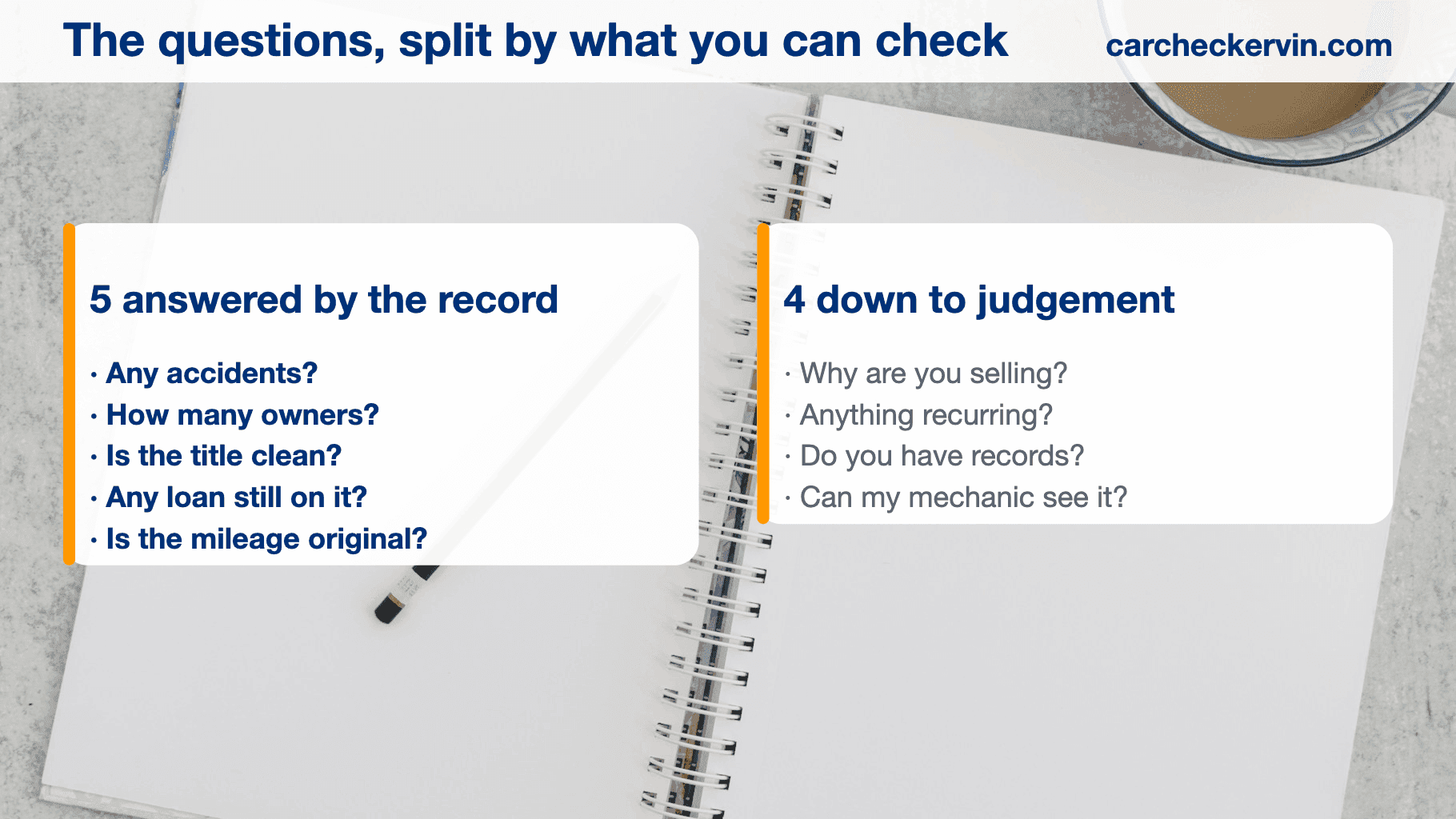
The five questions the record answers too
Ask each of these out loud — the seller's answer still matters, because you're comparing it against something. What you're comparing it against is in the right-hand column:
| Ask the seller | Why it matters | What the record shows |
|---|---|---|
| Has it ever been in an accident? | The single most-dodged question in private sales — and the one the record answers directly. | Reported damage entries, with severity where recorded |
| How many owners has it had? | Owner count sets context for everything else; rapid turnover is a question in itself. | Ownership history in the title chain |
| Is the title clean and in your name? | A brand or a name that doesn't match the seller stops the deal before price matters. | Title brands across every reporting state |
| Is there still a loan on it? | An open lien means the lender can repossess the car after you've paid the seller. | Title record and the state DMV's lien status |
| Is the mileage original? | The dash reading is a claim; the recorded trail is the evidence. | Odometer readings captured at each title transfer |
Ask first, then check — in that order. A seller who volunteers the accident before you mention the report has told you something real about who you're dealing with.
The four that are pure judgement
No record answers these. They're worth asking anyway, because what you're really assessing is the person and the paperwork they can produce:
Why are you selling it?
You're listening for a reason that matches the car's condition and paperwork. A vague answer isn't proof of anything — but it tells you which follow-ups to press.
What's it been like to own — anything recurring?
Owners of well-kept cars answer this in specifics: the shop they use, the part that failed once, the service that's due. Vagueness from a long-term owner is itself informative.
Do you have the service records?
Documentation beats assurances every time, and this question separates the two instantly. It also matters more than the odometer on a higher-mileage car.
Can I take it to my own mechanic?
The only answer that should end a deal on the spot is no. A seller with nothing to hide has no reason to refuse an independent inspection.
Walk in already knowing the answers to five of them.
Records on file, title brands and odometer flags for any 17-character VIN — free, before the first message goes out.
What to do when the answers and the record disagree
This is the situation the other question-lists never prepare you for, and it is the whole reason to check. Start from a fair assumption: a mismatch is not automatically a lie. Cars change hands, and a seller can genuinely not know about damage repaired under a previous owner — that is common and forgivable. What matters is what happens in the next sixty seconds. A seller who says "I had no idea, let me show you what I do have" is behaving like someone with nothing to hide, and the deal can continue on adjusted terms. A seller who becomes defensive, disputes the federal record without evidence, or suddenly has another buyer arriving has answered a different question entirely. Either way, you now hold a documented discrepancy — the strongest, least emotional negotiating position available to a private-party buyer, and the cleanest reason to walk if you need one.
What you can verify before you message the seller
Six sections of the $14.99 report, each one answering a question you'd otherwise have to take on trust:
Accident and damage records
Reported entries with severity where recorded — the answer to the question sellers most often soften.
Ownership and title chain
How many owners, which states, and how quickly the car moved between them.
Brands on the title
Salvage, rebuilt, flood, junk and lemon designations from any reporting state, ever.
Odometer at each transfer
The recorded readings in sequence — genuine ones only climb, which makes a rollback arithmetic.
Total-loss and salvage filings
Insurer write-offs behind a brand, in case the paper and the record tell different stories.
Auction lanes, with photos
Wholesale appearances and lane photos where available — the car before anyone staged it for a listing.
What no report replaces: the lien check with the issuing state's DMV, and an independent mechanic's inspection. Ask for both — the report tells you which cars are worth spending that money on.
Asking these of several sellers?
Private-party shopping means the same conversation three or four times over. Packs make checking each candidate before the conversation routine:
At $9.00 a report on the 10-pack, screening ten sellers costs less than two single reports at Carfax's $44.99 retail — and most candidates never need the paid unlock, because the free preview settles them.
The rest of the private-party sequence
Questions are step one. These are the steps around them.
Siempre verifica el VIN antes de comprar
La vista previa gratis muestra marcas de título, estado de robo y recalls abiertos en segundos, e indica si existen registros de accidentes y odómetro. El historial completo cuesta $14.99 — pago único, sin suscripción.
Asking the right questions — what buyers want to know
Including what to do when a seller won't answer.
What questions should I ask when buying a used car from a private seller?+
Start with the five that are checkable: has it been in an accident, how many owners, is the title clean and in your name, is there still a loan on it, and is the mileage original. Then the four that reveal the person: why are you selling, what's it been like to own, do you have the service records, and can I take it to my own mechanic. The last one is the only question whose answer can end a deal by itself.
Can I verify what the seller tells me?+
Five of the nine, yes — accidents, owners, title brands, mileage history and the paperwork trail behind a lien all appear in the vehicle's record, keyed to the 17-character VIN. The free preview shows what's on file before you pay anything, and the full NMVTIS-backed report is $14.99 against roughly $44.99 for a single Carfax.
What if the seller refuses a pre-purchase inspection?+
Walk. It's the one refusal with no innocent explanation available: an independent inspection costs the seller nothing but time, and a car that's what they say it is has nothing to fear from it. Softer versions — "the shop's too far," "I've got another buyer coming" — deserve the same response, politely.
Should I ask about the mileage even though I can see it?+
Yes, because you're not asking for the number — you're asking whether it's original, and listening to how they answer. Judge the figure against the car's age using the 12,000–15,000 miles-a-year benchmark, then check it against the readings recorded at each title transfer. Genuine readings only ever climb.
What's the most important question to ask?+
"Can I take it to my own mechanic?" — because it's the only one where the answer alone is decisive. Everything else is a data point to weigh or verify; that one is a yes or the end of the conversation. A close second is whether there's still a loan on the car, since an open lien can cost you the vehicle after you've paid for it.
How do I ask about accidents without being confrontational?+
Ask it plainly and early, before price comes up, so it reads as diligence rather than suspicion — most sellers expect it. Then check the record rather than pressing them. If a discrepancy turns up later, raise it as a question about the record rather than an accusation about them; you'll get a more useful answer either way.
Do these questions work with a dealer too?+
Mostly, with one adjustment: a dealer usually can't answer the ownership-experience question, so lean harder on documentation — the report, the service records, and their willingness to allow an independent inspection. Franchised dealers often attach a history report to the listing; take it, and run your own on the same VIN anyway.
Ask the nine. Verify the five.
Preview any 17-character VIN free — records, brands and flags — and open the full NMVTIS-backed report for $14.99 when a car makes your shortlist.
Verificaciones VIN relacionadas
Más herramientas para verificar el historial de cualquier vehículo