How many miles is too many — and is the number even real?
The benchmark is 12,000–15,000 miles a year, so "too many" depends entirely on age. But every mileage debate skips the first question: whether the odometer is telling the truth.
Check the odometer trail behind any listing — free
17-character VIN → recorded readings, brands and flags, before any payment.
Free preview · no card, no account
Quick Answer
- How many miles is too many for a used car?
- There is no universal cutoff. The working benchmark is 12,000–15,000 miles a year, so a car is "high mileage" relative to its age, not to a round number. Condition and service history outweigh the odometer: a well-maintained car at 120,000 miles is usually the safer buy than a neglected one at 60,000.
- What's good mileage for a used car?
- Anything at or below the 12,000-mile-a-year baseline reads as average-to-low for the age — the federal figure sits a little under it, at 11,106 miles per registered vehicle. But low miles carry their own risks — long idle periods age seals, fluids and batteries — and low miles are also the easiest thing on a listing to fake.
- Does the odometer reading actually prove the mileage?
- No — it's a claim until the record backs it. States capture the odometer at each title transfer, so the readings form a trail that should only ever climb. Enter the 17-character VIN above to see that trail before you judge the number on the dash.
What mileage should look like for the age
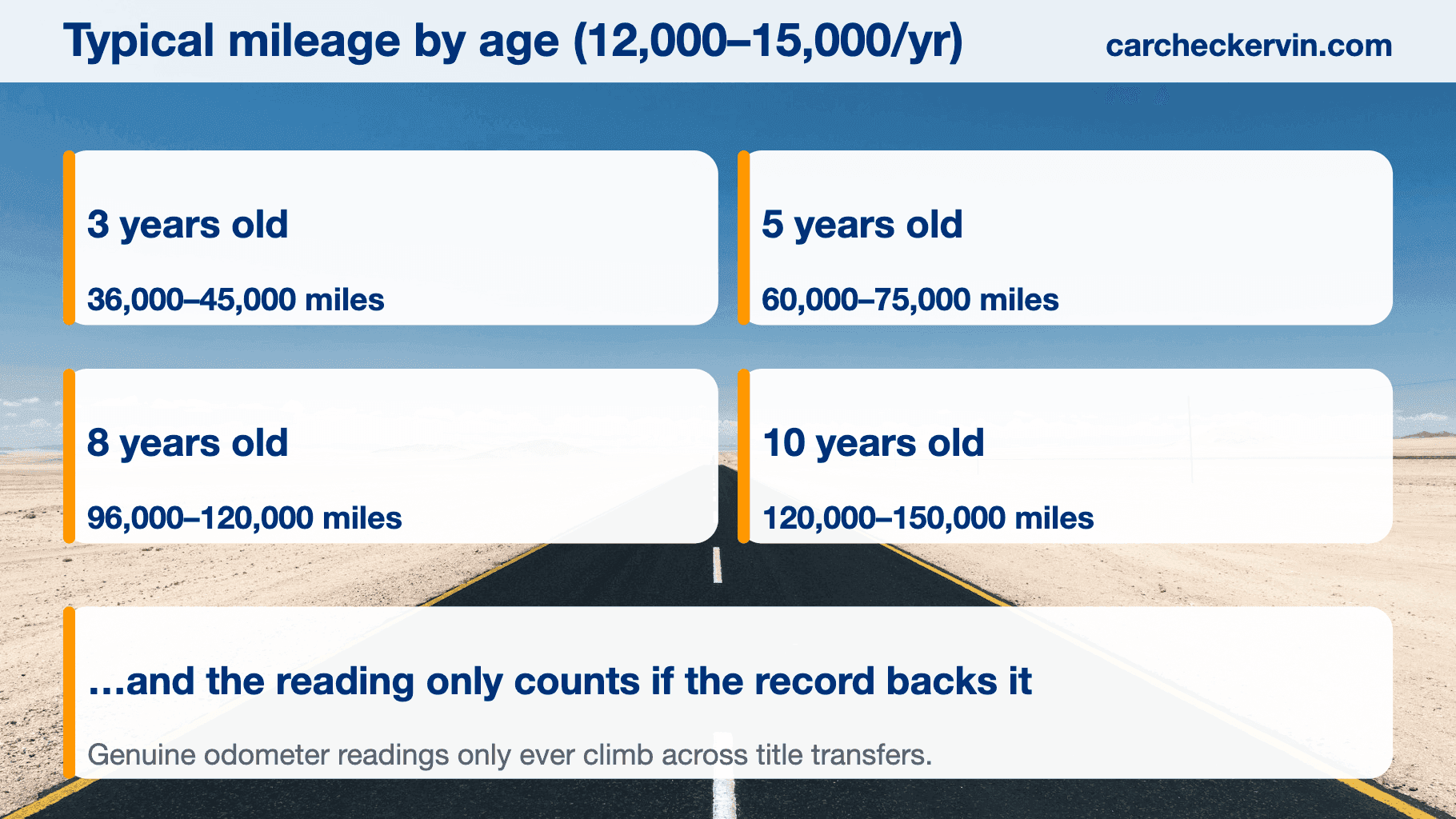
Work from the 12,000–15,000 miles-a-year benchmark and the question stops being “is that a lot?” and becomes “is that a lot for a car this old?” The bands below are simply the benchmark multiplied out:
| Age | Typical range at 12,000–15,000/yr | How to read a car outside it |
|---|---|---|
| 3 years | 36,000–45,000 miles | Well under? Ask why — long storage ages a car differently than driving does |
| 5 years | 60,000–75,000 miles | Well over? Highway commuting miles are far gentler than city miles |
| 8 years | 96,000–120,000 miles | This is where service history starts to outweigh the number entirely |
| 10 years | 120,000–150,000 miles | Documented maintenance beats a low reading with no records behind it |
Two cars can sit in the same band and be worth very different money — and a car that looks impressively below its band is exactly the profile a rolled-back odometer is built to imitate.
Why the raw number is the wrong question
Every mileage argument online debates a threshold. Three reasons the threshold matters less than buyers think:
Maintenance outranks the odometer
A well-maintained car at 120,000 miles is usually a safer bet than a neglected one at 60,000. Records of the services that matter — timing belts, transmission fluid, cooling systems — tell you more about the next three years than the dash ever will.
Not all miles are equal
Steady highway miles put a fraction of the wear on a drivetrain that stop-start city miles do, and a car that sat unused for two years has its own problems: dried seals, aged fluids, a battery that never fully recovers.
Mileage is already in the price
Valuation models penalise above-average miles by roughly 0.5% per 1,000 excess miles per year of ownership. The odometer's effect on price is already priced in — what isn't priced in is a reading that's false.
The part the mileage guides leave out
Every page arguing about thresholds assumes the number is real. It's a claim until the record supports it — and three things make that worth checking:
Low miles are the easy lie
Rolling a number back is cheap and turns an ordinary car into a premium listing. The profile it creates — suspiciously low miles for the age — is exactly the profile buyers are trained to chase.
The trail is what catches it
States record the odometer at each title transfer, so the readings form a sequence across the car's life. Genuine readings only climb. A number that shrinks between two transfers is the fraud showing itself in arithmetic.
It survives a test drive
Nothing in a walkaround reveals a rollback — worn pedals and a shiny cluster prove nothing either way. This is a records question, and it's answered before you ever meet the seller.
Judge the number after you've verified it.
Recorded odometer readings, title brands and record counts for any 17-character VIN — free, before the test drive is even booked.
Reading an odometer trail
The trail is simple to read once you see it laid out: each title transfer contributes a dated reading, and the sequence should rise steadily from the first entry to the last. Two patterns deserve attention. The obvious one is a reading lower than the one before it — that is rollback until documented otherwise, and "the cluster was replaced" needs paperwork rather than a shrug. The subtler one is a long flat stretch where a car covered almost nothing for years, which is worth understanding before you pay a premium for those low miles: storage, an off-road project, or a gap where the car was somewhere its miles weren't being recorded. Neither pattern is visible on the dash. Both are visible in the record.
What the report adds to the odometer
Six sections that turn the number on the dash into a verified fact — the same federal NMVTIS data and its supporting feeds:
Readings at each transfer
Every recorded odometer reading in sequence, with dates — the arithmetic that makes a rollback undeniable.
Title chain and brands
Where the car has been titled and whether any brand is attached, including the mileage-related ones.
Accident and damage records
Reported damage with severity where recorded — the wear that never shows up as miles.
Auction appearances, with photos
Wholesale sale records and lane photos where available, often carrying their own declared readings.
Total-loss and salvage filings
Insurer write-offs, in case a low-mileage bargain has a more interesting past than the odometer suggests.
Recalls and factory specs
Open manufacturer recalls plus the build sheet for the exact VIN — the maintenance context the mileage sits in.
Comparing a few cars on mileage?
Mileage shopping is comparison shopping — the band only means something across candidates. Packs make verifying each one routine:
At $9.00 a report on the 10-pack, verifying ten odometers costs less than two single reports at Carfax's $44.99 retail — and one caught rollback pays for all of them many times over.
The rest of the mileage question
From the odometer record to the buying decision around it.
Siempre verifica el VIN antes de comprar
La vista previa gratis muestra marcas de título, estado de robo y recalls abiertos en segundos, e indica si existen registros de accidentes y odómetro. El historial completo cuesta $14.99 — pago único, sin suscripción.
Used-car mileage — what buyers actually ask
Including the answer that says the odometer isn't the point.
How many miles is too many for a used car?+
There's no fixed cutoff, and any page that gives you one is simplifying. Judge the reading against the car's age using the 12,000–15,000 miles-a-year benchmark, then let condition and service history decide: a well-maintained car at 120,000 miles is usually a safer bet than a neglected one at 60,000. The one non-negotiable is that the reading itself is verified against the recorded trail.
What is good mileage for a used car?+
At or below roughly 12,000 miles a year for its age reads as average-to-low, which is what most buyers mean by good. Just remember that low miles cut both ways: a car that sat for long stretches has aged seals, old fluids and a tired battery, and an unusually low reading for the age is also the exact profile odometer rollback is designed to produce.
Is 100,000 miles a lot for a used car?+
It depends almost entirely on the age and the records. At the 12,000-mile-a-year benchmark that's roughly an eight-year-old car sitting right in its normal band — unremarkable. Modern drivetrains routinely pass it. What matters more is whether the maintenance that keeps a car healthy past that point was actually done, and whether the reading is genuine.
Do highway miles really count less than city miles?+
As wear, yes — steady highway running is gentler on a drivetrain, brakes and transmission than constant stop-start city use, which is why two cars with identical readings can be in very different condition. It's a reason to ask how a car was used, not a reason to ignore the odometer: valuation still works off the number, and the number still needs verifying.
How does mileage affect a used car's value?+
Valuation models penalise above-average mileage by roughly 0.5% per 1,000 excess miles per year of ownership, so the odometer is already reflected in what you're asked to pay. That's precisely why a false reading is expensive: you pay the low-mileage premium for a car that never earned it.
How do I know the odometer hasn't been rolled back?+
Check the recorded readings rather than the dash. States capture the odometer at each title transfer, so the readings form a trail across the car's life that should only ever climb. A reading lower than an earlier one is rollback until the seller produces documentation. The free preview shows what's on file for any 17-character VIN before you pay anything.
Should I buy a low-mileage car that sat unused for years?+
Cautiously, and with an inspection aimed at the right things: rubber, seals, fluids, brakes and battery, all of which degrade with time rather than distance. Long dormant stretches also show up as flat spots in the recorded trail, which is worth spotting before you pay a premium for miles the car simply never covered.
The odometer is a claim. Check the trail.
Preview any 17-character VIN free — recorded readings, brands and flags — and open the full NMVTIS-backed report for $14.99 when the car deserves it.
Verificaciones VIN relacionadas
Más herramientas para verificar el historial de cualquier vehículo