How to check a car's ownership history
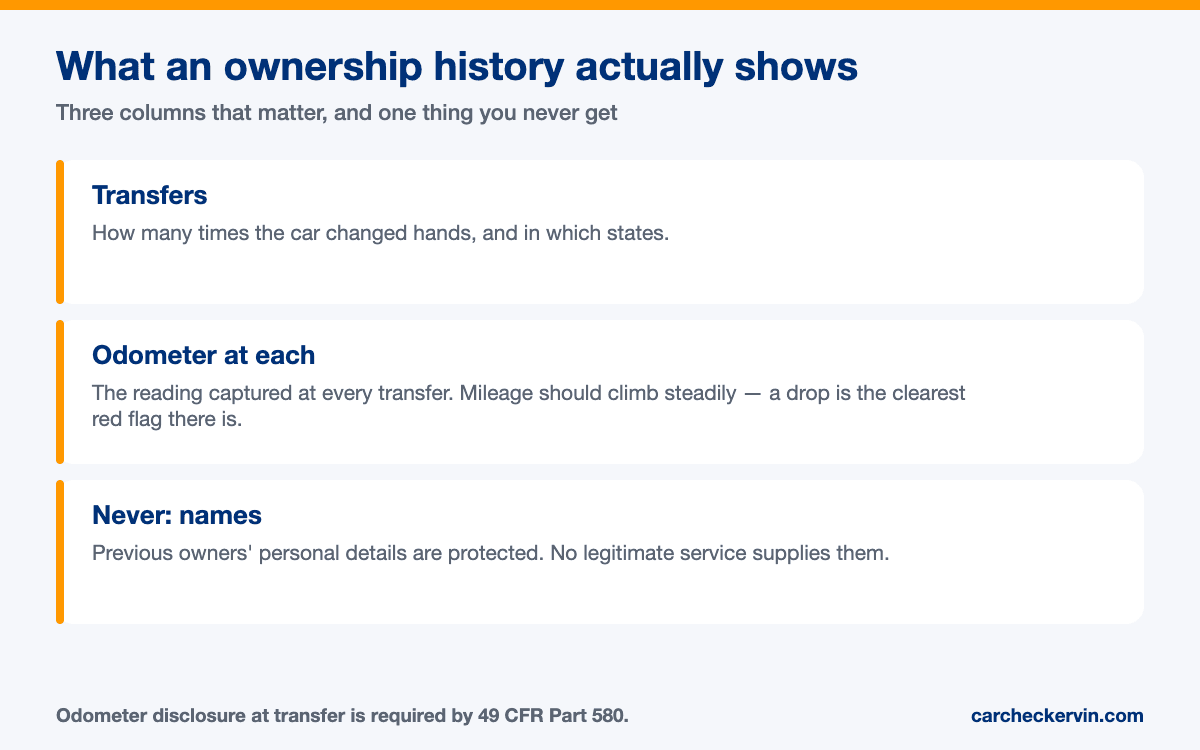
Ownership history is not a list of names — those are protected. It is a count of transfers, the states they happened in, and the mileage recorded at each one. Read together, those three things tell you whether the story you are being told holds.
Check this VIN now
Free decode. Full title history when you need it.
No account · Nothing stored · $14.99 only for the full report
The short answer
Ownership history is not a list of names — those are protected. It is a count of transfers, the states they happened in, and the mileage recorded at each one. Read together, those three things tell you whether the story you are being told holds.
Looking for the tool rather than the explanation? Ownership history by VIN runs the lookup directly.
The detail that matters
Read the federal record
Title brands across state lines — $14.99, no account.
Where the limits are
No record captures a repair somebody paid for in cash. Reporting duties have carve-outs, and older vehicles have thinner records. Read a clean result as strong evidence rather than proof, and pair it with an independent inspection on a lift.
Step by step
- 1
Count the transfers
More is not automatically worse. Several in quick succession, or across several states in a short window, is the pattern worth asking about.
- 2
Read the odometer at each transfer
Mileage should climb steadily. A reading that falls between transfers, or barely moves across years, is the single clearest signal of a problem.
- 3
Check the states involved
A car that has moved between states repeatedly is not suspicious by itself. Moves that coincide with a damage event are.
- 4
Compare it against what the seller told you
A record showing more transfers than the seller describes is a direct, testable contradiction — one of the few you can settle before paying.
- 5
Check the title is in the seller's name
If it is not, you may be looking at a jumped title, where an owner is simply missing from the record.
Sources
- NMVTIS — U.S. Department of Justice
The Justice Department's consumer entry point for the National Motor Vehicle Title Information System. Read 19 September 2026.
- NMVTIS Glossary (title-brand definitions)
Federal definitions of brand, junk automobile, salvage automobile and total loss. Read 19 September 2026.
- NHTSA Recalls by VIN
The federal safety-recall lookup: free, by VIN, covering unrepaired recalls.
- NICB VINCheck
The National Insurance Crime Bureau's free lookup for theft and total-loss records reported by participating member insurers.
Siempre verifica el VIN antes de comprar
La vista previa gratis muestra marcas de título, estado de robo y recalls abiertos en segundos, e indica si existen registros de accidentes y odómetro. El historial completo cuesta $14.99 — pago único, sin suscripción.
Keep reading
Frequently asked questions
Can I find out who owned the car before me?+
No, and no legitimate service will tell you. Personal details of previous owners are protected. What you get is the number of transfers, the states involved and the dates — which is what actually matters for judging a car.
Why does the number of owners matter?+
Not because more is automatically worse. A pattern matters: several transfers in quick succession, or transfers across several states in a short window, are worth asking about.
What does the odometer at each transfer tell me?+
It is the single most useful column. Mileage should climb steadily. A reading that drops between transfers, or barely moves across years, is the clearest signal of a problem there is.
What if the seller says they are the second owner?+
Check it. A federal transfer record that shows more transfers than the seller describes is a direct contradiction, and it is one of the few claims you can test before handing over money.
Can an owner be missing from the record?+
Yes — that is precisely what a jumped title does. Someone who never registers the car never appears, so the record can show a transfer straight from a stranger to you.
Do leases and fleet use show up?+
Often, as transfers to and from a company. A car with a fleet or rental chapter is not automatically bad, but it explains a mileage curve that would otherwise look odd.
Is a one-owner car always better?+
It is a decent signal, especially with service history to match. But one careless owner can be worse than three careful ones.
How far back does the record go?+
It depends when the states involved began reporting and when the car was first titled. Older cars generally have thinner records, which is a limit of the data rather than a fault in the car.
Run the VIN
Free decode; $14.99 for the NMVTIS-backed title history.
Verificaciones VIN relacionadas
Más herramientas para verificar el historial de cualquier vehículo