NHTSA VIN Decoder — How to Use vPIC and Read Every Field
NHTSA's VIN decoder is the free government tool at vpic.nhtsa.dot.gov/decoder that turns a 17-character VIN into the factory build sheet: make, model, engine, body class, assembly plant, and the safety equipment the vehicle left the line with. It is accurate and it costs nothing, but the interface is spare and the field names come straight out of regulatory filings. This page explains how to run it, what each returned field actually means, and the one thing it deliberately does not do — tell you anything about the vehicle's history.
Decode a VIN and See the History Counts
Enter a 17-character VIN for the decoded specs plus how many title, odometer and salvage records exist — free, before you pay
Free check · No sign-up · Instant result
Quick Answer
- What is the NHTSA VIN decoder?
- It is the free government lookup NHTSA publishes at vpic.nhtsa.dot.gov/decoder. Paste a 17-character VIN and it returns the specifications the manufacturer filed with the agency: make, model, model year, body class, engine, fuel type, drive type, assembly plant and restraint equipment. No account, no fee, no card.
- Does the NHTSA VIN decoder show accidents or previous owners?
- No. It decodes how a vehicle was built and nothing about what happened to it afterwards. Accidents, title brands, odometer readings, theft records and liens live in other databases — NMVTIS for title and odometer history, NICB for theft. A decode is not a history report.
- Is there a free NHTSA VIN decoder API?
- Yes. NHTSA publishes the same vPIC catalog as a public API on the same site. It returns decode results as JSON and does not require an account or an API key, which is why so many third-party decoders are built on top of it. It is rate-limited, so cache results and throttle bulk jobs.
What NHTSA's VIN Decoder Is, and Who Runs It
Before you read a single result field, it helps to know what kind of database you are querying — because it explains every quirk in the output.
The tool most people mean by "NHTSA VIN decoder" lives at vpic.nhtsa.dot.gov/decoder. vPIC stands for Product Information Catalog and Vehicle Listing, and it is run by the National Highway Traffic Safety Administration, an agency of the U.S. Department of Transportation. The catalog holds the vehicle and equipment information manufacturers file with the agency; the decoder is simply the public window onto it.
That distinction matters more than it sounds. A commercial VIN decoder often infers trim and options by pattern-matching against a licensed spec database. vPIC does not infer. It reports what the manufacturer said it built. When a field comes back empty, that usually means no value was ever filed for it — not that the lookup failed.
NHTSA also keeps a plain-language landing page at nhtsa.gov/vin-decoder that points at the same catalog. Both are free and neither asks you to register. CarCheckerVIN is an independent service with no affiliation with NHTSA or the Department of Transportation — we read the same public catalog for the specification half of a report, and add the history data NHTSA does not hold.
The decoder at a glance
- Run by
NHTSA - Tool name
vPIC - Cost
Free - Account
None - Covers
US-market
vPIC describes a vehicle as it was built. For anything that happened after the factory gate, you need title, odometer and theft data from other sources.
How to Use the vPIC Decoder, Step by Step
The whole process takes under a minute once you have the number in front of you. The part worth slowing down for is getting the VIN right in the first place.
Read the VIN off the car, not the ad
The 17 characters appear in the lower driver-side corner of the windshield, on the sticker inside the driver's door jamb, and on the title and registration. Copy from the car where you can. Since the 1981 model year every US-market VIN has been 17 characters, and none of them use the letters I, O or Q — if you think you are reading one of those, it is a one, a zero, or a transcription error.
Open the decoder and paste it in
Go to vpic.nhtsa.dot.gov/decoder and put the VIN in the box. There is an optional model-year field next to it. It is not required, but filling it in removes real ambiguity, and it is the difference between a useful and a useless partial decode. If you are working from a listing, the advertised year is good enough for this field.
Decode, then read the results in groups
Press the decode button and the answer comes back on the same page in a second or two. It arrives as a long list of labelled fields rather than a tidy summary, so read it in groups: vehicle identity first, then body and class, then powertrain, then the plant, then safety equipment. The last line to check is the error code.
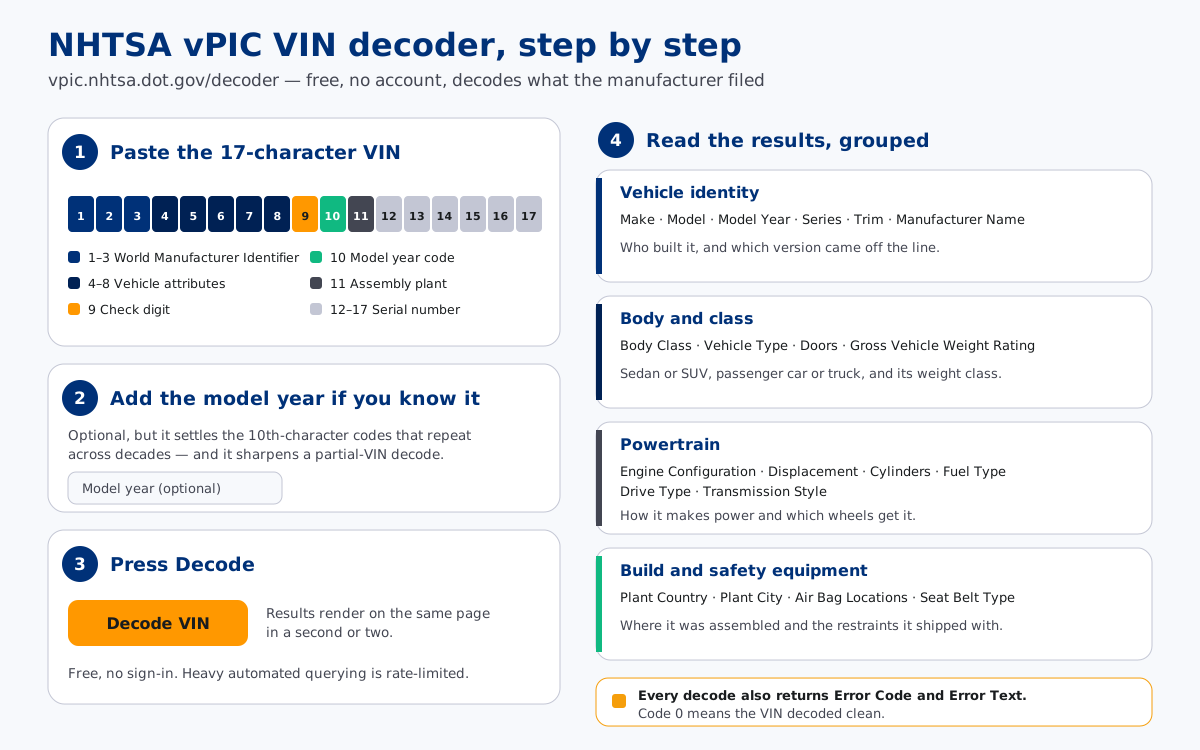
The vPIC decoder in four moves — and where each block of returned fields comes from in the VIN itself.
Reading the Results: What Each Field Means
This is where most people get stuck. vPIC returns dozens of labelled fields with names lifted from the regulatory filings, and several of them sound like they mean something they don't. Here is the plain-English translation for the fields you will actually use.
| Field, as vPIC labels it | What it means | What to do with it |
|---|---|---|
| Make / Model / Model Year | The brand, the nameplate, and the model year encoded in the tenth character. | Compare all three against the seller's listing. A mismatch is a paperwork problem at best. |
| Series / Trim | The variant, where the manufacturer filed one. | Often blank. When populated, it is the fastest way to confirm the trim an ad claims. |
| Body Class | The body style: sedan, coupe, hatchback, sport utility, pickup. | Insurance quotes and parts lookups both key off this field. |
| Vehicle Type | The broad category: passenger car, multipurpose passenger vehicle, truck, trailer, motorcycle, bus. | Explains why an SUV shows up as an MPV rather than a car. |
| Drive Type | Which wheels are driven — front, rear, four-wheel or all-wheel. | Worth confirming on any listing that advertises all-wheel drive. |
| Engine Configuration / Displacement / Number of Cylinders | The layout (inline, V, flat), the size in litres or cubic centimetres, and the cylinder count as built. | The single most useful cross-check against a swapped or misdescribed engine. |
| Fuel Type — Primary | Gasoline, diesel, electric, flexible fuel, or a hybrid combination. | Also tells you which emissions rules a state inspection will apply. |
| Transmission Style / Speeds | Automatic, manual or CVT, and the number of forward gears where filed. | Frequently blank on older vehicles. Treat silence as "not filed", not as "none". |
| Plant Country / Plant City / Plant Company Name | Where the vehicle was assembled. | Matters for parts sourcing, and for sanity-checking import paperwork. |
| Gross Vehicle Weight Rating | The weight class the vehicle was rated in when built. | Drives registration class, and whether a truck needs a commercial plate in some states. |
| Air Bag Locations / Seat Belt Type | Front, side, curtain and knee air bag positions, and the restraint type fitted. | Check it before buying a car whose airbags may have deployed and never been replaced. |
| Error Code / Error Text | The decoder's own verdict on the number you typed. | Code 0 means it decoded clean. Anything else is a specific complaint — read the text beside it. |
There are far more fields than these. vPIC will expose everything from bus floor configuration to battery chemistry when a manufacturer has filed it, but most of those stay empty on an ordinary passenger car. The twelve above are the ones that answer real questions.
Why It Is Free, and Where the Data Comes From
Nothing about vPIC is a loss leader or a trial. It is free because it is a public record, and it exists because federal vehicle identification rules require manufacturers to describe what they build.
Manufacturers file it, not NHTSA. A manufacturer selling into the US market has to tell the agency how its VINs are structured and what each position means across its model range. vPIC is that filing, published back out.
It is regulatory data, not marketing data. Nobody is paying to have a trim highlighted and there is no upsell attached, which is exactly why the field names are terse and why blanks are left blank instead of guessed at.
It sits underneath a lot of paid tools. Plenty of commercial decoders — the specification panel in a CarCheckerVIN report included — read vPIC and then present it more legibly. The underlying values are the same values.
Coverage tracks the US market. If a vehicle was never certified for sale in the United States, its manufacturer had no reason to file with NHTSA, so the decode comes back thin or empty. Grey-market imports are the usual case.
Treat vPIC as the authoritative answer to "what did the factory say this is" — and as no answer at all to "what has this car been through".
Decoding a Partial VIN, and How Model Year Is Handled
You will not always have all 17 characters, and the decoder is built for that. Understanding which positions carry which meaning tells you exactly how much you lose.
Partial VINs still decode
Auction sheets, insurance documents and dealer listings sometimes publish a masked VIN with the last digits removed to protect the individual car. The decoder still works from the leading characters, because everything describing the vehicle as a model sits in positions 1 through 11. What you lose is the identity of the specific unit, not the specification.
The tenth character is the model year
Position 10 encodes the model year, and those codes cycle. The same character comes around again decades later, which is why a decode with no year hint can land on the wrong generation of a long-running nameplate. Fill in the optional model-year field whenever you know it, even approximately.
Positions 12 to 17 are the serial number
The final characters are the sequential build number that identifies one individual vehicle. They are what a history report keys on, but they carry no specification information at all — which is why stripping them costs you nothing in a decode and everything in a history check.
Decode the VIN and See What History Exists
The decode is only half the answer. Enter the VIN below for the specs plus a free count of the title, odometer, salvage and accident records on file — no card required.
The Free vPIC API for Developers
For anyone building something, the interesting part of vPIC is not the web form at all.
NHTSA publishes the same catalog as a public API on the same domain, documented on the site itself. It returns decode results as structured JSON, and it does not require an account or an API key. That is unusual for a government dataset, and it is why so many small tools, dealer inventory systems and spreadsheet macros can decode VINs without licensing a commercial database.
You can decode a single VIN or send a batch, and you get back the same labelled fields the web decoder shows — the web form is a thin layer over the same catalog. Field names are stable, so it is reasonable to build against them, and empty values are returned as empty rather than omitted.
Two cautions worth building in from the start. First, it is a shared public resource and it is rate-limited: send hundreds of requests inside a few minutes and you will be blocked rather than gently throttled, so cache results and space out bulk jobs. Second, it decodes — it does not enrich. If your application needs title brands or odometer history, that is a different data source entirely, not a different endpoint.
vPIC API at a glance
- Format
JSON - API key
Not required - Cost
Free - Batch decode
Supported - Returns
Build specs
Rate limits are real. Cache aggressively and throttle bulk decoding, or expect requests to start being refused.
What the NHTSA Decoder Will Not Tell You
Read this section before you rely on a decode for a buying decision. vPIC describes a vehicle as it was manufactured, and it has no visibility into what happened afterwards — because that information was never filed with NHTSA in the first place.
No owners, no names
There is no ownership record in vPIC, no previous-owner count, and no personal information of any kind. A VIN decode is not a people search. Any site promising owner names or addresses from a VIN alone is selling you something other than what it claims.
No accidents or damage
Collision reports, insurance claims and body-shop records are not part of the catalog. A car that has been wrecked and rebuilt twice decodes identically to one that has never been touched, because both left the same factory the same way.
No title brands
Salvage, junk, flood, water damage, lemon-law buyback and rebuilt are title designations recorded by state motor vehicle agencies and pooled into NMVTIS. The decoder will never surface any of them, no matter how the VIN is queried.
No odometer readings
vPIC returns no mileage at any point in a vehicle's life, so it cannot help you detect a rollback. Odometer verification depends on the readings states capture at title transfer and inspection — a different record set entirely.
No theft or recovery status
Stolen-vehicle flags come from insurer and law-enforcement reporting. The NICB offers a free VINCheck at nicb.org that covers part of that picture for participating members; the decoder covers none of it.
No liens and no market value
Nothing about outstanding loans, and no pricing of any kind. A decode tells you what the car is — not what it is worth, and not whether the seller is legally able to hand you a clean title on the day.
None of that is a flaw in the tool. It is a scoping decision: NHTSA built a catalog of what manufacturers build, and the history of individual vehicles was never part of its remit.
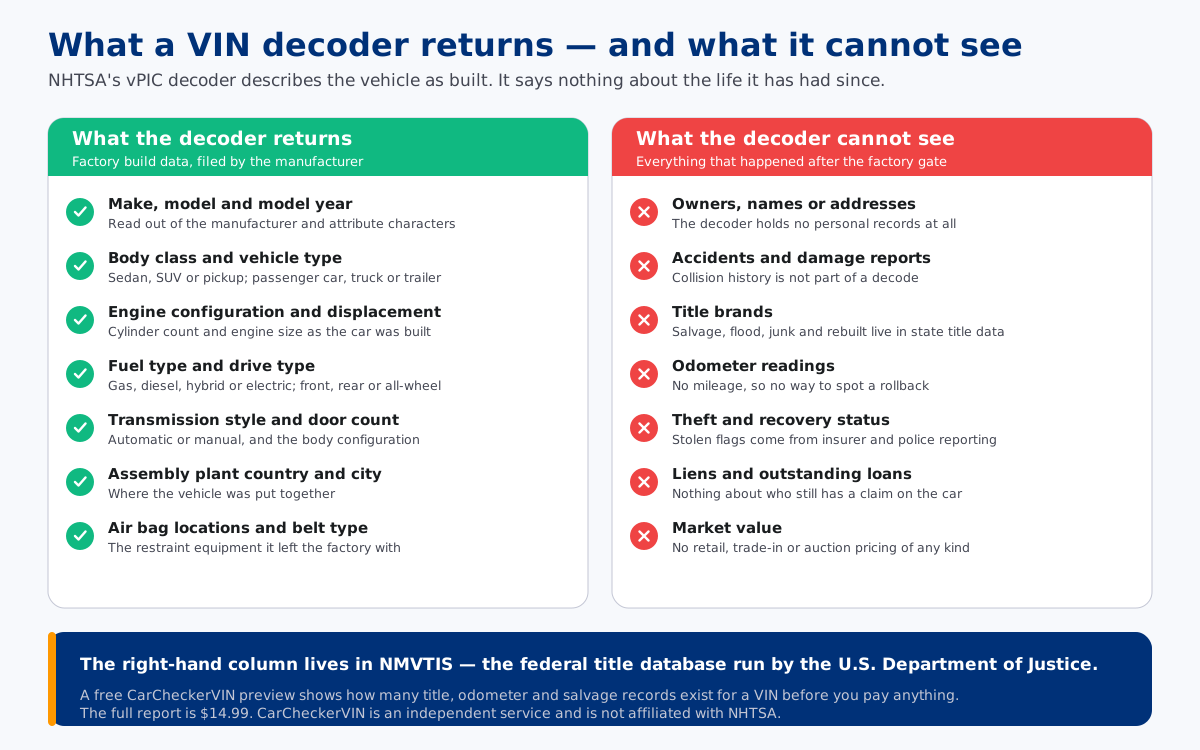
Everything on the right came after the factory — which is exactly why a decode and a history check are two different lookups.
NHTSA Recalls Are a Separate Lookup
A large share of people searching for an NHTSA VIN decoder actually want the answer to a different question.
"Is there an open recall on this car" is not something the decoder answers. Those are two different NHTSA tools sitting on two different databases. The decoder reads manufacturers' build filings. The recall lookup reads safety campaigns, which manufacturers report separately when a defect is identified after vehicles are already on the road.
The recall side is VIN-specific in a way a decode is not. It knows which VIN ranges a campaign covers and whether the remedy has been performed on that particular car, so it can tell you the repair is still outstanding. Recall work is carried out free of charge at a franchised dealer.
If recalls are what you came for, our NHTSA VIN lookup page covers that side and the title history in depth, and the recall check tool runs the lookup directly. Keep the two ideas apart: a decode confirms what the car is, a recall lookup tells you whether it is safe to drive as it stands.
When the Decoder Returns Blanks or an Error
A half-empty decode is the most common complaint about vPIC, and it is usually not a malfunction. Here is how to read what came back.
Blank means "not filed". If Trim, Transmission Speeds or Plant City comes back empty, the manufacturer did not submit a value for that model. Filings get thinner the further back you go, so an older vehicle legitimately returns fewer populated fields than a new one.
Error Code 0 means the VIN decoded clean. Any other code is the decoder telling you something specific — that the number is too short, that a character is not valid in a VIN, or that the check digit does not compute. Read the Error Text beside it rather than guessing at the number.
A check-digit warning deserves attention. Position 9 is a checksum calculated from the rest of the number. If it fails, either the VIN was mis-typed, or the VIN you were handed is not a real one. Re-read it directly off the car before you decide the tool is wrong.
An empty decode usually means a non-US vehicle. Imports never certified for the US market have no NHTSA filing behind them at all. For those, a manufacturer decoder or a region-specific service is the better route than retrying vPIC.
One habit is worth forming: whenever the decode disagrees with the listing, believe the VIN and question the listing — but confirm you typed the VIN correctly first.
Manufacturer-Specific Decoding Beyond vPIC
vPIC is the best free starting point, and it stops at the level manufacturers are required to file. For factory options, paint codes and the actual build sheet, you have to go to the manufacturer.
Manufacturer owner portals
Most brands run an owner site where entering a VIN returns the original build record, often including option packages and colour codes. Some require you to register the vehicle to an account first, and some will show a basic record to anyone with the number.
Dealer parts departments
A parts counter at a franchised dealer can pull a full build sheet from a VIN in about a minute, and will usually do it at no charge for a plausible customer. It remains the fastest way to confirm whether a specific option was fitted at the factory.
Window sticker reconstruction
The original Monroney label lists standard and optional equipment exactly as delivered. Rebuilding it from the VIN fills the gap between what a manufacturer filed with NHTSA and what was actually bolted to the car when it was sold.
How to Go From a Decode to a Full History Check
A decode answers "what is this car". Before money changes hands you still need "what has happened to it", and that is a different database.
The history side is NMVTIS — the National Motor Vehicle Title Information System, run by the U.S. Department of Justice. It pools title records from state motor vehicle agencies with reporting from insurers, junk yards and salvage auctions, which is where branded titles, total-loss declarations and odometer readings actually live.
Our free VIN check sits between the two. Enter the VIN and you get the decoded specifications alongside how many title, odometer, accident and salvage records exist for that vehicle — the counts, before you pay, with no card required. If they are all zero on a ten-year-old car, that is genuinely useful. If they are not, you know precisely what you would be buying access to.
The full report is $14.99. If you are shopping several cars at once, the multi-report packs come out cheaper per VIN: three for $35.99, five for $54.99, and ten for $89.99.
Tools That Pick Up Where the Decoder Stops
A decode is step one. These pages cover the parts of a vehicle's story that vPIC was never built to hold.
Siempre verifica el VIN antes de comprar
La vista previa gratis muestra marcas de título, estado de robo y recalls abiertos en segundos, e indica si existen registros de accidentes y odómetro. El historial completo cuesta $14.99 — pago único, sin suscripción.
NHTSA VIN Decoder — Frequently Asked Questions
The questions people ask most about vPIC, its output, and where it runs out of road.
What is the NHTSA VIN decoder?+
It is the free public lookup NHTSA publishes at vpic.nhtsa.dot.gov/decoder, backed by a catalog called vPIC — the Product Information Catalog and Vehicle Listing. Enter a 17-character VIN and it returns the specifications the manufacturer filed with the agency: make, model, model year, series and trim where filed, body class, vehicle type, drive type, engine configuration and displacement, cylinder count, fuel type, transmission style, assembly plant, gross vehicle weight rating and the air bag and seat belt equipment fitted at the factory. NHTSA also maintains a plain-language page at nhtsa.gov/vin-decoder that points at the same catalog.
Is the NHTSA VIN decoder free to use?+
Yes, completely. There is no fee, no account and no card. It is free because it is a public record: federal vehicle identification rules require manufacturers selling into the US market to file how their VINs are structured and what each position means, and vPIC publishes that filing back out. The same applies to the public API, which needs no key. The only practical limit is rate limiting on very heavy automated querying.
Does the NHTSA VIN decoder show accident history or previous owners?+
No, and this is the most important thing to understand about it. vPIC describes a vehicle as it was manufactured. It holds no ownership records, no names or addresses, no accident or damage reports, no title brands such as salvage or flood, no odometer readings, no theft status, no lien information and no market value. All of that is post-factory history recorded elsewhere — mainly NMVTIS, the federal title database run by the U.S. Department of Justice, plus insurer and law-enforcement reporting for theft. A decode and a history report are two different lookups.
Can I decode a partial VIN with NHTSA's decoder?+
Yes. Everything that describes a vehicle as a model sits in positions 1 through 11 of the VIN, so a partial number still returns make, model, body class, engine and plant. Positions 12 to 17 are the sequential serial number that identifies one individual car, and they carry no specification information. Because model-year codes in position 10 repeat over long cycles, supplying the optional model year alongside a partial VIN makes the result noticeably more reliable.
Is there an NHTSA VIN decoder API?+
Yes. NHTSA publishes the vPIC catalog as a free public API on the same site, documented there, returning results as JSON. It requires no account and no API key, which is why many third-party decoders, dealer systems and spreadsheet tools are built on top of it. Single and batch decoding are both supported. It is a shared public resource and is rate-limited, so cache results and throttle bulk jobs rather than sending hundreds of requests in quick succession.
Why did the NHTSA decoder return blank fields for my VIN?+
Usually because the manufacturer never filed a value for that field on that model. vPIC does not guess, so anything unfiled is returned empty rather than estimated, and filings are thinner the older the vehicle is. Two other causes are worth checking: an error code other than 0 means the decoder is objecting to the number itself — often a mis-typed character or a failed check digit at position 9 — and an almost entirely empty result usually means the vehicle was never certified for sale in the United States, so no NHTSA filing exists for it.
How do I check recalls instead of just decoding the VIN?+
Recalls are a separate NHTSA lookup with a separate database behind it. The decoder reads manufacturers' build filings; the recall tool reads safety campaigns reported after vehicles are already on the road, and it can tell you whether the remedy has been performed on a specific VIN. Recall work is carried out free of charge at a franchised dealer. Our NHTSA VIN lookup page covers the recall and title-history side, and the recall check tool runs the lookup directly.
Decode the VIN, Then Check the History
NHTSA tells you what the factory built. Enter the VIN here for the decoded specs plus a free count of the title, odometer, salvage and accident records that exist for it — and upgrade to the $14.99 report only if there is something worth reading.
Verificaciones VIN relacionadas
Más herramientas para verificar el historial de cualquier vehículo