Abandoned Vehicle Title — the routes that actually end in a title, state by state.
A car left on your land, in your shop or on your street still belongs to the person on its title and to any lender on its lien, however long it sits. Every state's route to a new title runs through notice to those people and a chance for them to claim it. In Texas that is a law-enforcement auction under Chapter 683; in California a DMV-supervised lien sale; in Florida a towing or repair lien sale, or a finder's claim after 90 days in police custody. Here is how each works, what it costs, and the one route that never produces a title.
Run the VIN Before You Spend a Dollar
Title brands and recorded liens decide whether the car is worth the process. Enter the VIN for a free preview; theft checks are the police's NCIC lookup, not a history report.
Free preview · No sign-up · No owner or personal data
Quick Answer
- How do you get a title for an abandoned vehicle?
- Not by finding it. Report the vehicle to law enforcement; in Texas the agency takes custody, sends certified-mail notice to the registered owner and lienholders within 10 days, and if nobody claims it within 20 days sells it at public auction, where the buyer takes title free and clear (§ 683.014). Garages and tow yards reach a title through a lien sale instead. Florida lets title vest in the finder after a 90-day custodial period if the notices were met (§ 705.104).
- Can I take ownership of an abandoned vehicle on my property?
- Not directly. Texas lets a property owner apply to TxDMV for authority to dispose of the vehicle to a demolisher (Form VTR-71-2, $2); after 20 days' notice the department issues a certificate of authority, which a scrap yard accepts in place of a title. That is a disposal, not a title in your name. For a title, the car goes through law-enforcement custody and auction, or you buy it there.
- How long before a car is considered abandoned?
- It is a state definition. Texas: 48 hours unattended on public property if inoperable and more than 5 years old, 48 hours on private property without the owner's consent, 24 hours on a turnpike or controlled-access highway. Florida treats property left wrecked or inoperable on public property as abandoned and gives the owner 5 days after a posted notice. California's statutes work from the lien or the parking violation rather than a single clock.
Five steps between a car left behind and a title
The Texas sequence under Chapter 683; California and Florida reorder the same pieces.
- 1Identify itRead the VIN and plate; run the VIN for brands and liens; let police check it against theft records.
- 2Report itLaw enforcement may take an abandoned vehicle into custody from public or private property (§ 683.011).
- 3Notice goes outCertified mail to the last registered owner and every recorded lienholder within 10 days; publication if they cannot be found.
- 4The claim window runs20 days to pay towing and storage and take the car back. Silence waives all rights.
- 5Auction, then titleThe buyer takes title free and clear, receives a sales receipt, and registers the vehicle (§ 683.014).
Why Finding a Car Does Not Make It Yours
A motor vehicle title is a state record of ownership, and a recorded lien is a lender's interest in that record. Neither lapses because the owner walked away. That is why every abandoned-vehicle statute is built around notice: the owner and lienholder must be told where the car is and given a period to claim it, and only their silence or a court's order moves the title. Texas states the rule bluntly: failure to claim within the period "is a waiver by that person of all right, title, and interest" and "consent to the sale of the item at a public auction" (§ 683.012(b)(5)).
Three kinds of people end up holding an abandoned car: a landowner who did not invite it, a garage or tow yard owed money on it, and a buyer who wants it. Each has a different route. The landowner reports it or has it towed; the garage forecloses its lien; the buyer buys at the auction or lien sale and receives the paperwork that lets a DMV issue a title. The one route that never ends in a title is the demolisher application: it produces a certificate of authority to scrap the car, and nothing else.
The Four Routes to a Title
Which one applies depends on who holds the car and why. The statutes behind each are linked at the foot of the page.
Law-enforcement custody and auction
Texas ch. 683: notice within 10 days, 20 days to claim, then public auction. The buyer takes title free and clear of all liens and gets a sales receipt to register with.
Lien sale
A garage, tow yard or storage lot owed money sells the car after statutory notices. California splits the process at $4,000; Florida runs separate procedures for towing-storage liens and repair liens.
Finder's claim
Florida § 705.104: title to lost or abandoned property vests in the finder after the 90-day custodial period, provided law enforcement met the notice requirements and no owner or lienholder claimed it.
Bonded title
Where a state allows it, a buyer who has the car but not the title posts a surety bond and receives a title that stays bonded for a period. The bond does not cure a lien or a theft record.
Not a route: the demolisher certificate
Texas § 683.051: a property owner or lienholder may apply (VTR-71-2, $2) to dispose of the car to a demolisher. After 20 days' notice TxDMV issues a certificate of authority, accepted "in lieu of a certificate of title" for scrapping only.
Not a route: junked-vehicle abatement
A Texas city or county that removes a junked vehicle as a public nuisance must prohibit it "from being reconstructed or made operable after removal", and TxDMV cancels its title (§ 683.074).
Texas: Chapter 683 From Custody to Auction
Section 683.002 defines an abandoned motor vehicle: inoperable, more than 5 years old and unattended on public property for more than 48 hours; illegally on public property for more than 48 hours; on private property without the consent of the owner or person in charge for more than 48 hours; on a highway right-of-way for more than 48 hours; or on a turnpike or controlled-access highway for more than 24 hours. A law enforcement agency may take such a vehicle into custody from public or private property (§ 683.011).
The agency sends notice by certified mail within 10 days to the last registered owner and each lienholder recorded under Chapter 501, stating the year, make, model and VIN, where the car is held, and the right to claim it within 20 days on payment of towing, preservation and storage charges. If the owner cannot be identified, one newspaper publication is enough. An unclaimed vehicle may be sold at public auction, kept for agency use, or transferred to another government body. Proceeds reimburse the auction, towing, storage and notice costs and are then held 90 days for the owner or lienholder. The earliest an auction can follow custody is therefore about 30 days.
What the Texas buyer receives
- Title: free and clear of all liens and claims of ownership (§ 683.014(c)).
- Paper: a sales receipt from the law enforcement agency.
- Next: register the vehicle and receive a certificate of title from TxDMV.
- Garagekeepers: must be told the time and place of the auction.
Texas, California and Florida Side by Side
The clocks, fees and documents from each state's statute on one page: the Texas custody-and-auction route, California's two lien-sale tracks and Florida's finder and lien-sale rules.
Every figure is read from the section cited beside it on the date shown.
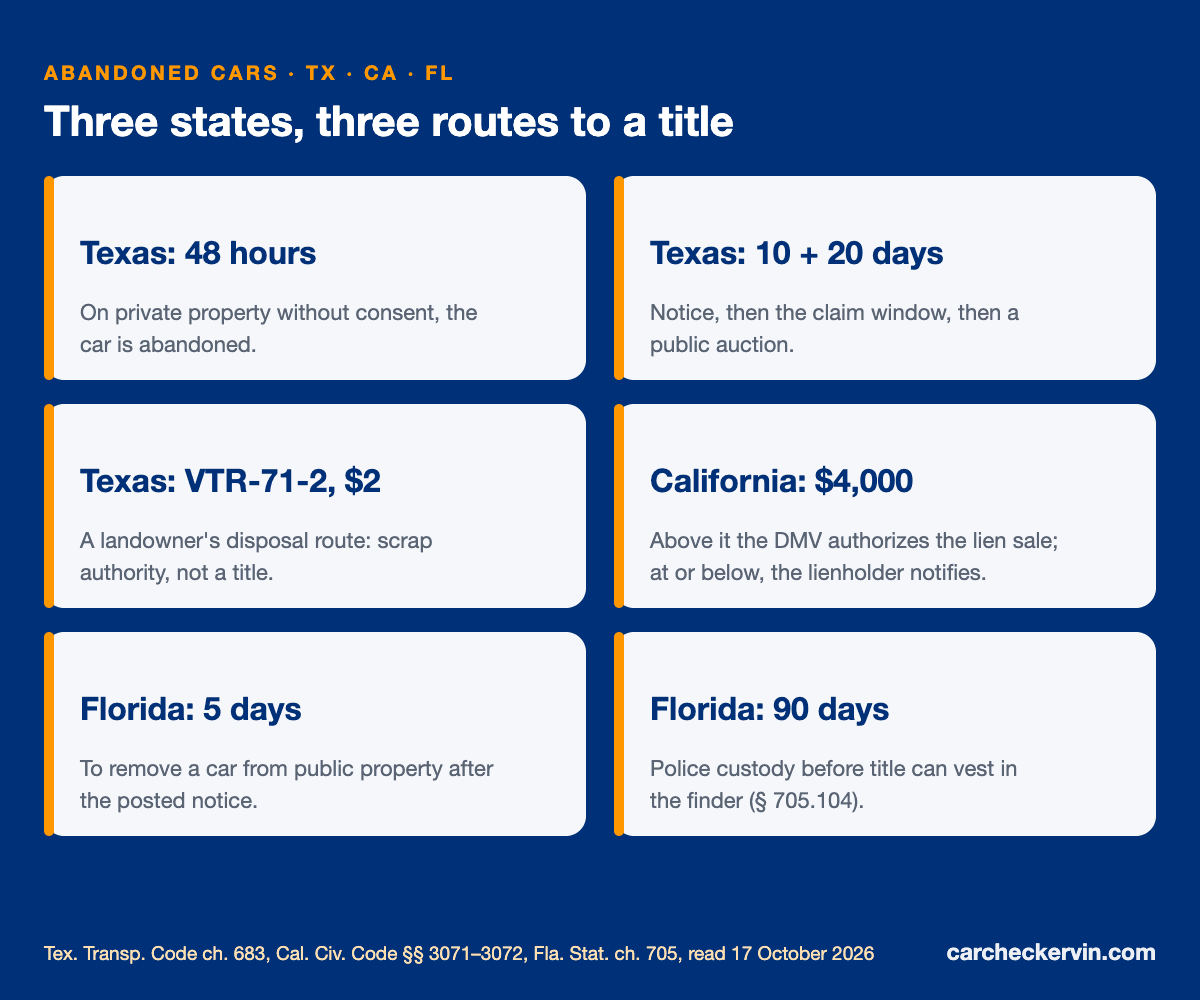
California: The Lien Sale Does the Work
California's Civil Code treats an unpaid garage, tow or storage bill as a lien on the vehicle and lets the lienholder sell the car, under DMV supervision, to satisfy it. Section 3071 governs vehicles worth more than $4,000: the lienholder applies to the DMV for authorization (the DMV lists the form as REG 656, due within 30 days of the lien arising), the DMV sends certified-mail notice to the registered and legal owners, and anyone who objects returns a Declaration of Opposition within 10 days, after which the lienholder needs a court judgment. Once authorized, the sale is advertised 5 to 20 days ahead and a Notice of Pending Lien Sale goes to the owners and the DMV 20 days before.
Section 3072 covers vehicles worth $4,000 or less: the lienholder requests the owners' names from the DMV (INF 1126, within 15 days per the DMV handbook), mails the Notice of Pending Lien Sale with a blank Declaration of Opposition, and sets the sale 31 to 41 days from the mailing, posting notice at the business for 10 days. Under both sections the car must be available for inspection for 1 hour before the sale, sealed bids are forbidden, the owner may redeem within 10 days after the sale at 12% interest (§ 3071), the plates are destroyed, and the lien sale documents the DMV requires are completed and delivered to the buyer, who titles the car with them.
Florida: The Finder's Title and the Lien Sales
Florida is the one of the three with a finder's route, and it runs through the police. Chapter 705 defines abandoned property as tangible personal property without an identifiable owner left on public property wrecked, inoperative or partially dismantled. An officer posts a weatherproof notice giving the owner 5 days to remove it, asks FLHSMV for the owner's and lienholder's names, and mails them the notice by certified mail. Property taken into custody is held 90 days, with the agency's intended disposition (which may be to "surrender such property to the finder") published during the first 45 days. Section 705.104 then vests title in the finder when the 90 days expire, if the notices were met and no owner or lienholder claimed it.
A tow yard or storage operator sells under § 713.78: 35 days after storage for an older-model vehicle or 57 days for a newer one, with the notice of lien sent at least 30 or 52 days before the sale. The certificate of title issued after that sale "must be discharged of all liens unless otherwise provided by court order", and surplus proceeds go to the clerk of court, who keeps 5%. A repair shop sells under § 713.585, described on the mechanic's lien page.
Florida's clocks
- 5 days: to remove the vehicle after the posted notice.
- 90 days: police custody before title can vest in the finder.
- 35 / 57 days: towing-storage lien sale, older / newer model.
- 60 days: after the repair before a shop may sell.
Check the Car Before the Paperwork
Enter the VIN for a free preview of its title brands and recorded liens. A salvage brand or an open lien changes what the car is worth, and whether the process is worth starting.
What the Routes Cost in State Fees
Only the amounts the statutes and agencies set. Towing and storage are charged at local rates and come off the top of any sale.
| Item | Amount | Source |
|---|---|---|
| Texas application to dispose to a demolisher (VTR-71-2) | $2 | § 683.052; TxDMV |
| Texas garagekeeper's abandonment report to police | $10 | § 683.031(c) |
| Texas repair-lien notice filed with the county tax assessor-collector | $25 | Property Code § 70.006 |
| California lien sale filing fee (REG 656) / record request (INF 1126) | Set by DMV, recoverable from the sale | Civil Code § 3071; DMV |
| Florida certificate of destruction when a lien car is scrapped | $3 + $4.25 service charge | § 713.78(11) |
| Florida clerk's share of surplus lien-sale proceeds | 5% (repair liens: at most $25) | §§ 713.78(6), 713.585(8) |
| Florida mechanic's lien certificate of compliance, clerk | $10 | § 713.585(4) |
The two Texas state fees a shop meets, the county filing and the demolisher application, add up to $27. Everything else in the process is notice postage, publication and the tow yard's bill.
What a Buyer Should Check First
An abandoned car reaches the market as an auction lot or a lien-sale vehicle, and the paperwork that comes with it is only as good as the statute behind it. Texas § 683.014 and Florida § 713.78 both say the buyer's title is free of prior liens; a California lien-sale buyer receives the DMV's lien sale documents and applies for a title. None of those documents erases the car's history. A salvage or rebuilt brand recorded in another state, a flood total loss, or an odometer reading inconsistent with the dash all survive the sale and follow the VIN through NMVTIS.
Run the VIN before you bid. A history report shows the brands and the liens recorded against the number; the stolen-vehicle question belongs to the police, who check the NCIC record when they take custody and, in Texas, must notify anyone who filed a theft report on the car (§ 683.012(f)). If the car has no plate and no legible VIN plate, California requires an inspection by a peace officer or licensed vehicle verifier before the DMV will accept a lien sale application (§ 3071(a)(1)), and the buyer should expect the same scrutiny at titling.
Related Checks and Guides
The two companion pages, the bonded-title route and the checks to run first.
Where These Facts Come From
From the Texas, California and Florida statutes and the agencies' own pages, read on 17 October 2026. Procedures and fees change; confirm with the agency before you file.
CarCheckerVIN is not affiliated with any state agency, towing company or title service. This page is general information, not legal advice; other states run different procedures.
Always check the VIN before you buy
The free preview shows title brands, theft status and open recalls in seconds, and flags whether accident and odometer records exist. The full history is $14.99 — one-time, no subscription.
Abandoned Vehicle Title — Frequently Asked Questions
What people who find, store or want to buy an abandoned car ask most.
Can you get a title for a car someone left on your property?+
Not by yourself. Report it; law enforcement in Texas can take it into custody and auction it after notice, and you may bid like anyone else. Texas lets you apply to dispose of it to a demolisher for $2, but that certificate authorizes scrapping, not a title in your name.
How long does the abandoned vehicle process take in Texas?+
Notice must be mailed within 10 days of custody and the claim period is 20 days, so an auction can follow about 30 days after the agency takes the car, plus the time to schedule and advertise the sale. Proceeds are then held 90 days for the owner.
Does an abandoned vehicle auction wipe out the liens?+
In Texas the purchaser at a law-enforcement auction takes title free and clear of all liens and claims of ownership (§ 683.014). In Florida the title issued after a towing-storage lien sale must be discharged of all liens unless a court orders otherwise (§ 713.78). The brands and history on the VIN are not wiped.
What is the finder's rule in Florida?+
Section 705.104 vests title to lost or abandoned property in the finder when the 90-day custodial period in § 705.103 expires, provided the notice requirements were met and no rightful owner or lienholder claimed it. It applies to property law enforcement took into custody, not to a car you kept in your yard.
What is a certificate of authority in Texas?+
The document TxDMV issues under § 683.054 after a demolisher application, which a motor vehicle demolisher must accept in place of a certificate of title. It authorizes demolition, wrecking or dismantling only.
Can I check whether an abandoned car is stolen?+
Police can, against the NCIC record, when you report the vehicle; in Texas the agency must also notify anyone who filed a theft report on it. A vehicle history report shows title brands and liens recorded against the VIN, which is what to check before you spend money on the process.
Run the VIN Before You Claim or Bid
Enter any 17-character VIN for a free preview. The full report lists title brands, NMVTIS junk and salvage records, insurance total-loss records, odometer readings, and auction records with the damage the auction recorded and its photos.
CarCheckerVIN is an independent vehicle-history service and is not affiliated with any state motor vehicle agency or law enforcement body. Procedures are summarized from public statutes and are not legal advice. Records in our reports reflect what was reported to our data providers. Our reports do not include police or repair-shop accident entries.
Related VIN Checks
More tools to verify any vehicle's history