Pre-Road-Trip Checklist: VIN Recalls + Tire + Brake Audit
Before any long road trip, run a VIN recall check, audit your tire age and pressure, and inspect your brakes. Here's the 30-minute checklist that prevents the worst breakdowns.
Check the car you're reading about
Free VIN decode and recall check
Factory specs and open NHTSA recalls in seconds. No sign-up.

Summer is the peak season for both road trips and the kind of mechanical failures that ruin them. Hot pavement accelerates tire wear and exposes old, dry-rotted rubber to blowout risk. Long highway grades reveal brake problems that city driving never tests. And manufacturer recalls — including ones that have been outstanding on your car for years without you knowing — can become safety-critical at the exact moment you're 800 miles from home with kids in the backseat.
Thirty focused minutes before you leave catches almost every preventable breakdown. Here's the pre-road-trip checklist that actually matters.
30-minute pre-trip checklist
VIN recall check (5 min, free) → tire age + pressure + tread (10 min) → brake pad check (5 min) → fluid levels (5 min) → battery test (5 min). Total: half an hour, all DIY, prevents the vast majority of roadside failures.

Step 1: VIN recall check (5 minutes, free)
Every vehicle sold in the US since 2014 can be checked for open safety recalls in under 60 seconds. You enter your VIN at the manufacturer's recall portal or the NHTSA recall lookup (nhtsa.gov/recalls), and it returns every active recall that hasn't been recorded as completed for your specific car.
Recalls are free to fix at any dealer of the same brand, even if your car is years out of warranty. Common ones that are road-trip-critical:
- Airbag inflator recalls (Takata and others) — affected airbags can rupture and project shrapnel.
- Fuel pump module recalls — failure causes the engine to stall, sometimes at highway speed.
- Brake booster vacuum hose recalls — sudden loss of brake assist.
- Wheel hub / lug nut recalls — wheel separation at speed.
- Power steering recalls — sudden loss of assist at low speed.
- Software / electronic recalls — typically updated by dealer in under an hour.
If your VIN has any outstanding safety recall, call a dealer this week and book an appointment to clear it. Most can do safety recalls same-day with parts in stock.
Step 2: Tire age + pressure + tread (10 minutes)
Tire age — the one most drivers ignore
Tires degrade with age regardless of mileage. Six years is the maximum recommended life for any passenger tire, even one with abundant tread depth. After that, the rubber compounds dry out and structural failure becomes possible without warning. A 10-year-old tire with full tread is still a 10-year-old tire — and it will blow out on a hot road eventually.
Find the DOT code on each tire's sidewall. It's a series of 8-13 characters ending in a 4-digit number — that 4-digit number is the manufacturing date: the first two digits are the week, the last two are the year. A code ending in '2519' means the tire was made in the 25th week of 2019.

Tire pressure
Check pressure cold (before driving more than a mile or two). The recommended pressure is on a sticker inside the driver's door jamb — not the maximum pressure printed on the tire sidewall. Underinflated tires generate heat, accelerate wear, and increase blowout risk; overinflated tires reduce traction and crash safety.
If you'll be loading the car heavily (luggage, passengers, roof box), add 3-5 PSI to compensate. The door-jamb sticker often includes both 'normal' and 'fully loaded' recommended pressures.
Tread depth
Use a tread depth gauge or the penny test (Lincoln's head down — if you can see the top of his head, you have less than 2/32" tread and the tire is legally bald). For long highway trips in summer rain, aim for at least 4/32" remaining tread. Wet-weather grip degrades rapidly below that threshold.
Step 3: Brake inspection (5 minutes)
Look through the spokes of each wheel at the brake pad through the caliper opening. You can usually see a sliver of pad material. New pads are 10-12mm thick; replace at 3mm. If the metal backing plate is visible through the pad, you're driving on metal-on-metal — book service immediately and don't take the trip.
Take the car around the block and brake hard from 30 mph. Listen for grinding (worn pads), high-pitched squealing (often a wear indicator deliberately triggered), and feel for pulsation through the pedal (warped rotors). Any of these suggests a service visit before a long trip — not after.
Step 4: Fluid levels (5 minutes)
- Engine oil — check on level ground after the engine has been off 5+ minutes. Level should be between the marks; color should be amber to light brown (very dark or black is overdue for a change).
- Coolant — check the overflow reservoir level; should be between MIN and MAX marks. NEVER open the radiator cap on a hot engine.
- Brake fluid — reservoir under the hood; should be between MIN and MAX. Dark brown fluid needs flushing.
- Power steering fluid (if applicable) — most newer cars are electric power steering with no fluid to check.
- Washer fluid — top it off. You'll go through more than you expect on highway bugs.
- Transmission fluid (if your car has a dipstick — many newer cars don't) — color should be red or pink, not brown or burnt-smelling.
Step 5: Battery test (5 minutes)
Most parts stores (AutoZone, O'Reilly, Advance) test batteries for free. A battery older than 3 years should be tested before a long trip. Heat is brutal on batteries; a marginal battery that's been getting by all winter can fail unexpectedly in summer.
Visually check the terminals for corrosion (white or green powder) and clean if needed. Check the date code on the battery — most have a sticker with the manufacture date. Most batteries last 3-5 years; if yours is past 4 and you're driving cross-country, replacing it proactively is cheaper than the cost of a tow.
The summer heat trap
Every system on your car works harder in summer heat. Battery life drops. Tire pressure rises. Engine cooling system is at peak load. AC compressor is under continuous strain. The right time to find weaknesses is in a parking lot near your home — not in the middle of a desert with no cell coverage.
Bonus: items to throw in the trunk
- Tire pressure gauge (digital is more accurate than dial).
- Tire repair kit + 12V air compressor (or a working spare + jack + lug wrench).
- Jumper cables or a portable jump-starter.
- Quart of motor oil matching your car's spec.
- Gallon of water (engine coolant emergencies AND drinking).
- Flashlight or headlamp with fresh batteries.
- First-aid kit.
- Roadside reflective triangles or flares.
- Phone charger that works without the engine running.
- Paper map of the regions you're traveling through (cell coverage gaps are real).
On the road: what to watch for
- Tire pressure can drop suddenly — most cars have a TPMS warning light; pull over and check immediately if it lights up.
- Engine temperature gauge climbing into the red — pull over and let it cool; never open the radiator cap hot.
- Brake fade on long downhill grades — downshift to use engine braking and give the brakes time to cool.
- Wind drift suddenly worse than before — could indicate a developing tire problem.
- Battery / charging light coming on — limit electrical loads (turn off AC, accessories) and head to the nearest service station.
What to do next
Before your next road trip: run the VIN recall check tomorrow, then the rest of the inspection 24-48 hours before departure (so there's time to book service if you find something). Thirty minutes of inspection beats six hours on the side of an interstate in July.
About the author
CarCheckerVIN Editorial Team
In-house automotive research team
The CarCheckerVIN editorial team combines decades of automotive industry, dealer, and journalism experience to produce trustworthy buying, selling, and ownership guidance backed by NMVTIS, NICB, and manufacturer data.
See more of our guides on Google
Add CarCheckerVIN as a preferred source and Google will show our guides more often in your results.

Keep reading
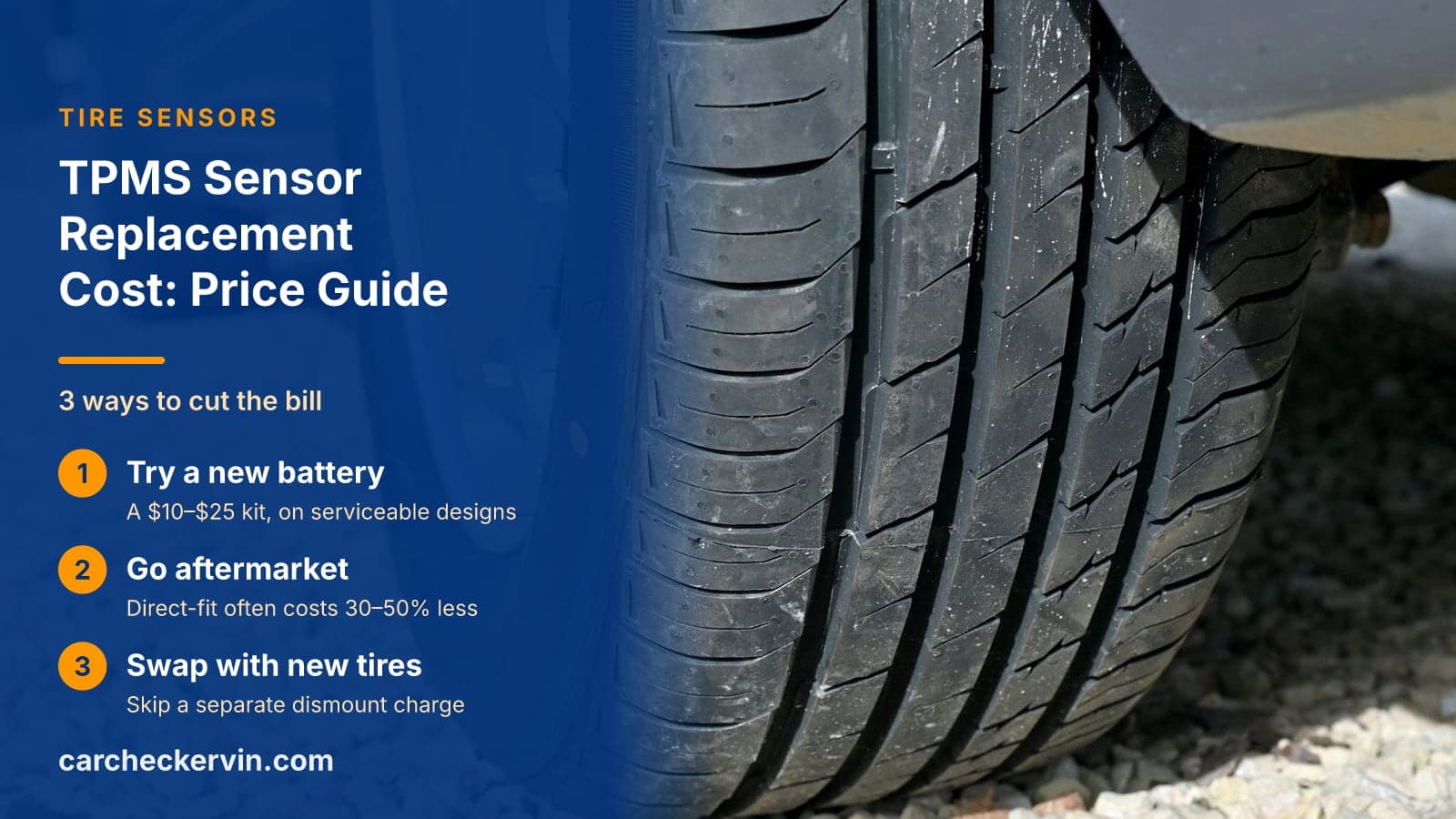
TPMS Sensor Replacement Cost: What You'll Really Pay
Your TPMS light just won't quit. Before you pay a dealer $250 per sensor, here's what every option actually costs — and when a $15 fix might be all you need.
Sep 28, 2026 · 10 min read
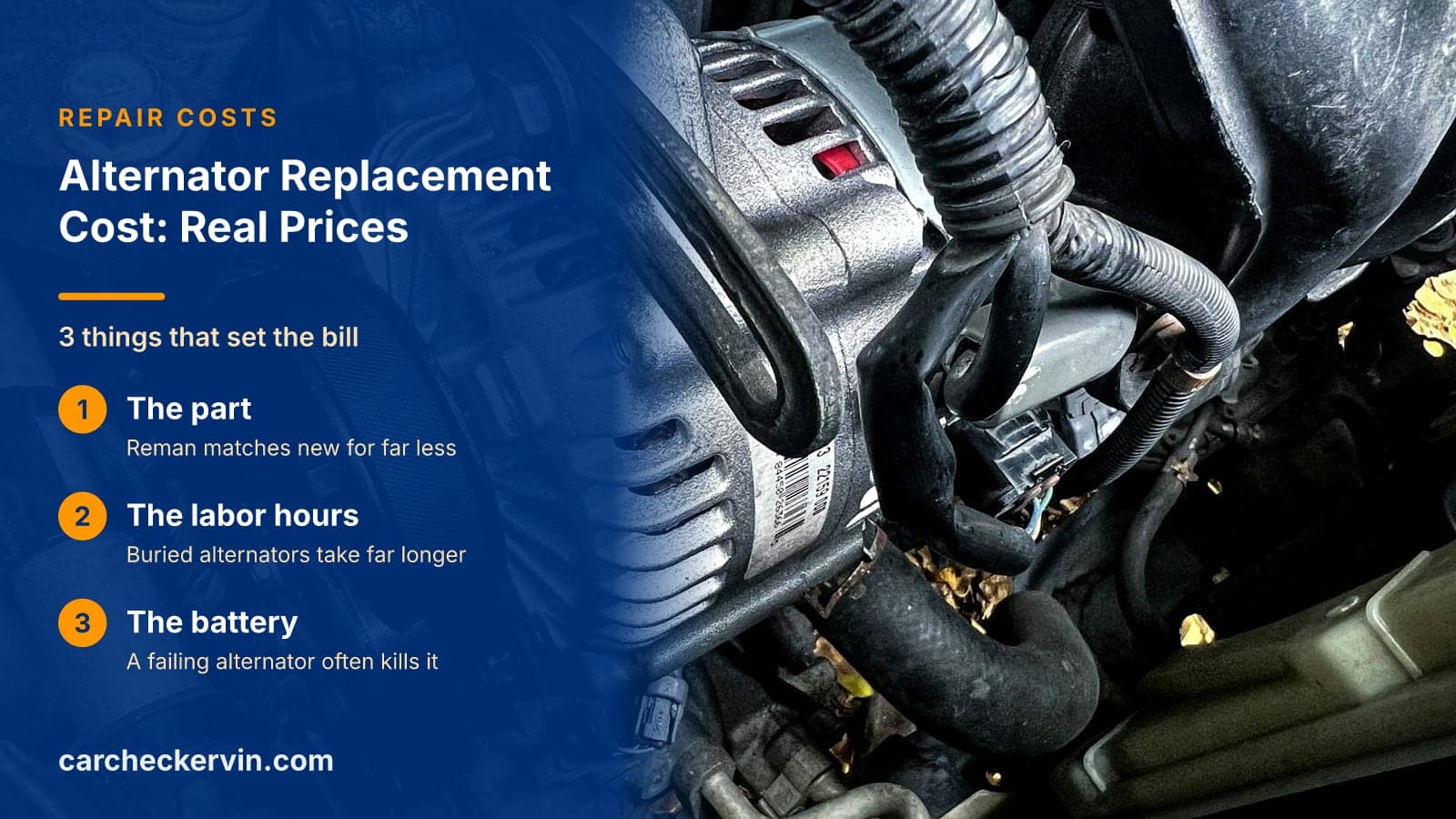
Alternator Replacement Cost: What You'll Actually Pay
Your alternator is dying and you need a number. Here's what alternator replacement actually costs by vehicle type, where to save, and when the repair bill should change your plans for the car.
Sep 28, 2026 · 10 min read
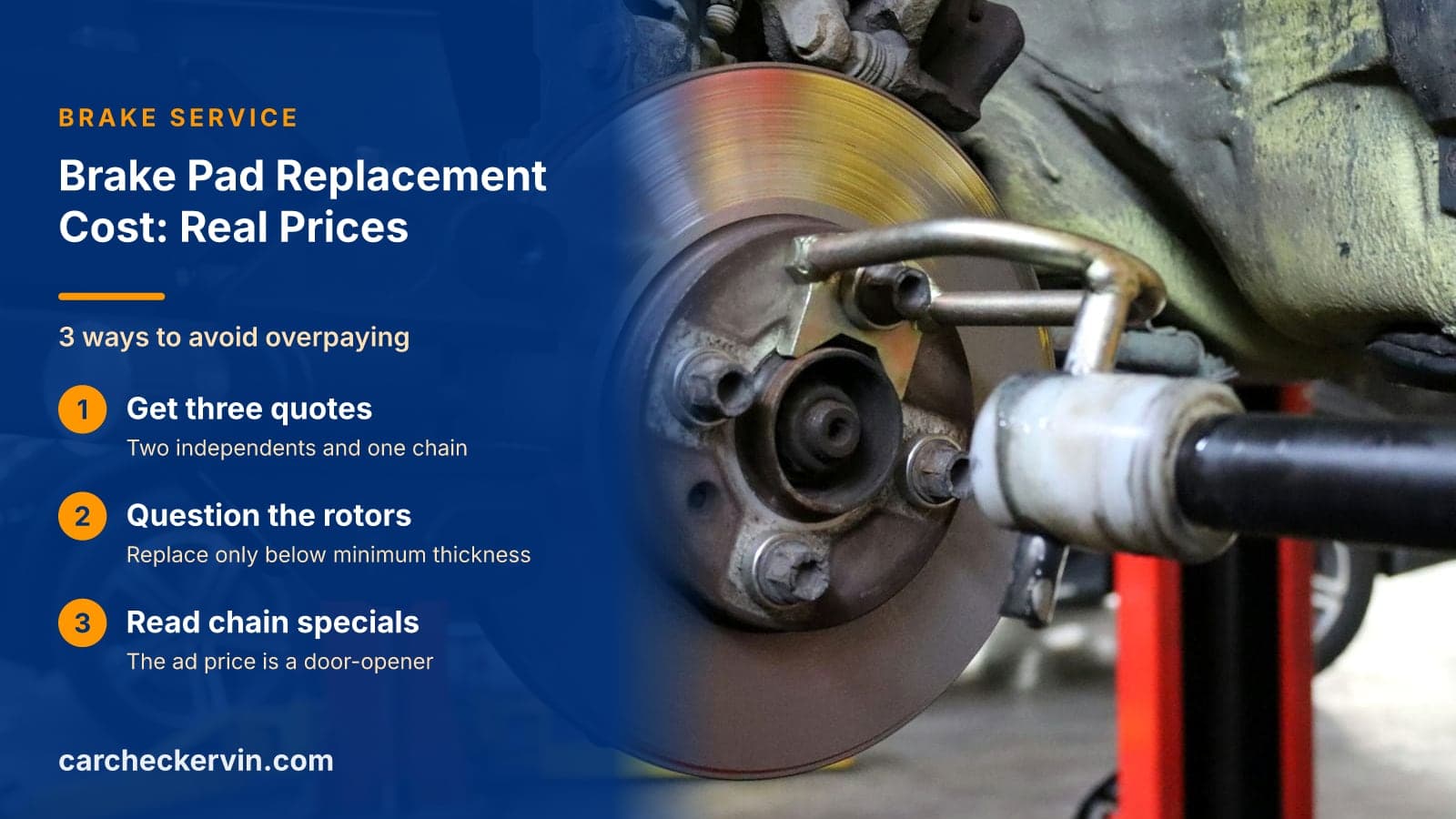
Brake Pad Replacement Cost: What You'll Actually Pay
Brake pad replacement cost varies widely by vehicle and shop. Here's what you'll actually pay per axle, when you can skip rotors, and how to avoid overpaying at chains or dealerships.
Sep 28, 2026 · 9 min read