Second Hand Car Buying Advice: The No-Nonsense Guide for US Buyers
From title brands and auction lots to financing traps and the best used EVs, this guide gives US buyers the specific, skeptical second hand car buying advice they need before spending a dollar.
Check the car you're reading about
Free VIN decode and recall check
Factory specs and open NHTSA recalls in seconds. No sign-up.
On this page· 9
- Understand the Legal Paperwork Before You Set Foot on a Lot
- Second Hand Car Buying Advice on Where to Shop
- Financing or Leasing a Used Vehicle: Finding the Best Place for a Car Loan
- Buying New vs Used Car: An Honest Cost Comparison
- Inexpensive Cars With Good Gas Mileage: How to Filter the Market
- Best Used EV to Buy: Federal Credits and Real-World Range
- The Pre-Purchase Inspection: What It Covers and What It Costs
- Negotiating Price Using Market Data
- Extended Warranties and Service Contracts: When They Make Sense

Sound second hand car buying advice has never mattered more: according to Cox Automotive's Used Vehicle Market Report, the average transaction price for a used vehicle in the United States exceeded $28,000 — a figure that turns a casual purchase into one of the largest financial decisions most households make in a given year. The stakes are high because the risks are real: NMVTIS-reported title brands such as Salvage, Flood, and Junk follow a vehicle through every state DMV transfer, yet millions of buyers never pull a vehicle history report before signing a Buyers Guide — the federally mandated FTC disclosure form required under 16 CFR Part 455 for every used vehicle sold by a dealer. Whether the goal is an inexpensive car with good gas mileage for a daily commute, a premium certified pre-owned family hauler, or the best used EV to buy before federal tax credit rules tighten again, the framework for making a safe decision is the same: verify the title, understand the financing, inspect the metal, and know your exit options before the ink dries.
The short answer
Run a VIN check, read the NMVTIS title history, and get an independent pre-purchase inspection before you negotiate price — those three steps eliminate most of the catastrophic surprises that define bad used-car purchases.
Understand the Legal Paperwork Before You Set Foot on a Lot
Every used-car transaction in the United States generates a paper trail that either protects or exposes the buyer, and knowing which documents to demand separates informed buyers from costly mistakes. The FTC's Used Car Rule — codified at 16 CFR Part 455 and enforced since 1985 — requires dealers to display a Buyers Guide on every used vehicle, disclosing whether any warranty is offered and its precise terms. Private-party sellers are exempt from this rule, which is one of the most underappreciated risks of buying outside a dealership.
NMVTIS, the National Motor Vehicle Title Information System administered by the U.S. Department of Justice, aggregates title data from all 50 state DMVs, insurance carriers, and salvage yards. A brand that appears in NMVTIS — Salvage, Rebuilt, Flood, Junk, or Lemon Law Buyback — survives the sale and transfers with the title regardless of how the car is advertised. The NICB (National Insurance Crime Bureau) estimates that tens of thousands of flood-damaged vehicles re-enter the market after major weather events each year. Requesting a duplicate title printout from the current state DMV and cross-referencing it against a vehicle history report should be non-negotiable for any purchase above a few thousand dollars.
Odometer Disclosure and Federal Fraud Protections
Federal law under 49 U.S.C. § 32705 requires sellers to provide a written odometer disclosure for most vehicles under ten model years old. Odometer rollback fraud costs American consumers an estimated $1 billion annually according to the NHTSA, making mileage verification one of the most financially consequential checks any buyer can perform. Compare the odometer reading against inspection stickers, oil-change labels inside the door jamb, and any service records the seller provides.
Second Hand Car Buying Advice on Where to Shop
The buying channel shapes nearly every risk the buyer faces. Franchised new-car dealers selling used inventory are bound by the FTC Buyers Guide rule and often offer certified pre-owned (CPO) programs with manufacturer-backed limited warranties. Independent used-car lots vary enormously: Buy Here Pay Here (BHPH) operations, which finance their own inventory and typically target buyers with subprime credit, charge effective APRs that the Consumer Financial Protection Bureau has flagged as routinely exceeding 20 percent — well above the national average auto loan rate tracked by the Federal Reserve's G.19 release.
Public auction platforms like Copart and Insurance Auto Auctions (IAA) sell vehicles as-is, no warranty, no test drive in most cases, and buyer's fees that can add 10 to 20 percent on top of the hammer price. These channels can surface genuine value for mechanically savvy buyers willing to absorb the risk, but they are a dangerous place for first-time buyers without a trusted mechanic on speed-dial. Private-party sales on platforms like Craigslist or Facebook Marketplace can offer lower prices but zero regulatory protection.
- Franchised dealer CPO programs: highest price, strongest consumer protections, manufacturer warranty.
- Independent used-car lots: wide price range, FTC Buyers Guide required, inspect carefully for BHPH financing traps.
- Public auctions (Copart, IAA): lowest prices possible, zero warranty, buyer's fees of 10–20% added to hammer price.
- Private-party sales: no Buyers Guide obligation, negotiate harder, always insist on a pre-purchase inspection.
- Online retailers (Carvana, CarMax): fixed-price transparency, return windows of 7 days (CarMax) or 7 days (Carvana), but prices reflect convenience.
Financing or Leasing a Used Vehicle: Finding the Best Place for a Car Loan
The financing decision is where many careful shoppers lose the money they saved on purchase price. Financing or leasing are distinct products: leasing a used vehicle is rare and typically only available through manufacturer CPO programs for near-new vehicles, while financing covers the vast majority of used purchases. The best place for a car loan is almost never the dealership's spot financing desk — it is a pre-approval from a credit union or community bank secured before the buyer walks onto the lot, because a pre-approval converts the buyer from a monthly-payment shopper into a cash-equivalent buyer.
According to the National Credit Union Administration (NCUA), credit unions have historically offered used-auto loan rates averaging 1 to 2 percentage points below those at commercial banks, a gap that on a $20,000 loan over 60 months translates to roughly $1,000 in interest savings. The CFPB's auto lending supervisory guidance also warns that dealer reserve markups — the spread a dealer adds to the buy rate the lender quotes — can cost buyers hundreds to thousands of dollars without any disclosure requirement. Securing a rate from your own institution first sets the ceiling; anything the dealer beats is a genuine win.
Loan Term Length and Total Cost of Ownership
Experian's State of the Automotive Finance Market report shows that the average used-vehicle loan term has stretched beyond 67 months, creating the dangerous condition where buyers owe more than the vehicle is worth for the majority of the loan's life. A 72-month loan on a five-year-old vehicle means the buyer could still be making payments when the car is eleven years old and potentially unreliable. Shorter terms at lower rates protect equity and flexibility.
Buying New vs Used Car: An Honest Cost Comparison
The buying new vs used car debate hinges on three measurable variables: depreciation, financing cost, and warranty coverage. A new vehicle loses an average of 20 percent of its value in the first year according to iSeeCars research published in their annual depreciation study, meaning a buyer who purchases a two-year-old off-lease unit captures most of that loss without experiencing it. On a $40,000 new vehicle, that first-year depreciation alone represents $8,000 — money that effectively vanishes the moment the car leaves the dealer lot.
Against that advantage, used buyers pay higher financing rates — the Federal Reserve's G.19 Consumer Credit data shows used auto loan rates averaging approximately 2 to 3 percentage points above new-car rates — and sacrifice any remaining factory warranty coverage unless the vehicle qualifies for a CPO program. Extended service contracts sold by dealers are not warranties under the Magnuson-Moss Warranty Act; they are insurance products administered by third parties, and their value depends entirely on the financial solvency of the administrator and the breadth of covered components. Read every exclusion before signing.
The Depreciation Trap in Reverse
If a used vehicle is priced within $2,000–$3,000 of its new equivalent — common during supply crunches — the new vehicle is usually the better financial decision: it comes with a full factory warranty, no title history concerns, and manufacturer incentives that used cars cannot match. Always compare new MSRP and current incentives before assuming used means cheaper.
Inexpensive Cars With Good Gas Mileage: How to Filter the Market
Buyers hunting for inexpensive cars with good gas mileage need to apply two filters simultaneously: the EPA's fueleconomy.gov database, which publishes city/highway/combined MPG ratings for every vehicle since 1984, and real-world reliability data from sources like Consumer Reports' Annual Auto Reliability Survey. A vehicle with stellar EPA ratings but a below-average reliability score can erase fuel savings in repair costs within a single ownership year.
Among vehicles that consistently score well on both axes are compact sedans and hatchbacks from Toyota, Honda, and Hyundai from roughly the 2015 model year onward. The Toyota Corolla, for example, has returned EPA combined ratings of 32 to 34 MPG in non-hybrid trims, while used examples from mid-decade typically trade for $12,000 to $18,000 depending on mileage and trim level — positioning them as genuine value propositions. Hybrid variants of the same models push combined ratings above 50 MPG according to EPA data, at a price premium of roughly $2,000 to $4,000 over non-hybrid equivalents in the used market.
Hidden Costs That Undermine Low Purchase Prices
Buyers seduced by a $6,000 asking price on a high-mileage import sometimes discover that timing belt replacement, failing CVT transmissions, or discontinued parts can push repair costs past the car's market value within 12 months. Always request a CarFax or AutoCheck report, cross-reference it with any available service records, and budget at least $150 for an independent pre-purchase inspection by a mechanic who has no financial stake in the sale.
Best Used EV to Buy: Federal Credits and Real-World Range
The market for used electric vehicles shifted materially after the Inflation Reduction Act of 2022 introduced a federal tax credit of up to $4,000 for qualifying used EVs purchased from a licensed dealer — a provision capped at 30 percent of the vehicle's sale price and subject to buyer income limits of $75,000 AGI for single filers as specified in 26 U.S.C. § 25E. That credit has made the best used EV to buy a genuine contender against gasoline alternatives on a total cost of ownership basis.
The used Chevrolet Bolt EV, Hyundai Ioniq 5, and Tesla Model 3 Standard Range consistently appear at or near the top of used EV value rankings from sources including Edmunds and MotorTrend. The Bolt in particular benefits from a GM battery warranty covering 8 years or 100,000 miles under federal EPA zero-emission vehicle standards — meaning many used Bolts still carry partial battery coverage. Buyers should pull the VIN through the manufacturer's warranty portal to confirm remaining coverage before any purchase, and run a vehicle history report to verify whether the battery has ever been replaced or the vehicle has sustained collision damage.
Charging Infrastructure and Real-World Range Degradation
Battery degradation is the used EV buyer's equivalent of a blown head gasket: expensive, hard to detect without specialized tools, and not always disclosed. Research by Recurrent, a battery analytics firm, tracking over 15,000 EVs showed that most EVs retain more than 90 percent of their original range after 100,000 miles — but outliers exist, particularly in hot climates or among vehicles that spent years on DC fast-charging exclusively. Request a battery health report or have the vehicle scanned by a technician with access to the manufacturer's diagnostic software.
The Pre-Purchase Inspection: What It Covers and What It Costs
A pre-purchase inspection (PPI) performed by an independent, ASE-certified mechanic is the single most cost-effective insurance any used-car buyer can purchase. Typical PPI fees range from $100 to $200 at an independent shop, with mobile inspection services like DEKRA or Lemon Squad operating in most major metro areas for similar fees. Against the cost of a missed transmission issue — average replacement cost between $1,800 and $3,400 according to RepairPal's database — that $150 expenditure represents an extraordinary return on risk reduction.
Any seller who refuses a pre-purchase inspection is providing information: either the vehicle has a known defect, or the seller is in a hurry to close before a problem surfaces. Both scenarios are red flags that should prompt the buyer to walk away. For vehicles purchased at auction where PPIs are prohibited, the discount must be substantial enough to absorb the unknown mechanical risk — a calculus that typically favors buyers with mechanical knowledge or a trusted repair relationship.
Negotiating Price Using Market Data
Dealers and private sellers both price to the top of what the market will bear, which means buyers who arrive with market data negotiate from a position of strength while those who arrive with only enthusiasm pay retail. Kelley Blue Book (KBB), Edmunds True Market Value (TMV), and NADA Guides are the three most widely referenced valuation tools in the US market, and a spread among them often reveals negotiating room. When two of three tools price a vehicle below the asking price, that gap is the opening number for a counter-offer, not a curiosity.
Reconditioning costs are a legitimate dealer expense — NADA's annual dealer profitability data shows average per-unit reconditioning costs of several hundred to over $1,000 for vehicles brought to retail standard — but they are also frequently inflated as a justification for above-market pricing. Asking for an itemized reconditioning sheet is entirely reasonable and reveals whether the work was cosmetic, mechanical, or purely a margin-padding accounting entry.
- Pull KBB, Edmunds TMV, and NADA prices for the specific year, trim, mileage, and zip code before visiting any seller.
- Identify any NMVTIS title brands or accident history through a vehicle history report and use them as price reduction levers.
- Get a PPI estimate in writing from your mechanic before entering final price negotiations — documented repair needs justify dollar-for-dollar deductions.
- Secure a pre-approved loan rate from a credit union before negotiating: it separates the vehicle price conversation from the financing conversation.
- Counter the asking price with the lowest of the three valuation tools, then negotiate toward the middle — never reveal your ceiling.
- Insist that all verbal promises (remaining warranty, repairs to be completed) appear in writing on the purchase contract before signing.
Extended Warranties and Service Contracts: When They Make Sense
Extended service contracts are among the highest-margin products a dealership sells, with markups that the CFPB has noted can reach 50 percent or more above the dealer's cost. That does not make them worthless — it makes them negotiable and worthy of scrutiny. For a high-complexity vehicle (turbocharged engine, dual-clutch transmission, air suspension) purchased outside the CPO window, a well-structured service contract from a financially solvent administrator can hedge genuine risk.
The key screening questions: Is the contract backed by an insurance company regulated by a state insurance commissioner, or by the dealership itself? What is the claims process — does the buyer pay and seek reimbursement, or does the shop bill directly? What components are explicitly excluded? The Magnuson-Moss Warranty Act (15 U.S.C. §§ 2301–2312) governs written warranties on consumer products including vehicles, but it does not regulate service contracts in the same way — meaning the contract's terms are the buyer's only protection, and those terms deserve a full read before any money changes hands.
What to do next
Before contacting any seller, run a VIN check on the vehicle you're considering to pull its NMVTIS title history and accident records — then use those findings as your first negotiating data point.
About the author
CarCheckerVIN Editorial Team
In-house automotive research team
The CarCheckerVIN editorial team combines decades of automotive industry, dealer, and journalism experience to produce trustworthy buying, selling, and ownership guidance backed by NMVTIS, NICB, and manufacturer data.
See more of our guides on Google
Add CarCheckerVIN as a preferred source and Google will show our guides more often in your results.

Frequently asked questions
- What is the safest car to buy?
- Safety is measurable: the Insurance Institute for Highway Safety (IIHS) awards a Top Safety Pick+ designation to vehicles that earn the highest ratings across six crash tests and meet strict headlight standards. Vehicles from Honda, Subaru, Toyota, and Volvo regularly earn this designation. For used buyers, prioritize models with standard automatic emergency braking, which NHTSA research links to significant reductions in rear-end crash rates.
- What is the $3000 rule for buying a car?
- The '$3,000 rule' is an informal buyer's guideline suggesting that at a purchase price around $3,000, a used vehicle's mechanical risk often outweighs its value — meaning one significant repair can exceed what the car is worth. It is not a statute or industry standard, but it reflects the reality that sub-$3,000 vehicles typically carry high mileage, deferred maintenance, or title concerns. A pre-purchase inspection is non-negotiable at this price point.
- What cars are worth buying second hand?
- Vehicles with the best combination of depreciation, reliability, and parts availability consistently include the Toyota Camry and Corolla, Honda Civic and CR-V, and Mazda3. Consumer Reports' Annual Auto Reliability Survey identifies these nameplates as repeatedly above-average over multi-year windows. For buyers open to used EVs, the Chevrolet Bolt EV qualifies for the federal used-EV tax credit of up to $4,000 under 26 U.S.C. § 25E and carries an 8-year battery warranty.
- How often should you wash your car?
- The American Automobile Association (AAA) recommends washing a vehicle every two weeks under normal conditions, and more frequently after exposure to road salt, bird droppings, or tree sap — all of which can damage clear coat within days if left untreated. For used-car buyers, the condition of the paint and the presence of rust are direct indicators of how the previous owner maintained the vehicle, making exterior care relevant to the purchase decision itself.
Keep reading
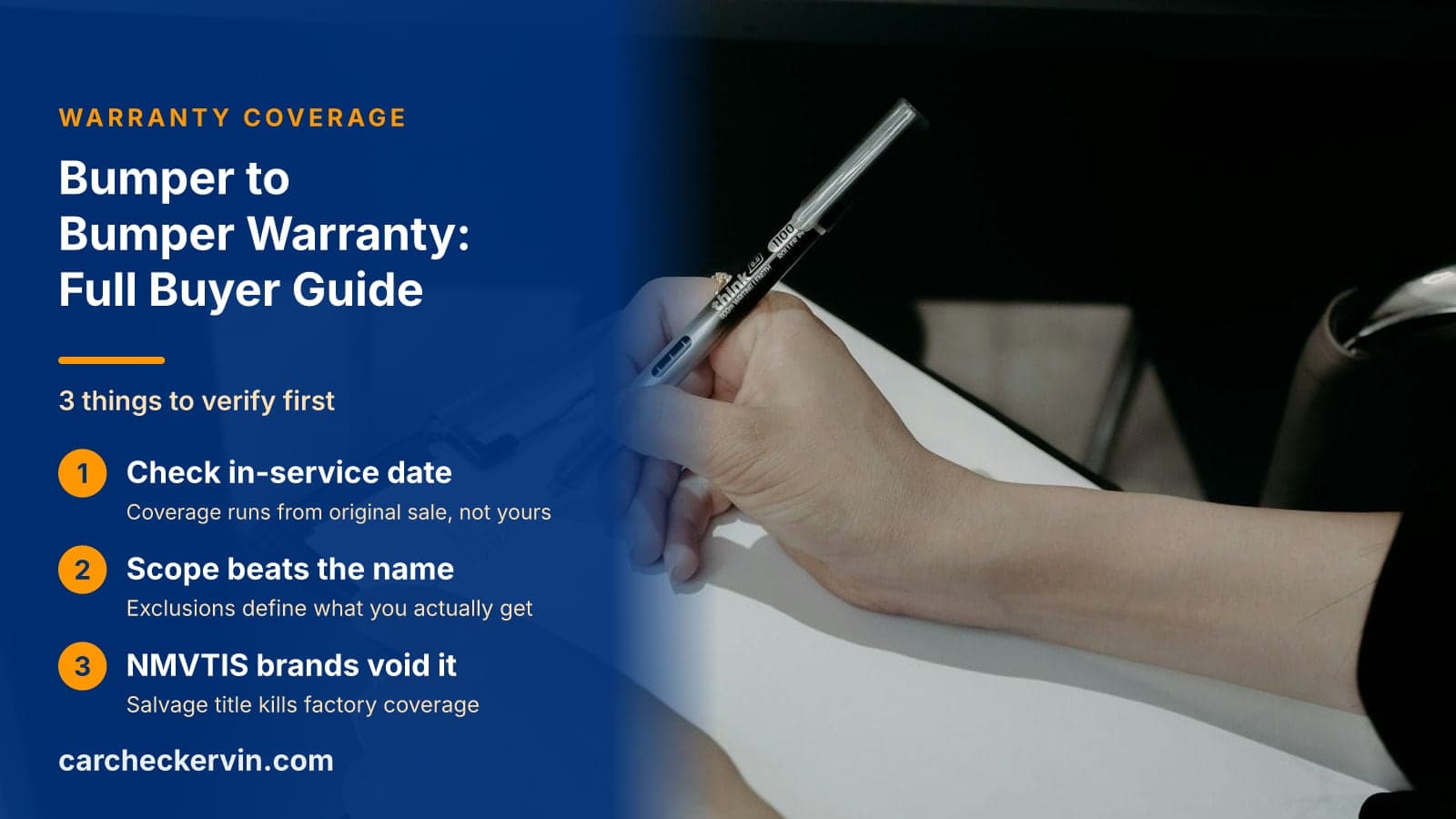
Bumper to Bumper Warranty: What It Covers, What It Doesn't, and Whether to Buy Extra
A bumper to bumper warranty sounds complete, but the exclusions can cost you thousands. Here's exactly what's covered, what isn't, and how to decide if extended coverage is worth the price.
Oct 26, 2026 · 8 min read
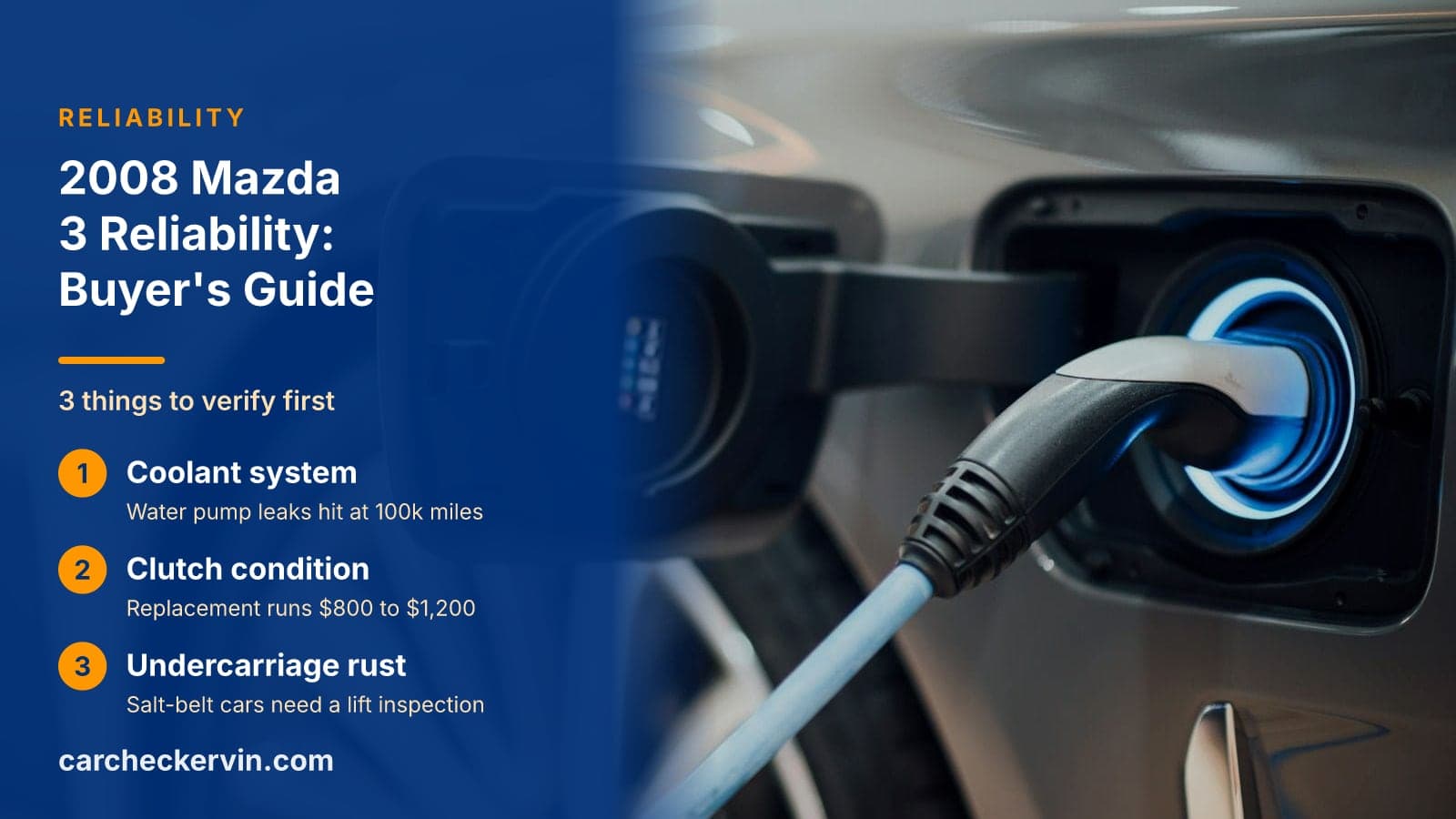
2008 Mazda 3 Reliability: What Every Buyer Needs to Know Before Handing Over Cash
The 2008 Mazda 3 has a strong reliability record, but a handful of recurring problems can turn a bargain into a money pit. Here's exactly what to check before you buy.
Oct 26, 2026 · 10 min read
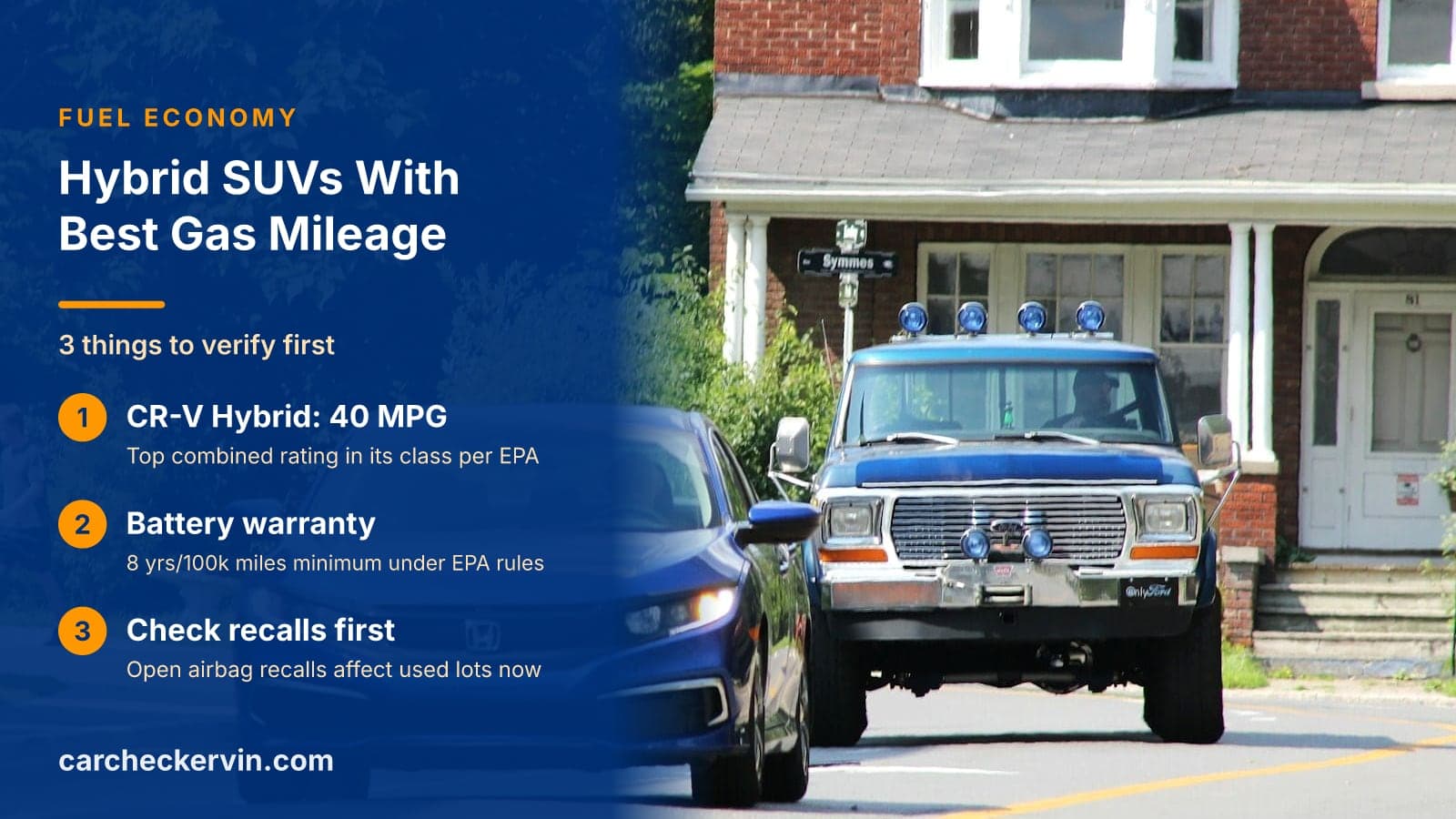
Hybrid SUVs With Best Gas Mileage: The Buyer's Field Guide
Shopping for a fuel-sipping SUV? This field guide ranks the top hybrid SUVs by real-world MPG, flags hidden costs, and tells you exactly what to verify before you buy.
Oct 25, 2026 · 10 min read