CarProof — the Brand Is Gone, the Report Is Not
CarProof was Canada's own vehicle history report. The name has been retired: every CarProof web address now permanently redirects to CARFAX Canada, and the product sold today is the CARFAX Canada Vehicle History Report + Lien Check. If you are holding an old CarProof document, it is a snapshot of the day it was pulled — not of the car in front of you.
Check the VIN Free, Right Now
Title brands, theft records and US import history — before you pay for anything, from anyone.
Free · No sign-up · About the car, not the owner
Quick Answer
- What happened to CarProof?
- It became CARFAX Canada. The brand is retired and every CarProof address now redirects permanently to carfax.ca. Reports issued under the CarProof name are still readable, but they describe the vehicle as of the date they were generated — which, given the rebrand, is now years ago.
How we know the brand is retired
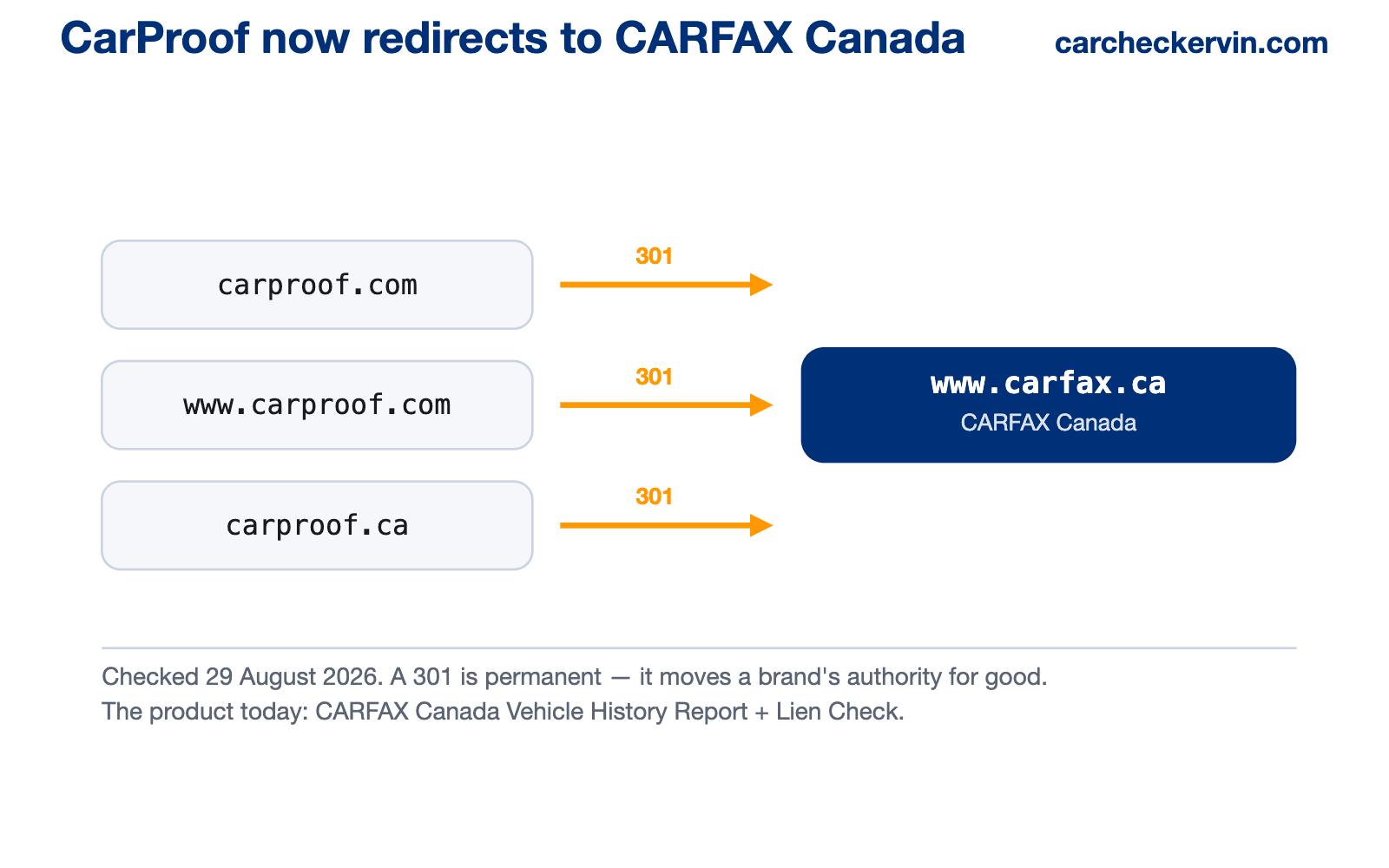
Not from an announcement or a remembered date — from the redirects themselves. Each of these was requested on 29 August 2026 and each answered with a permanent redirect to CARFAX Canada.
| CarProof address | Response | Lands on |
|---|---|---|
| carproof.com | 301 Moved Permanently | www.carfax.ca |
| www.carproof.com | 301 Moved Permanently | www.carfax.ca |
| carproof.ca | 301 Moved Permanently | www.carfax.ca |
A 301 is not a courtesy notice. It is the instruction a company gives search engines to move a brand's entire accumulated authority onto another domain permanently. Companies do not do that to a name they intend to use again.
What the report is called now
Follow any CarProof link and you arrive at CARFAX Canada, whose lineup reads as three products: the Vehicle History Report + Lien Check, a VIN Fraud Check, and Vehicle Monitoring. The first is the direct descendant of what CarProof sold, and the name is worth noting: the lien check is bundled into the report rather than sold beside it, which is a Canadian distinction. In the United States a lien sits on the title record; in Canada it sits in a provincial registry, so it has to be searched separately and then attached.
The limit every report shares, including ours
CARFAX Canada states it plainly on their own site: their reports are based only on the information supplied to them, and available as of the moment the report is generated. That sentence is worth reading carefully, because it is true of every vehicle history report ever sold, ours included.
A report is a snapshot
It describes the record on the day it was pulled. A collision last month that has not yet been reported is not in it, and no provider can make it be.
Nothing sees everything
Each provider receives data from the sources that supply it. A body shop that reports to one network and not another produces a record that differs by provider.
Which is why a free check first is rational
Spend nothing to find out whether the car is already disqualified by a brand or a theft record. Pay for depth only on a car that survives that.
Product names and the data disclaimer read from carfax.ca on 29 August 2026.
What to do with a CarProof document
Someone selling a car will sometimes produce a report they bought years ago. It is not fraudulent — it is just old, and the age is the problem.
- 1Find the generation dateEvery report carries the date it was pulled. That is the only date its contents describe.
- 2Count the gapIf it is headed CarProof, it predates the rebrand entirely. Everything since then is missing from it.
- 3Check what changed sinceCollisions, write-offs, a lien registered against the car, an out-of-province move — none of it will be in an old document.
- 4Pull a current checkRun the VIN yourself. It is the only way to know the record as of today rather than as of whenever the seller last looked.
What the report actually searches for
CARFAX Canada lists what every Vehicle History Report + Lien Check looks for, and the list is worth reading because it tells you what the product is built around rather than what the marketing says. Damage is the spine of it: vehicle damage, accident history, frame or structural damage, and the location of the damage on the car.
Damage location matters more than most buyers realise. The same repair bill means something entirely different depending on where the impact landed — a bumper is a cosmetic event, a hit to the frame rail or the B-pillar is a structural one that follows the car for the rest of its life and shows up in every future valuation. A report that records where the damage was, not merely that there was damage, is doing the more useful job.
What no such list can promise is completeness, and CARFAX Canada is explicit about that in their own words. The reports are built from information supplied to them. A collision settled privately between two drivers, with no insurer and no police report, generates no record for anyone to supply — and so appears in no report, from any provider, at any price. That is not a criticism of them; it is the shape of the whole category, and any seller who tells you a clean report proves a car was never hit is overstating what the document can do.
Why people still search for a retired brand
Roughly 1,300 searches a month in Canada still go looking for CarProof, and the figure is falling by about 47% year on year. Both halves of that are interesting. The decline is what you would expect of a name being slowly forgotten. The 1,300 is what you would not — it is a substantial number of people still typing a brand that no longer sells anything.
The practical consequence is that a Canadian used-car conversation can still contain the word. A seller may say they have a CarProof, an older listing may advertise one, a dealer may use the term out of habit. None of that is misleading in itself. It just means the document being described is either a current CARFAX Canada report under an old name, or an actual old report — and those are very different things to be handed.
The question worth asking a seller is not which brand the report carries but what date it was generated. That single answer tells you how much of the car's life the document actually covers.
A seller's report is a seller's snapshot
Pull the VIN yourself and read today's record — brands, theft flags and US import history, free before you spend anything.
The lien is the Canadian part
CarProof built its reputation partly on lien data, and the reason is structural. Canada has no DMV and no federal title register. A lien against a vehicle is registered under provincial personal-property legislation — Ontario's PPSR, Quebec's RDPRM, the PPR registries in the west — and it stays attached to the vehicle rather than to the person who borrowed the money. Buy a car with a live lien on it and the lienholder still has a claim, regardless of what you paid or what the seller told you.
That is a genuinely different legal instrument from a US title lien, which is why it deserves its own explanation rather than a paragraph here. See how a Canadian lien check works for the registries province by province. In Ontario the UVIP also carries a lien line, and a private seller is legally required to give you one.
Common questions
- Does CarProof still exist?
- Not as a brand you can buy from. Every CarProof web address now redirects to CARFAX Canada — carproof.com, www.carproof.com and carproof.ca all return a permanent redirect to carfax.ca. A permanent redirect is the strongest signal a company can send about a retired brand: it is not a landing page explaining the change, it is the old name handing every visitor straight to the new one.
- Is a CarProof report the same as a CARFAX Canada report?
- It is the same lineage, under a different name. The product sold today is the CARFAX Canada Vehicle History Report + Lien Check, and it is what you land on when you follow any old CarProof link. If someone hands you a document headed CarProof, you are looking at a report generated before the rebrand — the data in it was accurate when it was pulled, but it is a snapshot of that date and nothing after it.
- I was given an old CarProof report. Is it still valid?
- Treat it as dated rather than wrong. A vehicle history report describes what was on the record the day it was generated, and a car that has since been in a collision, been written off, or had a lien registered against it will not show any of that. CARFAX Canada says as much about its own reports — they are based only on the information supplied to them and available at the time the report is generated. If the report in your hand predates the rebrand, it predates it by years. Pull a fresh check on the VIN.
- Do I still need a lien check in Canada?
- Yes, and it is the part most worth getting right. A lien in Canada is registered in a provincial registry — Ontario's PPSR, Quebec's RDPRM, the PPR systems in the western provinces — not with any DMV, because Canada has no DMV. A lien that is still registered survives the sale, and the lienholder keeps a claim on the vehicle after the money has changed hands.
- What is the cheapest way to check a car in Canada now?
- Start with a free VIN snapshot to see whether the car is worth paying to investigate at all — brands, theft records and US import history come up before you spend anything. If the car survives that, buy the depth you actually need. A full CarCheckerVIN report is $14.99. We do not publish a comparison figure for CARFAX Canada here because they do not publish one on their own site, and inventing it would be worse than leaving the gap.
Always check the VIN before you buy
The free preview shows title brands, theft status and open recalls in seconds, and flags whether accident and odometer records exist. The full history is $14.99 — one-time, no subscription.
Read the record as it stands today
Whatever brand is on the report you were handed, the only date that matters is today's. Check the VIN free, then buy depth only if the car earns it — our full report is $14.99.
Related VIN Checks
More tools to verify any vehicle's history