California VIN verification — REG 31, explained.
California wants a physical VIN inspection before it registers most out-of-state cars — and a car's salvage history decides who may perform it. The seven triggers, the four verifiers, and what to check first.
Check the brand history before the paperwork
Any 17-character VIN → title brands, salvage records, odometer flags — free preview.
Free preview · no card, no account
Quick Answer
- When does California require a VIN verification?
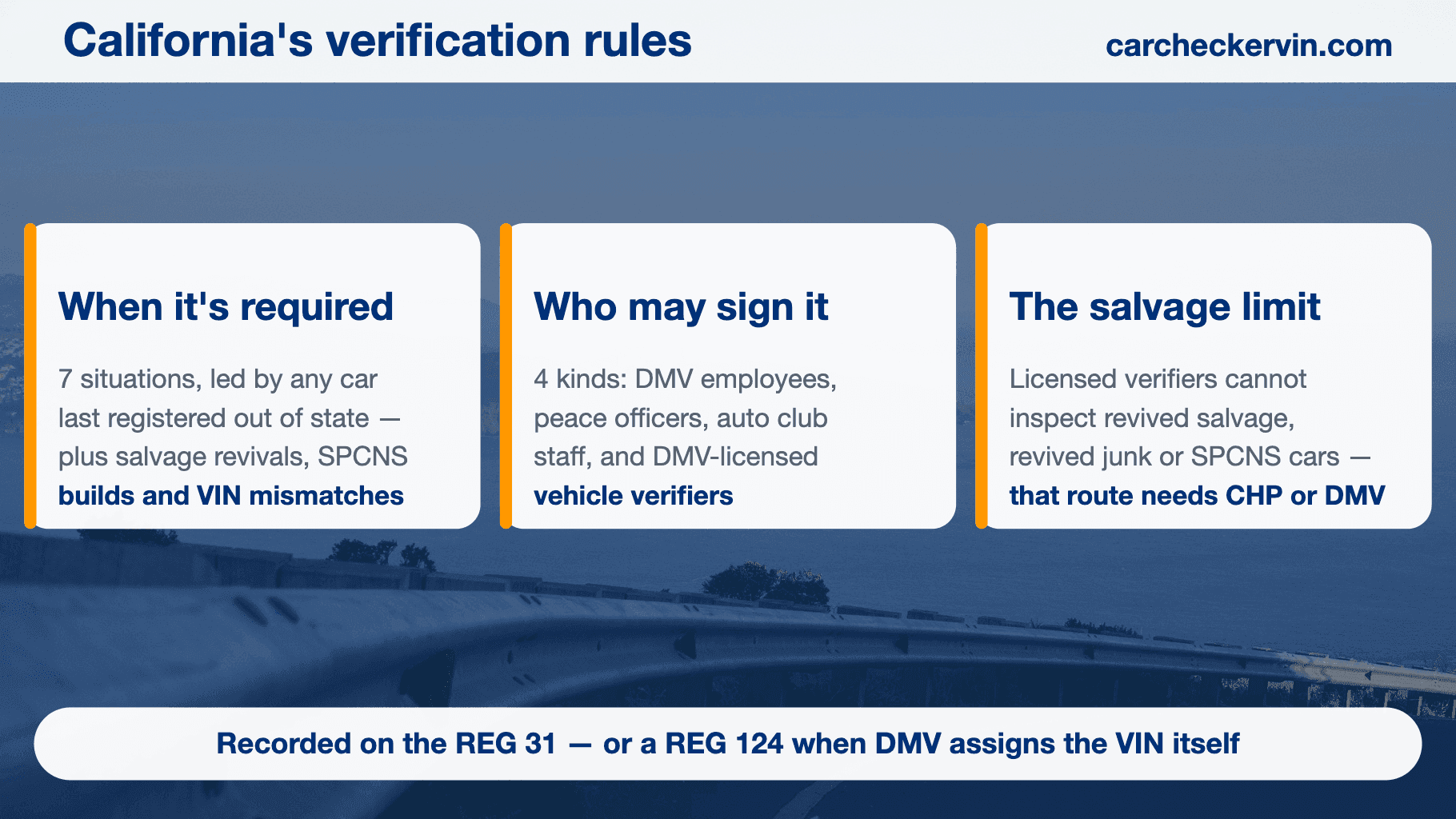
- Seven situations, per the DMV's own manual — the common one being any vehicle last registered out of state. It also applies to reviving a junk or salvage vehicle, specially constructed vehicles, cars DMV has no record of, engine changes, DMV-assigned VINs, and any case where the VIN on the paperwork doesn't match the VIN on record.
- Who can do it, and what's the form?
- Four kinds of verifier: DMV employees, peace officers (including military police), employees of auto clubs that provide registration services, and people licensed as vehicle verifiers by DMV. The inspection is recorded on the Verification of Vehicle (REG 31).
- Why does a salvage history change the process?
- Because it changes who is allowed to inspect the car. Licensed vehicle verifiers can't sign off on revived salvage, revived junk or SPCNS vehicles — and reviving a junk or salvage vehicle needs a CHP Certificate of Inspection (CHP 97C) instead. Knowing the car's brand history before you buy tells you which process you're walking into.
The seven situations that require one
The DMV manual is unusually specific here. A verification of vehicle is always required for:
A car last registered out of state
The everyday case — you moved to California, or bought a car elsewhere and want California plates. Certain new out-of-state trailers and heavy commercial vehicles are excepted.
Reviving a junk or salvage vehicle
Reregistering a previous junk or salvage vehicle requires it — unless the application already carries a CHP Certificate of Inspection (CHP 97C).
A specially constructed vehicle
SPCNS motor vehicles and trailers — kit cars, home-builds and the like — always get inspected before registration.
A vehicle DMV has no record of
If there's no DMV record, a verification is required. The exception is a new vehicle reported sold by a licensed California dealer on a REG 397.
Engine and number changes
Recording an engine change, a motorcycle engine case change, or a switch from engine number to VIN all require the physical inspection.
A DMV-assigned VIN
When DMV assigns an identifying VIN number to a vehicle, the physical inspection is part of that process.
A VIN that doesn't match the record
Whenever the VIN shown on the certificates differs from the VIN shown on record — including vehicles being junked. A mismatch is its own trigger.
Who can sign your REG 31
Four categories are authorized, and one of them carries a restriction most guides never mention:
DMV employees
The default route: bring the vehicle to a DMV office and an employee performs the verification. When a VIN is missing or illegible, a DMV employee is specifically the one who must locate an alternate, accessible VIN.
Peace officers and auto clubs
Peace officers, including military police under California Penal Code §830, can verify. So can employees of auto clubs that provide registration services — they must add their auto club's abbreviation alongside their signature.
DMV-licensed vehicle verifiers
Private verifiers licensed by DMV can come to the vehicle — but they cannot do VIN inspections for revived salvage, revived junk, SPCNS vehicles, or motorcycles with an unavailable California record. Those go back to DMV or CHP.
That restriction is the practical reason to know a car's history before you book anyone: if the vehicle is a revived salvage, the convenient mobile verifier isn't an option and your route changes entirely.
What the REG 31 inspection covers
The verification is a physical examination, not a paperwork review. What that means in practice:
REG 31, or REG 124
A verification is always completed on the Verification of Vehicle (REG 31) unless an Application for Assigned Vehicle Identification Number Plate (REG 124) is required instead.
Everything descriptive, physically checked
All descriptive information requested on the form must be physically inspected. Verifications of incomplete or unassembled vehicles — parts, in other words — are not acceptable.
The federal safety label
The federal safety label serves as a second source of public VIN verification. If it's missing or illegible, an alternate accessible VIN has to be located by a DMV employee.
Electric motorcycles
For an electric motorcycle, the serial number on the electric motor is used as the engine number — a small detail that saves an argument at the counter.
The brand history decides your route
Salvage or junk in the record changes who can verify the car. See what's on file before you commit — free.
When you don't need one
The exceptions are narrow and mostly commercial, but worth knowing before you queue for an appointment:
Certain new out-of-state trailers
A new trailer bought in another state and eligible for the Permanent Trailer Identification (PTI) program is excepted — provided it has never been registered, hasn't been modified, altered or assembled from a kit, and comes with a secured manufacturer's certificate of origin.
Certain new heavy commercial vehicles
A new commercial vehicle bought out of state with an unladen weight of 6,001 pounds or more can be excepted when it has never been registered (or held IRP registration within the last 60 days only), is unmodified, and meets California emission standards.
The emissions catch
That exception disappears the moment emissions don't line up: a REG 31 is required for a vehicle that does not meet California emission standards. And a bill of sale, invoice or sales slip can't stand in for a secured MCO/MSO.
Buying out of state to bring into California
California's rules make one thing plain: a car's recorded past determines the process you'll face, not just the price you pay. Two records matter most:
Salvage and junk brands
A revived salvage or junk vehicle needs a CHP Certificate of Inspection rather than an ordinary verification, and licensed verifiers can't touch it. If a seller's car carries that history, you want to know before the deposit, not at the counter.
VIN mismatches
A verification is required whenever the VIN on the certificates differs from the VIN on record. That mismatch can be a clerical error — or it can be the first visible sign of something worse. Either way it's a problem you inherit.
The cheap step first
A free preview shows whether title brands and odometer flags exist on the VIN at all. The full NMVTIS-backed report is $14.99 — $13.49 with the one-time VIN10 code — which is a rounding error against a car you can't register the easy way.
Source: the California DMV Vehicle Industry Registration Procedures Manual, sections 1.165 and 12.165, read August 23, 2026. Procedures change — dmv.ca.gov is the authority.
Registering a car in California — the rest
The neighbouring checks, each with its own page.
Always check the VIN before you buy
The free preview shows title brands, theft status and open recalls in seconds, and flags whether accident and odometer records exist. The full history is $14.99 — one-time, no subscription.
California VIN verification — asked and answered
Straight answers, taken from the DMV's registration procedures manual.
When is a VIN verification required in California?+
The DMV's registration procedures manual lists seven situations where a verification of vehicle is always required: registering a vehicle last registered out of state; reregistering a previous junk or salvage vehicle (unless the application includes a CHP Certificate of Inspection, CHP 97C); registering a specially constructed (SPCNS) vehicle or trailer; a vehicle DMV has no record of, other than a new vehicle reported sold by a licensed California dealer on a REG 397; recording an engine change, motorcycle engine case change, or a change from engine number to VIN; DMV assigning an identifying VIN; and any case where the VIN on the certificates differs from the VIN on record, including vehicles being junked.
Who is authorized to perform a California VIN verification?+
Four categories: DMV employees; peace officers, including military police under California Penal Code §830; employees of auto clubs that provide registration services, who must include their auto club abbreviation with their signature; and persons licensed as vehicle verifiers by DMV. One important limit applies to that last group — licensed vehicle verifiers cannot perform VIN inspections for revived salvage, revived junk, SPCNS vehicles, or motorcycles with an unavailable California record.
What is the REG 31 form?+
REG 31 is the Verification of Vehicle — the form the physical inspection is recorded on. The DMV manual states a verification is always completed on the REG 31 unless an Application for Assigned Vehicle Identification Number Plate (REG 124) is required instead. All descriptive information requested on the form must be physically inspected, and verifications of incomplete or unassembled vehicles are not acceptable.
Can a mobile verifier come to my car?+
Often yes — DMV licenses private vehicle verifiers, and auto clubs that provide registration services can also verify. But if the vehicle is a revived salvage, revived junk or specially constructed vehicle, or a motorcycle whose California record is unavailable, a licensed verifier cannot do it. Checking the VIN's brand history first tells you whether the convenient option is even open to you.
What happens if the VIN plate is missing or unreadable?+
The federal safety label is used as a second source of public VIN verification. When it is missing or illegible, the manual is explicit that an alternate, accessible VIN must be located by a DMV employee — not by a licensed verifier or an auto club. If your car's VIN plate is damaged, plan on a DMV office rather than a mobile appointment.
Are there vehicles that don't need a verification?+
A few, and they're mostly commercial. A new out-of-state trailer eligible for the Permanent Trailer Identification program is excepted if it has never been registered, hasn't been modified or assembled from a kit, and comes with a secured manufacturer's certificate of origin. So is a new out-of-state commercial vehicle with an unladen weight of 6,001 pounds or more that has never been registered — or held IRP registration within the last 60 days only — is unmodified, and meets California emission standards. A REG 31 is required for any vehicle that does not meet California emission standards.
Why check a vehicle history report before the verification?+
Because California's process branches on the car's recorded past. A junk or salvage revival needs a CHP Certificate of Inspection and is off-limits to licensed verifiers, and a VIN that doesn't match the record triggers a verification by itself. A free VIN preview shows whether brands and odometer flags exist at all, and the full NMVTIS-backed report — $14.99, or $13.49 with the one-time VIN10 code — spells out the title chain before you buy a car whose paperwork route is harder than the seller implied.
Know the brand history before you book the inspection.
California checks that the VIN on the car matches the paperwork. It doesn't tell you what that VIN has been through — that's a free preview, and a $14.99 full report when it matters.
Related VIN Checks
More tools to verify any vehicle's history