Arizona Dealer License — the bond, the fees and the seven-car rule, from the statute.
Arizona licenses car dealers through the Motor Vehicle Division of the Department of Transportation under Chapter 10 of Title 28. Sell 7 or more used vehicles in a continuous 12-month period and § 28-4301 calls you a used motor vehicle dealer. The license takes a $100,000 surety bond for retail dealers ($25,000 for wholesale dealers and brokers), an established place of business with room to display 2 vehicles, fingerprints for every 20% owner, and only $115 in state fees. Here is what the statute and the Administrative Code require, and how Arizona compares with its neighbors.
Check Every Car Before You Stock It
Arizona dealers must hold the title before they offer a car. A salvage brand or an auction loss on that title becomes your disclosure problem at resale. Enter a VIN for a free preview.
Free preview · No sign-up · No owner or personal data
Quick Answer
- How many cars can you sell in Arizona without a dealer license?
- Section 28-4301 defines a used motor vehicle dealer as anyone, other than a new-car dealer, who buys, sells, auctions, exchanges or negotiates sales of, or is in the business of selling, 7 or more used motor vehicles in a continuous 12-month period. Selling your own cars below that count is not dealing; a person who comes into possession of a vehicle as an incident to another business and sells it is excluded too. Doing business as a dealer without the license is a class 1 misdemeanor under § 28-4334.
- How much does an Arizona dealer license cost?
- The state charges $15 to file the application and $100 for the annual license, $115 in all, or $415 if the dealer has a contract with a third-party lender. Renewals are $100 ($250 with a lender). The larger cost is the bond premium on a $100,000 bond for retail dealers or $25,000 for wholesale dealers and brokers, plus the fingerprint fee and $30 per dealer plate.
- What are the requirements for a dealer license in Arizona?
- An established place of business: a permanent enclosed building, owned or leased, with space to display 2 or more vehicles, with a permanent sign legible at 300 feet; the surety bond on the director's form; a copy of your transaction privilege tax license; a verified application listing every owner and the business hours; a full set of fingerprints from each 20%-or-more owner for a state and FBI records check; and an inspection of the premises before the director decides.
Five steps Chapter 10 asks for
The statute sets the pieces and the rule sets the bond; ADOT's Dealer Licensing unit takes the application, inspects the premises and issues the license.
- 1Pick the license typeNew, used, wholesale, broker, public consignment auction or wholesale auction. The type fixes the bond and whether you need a lot.
- 2Secure the established placeA permanent enclosed building with display space for 2 vehicles and a sign legible at 300 feet; used dealers may use a lot, nobody may use a residence.
- 3Buy the bond$100,000 for retail dealers, $25,000 for wholesale dealers and brokers, on the director's form, one original per county, sealed by the surety.
- 4Fingerprint every 20% ownerA full set of prints to the department for a state and federal records check; the director may issue a provisional license while it runs.
- 5File, get inspected, get the decision$15 to file and $100 for the year, with the bond and your TPT license; the director inspects the premises and decides within 20 days of the records check.
When Arizona Says You Need a License
Section 28-4301 does the sorting. A new motor vehicle dealer buys, sells or negotiates new vehicles, or used vehicles taken in trade on them. A used motor vehicle dealer is anyone else who buys, sells, auctions, exchanges or negotiates, or "is engaged in the business of selling, 7 or more used motor vehicles in a continuous twelve month period". A wholesale motor vehicle dealer sells used vehicles only to licensed dealers. A broker arranges or assists a purchase for a fee without being any of those. A public consignment auction dealer runs live auctions for the public on consignment. All of them are "motor vehicle dealers" for the chapter, except a person who comes into possession of a vehicle as an incident to a regular business and sells it.
Section 28-4334 then forbids anyone from engaging in a business the chapter regulates "except from an established place of business and unless the person has obtained from the director a license", and makes a violation a class 1 misdemeanor. The only exemptions in § 28-4333 are for nonprofits, which may sell donated vehicles but only by assigning them through a licensed dealer. Compared with its neighbors, Arizona's count is generous: Texas needs a license at 5 sales a year, Florida presumes a dealer at 3, Virginia at 5, and California sets no number at all.
The Arizona Dealer License Types and Their Bonds
Section 28-4301 defines the types; A.A.C. R17-5-402 attaches a bond to each. The type decides whether you need an established place of business and how many dealer plates you can hold.
Used dealer · $100,000
7+ used vehicles in 12 months. An established place that may be a lot; 15 plates plus one per 50 sales.
New dealer · $100,000
Sells new vehicles under a manufacturer or distributor authorization, plus trade-ins. Up to 150 dealer plates.
Public consignment auction · $100,000
Live auctions with a licensed auctioneer, open to the public, on consignment, from the established place or a permitted off-premises site.
Wholesale dealer · $25,000
Sells used vehicles only to licensed dealers. No established place required, but a place for records; 2 plates plus one per 50 sales once 10 sales are shown.
Broker · $25,000
Arranges purchases for a fee without selling. A state resident, no established place, but never from a residentially zoned address.
Wholesale auction dealer · $25,000
Auction services solely between licensed dealers, without owning the vehicles. Exempt from the title-in-hand rule while auctioning.
The Established Place of Business
Section 28-4301 defines the established place of business as a permanent enclosed building or structure, owned in fee or leased, "with sufficient space to display two or more motor vehicles of a kind and type that the dealer is licensed to sell", devoted principally to the dealer's business. For a used dealer, trailer dealer or semitrailer dealer the statute relaxes the building: the place "need not be a permanent building" and "may be a vacant lot or part of a vacant lot". What it may never be, for anyone, is a residence, a tent, a temporary stand or temporary quarters. Section 28-4334 lets a licensee use unimproved lots in the same county for storing vehicles and parts. Section 28-4335 excuses wholesale dealers and brokers from an established place altogether, though they must be Arizona residents and keep a place of business where the records are, and a broker's principal place cannot be zoned residential.
Two sections dress the location. Section 28-4406 requires a permanent sign at the entrance stating that a motor vehicle dealer's business is conducted there, "legible at a distance of at least 300 feet during daylight"; wholesale dealers and brokers post a sign at their principal place too. Section 28-4407 has every licensee state its business hours on each renewal and give the director 10 days' written notice before changing them. Section 28-4405 has the license conspicuously displayed, and § 28-4408 requires the director's consent before a licensee moves to a new place. Off-premises sales within the same county need a separate permit under § 28-4401, at $25 per application.
The location checklist
- Building: permanent and enclosed; used dealers may use a lot.
- Display: space for 2+ vehicles of the kind you sell.
- Never: a residence, tent or temporary quarters.
- Sign: legible at 300 feet in daylight.
- Hours: on every renewal; 10 days' notice to change.
Arizona Requirements at a Glance
The statute's money and paperwork on one card: the two bond levels, the state fees, the display minimum, the sign distance and the fingerprint rule.
Every figure comes from Chapter 10 or A.A.C. R17-5-402 as read on the date shown.
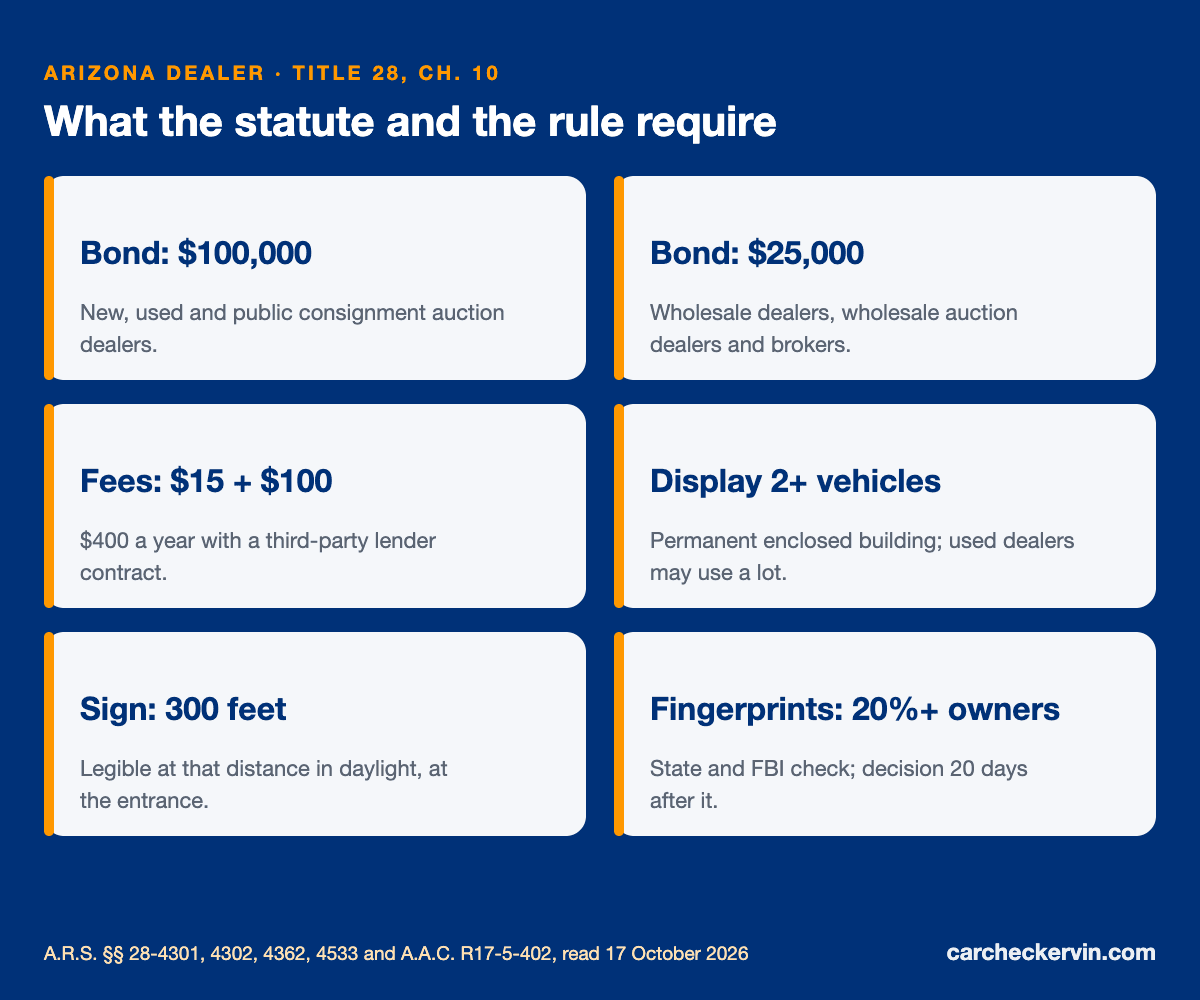
Arizona Dealer Fees, Bond and Plates
From § 28-4302 (fees), § 28-4362 and R17-5-402 (bond) and § 28-4533 (plates), read on 17 October 2026.
| Item | Amount |
|---|---|
| Application filing fee | $15 |
| Provisional license filed with the application | $10 |
| Annual dealer license | $100 ($400 with a third-party lender contract) |
| Annual continuation (renewal) | $100 ($250 with a lender) |
| Branch license, filing or continuation | $50 |
| Off-premises display-and-sale or exhibition permit | $25 per application |
| Bond: new, used, public consignment auction dealers | $100,000 |
| Bond: wholesale dealers, wholesale auction dealers, brokers | $25,000 |
| Bond: automotive recyclers | $20,000 |
| Dealer license plate or pair | $30 ($10 for motorcycle dealers) |
| Late renewal | a penalty equal to the fee |
So a first license year costs $115 in state fees, $415 with a lender contract, plus $30 per plate. The bond premium, the fingerprint vendor's charge and the transaction privilege tax license are priced elsewhere. Arizona has no state course or exam fee because, unlike Texas, California, Florida and Virginia, it mandates no pre-license course by statute, although § 28-4361 lets the director require education for used and wholesale applicants.
The Bond: $100,000 or $25,000
Section 28-4362 sets the frame and leaves the figure to the director. Every application carries a bond on a form the director approves, "in an amount prescribed by the director of at least $20,000 for an automotive recycler's license and not more than $100,000 for all other licenses", executed by a surety authorized in Arizona with the applicant as principal and the state as obligee, cancellable only on 60 days' notice to the director. It inures to anyone who loses money two ways: a dealer not paying over the title, registration and related fees or taxes a customer prepaid, or a dealer or recycler failing to deliver, with the sale, a valid title free of prior owners' interests and liens other than the buyer's own. The same section asks for a copy of the dealer's current transaction privilege tax license.
The figure is in the Administrative Code. Rule R17-5-402 requires $100,000 from a new motor vehicle dealer, a used motor vehicle dealer or a public consignment auction dealer; $25,000 from a broker, a wholesale motor vehicle dealer or a wholesale motor vehicle auction dealer; and $20,000 from an automotive recycler. The rule wants a separate original bond for each application and for each county in which the licensee has an established or principal place of business, a power of attorney for the attorney-in-fact, the signatures of all partners or an officer, and the surety's embossed stamp or seal; it will not accept a handwritten bond. At $100,000, Arizona's retail bond is the largest in this series, double the $50,000 Texas and California require and four times Florida's $25,000; its $25,000 wholesale bond is the smallest.
Fingerprints, the Records Check and the Decision
Section 28-4361 lists the application: the name and residence of the applicant, each partner, or each officer, director, agent or stockholder owning 20% or more of a corporation; the principal place of business; the established place the business will run from; the makes of any new vehicles; the business hours; and whatever else the director requires, all verified. Every applicant, partner or stockholder with 20% or more who seeks a new license supplies "a full set of fingerprints to the department of transportation for the purpose of obtaining a state and federal criminal records check" and pays the Department of Public Safety's fee for it; DPS may exchange the prints with the FBI. Adding a 20% owner later means notifying the department within 30 days with prints and the fee. The check is not repeated for an owner checked within the past 5 years or already licensed under the section, and it does not apply to manufacturers, distributors, or anyone under eighteen. The same section lets the director establish education and training requirements for used and wholesale dealer applicants.
Section 28-4364 has the director investigate the application and inspect, physically or by an approved alternate method, the place the applicant proposes to trade from, and lets the director issue a provisional dealer's license pending the records check if everything else is in order (the $10 provisional filing in the fee table). Section 28-4365 then gives the director 20 days after the records check to approve or deny, in writing with grounds. Denial follows a misrepresentation or omission meant to conceal a disqualifying fact, or a conviction for fraud or an auto-related felony anywhere in the 10 years before the check, among other grounds. A refused applicant has thirty days to request a hearing under § 28-4366.
Check the Cars You Buy for Resale
Enter the VIN for a free preview of its title brands, odometer readings and earlier auction records before you bid at the sale.
Dealer Plates
Section 28-4533 issues a dealer's certificate with a general distinguishing number and sets the plate counts by license type: a new motor vehicle dealer may hold up to 150 dealer plates; a used dealer up to 15 plus one more for every 50 vehicles sold in the previous license year; a wholesale dealer 2 plus one per 50 sales, never more than 10, and only after showing the department at least 10 sales to licensed dealers in the previous year, failing which the plates are cancelled. Each plate or pair costs $30, or $10 for a motorcycle dealer, and the right to use it ends at midnight on the last day of the month the fees fall due unless the next year is paid.
Section 28-4532 governs use. A dealer-owned vehicle is exempt from registration while the dealer owns it and may run on the highways on a dealer plate when driven by the dealer or an employee in connection with the business, or as personal transportation if assigned to the dealer or a full-time employee on a full-time basis and the assignment is recorded. The plates may not go on work or service vehicles (except a new-car dealer's manufacturer service program vehicle), leased or rented vehicles, laden cargo vehicles carrying more than three dealer-owned vehicles for resale, or any vehicle that has been sold. Arizona's counts are generous next to Virginia, which caps a dealer with fewer than 25 sales at two plates, and Texas, where the dealer plate costs $20.
Plates by license type
- New dealer: up to 150.
- Used dealer: 15 + 1 per 50 sales.
- Wholesale: 2 + 1 per 50; max 10; 10 sales first.
- Fee: $30 each ($10 motorcycle).
The Selling Rules Once Licensed
Section 28-4409 is the one buyers care about: a dealer offering a vehicle for sale must at the same time hold either a duly assigned certificate of title or indicia of ownership the director approves, and "shall not offer for sale or sell a motor vehicle" until it has the title, except new vehicles sold by a manufacturer to a dealer. A wholesale dealer must title in its own name any vehicle it acquires before passing it to another dealer. Section 28-4412 requires, before a used-car sale closes, a written statement in bold type saying whether an express warranty comes with the car, and if not, the words "as is — not expressly warranted or guaranteed". Section 28-4403 keeps a permanent record at the established place describing every vehicle bought, sold, brokered or exchanged, open to inspection.
Section 28-4405 lets the director stagger continuation dates across the year, issuing a first license for up to 18 months with a prorated fee; at renewal the dealer files its application, evidence of its current transaction privilege tax license and the fee on or before the continuation date, and a late fee "equal to the fee" is added after it. Changes to hours take 10 days' notice (§ 28-4407); a move takes the director's prior consent (§ 28-4408). Broker transactions carry their own disclosures: § 28-4417 has the selling dealer state on the contract whether a broker's fee is involved and name the broker.
From the first sale
- Title in hand: before you offer the car (§ 28-4409).
- As-is statement: in bold, before closing (§ 28-4412).
- Records: a permanent record at the place of business.
- Renewal: on the continuation date, TPT evidence attached.
Arizona Against Texas, California and Florida
The same four questions answered from each state's own statute: when you need the license, what the bond is, what the state charges, and whether there is a course or a test.
Arizona
- A used dealer at 7+ used vehicles in a continuous 12-month period.
- $100,000 bond for retail dealers; $25,000 for wholesale dealers and brokers.
- $15 application + $100 a year; $30 a plate.
- No statutory course or exam; fingerprints and a state and FBI check for every 20% owner.
- A building with 2 display spaces (a lot for used dealers); sign legible at 300 feet.
Texas · California · Florida
- Texas: a license from 5 sales a year; Florida presumes a dealer at 3; California sets no count.
- Bonds: Texas $50,000 and California $50,000 for the life of the license; Florida $25,000 every year.
- First-year state fees: Texas $500; California $175 application; Florida $300.
- Education: Texas 6 hours; California a 4-hour course and a DMV test (3 attempts); Florida a dealer-school course with its own exam.
- Display: Texas 5 vehicles with a 6-inch sign; Florida room to store what you offer.
Arizona pairs the cheapest state fees in the series with the largest retail bond; the bond premium, not the fee, is the real cost of entry.
Related Checks and Guides
Other states in the series, the Arizona VIN tool and the auctions a license opens.
Where These Facts Come From
From the Arizona Revised Statutes as published by the Arizona Legislature, and A.A.C. R17-5-402 as mirrored by Cornell's Legal Information Institute, read on 17 October 2026. Fees and bond amounts change; confirm with ADOT's Dealer Licensing unit before you apply.
CarCheckerVIN is not affiliated with the Arizona Department of Transportation or any surety, auction or dealer association. This page is general information, not legal advice. ADOT's own dealer-licensing pages could not be read when this page was written, so ADOT form numbers and portal steps are not quoted here; the Administrative Code was read on Cornell LII's mirror because the Secretary of State's site refused the request.
Prüfen Sie die Fahrgestellnummer immer vor dem Kauf
Die kostenlose Vorschau zeigt Title Brands (US-Titel-Kennzeichnungen), Diebstahlstatus und offene Rückrufe in Sekunden und meldet, ob Unfall- und Tachodaten vorliegen. Die vollständige Historie kostet 19,95 € — einmalig, ohne Abo.
Arizona Dealer License — Frequently Asked Questions
What Arizona applicants ask most.
How much is the Arizona dealer bond?+
$100,000 for a new, used or public consignment auction dealer and $25,000 for a broker, wholesale dealer or wholesale auction dealer, under A.A.C. R17-5-402; automotive recyclers post $20,000. The statute, § 28-4362, caps the director at $100,000. One original bond per county with an established place of business, on the director's form, sealed by the surety.
Can I get an Arizona dealer license without a lot?+
Only as a wholesale dealer or a broker. Section 28-4335 excuses both from an established place of business, though they must be Arizona residents, keep a place where their records are, and a broker may not operate from a residentially zoned address. Retail dealers need a permanent enclosed building with space to display 2 or more vehicles; a used dealer's place may be a vacant lot, but never a residence, tent or temporary quarters.
Is there a test or a course for an Arizona dealer license?+
Not in the statute. Chapter 10 requires no pre-license course or examination, which sets Arizona apart from Texas, California, Florida and Virginia. Section 28-4361 does allow the director to establish education and training requirements for used and wholesale dealer applicants, so check ADOT's current instructions.
Who has to be fingerprinted for an Arizona dealer license?+
Every applicant, partner or stockholder who owns 20% or more of the business and seeks a new license supplies a full set of fingerprints for a state and federal criminal records check (§ 28-4361). Someone checked within the past 5 years, or already licensed under the section, is not re-printed. A new 20% owner must be reported within 30 days.
How many dealer plates can an Arizona dealer get?+
Up to 150 for a new dealer; 15 plus one per 50 vehicles sold the previous year for a used dealer; 2 plus one per 50 sales, to a maximum of 10, for a wholesale dealer who shows at least 10 sales to licensed dealers. Each plate or pair is $30 ($10 for motorcycle dealers), § 28-4533.
What happens if I renew my Arizona dealer license late?+
Section 28-4405 adds a penalty equal to the fee once the continuation date passes, and renewal requires evidence of a current transaction privilege tax license. The director may issue licenses with staggered continuation dates and prorate the first period, which can run up to eighteen months.
Run the VIN Before You Buy Inventory
Enter any 17-character VIN for a free preview. The full report lists title brands, NMVTIS junk and salvage records, insurance total-loss records, odometer readings, and auction records with the damage the auction recorded and its photos.
CarCheckerVIN is an independent vehicle-history service and is not affiliated with the Arizona Department of Transportation. Requirements are summarized from the Arizona Revised Statutes and Administrative Code and are not legal advice. Records in our reports reflect what was reported to our data providers. Our reports do not include police or repair-shop accident entries.
Passende VIN-Abfragen
Weitere Tools, um die Historie jedes Fahrzeugs zu prüfen