Virginia Dealer License — the bond, the Board's fees and the five-car rule, from the Code.
Virginia licenses car dealers through the Motor Vehicle Dealer Board, an agency the dealers themselves fund, under Chapter 15 of Title 46.2. Offer, sell or display 5 or more vehicles in 12 consecutive months and the Code presumes you are a dealer. The license takes a $50,000 bond for the first 3 years, $350 a year into the Transaction Recovery Fund, a $270 dealer certificate, a qualified dealer-operator who has passed the Board's exam, and a lot that seats 10 cars. Here is what the statute and the Board require, and what it costs.
Check Every Car Before You Stock It
Virginia dealers must have every retail car safety-inspected before sale, but no inspection reads the title history. Enter a VIN for a free preview of brands and odometer records.
Free preview · No sign-up · No owner or personal data
Quick Answer
- How many cars can you sell in Virginia without a dealer license?
- Section 46.2-1500 presumes that anyone who offers, sells, displays or permits the display of 5 or more motor vehicles in any 12 consecutive months is a dealer, and lets that person rebut the presumption by a preponderance of the evidence. The definition itself turns on buying for resale or selling for commission or money, so a smaller number of cars bought to flip can still make you a dealer. Selling vehicles you acquired for your own use, in good faith, does not.
- How much does a Virginia dealer license cost?
- The Board charges $270 for the dealer certificate, $350 a year to the Transaction Recovery Fund for the first 3 years, $60 for the first two dealer plates and $50 per salesperson license. On top of that you buy a $50,000 surety bond for 3 years, pay the dealer-operator certificate fee (capped at $50 by statute) and the course provider's tuition, and insure every dealer plate.
- What are the requirements for a dealer license in Virginia?
- An established place of business that satisfies zoning, has at least 250 square feet of enclosed office space that is not a residence, a sign with 6-inch letters, posted hours of 20 a week and room to display 10 vehicles; a dealer-operator who holds the Board's certificate of qualification; the $50,000 bond; the Recovery Fund fee; a zoning certificate signed within 30 days; and an opening inspection by the Board's field representative.
Five steps the Board walks you through
The Code sets the pieces; the Motor Vehicle Dealer Board processes the forms, examines the dealer-operator and inspects the location before the license issues.
- 1Pick the dealer typeFranchise (new vehicles under a manufacturer agreement) or independent (used vehicles, trailers, motorcycles, RVs). Each needs its own kind of qualified dealer-operator.
- 2Qualify the dealer-operatorIndependent applicants take the Board's course before the exam; the certificate fee is capped at $50 and the certificate includes a salesperson license (form MVDB 57).
- 3Secure and zone the location250 square feet of enclosed office, display space for 10 vehicles, a 6-inch-letter sign and a zoning certificate (MVDB 19) signed within 30 days of filing.
- 4Buy the bond, pay the FundA $50,000 bond from an approved corporate surety (MVDB 2, dated within 30 days) plus $350 to the Transaction Recovery Fund.
- 5File, then pass the opening inspectionMVDB 10 with $270, MVDB 9 for plates with proof of insurance, MVDB 61 per salesperson. A field representative inspects the lot before the license is released.
When Virginia Says You Are a Dealer
Section 46.2-1500 defines a motor vehicle dealer two ways. The first is anyone who, for commission, money or anything else of value, buys for resale, sells or exchanges motor vehicles, or arranges or negotiates their sale for others. The second is anyone wholly or partly engaged in the business of selling new or used motor vehicles, whether or not they own them. Then comes the number: a person who offers to sell, sells, displays or permits the display for sale of 5 or more motor vehicles within any 12 consecutive months "is presumed to be a motor vehicle dealer and may rebut the presumption by a preponderance of the evidence".
The exclusions are narrow. Court-appointed receivers and trustees, public officers, financial institutions disposing of repossessions, and people selling vehicles they acquired for their own use and actually used, in good faith and not to dodge the chapter. Section 46.2-1508 makes it unlawful to do business as a dealer or salesperson without the license. The Board's enforcement word for the unlicensed seller who poses as a private party is curbstoning. Texas draws its line at 5 vehicles a year, Florida at 3; Virginia's 5-car presumption sits between them, and unlike both it is expressly rebuttable.
The Six Pieces of a Virginia Dealer License
Chapter 15 spreads the requirements across a dozen sections. These are the ones every applicant meets.
An established place of business
Owned or leased, zoned for the use, 250 square feet of enclosed office that is not a residence, display space for 10 vehicles (§ 46.2-1510).
A qualified dealer-operator
The person in charge of day-to-day operations holds the Board's certificate of qualification: a course for independent applicants, then an exam (§ 46.2-1511).
A $50,000 bond
From a corporate surety licensed in Virginia and approved by the Attorney General, held for the first 3 years (§ 46.2-1527.2).
The Transaction Recovery Fund
$350 a year for 3 years from new dealers, then $100; the Fund pays unpaid judgments against dealers (§ 46.2-1527.1).
A sign and posted hours
Trade name in 6-inch letters visible from the front of the office; open 20 hours a week, 10 of them between 9 and 5 on weekdays (§§ 46.2-1533, 1534).
Insured dealer plates
The DMV issues plates only to licensed dealers who certify liability insurance on each one; fewer than 25 sales last year caps you at 2 plates (§§ 46.2-1546, 1547).
The Established Place of Business
Section 46.2-1510 refuses a license to any dealer without an established place of business, owned or leased, "where a substantial portion of the sales activity of the business is routinely conducted". It then lists six conditions. The location satisfies local zoning. It has sales, service and office space devoted exclusively to the dealership of at least 250 square feet in a permanent, enclosed building that is not used as a residence. It houses the records § 46.2-1529 requires. It is equipped with a desk, chairs, filing space, a working telephone listed in the dealership's name, utilities including heat, and an internet connection with an email address. It displays the sign and the business hours the chapter requires. And it has contiguous space, for the dealer's exclusive use, "adequate to permit the display of at least 10 vehicles".
The hours rule is § 46.2-1533: open at least 20 hours a week, at least 10 of them between 9:00 a.m. and 5:00 p.m. Monday to Friday, posted on or near the main entrance and filed with the Board on every application; the Board can modify the rule on written request for good cause. The sign rule is § 46.2-1534: a permanent sign visible from the front of the business office, carrying the trade name in letters at least 6 inches high. The Board's page adds that a processing-fee sign, if you charge one, must be posted where customers can see it, and that the records must be available for inspection during the posted hours. A dealer refused for failing § 46.2-1510 cannot reapply for those premises for 30 days.
The § 46.2-1510 checklist
- Zoning: MVDB 19 signed by the locality within 30 days.
- Office: 250 sq ft, enclosed, not a residence.
- Display: contiguous space for 10 vehicles.
- Hours: 20 a week, 10 on weekday business hours.
- Sign: 6-inch lettering, visible from the front.
Virginia Requirements at a Glance
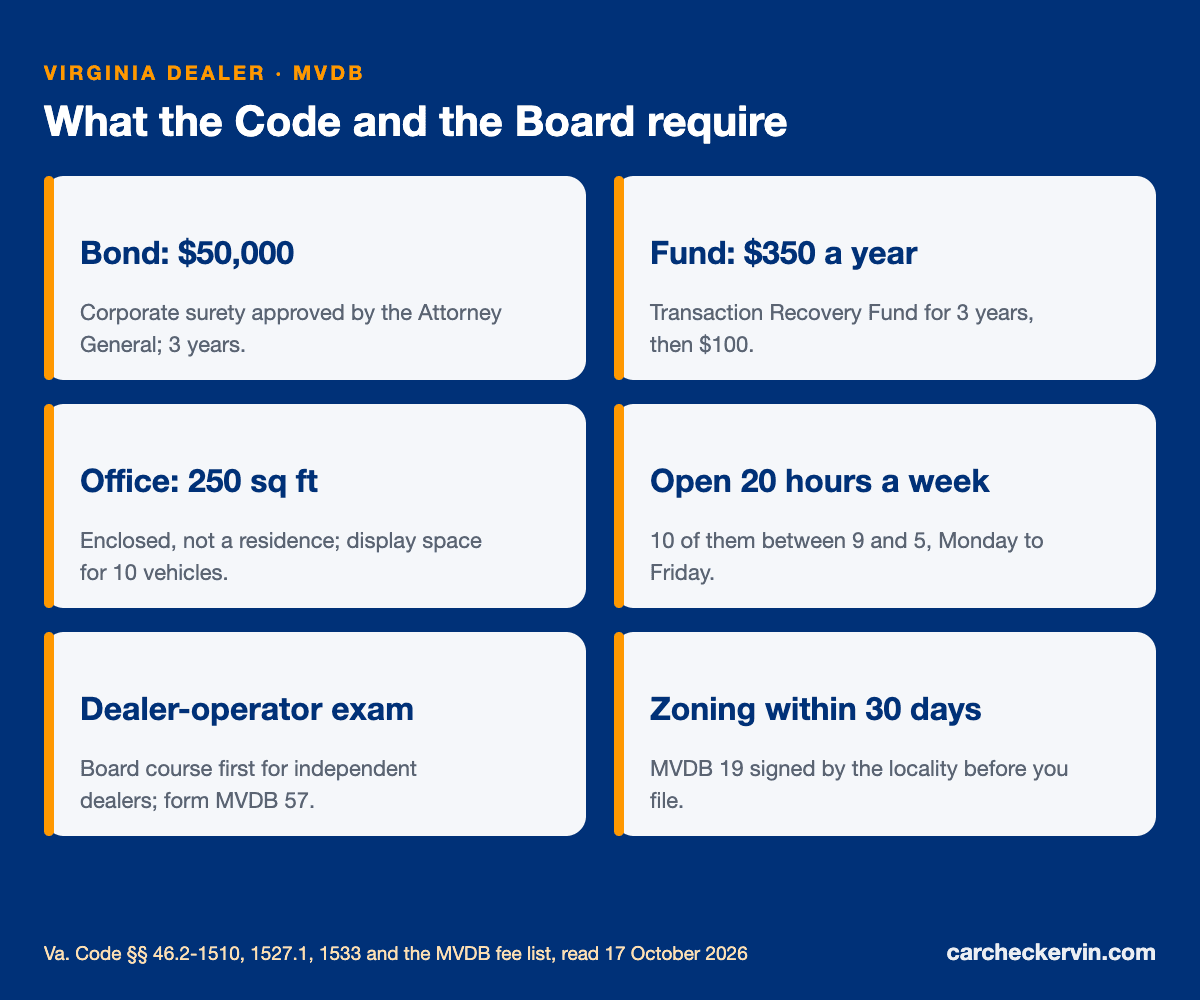
The money and the paperwork on one card: the bond, the Recovery Fund fee, the office and display minimums, the hours rule, the dealer-operator exam and the zoning deadline.
Every figure comes from Chapter 15 or the Board's fee list as read on the date shown.
The Dealer-Operator Course and Exam
Virginia does not test the dealership; it tests the dealer-operator, the individual who works at the established place of business and is in charge of its day-to-day operations. Section 46.2-1511 says no license issues to an independent dealer unless that person holds a certificate of qualification from the Board, issued on application, payment of a fee the Board sets at no more than $50, and "the successful completion of an examination approved by the Board". For original independent applicants the statute goes further: the Board "shall require" them to complete a course of study before taking the exam, and the Board writes the curriculum, sets the course fees and approves the providers. Franchise dealer-operators sit a Board exam too, but the course is at the Board's discretion rather than mandatory. The application is form MVDB 57; the Board's page notes that a dealer-operator receives a salesperson license as part of the certification if the right box is ticked.
The certificate does not last forever. Under § 46.2-1585 an independent dealer-operator's certificate is valid for 24 months. To recertify, § 46.2-1586 offers two routes: a live, instructor-led course certified by the Board with at least 4 hours of instruction followed by an exam, or the Department's recertification exam without the course. Recertification can be done up to 6 months early, the Board sends notice 90 days before expiry, and a certificate completed within 60 days after expiry is deemed not to have lapsed. Miss that window and the next filing counts as an original application, course included. Every salesperson needs a certificate too (§ 46.2-1512, exam and a fee of no more than $50), and § 46.2-1518 forbids a salesperson from working for two unrelated dealers at once.
Virginia Dealer Fees, Bond and Fund
The Board's published fees, with the statutory caps from § 46.2-1519 and the Fund rules from § 46.2-1527.1, read on 17 October 2026.
| Item | Amount |
|---|---|
| Dealer Certificate (statute cap per principal place) | $270 a year (cap $300) |
| Additional license-type endorsement, each | $50 |
| Transaction Recovery Fund, first 3 years | $350 a year |
| Transaction Recovery Fund, renewals after that | $100 a year |
| Surety bond | $50,000, held 3 years |
| First two dealer plates / each additional | $60 / $26 |
| Salesperson license + Fund fee | $50 + $10 a year |
| Dealer-operator or salesperson certificate application | up to $50 |
| Supplemental sales location, each | up to $40 |
| Out-of-state dealer registration for wholesale auctions | up to $100, plus $60 Fund fee |
| Late renewal, within 30 days of expiry | 150% of the fee |
| Reprint / reinstatement after suspension | $10 / $50 |
So an independent dealer with two plates pays the Board $680 in the first year before salesperson licenses, and $1,050 to the Fund across the three bonded years. The surety's bond premium, the course provider's tuition and the plate insurance premium are set by those vendors, not by the Code.
The Bond and the Transaction Recovery Fund
Virginia protects car buyers with two layers. The first is the bond. Section 46.2-1527.2 requires every applicant for an original license to file a $50,000 bond from a corporate surety licensed in the Commonwealth and approved by the Attorney General, conditioned on the dealer not practicing fraud, not making fraudulent representations and not violating the chapter. Anyone who suffers loss through a licensed dealer's or salesperson's fraud, through a violation of the chapter in a purchase or lease, or through a breach of an extended service contract has a claim against the dealer and the bond, and can recover a court judgment from the surety up to $25,000. The Board may suspend a license without a hearing while the bond lapses. The Board's form is MVDB 2, dated within 30 days of submission.
The second layer is the Motor Vehicle Transaction Recovery Fund, a special fund in the state treasury that pays unpaid judgments against dealers. Section 46.2-1527.1 funds it with licensing surcharges: a new dealer pays $350 a year for 3 consecutive years, in place of the ordinary $100 renewal fee, and holds the $50,000 bond for the same three years. A dealer who completes those years with no claim against the bond or the Fund drops to $100 a year and no longer needs the bond. Salespersons pay $10 a year, capped at $100 per dealer, and a certificate of dealer registration costs $60. Texas and California never let the bond go; both require $50,000 for as long as the license runs, and Florida's $25,000 bond renews every year.
Check the Cars You Buy for Resale
Enter the VIN for a free preview of its title brands, odometer readings and earlier auction records before you bid at the sale.
Plates, Records and the Selling Rules
Dealer plates come from the DMV, not the Board, and § 46.2-1547 issues them only to licensed dealers who certify automobile liability insurance on each plate; the Board's form is MVDB 9 with a copy of the policy showing the number of plates insured. Section 46.2-1546 adds a volume test: a dealership that sold fewer than 25 vehicles in the last 12 months of the preceding license year gets no more than 2 plates. The first two cost $60 and each further plate $26. Section 46.2-1550 lets the plates be used on inventory vehicles for business, personal and family purposes by the dealer, the dealer-operator, their spouses and employees, and nothing else.
Once open, § 46.2-1529 keeps every record on the licensed premises: inventory, purchases and sales, odometer statements, plate assignments, temporary tags and proof of safety inspections. Section 46.2-1530 requires a buyer's order for every sale, lease or exchange, shown to the customer during negotiation, with a duplicate handed over at the sale and a copy kept for 5 years. Section 46.2-1539 bars a retail sale of any road-going vehicle unless an official safety inspection station inspected it while the dealer owned it. Section 46.2-1518 has the dealer post a list of its salespersons and notify the Board of a termination by the 10th day of the following month. And § 46.2-1545 requires 30 days' notice before closing, with every license, plate and collected fee surrendered.
Four rules from day one
- Buyer's order: every sale, kept 5 years (§ 46.2-1530).
- Safety inspection: before any retail sale (§ 46.2-1539).
- Plates: insured each; 2 max under 25 sales.
- Records: on the premises, open in posted hours.
Virginia Against Texas, California and Florida
The same four questions answered from each state's own statute: when you need the license, what the bond is, what the state charges, and whether there is a test.
Virginia
- Presumed a dealer at 5+ vehicles in 12 months, rebuttable.
- $50,000 bond for 3 years, then released if claim-free.
- $270 certificate + $350 Fund fee a year; two plates $60.
- Board course, then a Board exam for the dealer-operator; recertify every two years.
- Office 250 sq ft, 10 display spaces, 20 hours a week.
Texas · California · Florida
- Texas: a license below 5 sales a year is not required; Florida presumes a dealer at 3; California sets no count.
- Bonds: Texas $50,000 and California $50,000 for the life of the license; Florida $25,000 every year.
- First-year state fees: Texas $500; California $175 application; Florida $300.
- Education: Texas 6 hours; California a 4-hour course and a DMV test (3 attempts); Florida a dealer-school course with its own exam.
- Display: Texas 5 vehicles with a 6-inch sign; Florida room to store what you offer.
Virginia's three-year bond release and its Recovery Fund are unusual; the other three keep the bond for as long as you sell.
Renewal, Supplemental Lots and Moving
Section 46.2-1521 issues every license for 12 months and renews it on application and payment. A renewal received or postmarked within 30 days after expiry is treated as on time, but at 150% of the § 46.2-1519 fee; the Board's page says a renewal later than that is handled as a new application, course and inspection included. The Board must act on any application within 60 days (§ 46.2-1514), and an applicant refused a license can demand a public hearing within thirty days.
Selling away from the lot needs a supplemental license under § 46.2-1516: a permanent one for premises within 500 yards of the established place, signed like the main lot, or a temporary one for at most 7 days (14 for trailers and motorcycles), applied for 15 days before the sale, with no more than 8 supplemental licenses a year and none back-to-back in the same jurisdiction. Wholesale auctions need no supplemental license. Moving the dealership takes 30 days' written notice to the Board and a passed inspection of the new site (§ 46.2-1515); within the same county or city the Board endorses the change for free, but a move to another county or city means a new license and fee. Changes of ownership form or partners also mean a new application (§ 46.2-1517).
Dates to diarize
- 30 days late: renew at 150% of the fee; later = new application.
- 60 days: the Board's deadline to act on an application.
- 30 days' notice: before moving the dealership, plus an inspection.
- 24 months: the dealer-operator certificate; 60-day grace.
Related Checks and Guides
Other states in the series, the Virginia title tools and the auctions a license opens.
Where These Facts Come From
From the Code of Virginia as published by the Division of Legislative Automated Systems, and the Motor Vehicle Dealer Board's own pages, read on 17 October 2026. Fees are set by the Board within statutory caps and change; confirm with the Board before you file.
CarCheckerVIN is not affiliated with the Virginia Motor Vehicle Dealer Board, the Virginia DMV, or any surety, course provider or dealer association. This page is general information, not legal advice.
Prüfen Sie die Fahrgestellnummer immer vor dem Kauf
Die kostenlose Vorschau zeigt Title Brands (US-Titel-Kennzeichnungen), Diebstahlstatus und offene Rückrufe in Sekunden und meldet, ob Unfall- und Tachodaten vorliegen. Die vollständige Historie kostet 19,95 € — einmalig, ohne Abo.
Virginia Dealer License — Frequently Asked Questions
What Virginia applicants ask most.
How much is the Virginia dealer bond?+
$50,000, from a corporate surety licensed in Virginia and approved by the Attorney General, filed before an original license issues and kept for 3 consecutive years. After three claim-free years the dealer pays the ordinary $100 Recovery Fund fee and no longer needs the bond.
Is there a test for a Virginia dealer license?+
Yes. The dealer-operator, the person running the lot day to day, must pass an examination approved by the Board to get a certificate of qualification. Original independent dealer-operators must complete the Board's course of study first. Salespersons take their own exam, and independent dealer-operators recertify every 24 months.
Can I get a Virginia dealer license without a lot?+
No. Section 46.2-1510 refuses a license to any dealer without an established place of business with at least 250 square feet of enclosed office in a building that is not a residence and contiguous space to display 10 vehicles. Virginia has no separate wholesale dealer license that waives the lot; out-of-state dealers may buy and sell at Virginia wholesale auctions on a certificate of dealer registration instead.
What does the Virginia Motor Vehicle Dealer Board charge?+
$270 for the dealer certificate, $50 per additional license-type endorsement, $350 a year to the Transaction Recovery Fund for the first 3 years, $60 for the first two dealer plates and $26 for each additional plate, and $50 per salesperson license, per the Board's fee list.
How many hours must a Virginia dealership be open?+
At least 20 hours a week, with at least 10 of them between 9:00 a.m. and 5:00 p.m. Monday through Friday (§ 46.2-1533). The hours are posted at the entrance, filed with the Board, and the dealer must actually be open and have its records available during them.
What happens if I renew my Virginia dealer license late?+
A renewal received or postmarked within 30 days after expiry keeps the license alive but costs 150% of the normal fee (§ 46.2-1521). The Board treats anything later as a new application.
Run the VIN Before You Buy Inventory
Enter any 17-character VIN for a free preview. The full report lists title brands, NMVTIS junk and salvage records, insurance total-loss records, odometer readings, and auction records with the damage the auction recorded and its photos.
CarCheckerVIN is an independent vehicle-history service and is not affiliated with the Virginia Motor Vehicle Dealer Board or the Virginia DMV. Requirements are summarized from the Code of Virginia and the Board's published fees and are not legal advice. Records in our reports reflect what was reported to our data providers. Our reports do not include police or repair-shop accident entries.
Passende VIN-Abfragen
Weitere Tools, um die Historie jedes Fahrzeugs zu prüfen