VIN Etching: What It Is, How It Works, and When It's Worth Paying For
VIN etching engraves your car's 17-character VIN into its window glass so a thief can't resell the car or its parts without replacing every pane. It's a real deterrent, it's often free, and it's also one of the most marked-up add-ons on a dealer's menu. Here's how to tell the two apart.
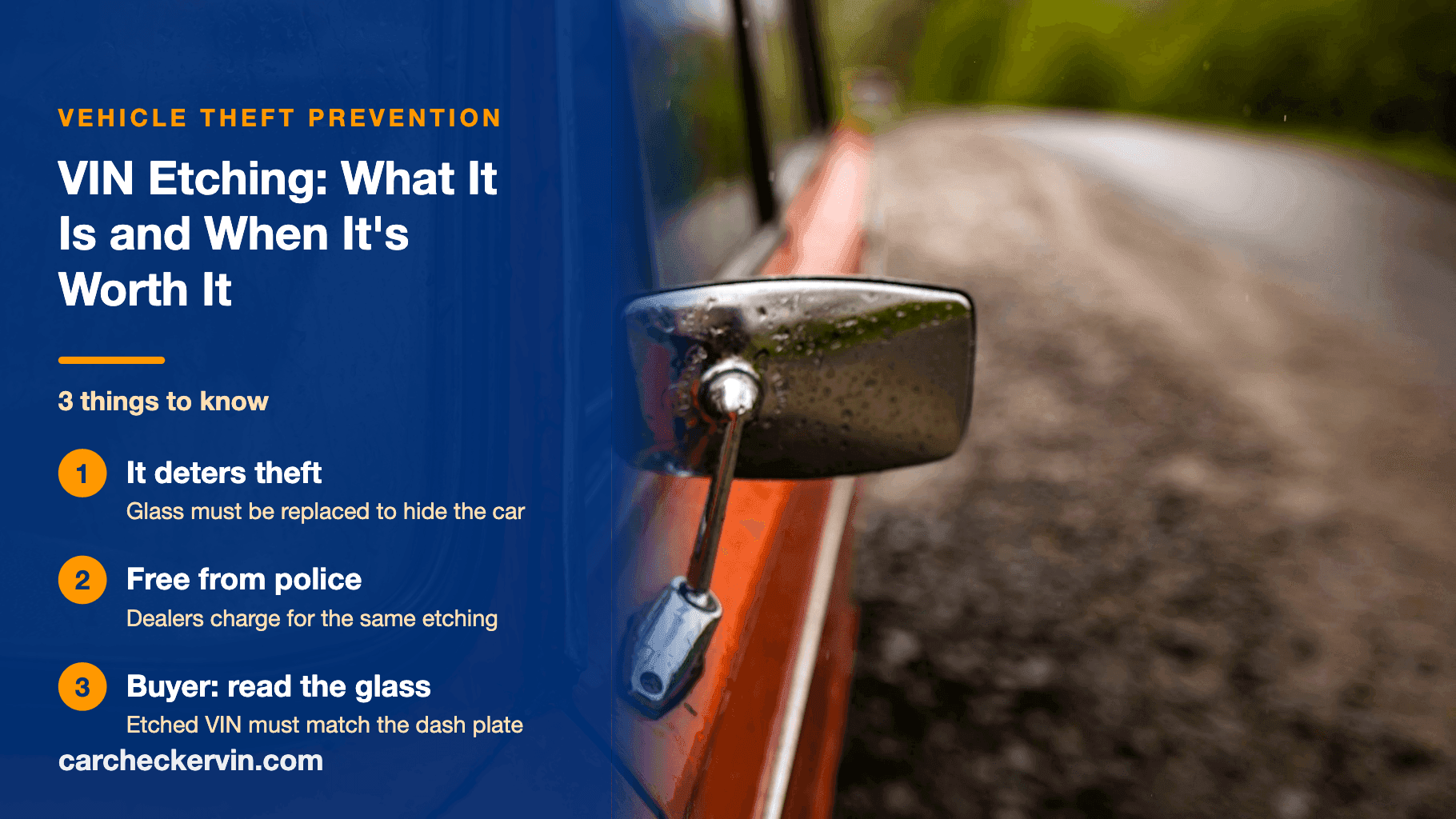
VIN etching is the process of engraving a vehicle's 17-character Vehicle Identification Number into the glass of its windows. Police departments do it in parking lots for free. Dealers sell it at the finance desk for hundreds of dollars. The etching is the same either way, which is the whole story of this guide in one sentence.
Below: what VIN etching actually does, whether it stops thieves, what it should cost, how to do it yourself, what it does to your insurance bill, and the one situation where an etched VIN matters most, which is when you are the one buying a used car and the number in the glass doesn't match the number on the dashboard.
The short answer
VIN etching works as a theft deterrent because a thief who wants to resell the car, or strip it, has to replace every etched pane to hide where it came from. NHTSA lists window etching among the visible anti-theft measures it recognizes, and police programs across the country etch cars for free. It is worth having. It is rarely worth what a dealer charges for it, and it is never mandatory.
What VIN etching is
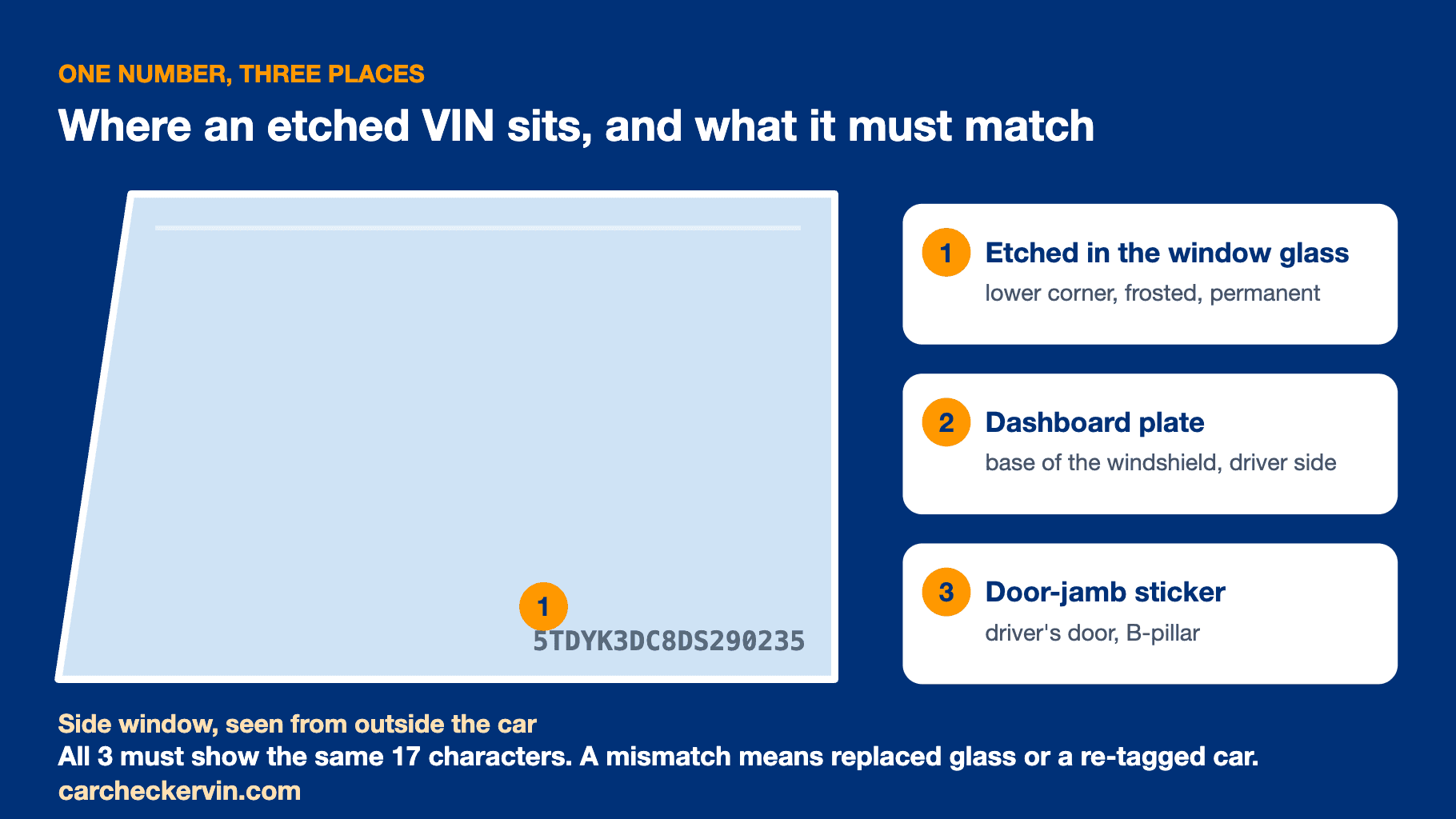
Every modern car carries a 17-character VIN stamped on a plate at the base of the windshield and printed on a sticker in the driver's door jamb. Those two places identify the car. VIN etching adds the same number to a third place: the glass itself.
The process is simple. A stencil of the VIN is fixed to each window, an etching compound is applied over it, and after a few minutes the compound has frosted the number permanently into the surface of the glass. Wayne State University's police department, which runs a public etching program, describes it as "a mild acid paste and six computer cut stencils" applied to "six of your vehicles windows (front, back and four side windows)." The Prince William County Sheriff's Office in Virginia says the whole process takes "anywhere from 5 to 15 minutes."
The result is a small, discreet frosted number, usually in a lower corner of each pane. It does not affect visibility, it cannot be polished off, and because it sits in the glass rather than on the body, it survives repainting.
What VIN etching looks like on the car
Knowing what to look for matters twice: once when you check the work on your own car, and again when you inspect a used one. The etched VIN is a single line of 17 characters, usually a few millimetres tall, frosted white or grey into the glass. On most cars it sits in a lower corner of each window, out of the driver's sightline but readable from outside. It shows best in daylight at a low angle, or with a flashlight held to the side of the glass; straight on, it can be almost invisible, which is why buyers miss it.
Police programs etch every window, front, back and all four sides, so a professionally etched car has the same number six times. Dealer etching and DIY jobs vary; some do only the side glass. A car with the number on two windows and not the others has either had glass replaced or was only partly done, and the difference matters when you are the buyer, as the section on inspection below explains.
One thing VIN etching is not: it is not the same as the VIN stamped into the body or the engine, and it is not a registration. It adds no information to any database. It is a physical mark, and its value is entirely in the fact that it cannot be removed without replacing the glass.
Does VIN etching actually deter theft?
Yes, for a specific kind of theft. NHTSA reports that more than 650,000 vehicles were stolen in the United States in 2025, one every 48 seconds. A large share of those cars are not driven off into the sunset; they are taken apart for parts or re-tagged with a different identity and resold. Both of those businesses depend on the car being anonymous.
Etching removes the anonymity. As the Prince William County Sheriff's Office puts it, once the VIN is on every window "a thief must strip and replace every piece of glass in order to profit off the sale of the stolen vehicle or its parts," which is "time consuming and expensive." Wayne State's police make the same point from the chop shop's side: those operations "thrive on vehicles that have easily removable VIN plates or no visible VIN number etched on them at all," and a re-tagged car with a "bogus VIN plate" is exposed the moment anyone reads the glass.
NHTSA groups window etching with horn alarms, steering-wheel locks and warning decals as a visible deterrent: something that persuades a thief to pick a different car. It is not an immobilizer and it will not stop someone who wants to joyride the car for an evening. What it does is make your car a worse business proposition than the one parked next to it, and most vehicle theft is a business.
Where it fits among anti-theft measures
NHTSA sorts anti-theft devices into three groups, and etching belongs to the first. Audible and visible devices, which "deter theft by bringing attention to an unauthorized attempt" or create "a visual threat/warning/deterrence": horn alarms, steering-wheel locks, theft-deterrent decals, flashing lights and window etching. Immobilizing devices, which stop a thief from hot-wiring the car by disabling the ignition, fuel or electrical flow, often through a chip in the key; NHTSA encourages manufacturers to fit these as standard equipment. And vehicle recovery systems, which transmit the car's location to law enforcement after it is taken.
A modern car with a factory immobilizer already has the second group covered. Etching adds the first at almost no cost, and the two protect against different thieves: the immobilizer against the one who wants to drive the car away, the etching against the one who wants to make it disappear into parts or paperwork. Neither replaces the third group, and none of the three tells you anything about a car's past, which is the job of the title record.
Passive, which is the point
The sheriff's office calls VIN etching a "passive" security system: there is nothing to arm, nothing to remember, and nothing to break. That is also why insurers treat it more favorably than devices the owner has to switch on.
What VIN etching costs, and what it should cost
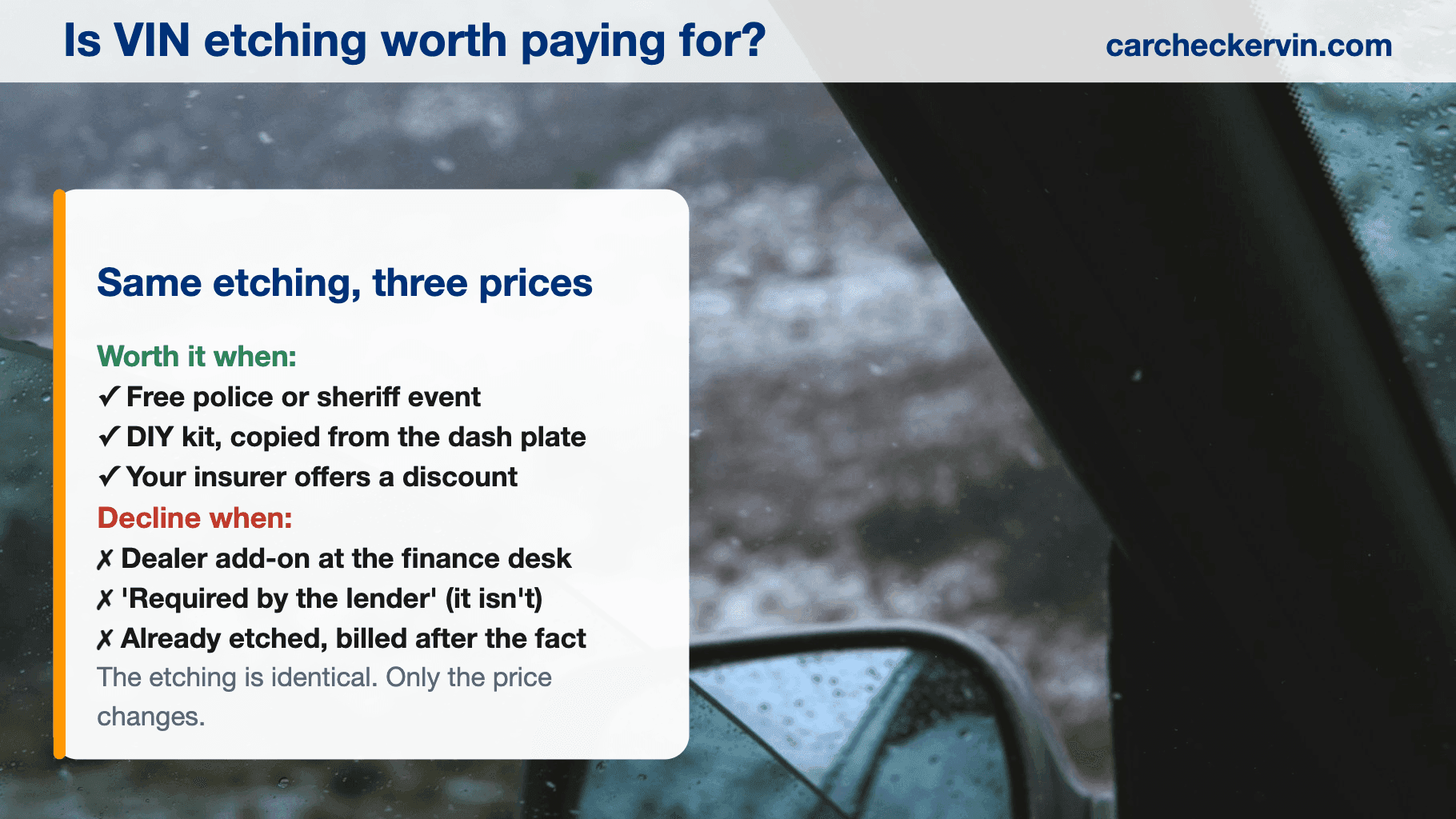
This is where the subject splits in two. The etching itself is cheap. Police departments, sheriff's offices, campus police, insurers and auto-theft prevention authorities run free or near-free etching events, often on a drive-through basis. A DIY kit with stencils and etching compound sells online for the price of a car wash. Our guide to dealer add-on scams puts the figure plainly: dealer-markup VIN etching runs $300+ for a $30 service.
The Federal Trade Commission names VIN etching explicitly in its advice on buying from a dealer, alongside gap insurance and rustproofing, as an add-on that "can cost thousands of dollars" when bundled and that is often "mentioned only at the end of an already difficult and time-consuming day at the dealership." The FTC's guidance is that "you can usually buy the vehicle you want without any add-ons, and you can buy most add-ons from independent retailers." VIN etching is the clearest case: the independent retailer is your local police department.
- If the car is already etched when you see it on the lot, the dealer did it to every car in inventory and is charging you for it afterwards. You did not order it and you can decline the charge. Ask for it to be removed from the buyer's order.
- If it appears on the paperwork as a line item, it is negotiable like any other add-on. A dealer will not lose a sale over it.
- If the finance manager says it is required by the lender or by law, that is not true. No state requires VIN etching as a condition of sale, and no lender does.
How to get your car etched for free, or do it yourself
Free etching events
Search your city or county name with "VIN etching" and you will usually find a police, sheriff or campus program. Wayne State's works like "a drive-thru oil change": you bring registration, a driver's license and proof of insurance, they cut the stencils and etch all six windows in about 10 minutes, and you leave with a certificate. Many programs run around July, which NHTSA designates National Vehicle Theft Prevention Month.
DIY kits
A kit contains stencil material, etching cream, applicator and instructions. The steps are the ones the police use: clean the glass, apply the stencil with your VIN, spread the cream, wait, rinse. The number should go in a corner of each window where it is visible from outside but does not block the view. Take your time with the stencil, because the result is permanent: a typo in your own VIN is worse than no etching at all, since it no longer matches the car.
Leased cars
Wayne State's program notes that "most leasing companies will allow your leased vehicle to be VIN etched as it does not reduce the value of the vehicle," but recommends calling the leasing company first. Ten minutes on the phone beats an argument at lease return.
Does VIN etching lower your insurance?
Sometimes, and only on one part of the policy. Wayne State's program says the certificate it issues, "when presented to most auto insurance companies, may qualify you for up to a 5 percent discount on the comprehensive portion of your auto insurance." Comprehensive is the coverage that pays out for theft, so that is where an anti-theft measure shows up. The discount is not universal; the sheriff's office advice is simply to "check with your insurance company to see if they offer a security device discount."
Do the arithmetic before you let a discount justify a dealer's price. A few percent off the comprehensive portion of a premium is a modest sum each year. It easily covers a free police etching or a DIY kit. It will take a long time to cover a three-figure dealer charge.
VIN etching when you are the buyer: read the glass
Everything above is about protecting a car you own. The etching matters at least as much when you are buying a used car, because it is a record the seller cannot edit.
Walk around the car and look at the lower corners of the windows. If the glass is etched, read the number and compare it, character by character, with the VIN on the dashboard plate and the door-jamb sticker. Three outcomes are possible.
- All three match. Normal. The glass is original or was replaced and re-etched, and the car is what it says it is.
- One window is not etched while the others are. That pane has been replaced. Ask why. A single replaced window is usually a break-in or a stone chip; a replaced windshield on a car with no accident history is worth a question.
- The etched number is different from the dashboard VIN. Stop. Either the glass came from another car, or the dashboard plate did. A re-tagged stolen vehicle is exactly what this looks like, and the police programs describe it in those terms.
Whatever the glass says, run the dashboard VIN through a VIN check before you negotiate. The report shows theft records, title brands across every reporting state, the chain of title and every recorded odometer reading. A car whose VIN has been swapped will usually show a history that does not fit the car in front of you: the wrong trim, the wrong color, an odometer reading that jumped. Our guide to spotting a cloned VIN walks through the mismatches to look for.
Etching is not a substitute for a history report
An etched VIN proves the glass belongs with the plate. It says nothing about whether the car was written off, flooded, rolled back or reported stolen and quietly resold. Those facts live in the title and theft records, and the only way to see them is to run the number.
Questions people ask about VIN etching
Does VIN etching really work?
As a deterrent to theft for parts or resale, yes. Police departments, the Michigan Auto Theft Prevention Authority and NHTSA all treat it as a legitimate visible anti-theft measure. It does not immobilize the car and will not stop every theft.
How much does VIN etching cost?
Police and sheriff programs commonly do it free. DIY kits cost a small amount. Dealers charge far more for the same result; our add-ons guide documents $300+ for what is, in materials and labor, a $30 job.
Is VIN etching mandatory?
No. It is optional everywhere. A dealer who says a lender or a state law requires it is wrong.
Can I do VIN etching myself?
Yes, with a kit. Copy the VIN from the dashboard plate carefully, because the etching is permanent.
Will VIN etching lower my insurance?
It may reduce the comprehensive portion of the premium by up to 5 percent with some insurers, according to Wayne State's police program. Ask your insurer; not all offer it.
How do I know if my VIN is etched?
Look at the lower corners of each window in daylight. The etched number is a small frosted 17-character string. If you cannot find one on any window, the car has not been etched.
What if a used car's etched VIN doesn't match the dashboard?
Do not buy it until you understand why. Run the dashboard VIN for theft and title records, and ask the seller for the glass replacement paperwork. A mismatch with no paperwork is a re-tagging red flag.
The bottom line
VIN etching is a cheap, permanent, passive deterrent that makes your car a worse target and may trim your comprehensive premium. Get it done at a police event or with a kit, decline it as a dealer add-on, and when you are the buyer, treat the number in the glass as one more thing to check against the dashboard, the door jamb and the history report.
CarCheckerVIN Editorial Team
In-house automotive research team
The CarCheckerVIN editorial team combines decades of automotive industry, dealer, and journalism experience to produce trustworthy buying, selling, and ownership guidance backed by NMVTIS, NICB, and manufacturer data.
Ready to check a VIN?
Run a free VIN check
Decode any vehicle in under 60 seconds.