Form 14-317 — gifting a car in Texas for $10 instead of 6.25%.
Texas charges 6.25% motor vehicle tax on most transfers, but a genuine gift between close family, or to or from a qualifying nonprofit or trust, is taxed at a flat $10. Form 14-317, the Comptroller's Affidavit of Motor Vehicle Gift Transfer, is how you claim it. The rules are strict: both sides sign it in front of a notary or the county tax office, it's filed in person with the title application, and a title service can't file it for you. Here is who qualifies and what the form requires.
Taking Over a Family Car?
The gift tax saves money; it doesn't tell you what the car has been through. Enter the VIN for a free preview of the title brands, salvage records and odometer readings on file.
Free preview · No sign-up · No owner or personal data
Quick Answer
- What is Texas Form 14-317?
- The Comptroller's Affidavit of Motor Vehicle Gift Transfer (Rev 12-25/9). It documents a gift of a motor vehicle between eligible parties, as Tax Code § 152.062 requires, so the $10 gift tax applies instead of the 6.25% motor vehicle tax. It's filed with Form 130-U at the county tax assessor-collector, not sent to the Comptroller.
- Who qualifies for the $10 gift tax in Texas?
- A vehicle received from a spouse (separate property only), parent, stepparent, father- or mother-in-law, foster parent, grandparent or great-grandparent (and in-laws), grandchild or great-grandchild (and in-laws), child, stepchild, son- or daughter-in-law, foster child, sibling or sibling-in-law, or guardian; or received from or donated by a 501(c)(3) nonprofit or a qualifying revocable trust.
- Does Form 14-317 have to be notarized?
- The signatures of all principal parties must be sworn to and subscribed before a Texas notary (or the equivalent elsewhere), an online notary authorized by the Secretary of State, or the county tax assessor-collector or one of its employees, in person. An absent party can sign before a notary, and that notarized signature may be reproduced or faxed.
Four steps to the $10 gift tax
Miss one and the transfer is taxed as a sale.
- 1Check eligibilityThe donor and recipient must be one of the related parties, or a qualifying nonprofit or trust.
- 2Make it a real giftNo consideration at all: no cash, no assumed loan, no services, no swap.
- 3Sign before a notary or the countyEvery principal party's signature, sworn and subscribed.
- 4File it in personWith Form 130-U, the fees and ID, at the county where you file the title application.
What Counts as a Gift
The form's instructions define it in one line: "A gift is the transfer of a motor vehicle between eligible parties for no consideration." And they are specific about what consideration includes: "anything given as payment such as cash, the assumption of a lien or other debt, payment for providing services or labor, or an exchange of real or tangible personal property." Taking over your parent's car payments is consideration. So is swapping a car for a boat.
Each signer certifies that "this motor vehicle is being transferred without consideration, including no assumption of debt." The affidavit warns that Tax Code § 152.101 makes signing a false statement a felony of the third degree. And a gift from an eligible donor who lives out of state still qualifies: the $10 gift tax applies when the vehicle is brought into Texas.
Who Can Give or Receive a Car for $10
Eligible parties under Tax Code § 152.025(a), as listed on Form 14-317 (Rev 12-25/9), read on 21 October 2026.
| Relationship | Who it covers | Note |
|---|---|---|
| Spouse | Husband or wife | Separate property only; community property vehicles aren't subject to the gift tax (see Rule 3.80) |
| Parents | Parent, stepparent, father- or mother-in-law, foster parent | |
| Children | Child, stepchild, son- or daughter-in-law, foster child | |
| Grandparents | Grandparent, great-grandparent, and their in-law equivalents | |
| Grandchildren | Grandchild, great-grandchild, and their in-law equivalents | |
| Siblings | Sibling, brother- or sister-in-law | |
| Guardian | A guardian | |
| Nonprofit | A 501(c)(3) organization, as donor or recipient | |
| Trust | A qualifying revocable trust under the Texas Trust Code, as donor or recipient |
A transfer with no payment to someone not on this list is treated as a sale and taxed using standard presumptive value; a vehicle excluded from SPV is taxed on its appraised value (Rule 3.80).
Form 14-317 at a Glance
Who qualifies, what the form requires and where it goes, on one card.
From Texas Comptroller Form 14-317 (Rev 12-25/9) and TxDMV Form 130-U, read on the date shown.
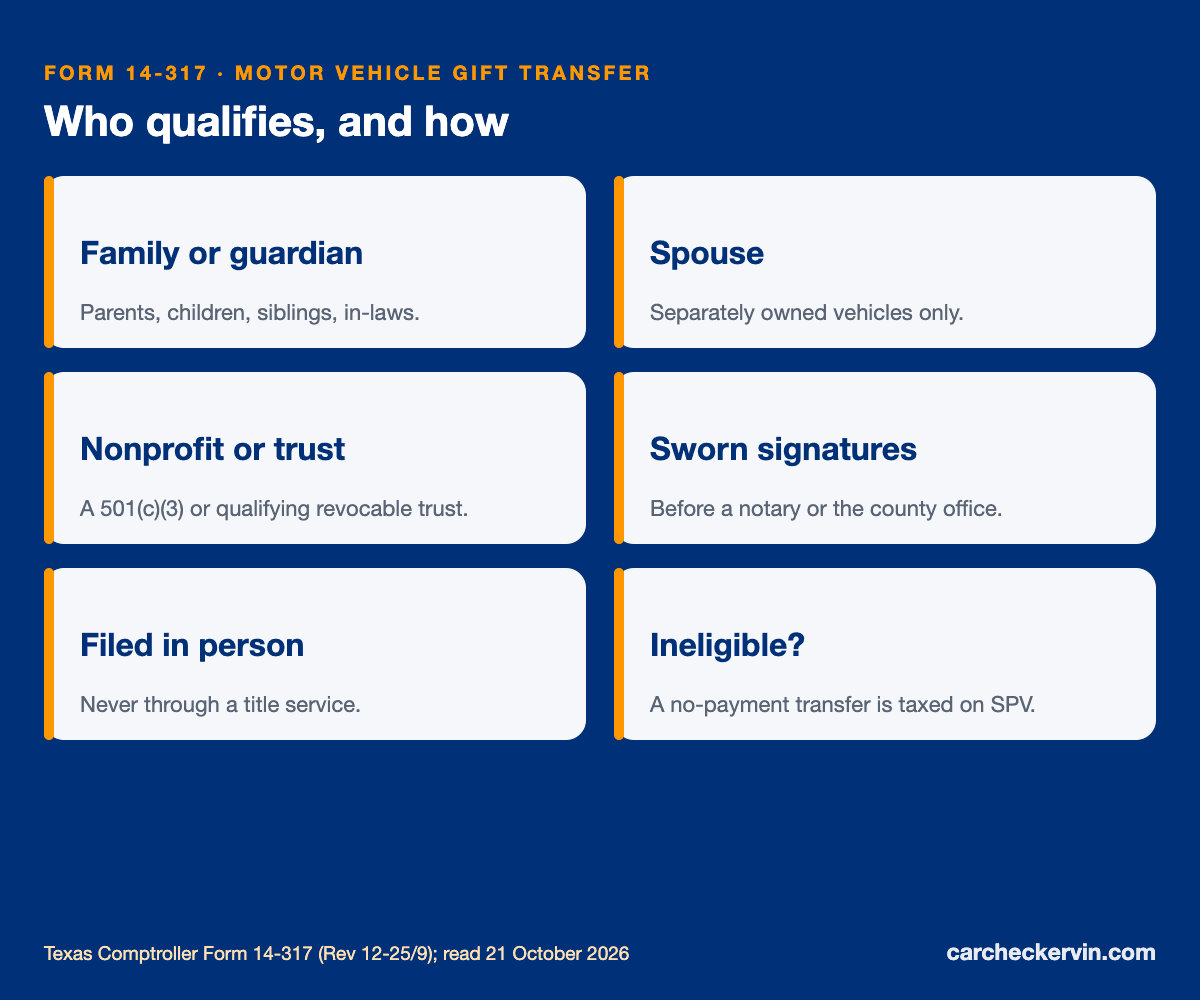
Signing and Filing Form 14-317
To be valid the affidavit must contain the signatures of all principal parties, each "sworn to and subscribed" before a notary public of Texas or the equivalent from another state, an online notary authorized by the Texas Secretary of State, or the county tax assessor-collector or one of its employees. Signing at the county counter means being there in person and signing in front of the tax assessor-collector or an employee. A party who can't come can sign before a notary, and their notarized signature may then be scanned, printed or faxed.
Then it is filed in person, by the donor, the recipient, or an authorized agent with a completed power of attorney, at the county tax assessor-collector's office where the title application (Form 130-U) is submitted, along with the fees, documents and any tax due. The filer shows an unexpired photo ID: a US state driver license or ID card, a passport, a Texas Department of Criminal Justice ID, a US military ID, or a Homeland Security or USCIS document. Two things to remember: do not send the affidavit to the Comptroller, and "a motor vehicle title service may not file this affidavit."
Valid only if
- Signed by: every principal party.
- Before: a notary, online notary or the county.
- Filed: in person with Form 130-U.
- Not by: a motor vehicle title service.
Inheriting or Receiving a Family Car?
It's still worth knowing its history. Enter the VIN for a free preview of the title brands and junk and salvage records on file before you title it.
When the $10 Gift Tax Doesn't Apply
Each from the form's own instructions.
Any payment
Cash, an assumed loan or debt, payment for services or labor, or a trade for property makes it a sale.
An ineligible recipient
A friend, a cousin or a partner who isn't a spouse isn't on the list, so a no-payment transfer is taxed on SPV.
Community property
Between spouses, only separately owned vehicles qualify; community property vehicles aren't subject to the gift tax.
A title service filing it
The affidavit must be filed in person by the donor, recipient or an authorized agent; title services are barred.
Unsworn signatures
Every principal party's signature must be sworn before a notary or the county.
A false statement
Signing a false affidavit is a third-degree felony under Tax Code § 152.101.
$10 Gift Tax or 6.25% Tax
What changes when a family transfer qualifies.
Qualifying gift
- $10 gift tax.
- Form 14-317, sworn by all parties.
- Filed in person with Form 130-U.
- No payment or assumed debt at all.
Everything else
- 6.25% motor vehicle tax.
- On the price less trade-in; private used sales use the greater of price or 80% of SPV.
- A no-payment transfer to an ineligible person is a sale on SPV.
- Late tax penalty of 5%, or 10% after 30 days late.
Form 130-U's tax lines include "$10 Gift Tax – Attach Comptroller Form 14-317".
Related Checks and Guides
The Texas title application it goes with, the other DMV form guides, and the national gifting guide.
Where These Facts Come From
From the Texas Comptroller's Form 14-317 and its instructions, and TxDMV's Form 130-U, read on 21 October 2026. Tax rules change; check the Comptroller's current form before you file.
CarCheckerVIN is not affiliated with the Texas Comptroller of Public Accounts or TxDMV, and does not file tax forms. This page is general information, not legal or tax advice.
Form 14-317 — Frequently Asked Questions
What Texas families ask most about gifting a car.
Can I gift a car to my girlfriend or boyfriend in Texas for $10?+
No. A partner who isn't your spouse isn't one of the eligible parties under Tax Code § 152.025(a). A transfer without payment to an ineligible person is taxed as a sale, using standard presumptive value.
Can I mail Form 14-317?+
No. It must be filed in person by the donor, the recipient or an authorized agent with a power of attorney, at the county tax assessor-collector's office where the title application is filed. Don't send it to the Comptroller.
Can my parent gift me a car that still has a loan on it?+
Not for the $10 gift tax if you take over the loan: the form counts the assumption of a lien or other debt as consideration, which makes it a sale.
Can a title service file Form 14-317 for me?+
No. The instructions say a motor vehicle title service may not file this affidavit.
My grandmother lives in another state. Does the gift still qualify?+
Yes, if she's an eligible donor: a motor vehicle received as a gift from an eligible donor located out of state is subject to the $10 gift tax when it's brought into Texas.
Where do I get Form 14-317?+
From the Texas Comptroller's website. It's a two-page form: the affidavit with donor and recipient certifications on the front, and the filing instructions on the back.
Check the Family Car's History Too
Enter any 17-character VIN for a free preview. The full report lists title brands, NMVTIS junk and salvage records, insurance total-loss records, odometer readings, and auction records with the damage the auction recorded and its photos.
CarCheckerVIN is an independent vehicle-history service and is not affiliated with the Texas Comptroller of Public Accounts or the Texas Department of Motor Vehicles. This guide summarizes the Comptroller's published Form 14-317 and TxDMV's Form 130-U and is not legal or tax advice. Records in our reports reflect what was reported to our data providers. Our reports do not include police or repair-shop accident entries.
Passende VIN-Abfragen
Weitere Tools, um die Historie jedes Fahrzeugs zu prüfen