DTF-802 — the sales-tax form for a private sale or gift in New York.
When you buy a car from a private seller in New York, nobody collects sales tax at the handshake. DTF-802, the Statement of Transaction, is how you settle it when you register: you write down what you paid, pick the rate for the place you live, and multiply. Buying from your spouse, parent, child, stepparent or stepchild? Line 4 is zero. A gift, or a sale well under market value, to anyone else needs the giver or seller to sign an affidavit on page 2. Here's each section, the exceptions, and the rates by county.
Paying Tax on a Car? Check It First
The tax is on the price; the risk is in the history. Enter the VIN for a free preview of the title brands, salvage and odometer records on file.
Free preview · No sign-up · No owner or personal data
Quick Answer
- What is form DTF-802 used for?
- It reports a motor vehicle, trailer, ATV, boat or snowmobile you bought without paying sales tax at the sale, which is every private-party purchase, or one you received as a gift. The form figures the tax from the purchase price and the rate where you live, and you file it with the DMV when you register and title the vehicle. The new owner's Social Security number, TIN or EIN is required.
- Do you pay sales tax on a car gifted by family in New York?
- Not if the giver is your spouse, parent, child, stepparent or stepchild. DTF-802 line 2 asks exactly that, and a yes means you enter 0 on line 4. Those are the only relationships the form names: a sibling, grandparent or friend doesn't qualify, and for them the giver completes the Section 6 affidavit.
- Who fills out Section 6 of the DTF-802?
- The seller or donor. Section 6 is required when the car is a gift to someone outside the five family relationships, or is sold below fair market value to someone outside them. For a trailer, ATV, boat or snowmobile it's required for any gift or below-market sale. The seller lists the cash received and anything else given instead of cash, then signs.
Four steps through a DTF-802
The tax is due when you register. The form is how the DMV knows the number.
- 1Describe the vehicle and both ownersSections 1 to 3: type, year, make, VIN, your SSN or EIN, and the previous owner's name and address.
- 2Say how you're relatedSection 4: date, your relationship to the seller, and whether it's a sale or a gift.
- 3Work out the taxSection 5: cash paid plus debt taken over plus property or services, times the rate where you live.
- 4Seller signs if it's a giftSection 6 is the seller's or donor's affidavit for gifts and below-market prices outside the family.
Combined Sales Tax Rates for a Car in New York
Use the rate where the new owner lives (DTF-802's tax-rate note). Combined state and local rates from Publication 718 (2/25), effective March 1, 2025, with the tax on a $15,000 private purchase worked out.
| Where the new owner lives | Combined rate | Tax on $15,000 |
|---|---|---|
| New York City (all five boroughs) | 8.875% | $1,331.25 |
| Yonkers (city) | 8.875% | $1,331.25 |
| Suffolk | 8.75% | $1,312.50 |
| Erie | 8.75% | $1,312.50 |
| Nassau | 8.625% | $1,293.75 |
| Westchester (outside its cities) | 8.375% | $1,256.25 |
| Rockland | 8.375% | $1,256.25 |
| Dutchess | 8.125% | $1,218.75 |
| Orange | 8.125% | $1,218.75 |
| Albany | 8% | $1,200 |
| Monroe | 8% | $1,200 |
| Onondaga | 8% | $1,200 |
| Ontario | 7.5% | $1,125 |
| Saratoga | 7% | $1,050 |
The state's own rate is 4%; every county adds to it. Rates in New York City and seven nearby counties (Dutchess, Nassau, Orange, Putnam, Rockland, Suffolk and Westchester) include 0.375% for the Metropolitan Commuter Transportation District. For an address not listed here, the Tax Department's Sales Tax Jurisdiction and Rate Lookup gives the exact rate.
What's on the DTF-802, Section by Section
Rev 5/15 is 2 pages. Page 1 opens with the instructions and three pointers: claiming an exemption other than a gift uses DTF-803 instead, claiming credit for sales tax paid to another state uses DTF-804, and registering more than one vehicle for the same taxing jurisdiction uses DTF-805. Section 1 describes the vehicle (type, year, make, model and VIN, plus the trailer's details for a boat-and-trailer combination). Section 2 is the new owner: name, Social Security number, TIN or EIN, address and county, and for an ATV or snowmobile where it was delivered and where it will be stored or used. Section 3 is the previous owner.
Section 4 records the date and how you're related to the seller: none, spouse, parent, child, stepparent, stepchild or other. It also asks what kind of transaction it was: a gift or below-market sale to someone outside the family, the same for a trailer, ATV, boat or snowmobile, a gift or purchase within the family, or none of these. It also asks whether you have a residence in the county, which matters for the rate.
Section 5, on page 2, does the arithmetic. Line 1 adds up the purchase price: cash paid, any loan balance you took over, and the value of property traded or services performed instead of cash. Line 2 asks whether the seller was your spouse, parent, child, stepparent or stepchild; if yes, enter 0 on line 4 and stop. Otherwise line 3 is your tax rate as a decimal and line 4 is the tax. Line 5 asks whether the price is below fair market value; if it is, the seller or donor completes Section 6. For boats, tax applies only to the first $230,000 of the price for purchases on or after June 1, 2015.
Section 6 is the seller's or donor's affidavit: the cash they received (line 6), whether the buyer performed a service, assumed a debt or traded property as part of the deal (line 7), and, for a business seller, whether the buyer was an employee, officer or stockholder and whether the sale was part of an employment deal (line 8). Both the purchaser and the seller certify their statements. The form warns that a false statement meant to evade tax is a misdemeanor under Tax Law § 1817(b) and Penal Law § 210.45, with fines up to $10,000 for an individual and $20,000 for a corporation.
DTF-802 at a Glance
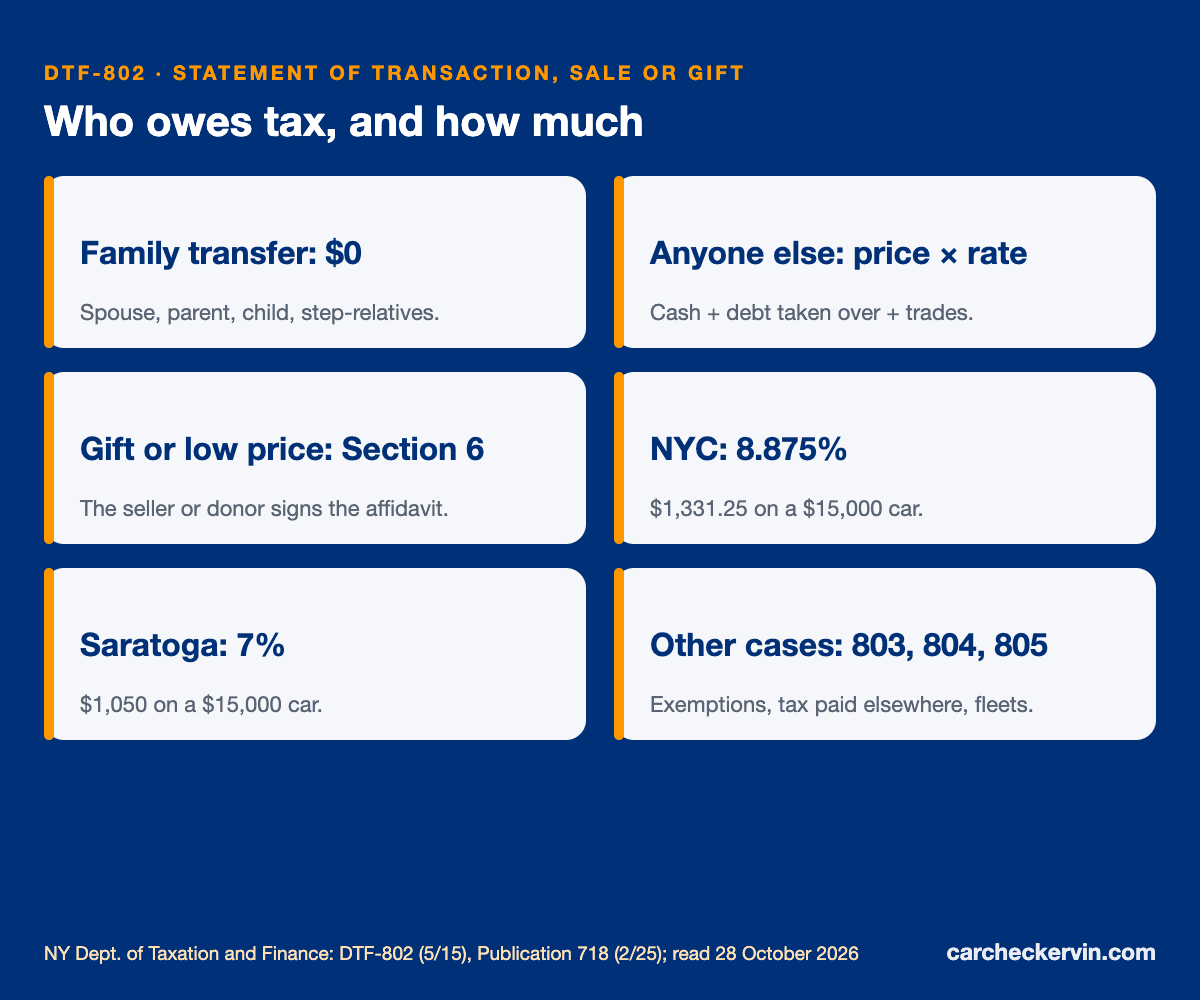
Who owes tax, who signs the affidavit and which rate applies, on one card.
From DTF-802 (5/15) and Publication 718 (2/25), read on 28 October 2026.
Gifts and Low Prices: Why Section 6 Exists
The tax is figured on what changed hands: cash, a loan you took over, property you traded or work you did instead of paying. A real gift puts nothing on those lines, and a favor-price sale puts very little. That's why the form asks the giver or seller to sign an affidavit when the price is below market and the two of you aren't family: it's the state's evidence that the low number is real.
If the DMV needs the registration done before that below-market price can be settled, the form offers a way through: pay tax on the fair market value the Tax Department sets, get your tax clearance, and apply to the Tax Department for a refund or credit of the overpayment. If the seller isn't required to complete Section 6, the new owner must keep a copy of the bill of sale signed by the seller.
Which form, when
- DTF-802: a private sale or a gift, with no sales tax paid at the sale.
- DTF-803: claiming an exemption other than a gift.
- DTF-804: claiming credit for sales tax paid to another state.
- DTF-805: registering more than one vehicle for the same taxing jurisdiction.
Check the Car Before You Pay the Tax
The DTF-802 settles the tax, not the car's past. Enter the VIN for a free preview of the title brands, salvage records and odometer readings on file.
Mistakes That Cost You at the Counter
From the form's own instructions and warnings.
Wrong relationship box
Only a spouse, parent, child, stepparent or stepchild zeroes the tax. Siblings and grandparents don't.
Wrong rate
Use the rate where the new owner lives; a business uses its place of business.
No Section 6 on a gift
Outside the family, a gift needs the donor's signed affidavit.
Price left incomplete
Include a loan you took over and anything traded, not just the cash.
No SSN, TIN or EIN
The form says the new owner's number is required.
A made-up price
A misdemeanor, with fines up to $10,000 (individual) or $20,000 (corporation).
Buying From Family vs. Buying From Anyone Else
The same form, two very different results.
From your spouse, parent, child or a step-relative
- Line 2: yes. Enter 0 on line 4.
- No sales tax, whether it's a sale or a gift.
- Section 6 isn't needed for a motor vehicle.
- The relationship box in Section 4 has to match.
From anyone else
- Tax = the full price (line 1d) × your local rate.
- On a $15,000 car that's $1,050 to $1,331.25, depending on the county.
- A gift or below-market price needs the seller's Section 6.
- Tax paid to another state? DTF-804, not DTF-802.
Siblings, grandparents, in-laws and friends are "anyone else" on this form.
Related Checks and Guides
The other DMV form guides, and the New York pages they connect to.
Where These Facts Come From
From the New York State Department of Taxation and Finance, read on 28 October 2026. dmv.ny.gov refused our requests, so this page doesn't describe DMV counter procedure beyond what the form itself prints.
CarCheckerVIN is not affiliated with the New York State Department of Taxation and Finance or the New York DMV. This page is general information, not tax or legal advice.
DTF-802 — Frequently Asked Questions
What New York buyers and sellers ask most.
Where do I file the DTF-802?+
With the DMV, when you register and title the vehicle. The office-use box on page 1 is where the clerk records the fair market value, the rate and the tax paid. Bring it with the signed title and the seller's bill of sale.
Is a car from my brother or grandmother tax-free in New York?+
No. DTF-802 names only a spouse, parent, child, stepparent or stepchild. A brother, sister, grandparent, grandchild or in-law counts as anyone else: you owe tax on what you paid, and if it was a gift or a below-market price the giver signs Section 6.
What sales tax rate do I use on the DTF-802?+
The rate where the new owner lives, from Publication 718: 4% state plus the local rate, 7% to 8.875% across the counties listed above. If you live in two counties, use the one where the car will mostly be kept. A business uses the rate where it's located.
Do I need the seller's signature on the DTF-802?+
Only on Section 6, which the seller or donor completes for a gift or a below-market sale to someone outside the five family relationships (and for any gift or below-market sale of a trailer, ATV, boat or snowmobile). Otherwise the seller doesn't sign it, but you must have a bill of sale they signed.
I paid sales tax in another state. Do I still file a DTF-802?+
No. The form sends you to DTF-804 to claim credit for tax paid to another state. Other exemptions go on DTF-803, and registering several vehicles for the same taxing jurisdiction goes on DTF-805.
What if the DMV values the car higher than my price?+
The form lets you pay tax on the fair market value the Tax Department sets so you can register now, then apply to the Tax Department for a refund or credit of what you overpaid once the lower price is established.
Run the VIN Before You Settle the Tax
Enter any 17-character VIN for a free preview. The full report lists title brands, NMVTIS junk and salvage records, insurance total-loss records, odometer readings, and auction records with the damage the auction recorded and its photos.
CarCheckerVIN is an independent vehicle-history service and is not affiliated with the New York State Department of Taxation and Finance or the DMV. This guide summarizes Form DTF-802 and Publication 718 and is not tax or legal advice. Records in our reports reflect what was reported to our data providers. Our reports do not include police or repair-shop accident entries.
Related VIN Checks
More tools to verify any vehicle's history