Buying a used electric car
Battery failure is rarer than the reputation suggests — EPA puts it under 0.5% for EVs since 2016. But the federal battery-health rules everyone cites do not cover the car you are looking at, and that changes what you should check.
Check the title and recalls first
A flood-branded EV is a battery safety question. Start there.
No account · Nothing stored · $14.99 only for the full report
Quick Answer
- Is a used electric car worth buying?
- Increasingly, yes — battery failure is rarer than the reputation suggests. EPA, citing Recurrent (2025), reports that EVs from model year 2016 onwards have had less than a 0.5% failure rate, and that 97.5% of EVs are still on their original battery. What you are buying is a battery with a history, so check that history the way you would check a title.
- Does federal law guarantee the battery?
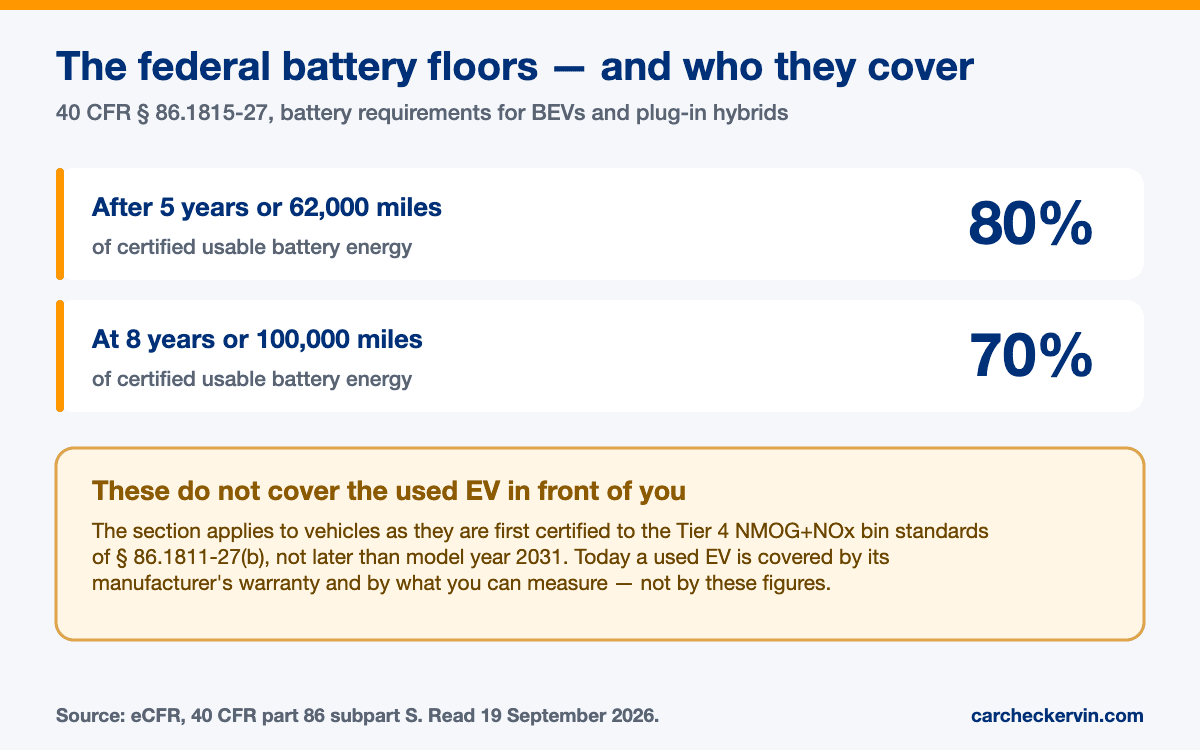
- Not for a used EV you can buy today. 40 CFR § 86.1815-27 does set floors — 80% of certified usable energy at 5 years or 62,000 miles, 70% at 8 years or 100,000 miles — but it applies to vehicles as they are first certified to the Tier 4 NMOG+NOx bin standards of § 86.1811-27(b), not later than model year 2031. Today's used EVs are covered by their manufacturer's warranty, not by those numbers.
- How do I check the battery before buying?
- Read the car's own state-of-health readout where it has one, compare indicated full-charge range against the original EPA rating for that model year, and get an independent battery test. Then run the VIN for title brands and open recalls, which matter on an EV exactly as much as on a petrol car.
The battery is the car
On a petrol car the expensive unknowns are spread across an engine, a gearbox and an exhaust system. On an EV they are concentrated in one component, and that component cannot be judged by looking at it. Everything below follows from that.
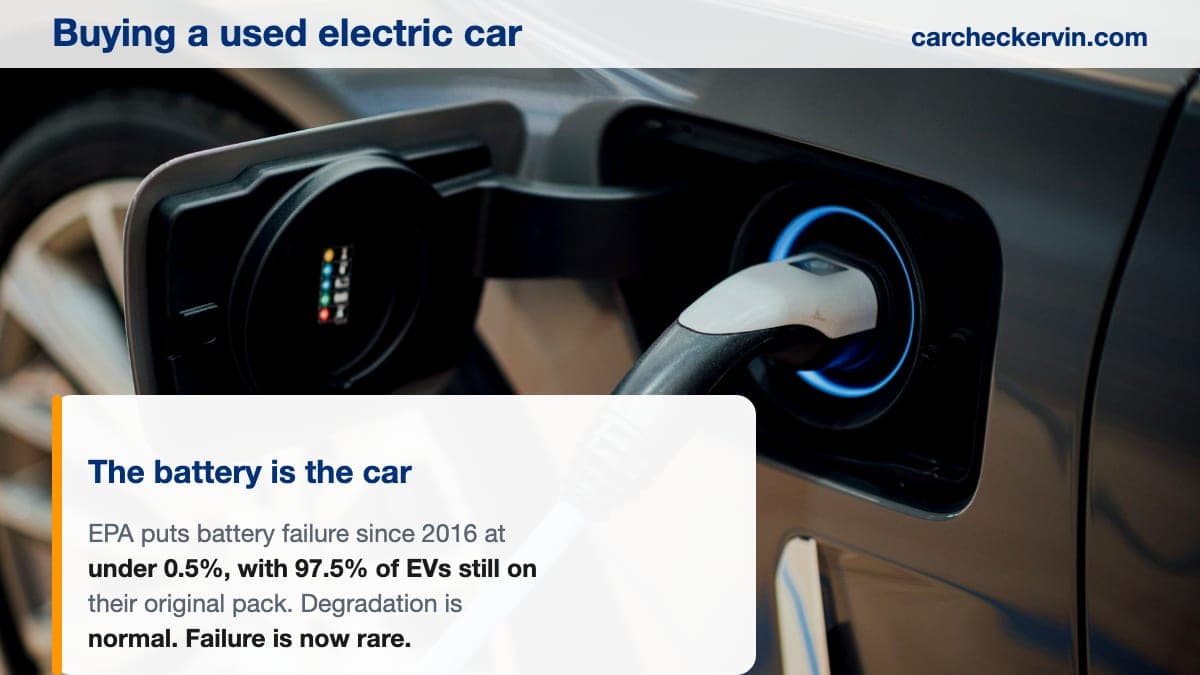
The good news is that the pessimism is dated. EPA, citing Recurrent (2025), reports less than a 0.5% failure rate for EVs from model year 2016 onwards, and that 97.5% of EVs are still running their original batteries. EPA notes the failure figure excludes recall replacements.
The federal rules everyone quotes — and who they actually cover
40 CFR § 86.1815-27 is real, and it is specific. It requires that:
| At | Usable battery energy must be at least |
|---|---|
| 5 years or 62,000 miles | 80% of certified usable energy |
| 8 years or 100,000 miles | 70% of certified usable energy |
These do not cover the used EV in front of you. The section applies to vehicles as they are first certified to the Tier 4 NMOG+NOx bin standards of § 86.1811-27(b), not later than model year 2031. Plenty of writing on this topic quotes the thresholds as though they protect today's buyers. They do not — today a used EV is covered by its manufacturer's warranty and by what you can measure yourself.
The same section is why used EVs will get easier to buy. It requires an operator-accessible display of State of Certified Energy as a whole-number percentage, and requires in-use vehicles to show values “In-use vehicles must display SOCE values that are accurate within 5 percent of measured values”. Battery condition stops being a negotiation and becomes a number on the dashboard.
A flood-branded EV is a battery problem
Check salvage, junk and flood brands before you look at range. $14.99, no account.
Degradation is not failure
This distinction is where most used-EV anxiety comes from, and it is worth being precise about:
Degradation — expected
Gradual loss of usable capacity. The car works exactly as before; the range is shorter than when new. Every lithium battery does this. It is priceable, and it is what you are negotiating over.
Failure — rare
The pack or a module stops working. This is the scenario the reputation is built on, and it is the one EPA's figures say has become uncommon on cars from 2016 onwards.
A used EV with 85% of its original capacity is not a broken car. It is a car with a shorter range than the brochure, which is a fact about the price rather than a fault.
How to check a used EV, in order
- 1
Run the title and recall checks first
A flood or salvage brand on an EV is a battery safety question, not paperwork. NHTSA's recall lookup is free and covers EV VINs; the NMVTIS title record is the $14.99 step.
- 2
Read the state-of-health readout
Where the car has one, note the figure. From the model years covered by the new rule this becomes mandatory and accuracy-bounded; before that, treat a manufacturer readout as useful but not audited.
- 3
Compare range against the original rating
Look up the EPA rating for that exact model year on fueleconomy.gov and compare it with the indicated range at a full charge. A large gap is the conversation.
- 4
Get an independent battery test
Third-party tests read the pack directly rather than trusting the dashboard. On a purchase dominated by one component, this is the equivalent of a compression test.
- 5
Confirm the warranty transfers
Ask the manufacturer whether the remaining battery coverage passes to a second owner on that VIN. Terms differ, and the answer can be worth more than the price difference between two cars.
- 6
Check the charging hardware
Which standards the car supports, and whether the cables that should come with it actually do. Replacing them is a real cost that is easy to overlook at the viewing.
What we will not tell you
We do not publish a battery replacement cost. Credible figures vary enormously by model, by whether a single module or the whole pack is replaced, and by whether the work falls under warranty — and we could not source a reliable range from a primary, non-commercial source. On the most consequential number in an EV purchase, a guess on a web page is worth less than one phone call to a franchise dealer about that specific VIN.
Sources
- 40 CFR § 86.1815-27 — battery requirements for BEVs and PHEVs
The federal battery durability floors, the SOCE display requirement, and the model-year applicability that limits them to future vehicles. Read 19 September 2026.
- EPA — Electric Vehicle Myths
EPA's battery reliability figures, which it attributes to Recurrent (2025). Read 19 September 2026.
- U.S. DOE Alternative Fuels Data Center — Electric Vehicle Basics
How battery-electric vehicles work, from the Department of Energy. Read 19 September 2026.
- fueleconomy.gov — the official U.S. fuel economy site
EPA and DOE combined-MPG ratings and annual fuel cost estimates, queried through its public API on 19 September 2026.
- NHTSA Recalls by VIN
The federal safety-recall lookup: free, by VIN, covering unrepaired recalls.
Siempre verifica el VIN antes de comprar
La vista previa gratis muestra marcas de título, estado de robo y recalls abiertos en segundos, e indica si existen registros de accidentes y odómetro. El historial completo cuesta $14.99 — pago único, sin suscripción.
Keep reading
Frequently asked questions
How long do EV batteries actually last?+
Longer than the folklore. EPA, citing Recurrent (2025), reports that EVs from model year 2016 onwards have shown less than a 0.5% failure rate, and that 97.5% of EVs are still using their original batteries. EPA notes that figure excludes recall replacements. Batteries do lose some range gradually — that is degradation, which is normal, and it is different from failure.
What is the difference between degradation and failure?+
Degradation is the slow loss of usable capacity that every lithium battery experiences: the car still works, the range is just shorter than when new. Failure is the pack or a module ceasing to function. Degradation is expected and priceable; failure is rare and usually a warranty matter. Conflating the two is why used EVs have a worse reputation than the data supports.
Will the car tell me its battery health?+
Some already do, and from the model years covered by 40 CFR § 86.1815-27 they will have to. That rule requires manufacturers to install an operator-accessible display of State of Certified Energy as a whole-number percentage, and says in-use vehicles must display values "accurate within 5 percent of measured values". Until then, whether you get a trustworthy readout depends on the manufacturer.
When do those federal battery rules start applying?+
They apply to vehicles as they are first certified to the Tier 4 NMOG+NOx bin standards of § 86.1811-27(b), not later than model year 2031. That means they cover future vehicles, not the used EVs on forecourts now. It is worth knowing because it changes what a used EV purchase will look like in a few years — the battery's condition becomes a published number rather than a guess.
How much does an EV battery replacement cost?+
We deliberately do not publish a figure. The credible ranges vary enormously by model, by whether a module or the whole pack is replaced, and by whether the work is done under warranty, and we could not source a reliable number from a primary, non-commercial source. Ask the specific manufacturer's dealer for a quote on that exact VIN — on a purchase this size, a guess from a web page is worth nothing.
Do EVs get recalls like other cars?+
Yes, and some EV recalls have concerned battery packs specifically. NHTSA's free recall lookup works on an EV VIN exactly as it does on any other, and an open recall must be repaired free of charge by a franchise dealer. Run it before you buy.
Can a used EV have a salvage or flood title?+
Absolutely, and it matters more, not less. A flooded battery pack is a serious safety concern, and the federal NMVTIS title record carries flood and salvage brands for EVs exactly as for petrol cars. Check the title history before you look at the battery.
Does fast charging ruin the battery?+
Frequent DC fast charging is generally understood to add stress compared with slower AC charging, but it is one factor among several — climate, how the car was stored, and how often it sat at very high or very low charge all matter. Rather than interrogate a seller's charging habits, measure the outcome: what usable capacity does the pack have now?
What should I check that is specific to an EV?+
The battery's usable capacity against its original rating, the charging equipment that comes with the car, which charging standards it supports, whether any battery or drive-unit recalls are open, and whether the warranty is transferable to you. Everything else — title brands, accident history, odometer — you check exactly as on any used car.
Check the EV's history
Title brands, flood records and open recalls — $14.99, no account.
Verificaciones VIN relacionadas
Más herramientas para verificar el historial de cualquier vehículo