Is a used hybrid worth it?
It comes down to arithmetic almost nobody does. On EPA's own figures, matched pairs save $700 to $1200 a year in fuel. Divide the premium you are being asked to pay by that, and you have your answer in years.
Check the car before you check the maths
Title brands and open recalls, by VIN.
No account · Nothing stored · $14.99 only for the full report
Quick Answer
- Is a used hybrid worth it?
- It depends on one number nobody can look up for you: the premium you pay over the identical petrol car. On EPA's own basis, matched pairs — same model, same year — save between $700 and $1200 a year in fuel. Divide your premium by that and you have the payback in years.
- What does the EPA data actually show?
- Real differences, not marginal ones. A 2019 Camry rates 26 mpg against 52 for the Camry Hybrid LE; a 2021 Highlander rates 23 against 36. The full table of matched pairs is below, with EPA's annual fuel cost for each.
- What about the hybrid battery?
- It is the thing to check, but it is not the thing to fear — hybrid packs are far smaller than an EV's and the petrol engine remains. Check for open recalls, ask about any pack replacement, and treat a well-documented service history as worth paying for.
The comparison that actually means something
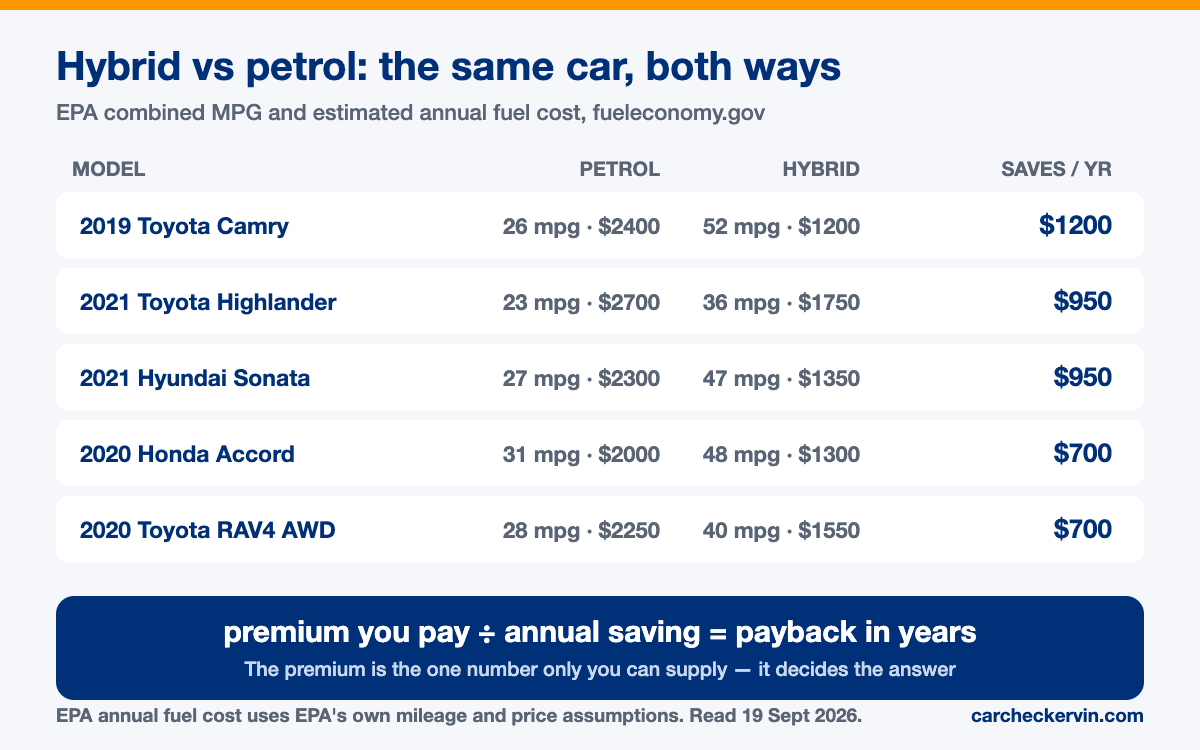
“Hybrids save fuel” is not a useful claim, because a hybrid hatchback measured against a petrol SUV proves nothing about hybrids. Every row below is the same model in the same year, hybrid against petrol, so the only thing that changes is the drivetrain.
Matched pairs, EPA figures
| Model | Petrol | Hybrid | Saving / yr |
|---|---|---|---|
| 2019 Toyota Camryvs Camry Hybrid LE | 26 mpg$2400/yr | 52 mpg$1200/yr | $1200+100% mpg |
| 2021 Toyota Highlandervs Highlander Hybrid | 23 mpg$2700/yr | 36 mpg$1750/yr | $950+57% mpg |
| 2021 Hyundai Sonatavs Sonata Hybrid | 27 mpg$2300/yr | 47 mpg$1350/yr | $950+74% mpg |
| 2020 Honda Accordvs Accord Hybrid | 31 mpg$2000/yr | 48 mpg$1300/yr | $700+55% mpg |
| 2020 Toyota RAV4 AWDvs RAV4 Hybrid AWD | 28 mpg$2250/yr | 40 mpg$1550/yr | $700+43% mpg |
Source: fueleconomy.gov, the official EPA and DOE fuel economy site, queried through its public API on 2026-09-19. Combined MPG and EPA estimated annual fuel cost.
EPA's annual fuel cost uses its own mileage and fuel-price assumptions. That makes it an excellent way to compare two cars on one consistent basis, and a poor way to predict your own spending. Drive far more than average and the saving grows; drive less and it shrinks.
The maths only helps if the car is sound
Title brands, flood records and open recalls by VIN — $14.99, no account.
Doing the payback sum
One division, and it settles the question:
premium you pay ÷ annual saving = payback in years
If the hybrid version of the car you want costs $2,000 more and its pair saves $1200 a year, that is under two years. If it costs $4,000 more and saves $700, it is closer to six — and the question becomes whether you will still own it then.
We do not publish a “typical premium”, because it moves with model, trim, mileage and your local market. It is also the input that decides the answer, so a made-up figure would quietly make the whole calculation worthless.
Where a hybrid stops making sense
- Mostly long highway journeys — regenerative braking has little to recover, so the gap narrows sharply.
- A premium so large the payback runs past how long you intend to keep the car.
- No service history and no way to confirm whether the pack has ever been replaced or serviced.
- A branded title. The drivetrain question is irrelevant if the car has a salvage or flood history.
And where it does make sense: heavy city driving, a modest premium, a documented history, and a car you plan to keep. Those four together are the case for a used hybrid, and they are checkable.
Sources
- fueleconomy.gov — the official U.S. fuel economy site
EPA and DOE combined-MPG ratings and annual fuel cost estimates, queried through its public API on 19 September 2026.
- 40 CFR § 86.1815-27 — battery requirements for BEVs and PHEVs
The federal battery durability floors, the SOCE display requirement, and the model-year applicability that limits them to future vehicles. Read 19 September 2026.
- NHTSA Recalls by VIN
The federal safety-recall lookup: free, by VIN, covering unrepaired recalls.
- NMVTIS — U.S. Department of Justice
The Justice Department's consumer entry point for the National Motor Vehicle Title Information System. Read 19 September 2026.
Siempre verifica el VIN antes de comprar
La vista previa gratis muestra marcas de título, estado de robo y recalls abiertos en segundos, e indica si existen registros de accidentes y odómetro. El historial completo cuesta $14.99 — pago único, sin suscripción.
Keep reading
Frequently asked questions
How much fuel does a used hybrid actually save?+
On matched pairs from fueleconomy.gov — same model, same year, hybrid against petrol — EPA's estimated annual fuel cost differs by $700 to $1200. The largest gap in the table is the 2019 Camry, where the hybrid rates 52 mpg against the petrol car's 26. Those are EPA's figures on EPA's assumptions, which is a consistent basis for comparing two cars rather than a forecast for your driving.
How do I work out whether it pays back?+
Take the price premium over the identical petrol model in your market, and divide it by the annual saving for that pair. That gives the payback in years. If you expect to keep the car longer than the payback period, the hybrid wins on running costs; if not, it does not. We deliberately publish no 'typical premium' because it varies by model, trim and local market — and it is the input that decides the answer.
Does a hybrid save more in city or highway driving?+
City, generally and often dramatically. Hybrids recover energy under braking and can run the electric motor at low speeds, which is exactly what stop-start traffic demands. A car used mostly for long highway runs sees much less benefit, which is why the same hybrid can be an obvious buy for one driver and pointless for another.
What is the difference between a hybrid and a plug-in hybrid?+
Federally, a plug-in hybrid is a subtype. The regulations define a hybrid as a vehicle drawing propulsion energy from both a combustion engine and a rechargeable storage system, and define a plug-in hybrid as "a hybrid electric vehicle that has the capability to charge the battery from an off-vehicle electric source, such that the off-vehicle source cannot be connected to the vehicle while the vehicle is in motion." In practice: a plug-in can be charged from an outlet and drive some distance on electricity alone; an ordinary hybrid cannot and never needs to be plugged in.
How long do hybrid batteries last?+
Hybrid packs are much smaller than an EV's and work in a narrower state-of-charge band, which is part of why many last the life of the car. The honest answer for a specific vehicle is its service record plus a check for open recalls — not a general figure, which would tell you nothing about the car in front of you.
Are hybrids more expensive to repair?+
The hybrid-specific components add complexity, but they also reduce wear elsewhere — regenerative braking means brake pads on hybrids often last notably longer, because friction braking does less of the work. Get a pre-purchase inspection from somebody who works on hybrids rather than assuming either direction.
Should I worry about a hybrid with high mileage?+
Mileage matters less than history. A high-mileage hybrid with a complete service record and no open recalls is usually a better proposition than a low-mileage one with no paperwork. Check the title record for brands and the odometer readings captured at each title transfer.
Does a hybrid hold its value better?+
That varies too much by model and market for a blanket answer, and it moves with fuel prices. What you can do is compare current asking prices for the hybrid and petrol versions of the same model and year in your own market — the premium you are being asked to pay today is itself the market's answer.
Run the VIN
Free decode. $14.99 for title brands, flood records and ownership history.
Verificaciones VIN relacionadas
Más herramientas para verificar el historial de cualquier vehículo