How to read a tire date code
Every tire carries the week and year it was built, moulded into the sidewall. It takes about five seconds to read once you know where to look — and the regulation that puts it there says something surprising about how long a tire is allowed to last.
Checking over a used car?
Read the tires yourself — and run the VIN for everything the tires cannot tell you.
No account · Nothing stored · $14.99 only for the full report
Quick Answer
- Where is the date on a tire?
- On the sidewall, at the end of the DOT number. The last four digits are the date code: the first two are the week of the year, the last two are the year. A tire marked 3624 was built in the 36th full calendar week of 2024.
- Do tires legally expire?
- No. The federal regulation that puts the date on the sidewall sets no expiry, no service life and no maximum age. It exists so a defective tire can be traced and recalled. Any age limit you have been quoted comes from a vehicle or tire manufacturer, not from the law.
- Why does an old tire matter on a used car?
- Because tread depth does not tell you age. A car that sat on a lot for years can show plenty of tread on tires that are nearly a decade old, and replacing a set is a real cost you can negotiate before you buy rather than discover after.
Where to look, and what you are looking at
Find the letters DOT on the sidewall. What follows is the tire identification number, and the federal rule that requires it is specific about how it gets there:
“Each new tire manufacturer must conspicuously label on one sidewall of each tire it manufactures, except non-pneumatic tires or non-pneumatic tire assemblies, by permanently molding into or onto the sidewall, in the manner and location specified in Figure 1, a TIN consisting of 13 symbols.”
Two things follow from that wording. It is moulded in, not printed, so it does not wear off or wash away. And it is required on one sidewall — so if you cannot find it, look at the other side of the tire before concluding anything.
The number in three groups
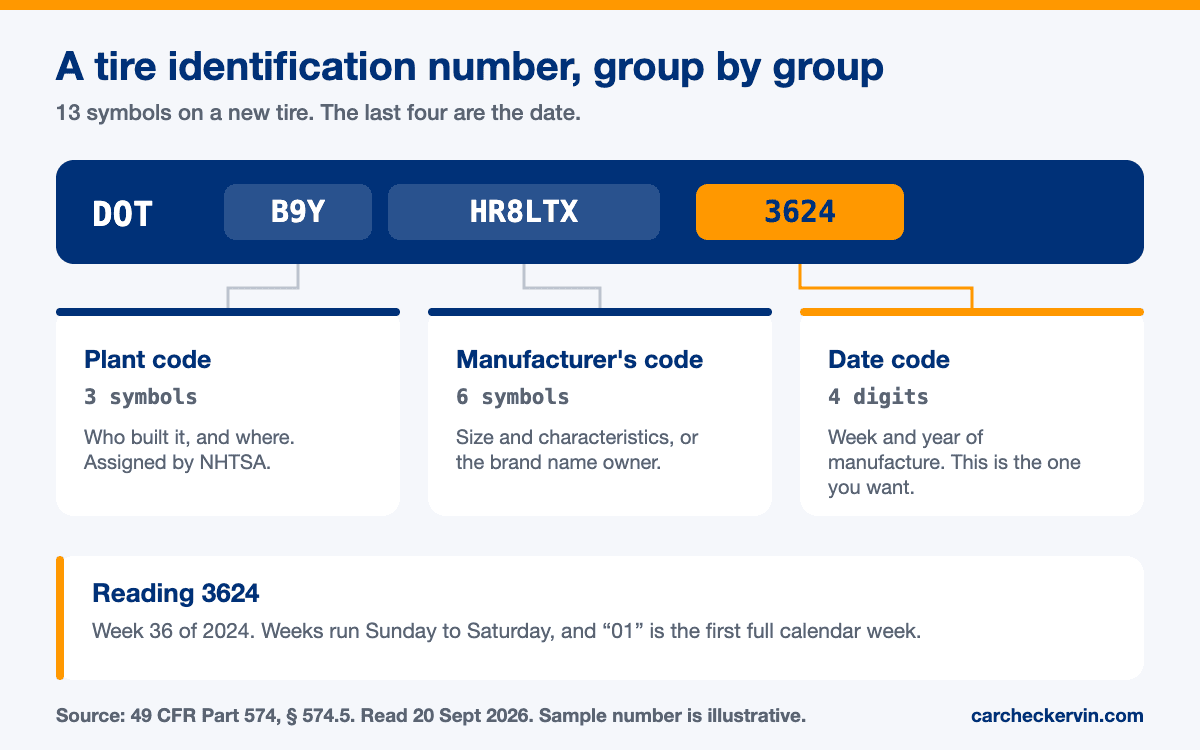
A new-tire identification number is 13 symbols, and they are not one undifferentiated string. The regulation defines three groups, in this order:
1Plant code3 symbols · first group
The plant code, consisting of three symbols, must be the first group of the TIN. The plant code represents the identity of the new tire manufacturer or retreader. The plant code is assigned to the manufacturer or retreader by NHTSA upon request.
2Manufacturer's code6 symbols · second group
The manufacturer's code, consisting of six symbols, is the second group of the TIN for all new tires, but it cannot be used for retreaded tires. The manufacturer's code must be located between the plant code and the date code. For new tires, the manufacturer's code may be used as a descriptive code for the purpose of identifying significant characteristics of the tire or to identify the brand name owner.
3Date code4 symbols · final group
The date code, consisting of four numerical symbols, is the final group. The date code must identify the week and year of manufacture.
3 plus 6 plus 4 is 13, which is the length the rule specifies. If the number you are reading is shorter, that is informative rather than wrong — see retreads below.
Turning four digits into a date
The date code is the part you actually came for, and it is defined precisely enough to be worth quoting rather than paraphrasing:
“The first and second symbols of the date code must identify the week of the year by using "01" for the first full calendar week in each year, "02" for the second full calendar week, and so on.”
The calendar week runs from Sunday through the following Saturday. That matters more than it sounds: a week number is not simply the day of the year divided by seven, and the year boundary has its own rule — the final week of each year may include no more than six days of the following year.
The tires are one check of several
Title brands, flood and salvage records, reported mileage and open recalls — $14.99, no account.
What the regulation does not say
This is where most writing on tire age goes wrong. You will read constantly that tires “expire” after a fixed number of years, stated in a way that implies a legal limit. There is no such limit in the regulation that governs tire identification.
Part 574 sets no expiry date, service life or maximum age for a tire. It requires only that the week and year of manufacture be permanently molded into the sidewall so the tire can be traced and recalled.
We checked rather than assumed. The text of the part was searched for 9 separate age-related terms — expire, expiration, six years, 6 years and others — and not one of them appears anywhere in it. The control term “date code” was present, so the absences above are a real finding and not a failed search.
None of this means an old tire is a safe tire. It means the age limit you have been quoted came from a vehicle or tire manufacturer rather than from federal law — so check what your car's maker and yourtire's maker actually recommend, and treat any figure that cites “federal regulations” for a tire expiry date as unsourced.
Retreads, and why some numbers are shorter
A retreaded tire is marked too, under the same part, but with a shorter number:
“Each tire retreader must conspicuously label at least one sidewall of each tire it retreads by permanently molding or branding into or onto the sidewall, in the manner and location specified by Figure 2, a TIN consisting of seven symbols.”
7 symbols rather than 13, because a retread carries the plant code and the date code but not the manufacturer's code. So a short identification number is not a defect in the marking — it is the tire telling you what it is.
A two-character plant code dates the tire on sight
Here is a shortcut that needs no arithmetic. Plant codes used to be two symbols and are now three, and the changeover had a deadline:
“NHTSA will assign to tire manufacturers who were previously assigned a plant code consisting of two symbols a new three-symbol plant code to replace each two-symbol plant code. A manufacturer may continue to use a previously assigned two-symbol plant code until April 13, 2025.”
That date, April 13, 2025, has passed. A tire whose identification number opens with two characters rather than three is therefore an older tire, and you can tell before you have read a single digit of the date code.
Why the date is there at all
The marking was never intended as a freshness label for consumers. Its stated purpose is narrower and more interesting:
“The purpose of this part is to facilitate notification to purchasers of defective or nonconforming tires, pursuant to Sections 30118 and 30119 of Title 49, United States Code, so that they may take appropriate action in the interest of motor vehicle safety.”
In other words, the date code exists so that a bad production run can be identified and recalled — the same function the VIN performs for a whole vehicle. That is also why reading it is worth your time on a used car: it is the one identifier that tells you whether the tires on the car are subject to a recall you have not heard about.
What to do with this when you are buying
- 1
Read all five
Four tires and the spare. Sets are often replaced in pairs, so two fresh tires and two old ones on the same car is common and tells you something about how it was maintained.
- 2
Compare the date to the model year
Tires much older than the car mean it sat — on a lot, in storage, or unused. Tread depth will not reveal that; the date code will.
- 3
Treat a full set as a negotiating line
If the tires are near the end of their useful life, that is a known, priceable cost. Raise it before you agree a number, not after.
- 4
Check the tires for their own recalls
Tire recalls are separate from vehicle recalls and are traced by exactly this number. A tire can be recalled on a car that has no open vehicle recall at all.
- 5
Run the VIN for everything the tire cannot tell you
Tire age says nothing about title brands, flood history, salvage records or reported mileage. Those come from the vehicle's own record — the $14.99 check.
Sources
- 49 CFR Part 574 — Tire Identification and Recordkeeping
The regulation that puts a date on every tire sidewall: the 13-symbol TIN, its three groups, and the week-and-year date code. Authority 49 U.S.C. 322, 30111, 30115, 30117, and 30166. Read 2026-09-20.
- 49 CFR § 574.5 — Tire identification requirements
Symbol counts and content: 13 symbols for a new tire, 7 for a retread, and the plant-code phase-out deadline of April 13, 2025. Read 2026-09-20.
- 49 CFR § 574.2 — Purpose
Why the marking exists at all — so owners of defective or nonconforming tires can be notified and the tires recalled. Read 20 September 2026.
- NHTSA Recalls by VIN
The federal safety-recall lookup: free, by VIN, covering unrepaired recalls.
Siempre verifica el VIN antes de comprar
La vista previa gratis muestra marcas de título, estado de robo y recalls abiertos en segundos, e indica si existen registros de accidentes y odómetro. El historial completo cuesta $14.99 — pago único, sin suscripción.
Keep reading
Frequently asked questions
Which digits are the date?+
The last four of the DOT number, always. The regulation is explicit about it: "The date code, consisting of four numerical symbols, is the final group. The date code must identify the week and year of manufacture." So you read from the end of the number, not the start.
How exactly does the week number work?+
By full calendar weeks. The rule states: "The first and second symbols of the date code must identify the week of the year by using "01" for the first full calendar week in each year, "02" for the second full calendar week, and so on." And the calendar week runs from Sunday through the following Saturday.
Can a date code straddle two years?+
Slightly, and the regulation allows for it: "The final week of each year may include no more than six days of the following year." So a tire stamped with the final week of a year may physically have been built in the first days of the next one.
What are the other digits for?+
The full identification number on a new tire is 13 symbols in three groups — a 3-symbol plant code, a 6-symbol manufacturer's code, then the 4-digit date. The plant code identifies who built it and where; the manufacturer's code can encode size and characteristics.
Why is the number on my tire shorter?+
Because it is a retread. Each tire retreader must conspicuously label at least one sidewall of each tire it retreads by permanently molding or branding into or onto the sidewall, in the manner and location specified by Figure 2, a TIN consisting of seven symbols. That is 7 symbols rather than 13, because retreads do not carry the manufacturer's code.
The plant code is only two characters — what does that mean?+
It means the tire is not new. NHTSA replaced two-symbol plant codes with three-symbol ones, and "NHTSA will assign to tire manufacturers who were previously assigned a plant code consisting of two symbols a new three-symbol plant code to replace each two-symbol plant code. A manufacturer may continue to use a previously assigned two-symbol plant code until April 13, 2025." That deadline has passed, so a two-character plant code is a quick signal you are looking at an older tire.
So is there any legal maximum age for a tire?+
Part 574 sets no expiry date, service life or maximum age for a tire. It requires only that the week and year of manufacture be permanently molded into the sidewall so the tire can be traced and recalled. We checked directly: Part 574 was searched for 9 different age-related terms and none appears, while the control term "date code" does — so that is a real finding, not a failed search.
Why is the date there at all, then?+
Recalls. The stated purpose of the part is "The purpose of this part is to facilitate notification to purchasers of defective or nonconforming tires, pursuant to Sections 30118 and 30119 of Title 49, United States Code, so that they may take appropriate action in the interest of motor vehicle safety." The date code is what makes a specific production run identifiable — the same job the VIN does for a whole vehicle.
Does a vehicle history report show tire age?+
No, and nothing does — tire age lives on the tire, not in the title record. What the $14.99 report covers is the vehicle's own history: title brands, flood and salvage records, reported mileage and open recalls. Read the tires yourself when you go to look at the car.
Check the car's history
Title brands, flood records and open recalls — $14.99.
Verificaciones VIN relacionadas
Más herramientas para verificar el historial de cualquier vehículo