What is a good interest rate for a used car?
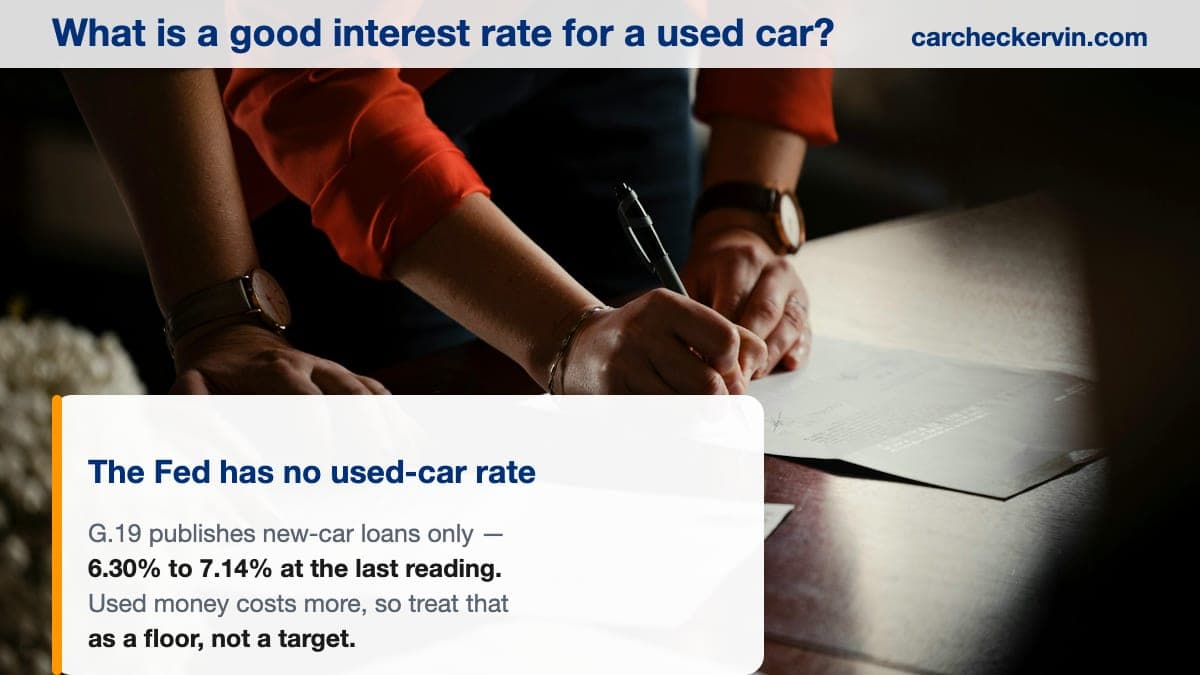
Judge it against the Federal Reserve's benchmark — 6.3% to 7.14% — but know what you are comparing with. Those are new-car rates, because the Fed publishes no used-car figure at all.
Lenders are pricing the car, not just you
A branded title is a collateral problem. Check it before you apply.
No account · Nothing stored · $14.99 only for the full report
Quick Answer
- What is a good interest rate for a used car?
- Judge it against the Federal Reserve's G.19 benchmark, which runs 6.3% to 7.14% depending on lender and term — but note those are new-car rates. G.19 publishes no used-car figure at all, and used-car money is normally dearer, so treat the benchmark as a floor rather than a target.
- Why is there no official used-car rate?
- Because the Fed's Terms of Credit table only collects new-car loan pricing from commercial banks and finance companies. Any “national average used-car rate” you see quoted comes from a private lender or aggregator's own book, not from a government series.
- What moves the rate most?
- Your credit profile, the loan term, and the size of your deposit — but also the car. A branded title makes a car harder to value and harder to resell, which is exactly the collateral problem lenders price for or decline outright.
The benchmark, and what it does not cover
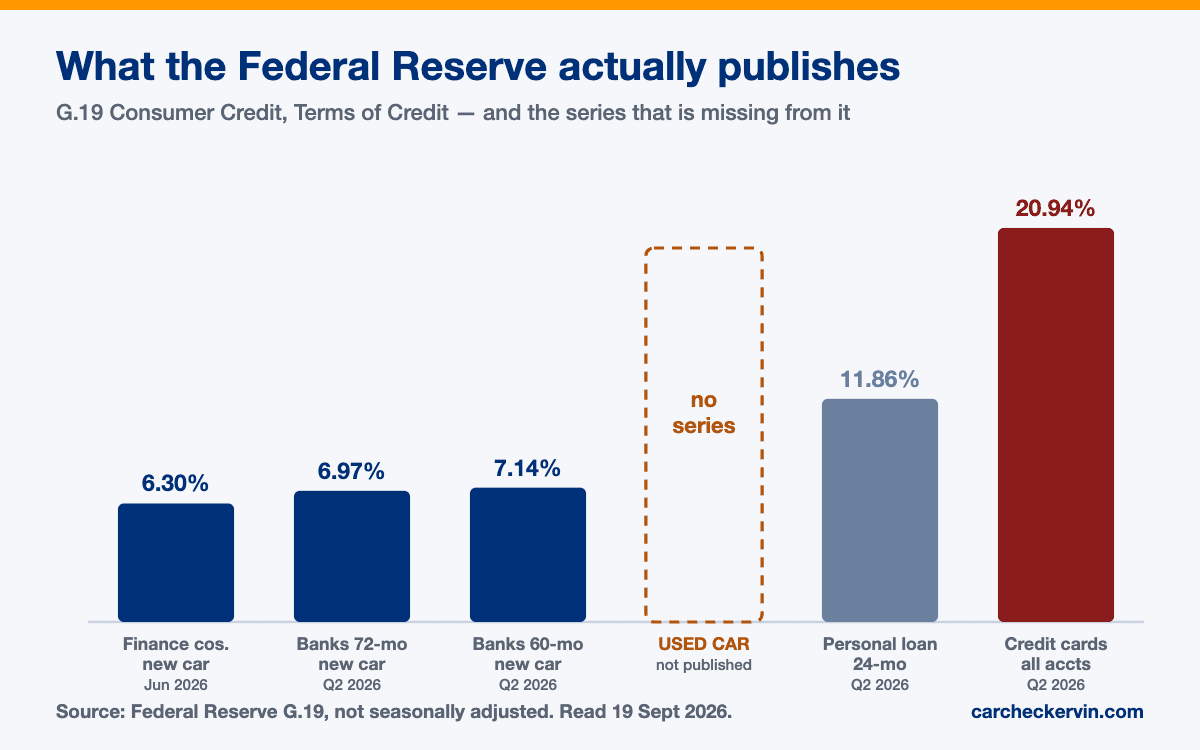
The Federal Reserve publishes consumer credit terms every month in its G.19 release. It is the only official, non-commercial source for what car loans actually cost in the United States — and it is worth knowing exactly what it contains before anyone quotes an “average” at you.
G.19 has no used-car rate.Its Terms of Credit table covers new car loans at commercial banks and at finance companies. The phrase “used car” does not appear in the release. Any precise-sounding national average for used-car finance comes from a private lender or aggregator, not from the government.
What the Fed actually reports
| Series | Latest | Period | 2023 |
|---|---|---|---|
| Commercial banks, 60-month new car | 7.14% | Q2 2026 | 7.83% |
| Commercial banks, 72-month new car | 6.97% | Q2 2026 | 7.89% |
| Finance companies, new car | 6.3% | June 2026 | 6.7% |
| Personal loans, 24-month | 11.86% | Q2 2026 | 11.87% |
| Credit cards, all accounts | 20.94% | Q2 2026 | 20.9% |
| Credit cards, accounts assessed interest | 22.15% | Q2 2026 | 22.15% |
Highlighted rows are car loans, and all three are new-car series. Source: Federal Reserve G.19 Consumer Credit, Terms of Credit, not seasonally adjusted. Read 2026-09-19. Figures are revised, so check the current release before relying on one.
A branded title is a financing problem
Lenders price collateral. Find out what the title says before you apply — $14.99, no account.
What the rate is worth in money
Worked on a $20,000 loan, so the assumptions are visible. These are straight amortisation sums on the rates in the table above, not quotes:
| Rate | 60 months | 72 months |
|---|---|---|
| 6.3% | $389.45/mo | $334.3/mo |
| 7.14% | $397.35/mo | $342.33/mo |
| 11.86% | $443.48/mo | $389.55/mo |
A longer term always lowers the monthly figure and always raises the total interest. It also extends the period during which you owe more than the car is worth.
The part most rate guides leave out
Articles about car-loan rates talk almost entirely about you — your score, your income, your deposit. But a secured loan is priced on the collateral too, and the collateral is a specific car with a specific history.
- A salvage or rebuilt brand makes a car hard to value and hard to resell — many lenders decline it outright, and those that do not price for the risk.
- Age and mileage shorten the term a lender will write, which pushes the monthly payment up even at the same rate.
- An undisclosed brand discovered after approval can unwind the deal at the worst possible moment.
Checking the title record before you apply costs $14.99 and takes a minute. Discovering the problem after you have a rate, a deposit down and a delivery date costs considerably more.
How to get the best rate you can
- 1
Get pre-approved before you shop
A quote from your own bank or credit union turns dealer finance into one option rather than the only one, and fixes your real budget before you see a car you want.
- 2
Compare APR over the same term
A lower monthly payment on a longer term is not a better deal. Put every offer on the same number of months before judging.
- 3
Check the car's title record
A brand is a collateral problem as much as a safety one. $14.99 before you apply.
- 4
Put the benchmark in front of them
G.19's new-car rates ran 6.3% to 7.14% at the last reading. Knowing the official floor makes an inflated quote much easier to question.
- 5
Keep the term as short as the payment allows
It is the single largest lever on total interest, and it shortens the stretch where you owe more than the car is worth.
Sources
- Federal Reserve G.19 — Consumer Credit, Terms of Credit
Commercial bank and finance-company new-car loan rates, credit card and personal loan rates. Not seasonally adjusted. Read 2026-09-19.
- NMVTIS — U.S. Department of Justice
The Justice Department's consumer entry point for the National Motor Vehicle Title Information System. Read 19 September 2026.
- FTC Consumer Advice — Buying a Used Car From a Dealer
The consumer-facing companion to the Used Car Rule. Read 19 September 2026.
- NHTSA Recalls by VIN
The federal safety-recall lookup: free, by VIN, covering unrepaired recalls.
Siempre verifica el VIN antes de comprar
La vista previa gratis muestra marcas de título, estado de robo y recalls abiertos en segundos, e indica si existen registros de accidentes y odómetro. El historial completo cuesta $14.99 — pago único, sin suscripción.
Keep reading
Frequently asked questions
What rate should I expect on a used car?+
Start from the federal benchmark and expect to pay more. G.19's commercial-bank new-car rates were 7.14% over 60 months and 6.97% over 72 months in Q2 2026, with finance companies at 6.3% in June 2026. Used-car loans typically price above those because the collateral is older and harder to value. If a quote is far above the benchmark, the question to ask is which part — you, the term, or the car — is driving it.
Does the Federal Reserve publish a used-car rate?+
No. The G.19 Terms of Credit table covers new car loans at commercial banks and at finance companies, plus credit cards and personal loans. It does not contain a used-car series — the phrase does not appear in the release. That is worth knowing whenever you see a precise-sounding 'national average used car rate' presented as official.
How much does the rate actually change the payment?+
Take a $20,000 loan over 60 months. At 7.14% the payment is about $397.35; at 11.86% — roughly the personal-loan rate in the same table — it is about $443.48. That is the value of shopping the loan rather than accepting the first offer.
Is a longer term a good idea if it lowers the payment?+
It lowers the payment and raises the total. In the same $20,000 example, 72 months at 6.97% gives about $340.69 a month against about $395.74 over 60 — cheaper monthly, more interest overall, and longer spent owing more than the car is worth.
What is the average new-car loan actually like?+
In June 2026, finance companies reported an average amount financed of $41,705 over an average maturity of 67 months. That is the shape of a typical new-car loan, and a useful reference point when a dealer presents a used-car term that looks unusually long.
Should I get pre-approved before I shop?+
It is the cheapest leverage available. A pre-approval from your own bank or credit union turns the dealer's financing into one quote among several rather than the only option on the table, and it tells you your real budget before you fall for a car.
Does the car itself affect the rate?+
Yes, and this is the part most rate articles skip. Lenders are pricing collateral. Age, mileage and — critically — the title all matter: a salvage or rebuilt brand makes a car hard to value and hard to resell, so many lenders decline it or price it steeply. Check the title record before you apply, not after.
Will a dealer always beat my bank?+
Sometimes, because manufacturers subsidise finance on specific models. Often not. The only way to know is to arrive with a pre-approval and let them try to beat it. Compare the APR and the total cost over the same term, not the monthly payment, which can be engineered to look better by stretching the loan.
What if I have poor credit?+
Expect a materially higher rate and be careful with very long terms, which is where a high rate does the most damage. Refinancing later once the account has a payment history is often possible. What you should not do is let a high rate push you into a cheaper-but-branded car — the saving on the sticker is usually smaller than the loss on resale.
Check the car before you apply
Title brands, flood records and ownership history — $14.99.
Verificaciones VIN relacionadas
Más herramientas para verificar el historial de cualquier vehículo