Ford Warranty Check by VIN — Six Clocks, Not One.
Ford does not sell one warranty. It publishes six coverage terms that start on the same day and expire on six different ones — which is why "is it still under warranty" rarely has one answer on a used Ford. This free check estimates each remaining window from the VIN and reads NMVTIS for the title brands that end coverage outright.
Free Ford Warranty Check — Any 17-Character Ford VIN
Enter the VIN and we will estimate the remaining coverage windows and surface any title brand that would end them.
Free · No sign-up · Instant result
Quick Answer
- How do I check a Ford warranty by VIN?
- Enter the 17-character VIN in the free check on this page. It decodes the model year and reads NMVTIS title records for brands that end factory coverage. Ford publishes a 3-year / 36,000-mile New Vehicle Limited Warranty and a separate 5-year / 60,000-mile Powertrain Warranty, so the result is an estimate measured against those terms. The exact answer lives with Ford, because Ford holds the Warranty Start Date — any Ford Dealer can read it from the VIN.
- Does Ford have a 100,000-mile warranty?
- On specific coverages, yes — not on the whole car. Ford's standard Powertrain Warranty runs 5 years / 60,000 miles. The Power Stroke Diesel term is 5 years / 100,000 miles, and hybrid and electric unique components carry 8 years / 100,000 miles. Separately, a Gold Certified vehicle under Ford Blue Advantage carries a 7-year / 100,000-mile Powertrain Limited Warranty. So the honest answer depends entirely on which engine and which certification the specific car has.
- When did the warranty clock actually start?
- Not when you buy the car, and not on the model year. Ford states that the Warranty Start Date is the day the vehicle was delivered to its first owner or the day it was first put into service — for example as a Ford Dealer demonstrator — whichever occurs first. On a car that sat in inventory or ran as a demo, that date can precede the first retail sale by months, and every one of Ford's coverage clocks starts there. This is the single most common reason a buyer's warranty arithmetic comes out wrong.
What happens between your VIN and the answer
One box, one button — and underneath it a decode, a federal records read, and a date estimate. Knowing which of the three the tool can be certain about is what keeps you from over-trusting the result.
- 1The VIN is decodedThe tenth character carries the model-year code, and the World Manufacturer Identifier at the front confirms the vehicle is a Ford and where it was built. That gives the tool a model year and a body type, which is what determines which of Ford's six coverage terms are in play on the car in front of you.
- 2NMVTIS title records are readThe same VIN goes to the National Motor Vehicle Title Information System, the federal title database, looking for salvage, junk, rebuilt and flood brands. A brand found here outranks every date calculation on the page, because it ends factory coverage regardless of how much time or mileage is left.
- 3The remaining windows are estimated — not looked upThis is the honest limit of any third-party tool, ours included. Ford measures every term from the Warranty Start Date, and Ford holds that date. We estimate from the decoded model year, which is close but is not the same thing. Take the VIN to a Ford Dealer to convert the estimate into a definitive answer before money changes hands.
Ford's Six Coverage Terms, Side by Side
The basic New Vehicle Limited Warranty runs 3 years or 36,000 miles. The Powertrain Warranty runs 5 years or 60,000 miles. A Power Stroke diesel and a hybrid battery run longer still. These are Ford's own published terms for US-market vehicles, quoted rather than paraphrased — and they are best read as six separate clocks rather than one warranty, because that is how they behave: a Ford can be years out of bumper-to-bumper cover while still inside its corrosion, diesel or hybrid-battery window.
3yr/36kNew Vehicle Limited Warranty — the bumper-to-bumper term, 3 years or 36,000 miles, whichever occurs first. This is the coverage people mean when they say a car is "still under warranty," and it is also the first of the six to expire on almost every vehicle.5yr/60kPowertrain Warranty — 5 years or 60,000 miles, whichever occurs first, covering the engine, transmission and drive-system parts listed further down this page. On a used Ford past 36,000 miles this is usually the only factory coverage still running.5yr/∞Corrosion Warranty — 5 years with unlimited mileage. Note the shape of this one: it is the only term on the list with no mileage cap at all, so a high-mileage Ford can hold corrosion cover long after every other clock has stopped.5yr/60kSafety Restraint System — 5 years or 60,000 miles, whichever occurs first, running alongside the powertrain term on its own clock. Airbag and restraint faults are handled here rather than under the basic warranty.5yr/100kPower Stroke Diesel — 5 years or 100,000 miles, whichever occurs first. A diesel Super Duty therefore carries a materially longer engine window than the petrol truck parked beside it, which is a real and frequently missed difference in asking price.8yr/100kHybrid and electric unique components — 8 years or 100,000 miles, whichever occurs first. On a used hybrid or EV this is the longest clock on the vehicle and normally the one that decides whether the price is defensible.
One thing is deliberately not on this page: an exclusions list. Ford publishes what is not covered on a separate page that we did not pull for this article, and we do not print figures or lists we have not read at the source. Ask a Ford Dealer for the Warranty Guide covering the specific model year — Ford will supply it against the VIN — and read the exclusions there rather than from any summary, ours included.
The Warranty Start Date Is the Only Date That Matters
Ford puts it in one sentence: the Warranty Start Date is the day you take delivery of your new vehicle or the day it is first put into service, for example as a Ford Dealer demonstrator, whichever occurs first. Read that twice if you are buying used, because both halves matter — and the second half is the one that costs people coverage they thought they had.
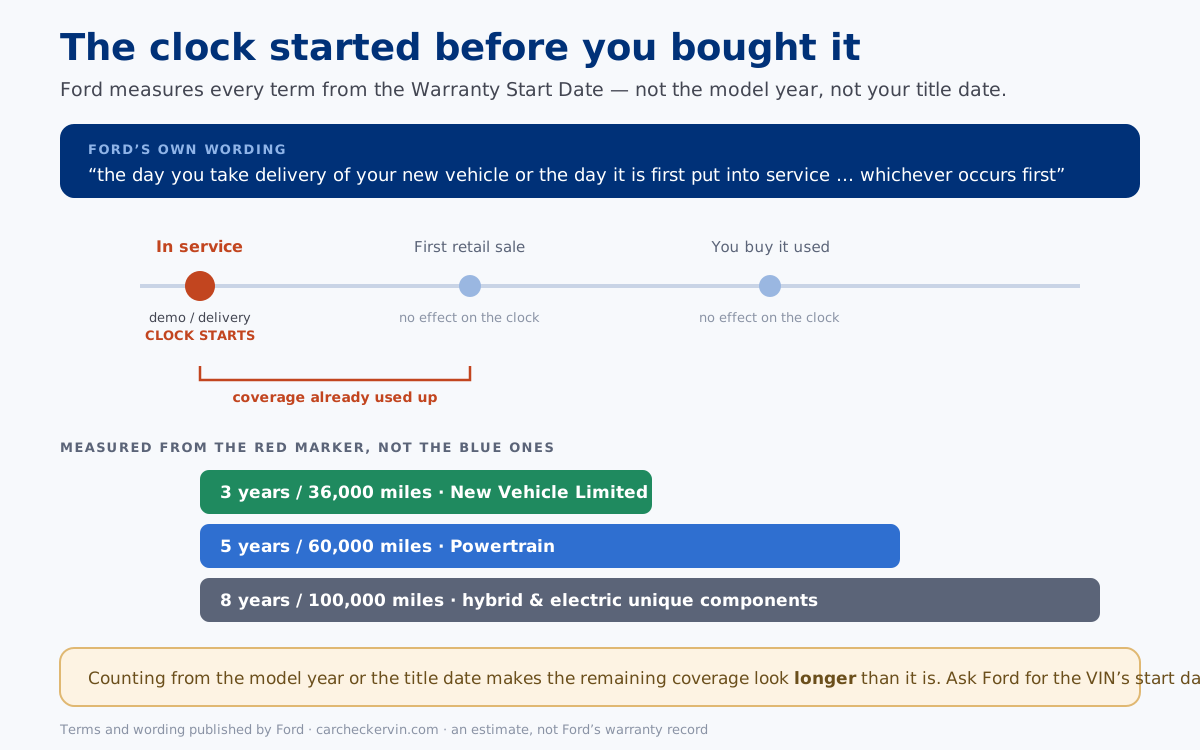
A vehicle badged as a given model year can be delivered well before or well after the calendar year it names. If it then spent time as a demonstrator on a dealer lot, Ford's clock started when it went into service in that role — not when a retail buyer finally signed for it.
The practical consequence is one-directional and it is not in your favour: counting from the model year, or from the date on the title you are being shown, will tend to make the remaining coverage look longer than it is. Nobody advertises a car as having less warranty than you assumed.
Ask this one question
“What is Ford's Warranty Start Date for this VIN?” A Ford Dealer can read it directly. A seller who cannot or will not get it is asking you to pay for coverage nobody has confirmed exists — and on a car near the 36,000-mile line, that is the whole negotiation.
Always check the VIN before you buy
The free preview shows title brands, theft status and open recalls in seconds, and flags whether accident and odometer records exist. The full history is $14.99 — one-time, no subscription.
What the Powertrain Warranty Actually Covers
"What exactly does a powertrain warranty cover" is the most-asked follow-up on this term, and most pages answer it with the words "engine and transmission" and stop. Ford publishes the actual component list. Here it is, quoted from Ford's own powertrain coverage page, under the 5-year / 60,000-mile term.
Engine
All internal lubricated parts, oil pan, cylinder block, oil pump, cylinder heads, seals and gaskets, electrical fuel pump, engine thermostat, powertrain control module, engine thermostat housing, engine mounts, timing chain cover, flywheel, timing chain, injection pump, turbocharger/supercharger unit, manifolds, valve covers, and water pump.
Transmission
All internal parts, transfer case with internal parts, clutch cover, transmission case, seals and gaskets, transmission mounts, and torque converter.
Front-wheel drive
Axle shafts, seals and gaskets, front bearings, universal and constant velocity joints.
Rear-wheel drive
Axle shafts, retainers, rear bearings, supports, center support bearing, seals and gaskets, drive axle housing with internal parts, universal joints, and driveshaft.
Four-wheel and all-wheel drive
Axle shafts, hubs, bearings, locking rings, center support bearing, seals and gaskets, driveshafts, universal joints, and final drive housing with internal parts.
Read that list against the failure you are worried about before assuming a repair is covered. Note also what the grouping tells you: the drive-system coverage differs by drivetrain, so a front-wheel-drive car, a rear-wheel-drive truck and a four-wheel-drive truck are not being offered the same set of parts under the same words.
Ford Blue Advantage: What Certification Adds
A certified used Ford is sold under Ford Blue Advantage, which has three tiers with materially different coverage. The difference between the entry tier and the middle tier is the difference between three months of cover and seven years of powertrain cover, so "certified" on its own is not a specification — the tier is.
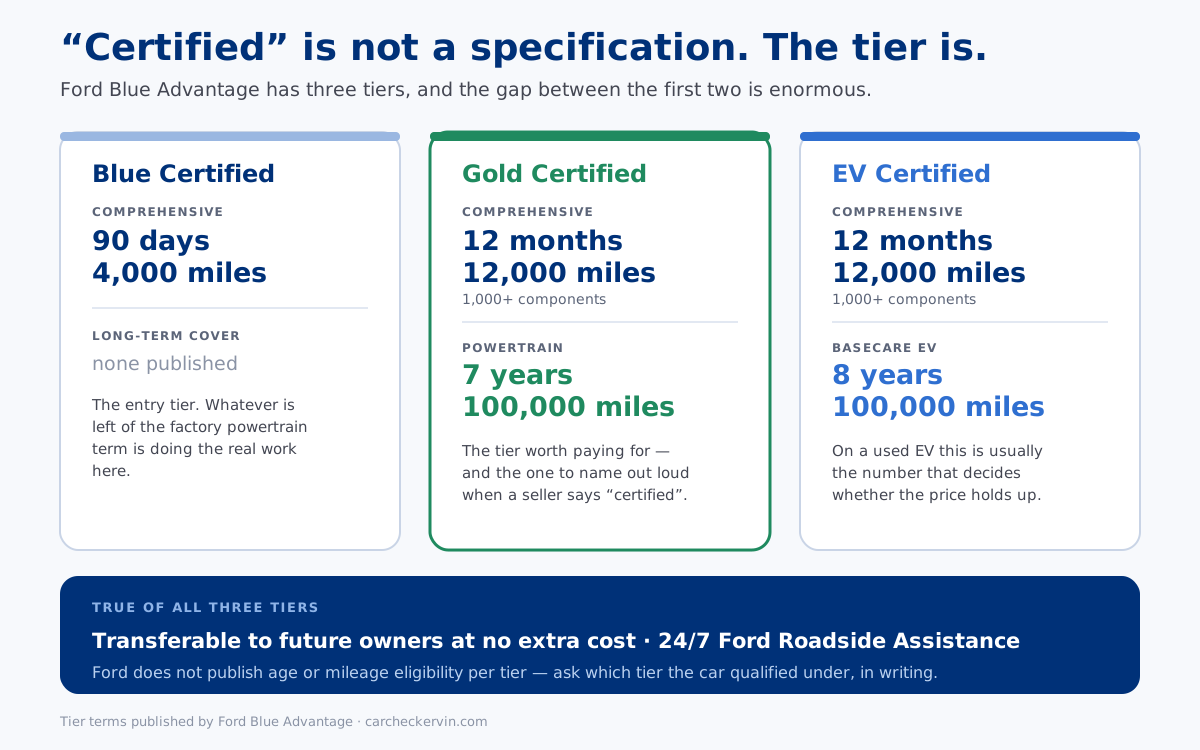
Blue Certified
Comprehensive
90-Day / 4,000-Mile Comprehensive Limited Warranty
The entry tier. Short comprehensive cover and no separate powertrain term published alongside it, so on a Blue Certified car the factory Powertrain Warranty — if any of it is left — is doing the heavy lifting.
Gold Certified
Comprehensive
12-Month / 12,000-Mile Comprehensive Limited Warranty covering more than 1,000 components
Long-term
7-Year / 100,000-Mile Powertrain Limited Warranty
The tier worth paying for. Ford lists engine, transmission, drive systems, steering, brakes, suspension, electrical, climate, technology, emissions, audio and safety systems under the comprehensive term.
EV Certified
Comprehensive
12-Month / 12,000-Mile Comprehensive Limited Warranty covering more than 1,000 components
Long-term
8-Year / 100,000-Mile BaseCARE EV Limited Warranty
The electric equivalent, with the high-voltage battery rather than a powertrain as the long-term item. On a used EV this is normally the coverage that decides whether the price makes sense.
Ford states that this coverage is transferable to future owners at no extra cost and that every tier includes 24/7 Ford Roadside Assistance. Worth noting precisely because the equivalent question about the original factory warranty is not answered on Ford's New Vehicle Limited Warranty page — so we do not assert it here either. Ford's warranties page also does not publish age or mileage eligibility limits per tier, so ask the dealer which tier a specific car qualified under and get it in writing.
What Ends Ford Coverage Before the Clock Runs Out
Time and mileage are the ordinary ways a warranty ends. These are the ways it stops early — and the first two are the reason this tool reads federal title records rather than only counting days.
A salvage or junk title brand
When an insurer declares a vehicle a total loss, the state records a brand against the VIN. That brand ends factory coverage, and it does so permanently — it does not matter how long is left on the clock, how well the car was repaired, or how many owners ago it happened. This is the reason the check on this page reads title records instead of only doing date arithmetic.
A rebuilt title after repair
Repairing a salvage vehicle and passing a state re-inspection produces a rebuilt brand. It makes the car road-legal again. It does not restore the original manufacturer warranty, and no later sale restores it either. A rebuilt Ford can present beautifully and still have no factory coverage behind it at all.
The mileage cap, reached early
Every Ford term is capped by miles as well as years, and the cap that arrives first is the one that ends the coverage. A high-mileage truck can pass 36,000 miles well inside year two, and pass 60,000 miles before year three. On a work vehicle the odometer, not the calendar, is usually what closes the window.
A Warranty Start Date earlier than you assumed
Not an exclusion so much as an arithmetic trap. If the car ran as a demonstrator before its first retail sale, Ford's clock started on that earlier in-service date. Buyers who count from the title date consistently overestimate what is left, which is precisely why the definitive answer has to come from Ford rather than from a listing.
Diesel and Hybrid Buyers Are Reading a Different Line
Two of Ford's six terms only apply to particular drivetrains, and both of them run longer than the coverage most buyers are thinking about. A Power Stroke Diesel engine is covered for 5 years or 100,000 miles, whichever occurs first — against 5 years or 60,000 miles for the standard powertrain term. On a Super Duty that is 40,000 additional miles of engine coverage, and it belongs in the price.
Hybrid and electric unique components are covered for 8 years or 100,000 miles, the longest clock Ford publishes. On a used hybrid or EV this is normally the coverage that decides whether the asking price is defensible, because it is attached to the most expensive single assembly in the vehicle.
Confirm the engine from the VIN
Badges get swapped and listings get typed by hand. The VIN encodes the engine, and on a truck where the diesel term is worth 40,000 extra miles of coverage, that is not a detail to take on trust. Decode it, then confirm the Warranty Start Date with a Ford Dealer — two questions, one phone call.
Where to Get the Definitive Answer
We will say this as plainly as we can, because it is the part most tools in this category leave vague: no third-party service, ours included, holds Ford's warranty status. What we can do is decode the VIN, estimate the windows against Ford's published terms, and read the federal title record for brands that end coverage. What we cannot do is tell you Ford's Warranty Start Date, because Ford does not publish it to us.
What this page can tell you
Which of Ford's six terms apply, what each one runs to, what the powertrain term actually lists, what certification adds — and whether a federal title brand has already ended factory coverage on this specific VIN.
What only Ford can tell you
The Warranty Start Date, and therefore the exact day each clock stops. Ford does not publish it to third parties. Any Ford Dealer can read it from the VIN, and it costs nothing to ask.
Sources
Every coverage figure on this page comes from one of these, pulled in September 2026. Check them yourself — that is the point of listing them.
Ford — What is the Ford New Vehicle Limited Warranty? (all six coverage terms and the Warranty Start Date)
Ford — What parts are covered by the Powertrain Warranty? (the component list quoted above)
Ford Blue Advantage — Certified vehicle warranties by tier
NMVTIS — US Department of Justice vehicle title system
NHTSA — open recall lookup, free to fix regardless of warranty status
Related Warranty and Ford Pages
The warranty window is one input into the price. These cover the rest of what decides whether a used Ford is worth what is being asked for it.
Ford Warranty Check — Common Questions
What used-Ford buyers ask once they discover the model year is not the warranty start date.
How do I check a Ford warranty by VIN?
Enter the 17-character VIN into the free Ford warranty check on this page. The tool decodes the model year from the tenth VIN character, measures it against Ford's published terms — a 3-year / 36,000-mile New Vehicle Limited Warranty and a 5-year / 60,000-mile Powertrain Warranty among them — and reads NMVTIS for any salvage, junk or rebuilt brand that would end factory coverage. The result is an estimate rather than a lookup, because Ford measures every term from the Warranty Start Date and Ford holds that date, not us. For a definitive answer on a specific vehicle, a Ford Dealer can read the VIN in Ford's own system.
How long is the Ford factory warranty?
Ford publishes six terms rather than one. The New Vehicle Limited Warranty, the bumper-to-bumper coverage, runs 3 years or 36,000 miles, whichever occurs first. The Powertrain Warranty runs 5 years or 60,000 miles. Corrosion coverage runs 5 years with unlimited mileage. The Safety Restraint System is covered for 5 years or 60,000 miles. A Power Stroke Diesel engine carries 5 years or 100,000 miles, and hybrid and electric unique components carry 8 years or 100,000 miles. They all start on the same day and stop on six different ones, so a Ford can be outside one and comfortably inside another.
Does Ford have a 100,000-mile warranty?
On specific coverages, not on the whole vehicle. Ford's standard Powertrain Warranty is 5 years or 60,000 miles. Two published terms do reach 100,000 miles: the Power Stroke Diesel term at 5 years / 100,000 miles, and hybrid and electric unique components at 8 years / 100,000 miles. Separately, a Gold Certified vehicle under Ford Blue Advantage carries a 7-year / 100,000-mile Powertrain Limited Warranty, and an EV Certified vehicle carries an 8-year / 100,000-mile BaseCARE EV Limited Warranty. So the accurate answer depends on the engine and on whether the car was certified — which is exactly why the VIN matters more than the brochure.
When does the Ford warranty clock start?
Ford states that the Warranty Start Date is the day you take delivery of the vehicle or the day it is first put into service — for example as a Ford Dealer demonstrator — whichever occurs first. It does not start at the model year, the build date, or the day the current seller acquired the car. On a vehicle that sold quickly the gap is small. On an inventory unit or a demonstrator it can be months, and every one of Ford's six clocks starts at that earlier point. Counting from the title date is the single most common way buyers overestimate the coverage they are inheriting.
What exactly does the Ford powertrain warranty cover?
Ford publishes the component list rather than leaving it at "engine and transmission," and it runs for 5 years or 60,000 miles, whichever occurs first. On the engine side it lists all internal lubricated parts, the oil pan, cylinder block, oil pump, cylinder heads, seals and gaskets, electrical fuel pump, engine thermostat and its housing, the powertrain control module, engine mounts, timing chain and timing chain cover, flywheel, injection pump, turbocharger or supercharger unit, manifolds, valve covers and water pump. On the transmission side it lists all internal parts, the transfer case with internal parts, clutch cover, transmission case, seals and gaskets, transmission mounts and the torque converter. Drive-system coverage is listed separately for front-wheel drive, rear-wheel drive and four-wheel or all-wheel drive, so the exact parts depend on the drivetrain.
Does the Ford powertrain warranty cover the transmission?
Yes. Ford lists the transmission under powertrain coverage, specifying all internal parts along with the transfer case and its internal parts, the clutch cover, the transmission case, seals and gaskets, transmission mounts and the torque converter. The term is 5 years or 60,000 miles, whichever occurs first. What that does not tell you is whether a particular failure will be honoured on a particular car — that depends on the exclusions, which Ford publishes on a separate page we have not reproduced here, and on the service history. Ask a Ford Dealer for the Warranty Guide for that model year and read the exclusions in the source document.
What is the Ford Blue Advantage certified warranty?
Ford Blue Advantage is Ford's certified used programme, and it has three tiers with very different coverage. Blue Certified carries a 90-Day / 4,000-Mile Comprehensive Limited Warranty. Gold Certified carries a 12-Month / 12,000-Mile Comprehensive Limited Warranty covering more than 1,000 components, plus a 7-Year / 100,000-Mile Powertrain Limited Warranty. EV Certified carries the same 12-month comprehensive term plus an 8-Year / 100,000-Mile BaseCARE EV Limited Warranty. Ford states the coverage is transferable to future owners at no extra cost and that every tier includes 24/7 Ford Roadside Assistance. Because the tiers differ so much, ask which tier the specific car qualified under rather than accepting the word "certified" on its own.
Does a salvage title void a Ford warranty?
A salvage brand is recorded when an insurer declares a vehicle a total loss, and it ends factory coverage. Repairing the vehicle and passing a state re-inspection produces a rebuilt brand, which makes the car road-legal again but does not restore the original manufacturer warranty — and no subsequent sale restores it either. This holds regardless of how good the repair was or how the car presents in person, and it applies to a brand recorded several owners ago exactly as much as a recent one. The free check on this page reads NMVTIS for those brands at the same time it estimates the remaining windows, which is why the two checks belong together.
Can I look up remaining Ford warranty with just the VIN?
You can get a well-founded estimate from the VIN, and you cannot get the definitive status from it — not from us and not from any other third-party tool. The VIN reliably yields the model year, the build origin and the federal title record, and those are enough to say which of Ford's six terms are in play and whether a brand has already ended them. What the VIN alone does not yield is Ford's Warranty Start Date, which is the date every term is measured from and which Ford holds in its own system. Any Ford Dealer can read it against the VIN. Treat the estimate as the thing that tells you whether the question is worth asking, and the dealer read as the answer.
Is a diesel Ford covered for longer than a petrol one?
On the engine, yes. Ford publishes a Power Stroke Diesel term of 5 years or 100,000 miles, whichever occurs first, against a standard Powertrain Warranty of 5 years or 60,000 miles. On a Super Duty that difference is 40,000 miles of engine coverage, and it is a real input into what the truck is worth — particularly on a work vehicle that will pass 60,000 miles quickly. The other five terms are unaffected by the engine choice, so the diesel advantage is specific rather than general. Confirm the engine from the VIN rather than from the badge on the tailgate.
Check What Is Left on the Ford
Enter any 17-character Ford VIN for a remaining-coverage estimate against Ford's published terms, plus an NMVTIS read for the brands that end coverage outright.
No credit card · No sign-up · Free
Related VIN Checks
More tools to verify any vehicle's history