KBB VIN Check — What It Shows, and What It Can't
Kelley Blue Book is a valuation company, not a vehicle-history company. A KBB VIN check tells you what a car like this one is worth; it does not tell you whether this particular car was flooded, totalled, or had its odometer wound back. Run the VIN below for a free preview of the history records that decide whether the Blue Book number applies at all.
Free VIN Preview — See the Records First
Enter the 17-character VIN to see how many title, brand, odometer and salvage records exist for it — before you pay for anything
Free preview · No card required · Instant result
Quick Answer
- Is the KBB VIN check free?
- The Kelley Blue Book valuation is free — you can price a car all day without paying. The historycheck on kbb.com is not: it hands you to a partner brand's paid report. CarCheckerVIN shows you the record counts for any VIN free, with no card, and the full NMVTIS-backed report is $14.99.
- How do I check a VIN on KBB?
- Decode the VIN first — the free NHTSA vPIC decoder gives you the exact year, model and engine — then enter that vehicle on kbb.com with your mileage, condition and ZIP code. The VIN's job in a valuation is to pin down the trim and factory options, not to reveal history.
- Does a KBB VIN check show accidents or a salvage title?
- No. Kelley Blue Book prices vehicles; it does not hold title records. Branded titles, odometer readings, total-loss declarations and salvage-auction records live in NMVTIS, the federal title system run by the U.S. Department of Justice — which is what a VIN history check reads.
What a Kelley Blue Book VIN Check Actually Is
Kelley Blue Book has been publishing used-vehicle values since long before anyone typed a VIN into a browser, and it is still the name most buyers and sellers trust for a price. That reputation is earned — but it is a reputation for pricing, and pricing only. KBB's business is estimating what a vehicle of a given year, model, trim, mileage and condition should sell for in your part of the country. It is not, and never has been, in the business of collecting title records from state motor vehicle agencies.
So when people search for a "KBB VIN check" they are usually after one of two very different things without realising they are different. The first is a valuation that is accurate to the exact car — and for that, the VIN genuinely helps, because those 17 characters encode the trim level, engine, drivetrain and factory equipment that separate a base model from a loaded one. The second is a history check: has this car been wrecked, branded, or rolled back? That question has a different answer and a different source.
Kelley Blue Book's own vehicle-history offering makes the split obvious. Follow the history link on kbb.com and you are handed to a partner brand's report, built and billed by that partner rather than by KBB. The valuation is KBB's product. The history file never was. We mapped that hand-off in detail here.
Is the KBB VIN Check Free? Here Is the Plain Answer
The valuation is free. You can look up Blue Book values for as many vehicles as you like without an account, without a card, and without a limit. That part of KBB has been free to consumers for years and there is no catch in it.
The history report is not free. Clicking through KBB's vehicle-history option lands you on a partner brand's checkout, at that brand's retail price — currently around $24.99 for a single AutoCheck report and roughly $39.99 to $44.99 for a single Carfax. Those are the partner's prices, not KBB's, and KBB is not the one producing the data.
That is the gap this page exists to fill. A free VIN preview here shows you how many title records, brand records, odometer readings and salvage entries exist for the VIN before you spend anything. If the counts are zero across the board, you have learned something useful for free. If they are not, the full NMVTIS-backed report is $14.99 — a three-pack is $35.99, five is $54.99, ten is $89.99 if you are shopping several cars at once.
KBB VIN check, priced honestly
- Blue Book value
Free - History via KBB
Partner price - Our VIN preview
Free - Our full report
$14.99
The free preview shows record counts with no card. You only pay if you want the records themselves.
How to Run a VIN Check on KBB, Step by Step
There is a right order to this, and doing it backwards is how people end up paying market price for a rebuilt car. Each step returns something the previous step could not.
Read the VIN off the car
The 17-character VIN sits on the driver-side dashboard, visible through the windshield, and is repeated on the driver's door-jamb sticker. Compare both against the title and the registration. All four should match exactly. Every VIN from the 1981 model year onward is 17 characters, and a genuine one never contains the letters I, O or Q — those were dropped so nobody confuses them with 1 and 0.
Decode it for free first
Before you price anything, run the number through NHTSA's free vPIC decoder to confirm the year, make, model, body style, engine and assembly plant. This is the step that stops you valuing a four-cylinder as a V6. Our own decoder does the same job in the same breath as the history lookup.
Price the decoded vehicle on KBB
On kbb.com, select the year, make, model and trim you just confirmed, then add your mileage, your honest condition grade and your ZIP code. KBB returns a value range for a vehicle configured that way. Be truthful about condition — the difference between "good" and "excellent" is real money, and inflating it only fools you.
Check the history separately
Now run the same VIN against NMVTIS records. This is where title brands, odometer readings, total-loss declarations and salvage-auction appearances surface. It is the step that decides whether the number KBB just gave you applies to this car at all.
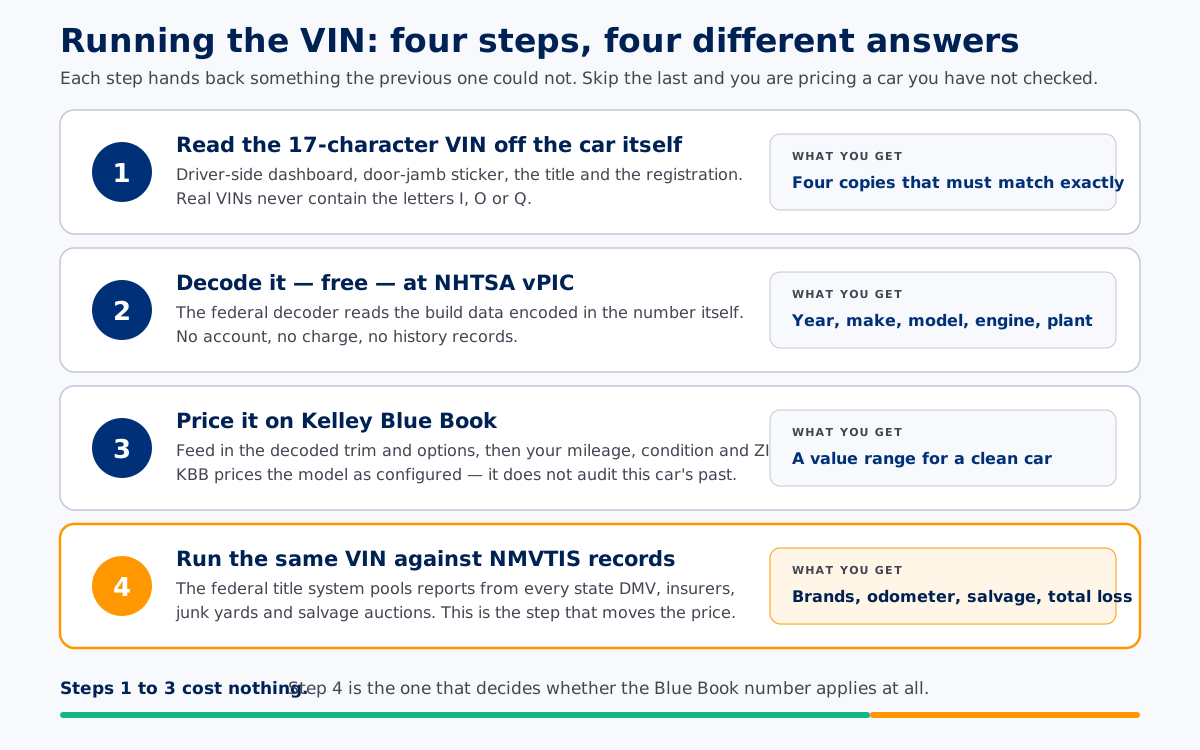
Step two is the one people skip. Decoding the VIN first costs nothing and stops you pricing the wrong trim, which is the most common way a valuation ends up several thousand dollars off before any history is even considered.
What KBB's VIN Lookup Tells You
Used properly, the VIN makes a Blue Book valuation dramatically more accurate than a year-make-model guess. Here is what it actually contributes.
A value range, not a single price
KBB publishes a range rather than one figure, because identical cars sell for different money depending on condition, mileage and where you are standing. The range is the honest representation of a used-car market that does not have fixed prices.
The exact trim and factory options
This is the VIN's real contribution to a valuation. Trim level, engine, drivetrain and factory-installed equipment are encoded in the number, and the gap between a base trim and a fully optioned one can be thousands of dollars on the same model year.
Mileage-adjusted pricing
Every valuation tool discounts or credits against expected mileage for the vehicle's age. Enter the odometer reading you actually see on the dash — and then confirm that reading against the title history, because a false number in produces a false number out.
Condition grading
You grade the car yourself, from rough through fair, good and excellent. Most private sellers overrate their own vehicle by a grade. Grading it the way a stranger with cash would grade it produces a number you can defend in a negotiation.
Separate trade-in, private-party and retail figures
The same car carries three different values depending on how it changes hands. Trade-in is lowest because a dealer has to recondition and resell it; private-party sits higher; dealer retail higher still. Quote the wrong one and you will feel insulted by an offer that was fair.
Regional pricing by ZIP code
A convertible is worth more in Phoenix than in Buffalo, and four-wheel drive carries a premium where it snows. Blue Book values adjust for the local market rather than pretending the country is one price.
None of this requires a paid report, and none of it depends on the car's past. That is exactly why it cannot substitute for one.
See the History Records Before You Trust the Value
Enter the 17-character VIN for a free preview of the title, brand, odometer and salvage records on file. No card, no account — just the counts, so you know whether the Blue Book number is safe to rely on.
What a KBB VIN Check Does Not Tell You
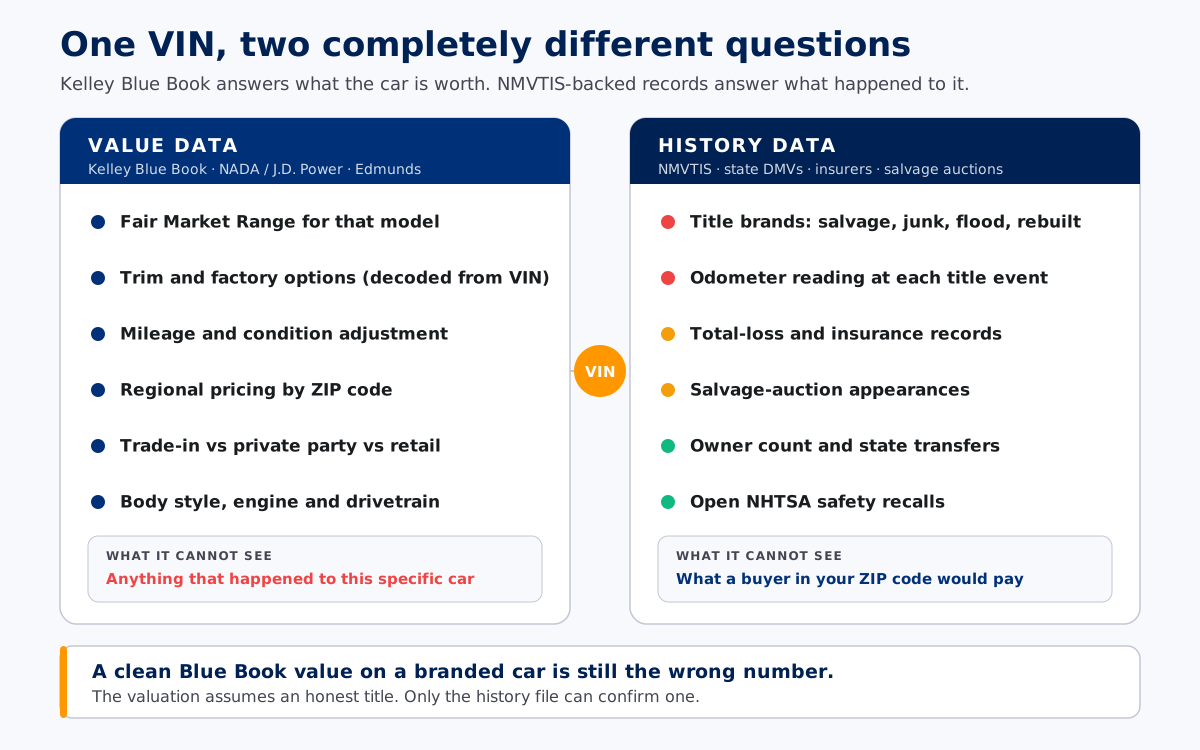
This is the part that costs people money. A valuation model assumes a normal car with an honest title, because it has no way to know otherwise. Everything below is invisible to it.
Title brands
Salvage, junk, flood, water damage, lemon-law buyback, rebuilt — the permanent marks a state puts on a title after something serious happened. A branded title is the single biggest destroyer of resale value there is, and no valuation tool knows it is there unless you tell it.
Odometer rollback
The valuation takes whatever mileage you type in. If the seller wound the number back, the figure you get out is the value of a car that does not exist. Only the sequence of readings recorded at each title event exposes a reading that stalls or drops.
Total-loss declarations
When an insurer writes a car off, that decision is reported and stays attached to the VIN. A car can be repaired and put back on the road looking perfectly ordinary while carrying that record — and the record is what a future buyer will find.
Salvage-auction appearances
Vehicles that pass through the big salvage auctions leave a trail. This is where flood cars and rebuilt wrecks are most often caught, because the auction record predates the cosmetic repair and the fresh title from a friendlier state.
Reported accidents and damage
Collision and damage events reported by insurers, police and inspections do not reach a pricing model. Coverage varies by state, so a clean field is not proof of an accident-free car — but a logged event is confirmed history you can hold a seller to.
Open safety recalls
Outstanding manufacturer recalls are free to fix at a franchised dealer and have nothing to do with what the car is worth on paper. They do have something to do with whether it is safe to drive home.
A pricing model is not hiding any of this from you. It simply has no access to it — which is a reason to run the second check, not a criticism of the first. See what a reported-accident check covers.
KBB vs AutoCheck vs Carfax vs NMVTIS — Who Holds What
Four names get used interchangeably in used-car conversations and they do genuinely different jobs. NMVTIS sits underneath most of it: the National Motor Vehicle Title Information System is a federal database, administered by the U.S. Department of Justice, that pools title and brand reports from state motor vehicle agencies, insurers, junk yards and salvage auctions. Here is who supplies what.
| Source | What it holds | What it does not |
|---|---|---|
| Kelley Blue Book | Valuations — Fair Market Range, trim and option adjustments, condition and mileage grading, regional pricing | No title records, no accident data, no odometer verification. Its history option is a partner product. |
| NMVTIS | Title brands, brand history across states, odometer readings at title events, total-loss and salvage reporting | No prices, no valuations, no dealer service invoices. It is a title system, not a market. |
| AutoCheck | A commercial history report, Experian-owned, known for its auction-record coverage and its own vehicle score | Not a valuation service. Sold at its own retail price, currently around $24.99 for a single report. |
| Carfax | A commercial history report with dealer-network service records layered on top of the federal title data | Not a valuation service. A single report currently runs about $39.99 to $44.99. |
| CarCheckerVIN | NMVTIS-backed title, brand, odometer, salvage and total-loss records, plus open NHTSA recalls | Not a valuation authority — pair it with a Blue Book number rather than replacing one. |
The practical takeaway: the pricing names and the history names are not competitors, they are halves. Buying two history reports is redundant. Buying a history report and no valuation — or a valuation and no history report — leaves you exposed on one side.
Free Ways to Check a VIN's History
Are any VIN checks actually free? Some are, genuinely — they just each cover a slice rather than the whole picture. Stack them and you get a long way for nothing.
NICB VINCheck
The National Insurance Crime Bureau runs a free lookup that flags whether a VIN has been reported stolen and not recovered, or reported as a salvage or total loss by a participating insurance member. Coverage is limited to participating members, so a clean result is not a guarantee — but a hit is decisive. Kelley Blue Book's own VIN guidance points readers here for exactly this reason.
NHTSA vPIC decoder
The federal decoder returns the manufacturer, model year, body style, engine, and assembly plant encoded in the VIN, at no cost and with no account. It verifies that a VIN is structurally valid and describes the car it belongs to. It holds no history records at all.
NHTSA recall lookup
Enter a VIN and see open safety recalls that have not yet been repaired. Recall work is performed free of charge by franchised dealers, so this check costs nothing and can save you a repair bill and a genuine safety risk.
Our free VIN preview
Enter a VIN here and you see the number of title, brand, odometer, salvage and total-loss records on file before any payment. That count alone often answers the question — a car with salvage records is not one you need a paid report to walk away from.
What none of the free tools gives you is the detail: the dates, the states, the readings, the specific brand applied. That is what a paid NMVTIS-backed report is for, and it is why ours is $14.99 rather than $40. How the free NICB lookup fits in.
Value and History Are Two Different Questions
Here is the way to hold it in your head. A Blue Book value answers a question about a category: what does a 2018 mid-trim sedan with 62,000 miles in good condition sell for around here? It is a statement about a population of cars. A history check answers a question about an individual: what happened to this one?
Most of the time the two line up, because most used cars have unremarkable pasts. The valuation is built on the assumption of a clean title, and for the majority of vehicles that assumption holds. The problem is that the exceptions are precisely the cars a dishonest seller is most motivated to put in front of you, and the assumption fails silently. Nothing on the valuation screen tells you it made an assumption.
That is why the useful move is not choosing between the two. It is running both and checking they agree. If the history comes back clean, the Blue Book range is your negotiating floor and ceiling. If it does not, the range was never the right number for this car.
When a Valuation Is Wrong Because of Hidden History
The failure mode is always the same shape: a correct value for a car that is not the car in front of you.
A branded title takes a large bite out of resale value
Once a state brands a title salvage or rebuilt, it stays branded — it follows the vehicle through every subsequent sale, in every state. Buyers discount branded cars heavily, some lenders decline to finance them and some insurers will not write full coverage. A clean-title valuation on a branded car is not slightly optimistic; it is describing a different vehicle.
A rolled-back odometer inflates every input
Mileage drives the valuation more than almost any other field. Wind 40,000 miles off the clock and the value goes up, the perceived remaining life goes up, and the buyer overpays twice — once at purchase, again on the maintenance a higher-mileage car actually needs.
Flood damage is cosmetic until it isn't
Water-damaged cars clean up well and fail slowly, through corroded connectors and electronics that misbehave months later. They are frequently retitled through states with looser brand rules, which is why the auction and total-loss record often tells you more than the paperwork in the seller's hand.
A repaired total loss looks like a bargain
A car written off, bought at salvage, repaired and put back on the road can present beautifully and be priced just under market. The price is under market because the record exists — and the next buyer will find it exactly as you should have.
In each case the valuation tool did its job correctly. It was answering a question about a clean car, because nobody told it the car was not clean. Check the mileage sequence and confirm the title is unbranded before you treat any valuation as final.
How to Pair a KBB Value With an NMVTIS History Check
Three moves, in this order, and the whole thing takes a few minutes.
Preview the VIN before you get attached
Enter the 17-character VIN here and read the free preview. You will see how many title, brand, odometer, salvage and total-loss records exist for that specific vehicle. Do this before you drive across town, not after.
Pull the full record if anything shows
If the preview surfaces brand, salvage or total-loss counts — or if the car is expensive enough that you want certainty either way — unlock the full NMVTIS-backed report for $14.99. You get the dates, the states, the readings and the specific brands applied.
Then price it, adjusted for what you found
Now go to KBB with the confirmed trim, the verified mileage and an honest condition grade. If the history is clean, the range is your negotiating anchor. If it is branded, the clean-title range no longer applies and any seller quoting it is quoting the wrong number.
Run in that order, the free preview does the filtering, the $14.99 report does the confirming, and the Blue Book value does what it is genuinely good at — telling you what a sound example of this car is worth.
Tools That Pair With a KBB VIN Check
A valuation and a history check are two halves. These pages cover the rest of the vetting, and the comparison pages show how the Blue Book route lines up against the alternatives.
Always check the VIN before you buy
The free preview shows title brands, theft status and open recalls in seconds, and flags whether accident and odometer records exist. The full history is $14.99 — one-time, no subscription.
KBB VIN Check — Frequently Asked Questions
The questions people ask most when they search for a Kelley Blue Book VIN check.
Is Kelley Blue Book VIN check free?+
The valuation side is free — you can look up Blue Book values for as many vehicles as you like without an account or a card. The vehicle-history side is not. KBB's history option hands you to a partner brand's report, sold at that partner's retail price, currently around $24.99 for a single AutoCheck and roughly $39.99 to $44.99 for a single Carfax. Kelley Blue Book does not produce history data itself. A free VIN preview at CarCheckerVIN shows you how many title, brand, odometer and salvage records exist for a VIN with no card required, and the full NMVTIS-backed report is $14.99.
How do I check a VIN on KBB?+
Start by reading the 17-character VIN off the driver-side dashboard and the door-jamb sticker, then confirm it matches the title and registration. Decode it for free at NHTSA's vPIC decoder to establish the exact year, model, engine and trim. Then on kbb.com, select that vehicle and enter your mileage, an honest condition grade and your ZIP code to get a value range. The VIN's role in a valuation is to pin down the trim and factory options — it does not pull the car's history into the estimate.
How do I check a VIN for free?+
Stack the free tools, because each covers a different slice. NHTSA's vPIC decoder returns the manufacturer, model year, body style, engine and assembly plant at no cost. NHTSA's recall lookup shows open safety recalls tied to that VIN, and recall repairs are free at a franchised dealer. The NICB's VINCheck flags whether a VIN was reported stolen and not recovered, or reported as a salvage or total loss by a participating insurer. And our free VIN preview shows the number of title, brand, odometer and salvage records on file before you pay anything.
Are any VIN checks actually free?+
Yes, but read what each one covers. The genuinely free tools — NHTSA vPIC, the NHTSA recall lookup, NICB VINCheck, and our record-count preview — are free without conditions. What they do not give you is detail: the dates, the states, the specific brand applied, the odometer reading recorded at each title transfer. Sites promising a complete free history report generally collect an email or a card first and then charge for the actual records. Our approach is to show the counts free so you can decide whether the $14.99 full report is worth it for that particular car.
Does a KBB VIN check show accidents or a salvage title?+
No. Kelley Blue Book is a valuation service and holds no title records. Accidents, salvage and junk brands, flood damage, total-loss declarations and odometer readings are recorded in NMVTIS — the National Motor Vehicle Title Information System, administered by the U.S. Department of Justice, which pools reports from state motor vehicle agencies, insurers, junk yards and salvage auctions. A VIN history check reads that system. A valuation does not touch it.
Why does the Blue Book value not match what a dealer offers me?+
Usually one of three reasons. You may be quoting the private-party or retail figure while the dealer is offering trade-in, which is lower by design because they have to recondition and resell the car. You may have graded the condition more generously than a stranger would. Or the history check turned up something — a branded title, a total-loss record, an odometer inconsistency — that takes the clean-title valuation off the table entirely. Running the VIN before you negotiate tells you which of the three you are dealing with.
Do I need both a Blue Book value and a history report?+
For any car you are actually going to buy, yes. They answer different questions. The valuation tells you what a sound example of that model, trim and mileage is worth in your area — a statement about a category of cars. The history report tells you what happened to the specific vehicle in front of you. The valuation quietly assumes a clean title, and that assumption is right most of the time and expensive when it is wrong. Checking both and confirming they agree is the whole point.
Can I get a car's history from the VIN without paying anything?+
You can get part of it. A free preview here returns the record counts — how many title, brand, odometer, salvage and total-loss entries exist for the VIN — which is often enough to walk away from a bad car at no cost. NICB VINCheck adds a free theft and total-loss flag from participating insurers, and NHTSA covers recalls. What costs money is the underlying detail from NMVTIS: the dates, the states and the readings. That is the $14.99 report, or $35.99 for three, $54.99 for five and $89.99 for ten if you are checking several cars.
Check the VIN Before You Trust the Number
Get the Blue Book value from Kelley Blue Book. Get the title, brand, odometer and salvage records here — free preview first, full NMVTIS-backed report for $14.99 only if you want it.
Title, brand, odometer and salvage records are sourced from NMVTIS via a licensed provider; recall data from NHTSA, and specifications from NHTSA vPIC. No history database is complete; pair any report with a pre-purchase inspection. CarCheckerVIN is not affiliated with Kelley Blue Book, Carfax, or AutoCheck; those are trademarks of their respective owners.
Related VIN Checks
More tools to verify any vehicle's history