Washington Lemon Check by VIN — Catch the Buyback Before You Buy
Check any vehicle titled in Washington for a "Lemon Law Buyback" brand, lemon-law repurchase, or warranty return. Washington's lemon law covers eligible cars for 2 years / 24,000 mi. Free preview, no credit card, instant results sourced from NMVTIS and the Washington Department of Licensing.
Run a Free Washington Lemon Check
Enter any 17-character VIN — cars, trucks, SUVs, leased vehicles
256-bit encrypted · DPPA compliant · NMVTIS-sourced title data
Washington Lemon Law at a Glance
- Washington coverage window
- 2 years / 24,000 mi
- Repair-attempt threshold
- 4 attempts (2 for safety) or 30 days
- Used-car lemon protection
- Limited
- Buyback title brand used
- Lemon Law Buyback
How Washington's Lemon Law Works
Washington Rev. Code § 19.118 covers new vehicles for 2 years or 24,000 miles. Limited used-car protection applies to certified pre-owned vehicles sold with manufacturer warranty extensions.
In Washington, the manufacturer generally gets 4 attempts (2 for safety) or 30 days to fix the same defect before the vehicle can qualify. That tracks the 30-day out-of-service standard used across most of the country.
Washington extends limited lemon protection to some used vehicles, typically those still inside the original manufacturer warranty. Outside that narrow window, used-car buyers in Washington lean on the federal Magnuson-Moss Warranty Act and any implied warranty of merchantability.
When a Washington vehicle qualifies, the manufacturer must repurchase or replace it, and the title is branded as a "buyback". A VIN-based lemon check pulls that brand from NMVTIS, the federal title system that gathers records from the Washington Department of Licensing and every other state DMV, so a buyback cannot quietly disappear by moving the car across state lines.
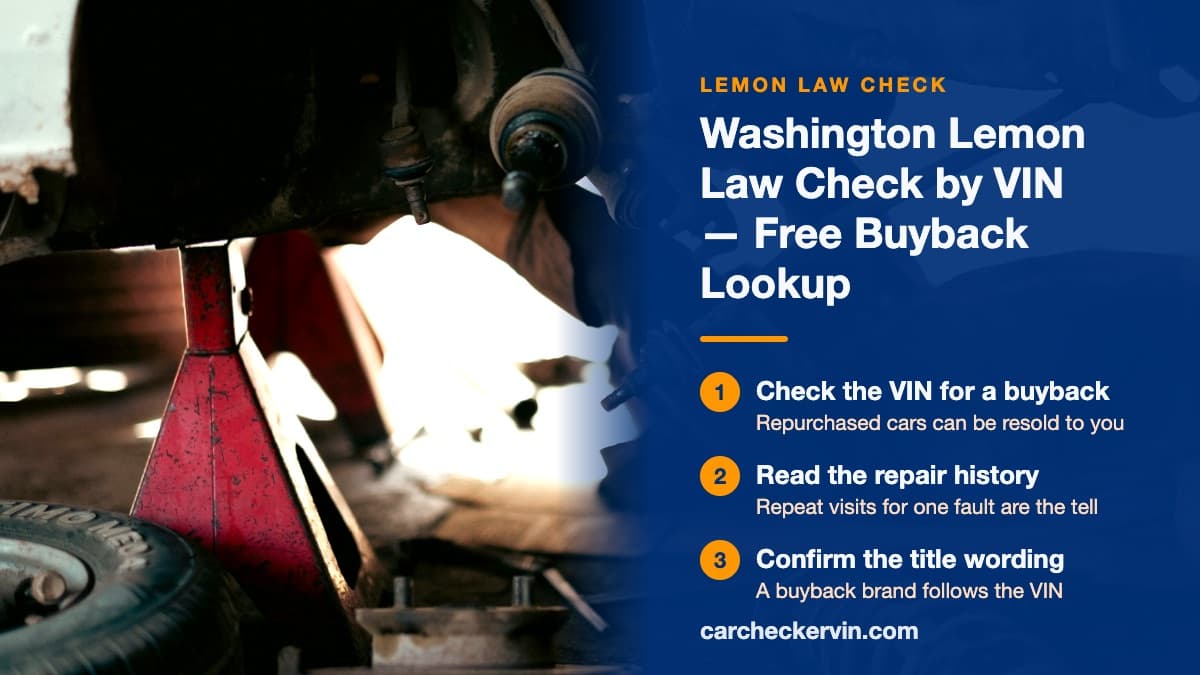
Washington Buyback & Disclosure Rules
When a manufacturer repurchases a vehicle in Washington, the buyback must be recorded on the title as a "Lemon Law Buyback" and disclosed to the next buyer in writing. That paper trail can still break down once a car crosses state lines, which is why the NMVTIS-sourced VIN record is the more reliable source.
Coverage & eligibility
- Coverage window: 2 years / 24,000 mi
- Repair threshold: 4 attempts (2 for safety) or 30 days
- Used-car protection: Limited
Washington title office
- Buyback brand term: Lemon Law Buyback
- Washington Department of Licensing
- 6.6M vehicles registered
Washington fact: Washington brands a vehicle 'Destroyed' when it cannot be returned to roadworthy condition, providing strong buyer warnings.
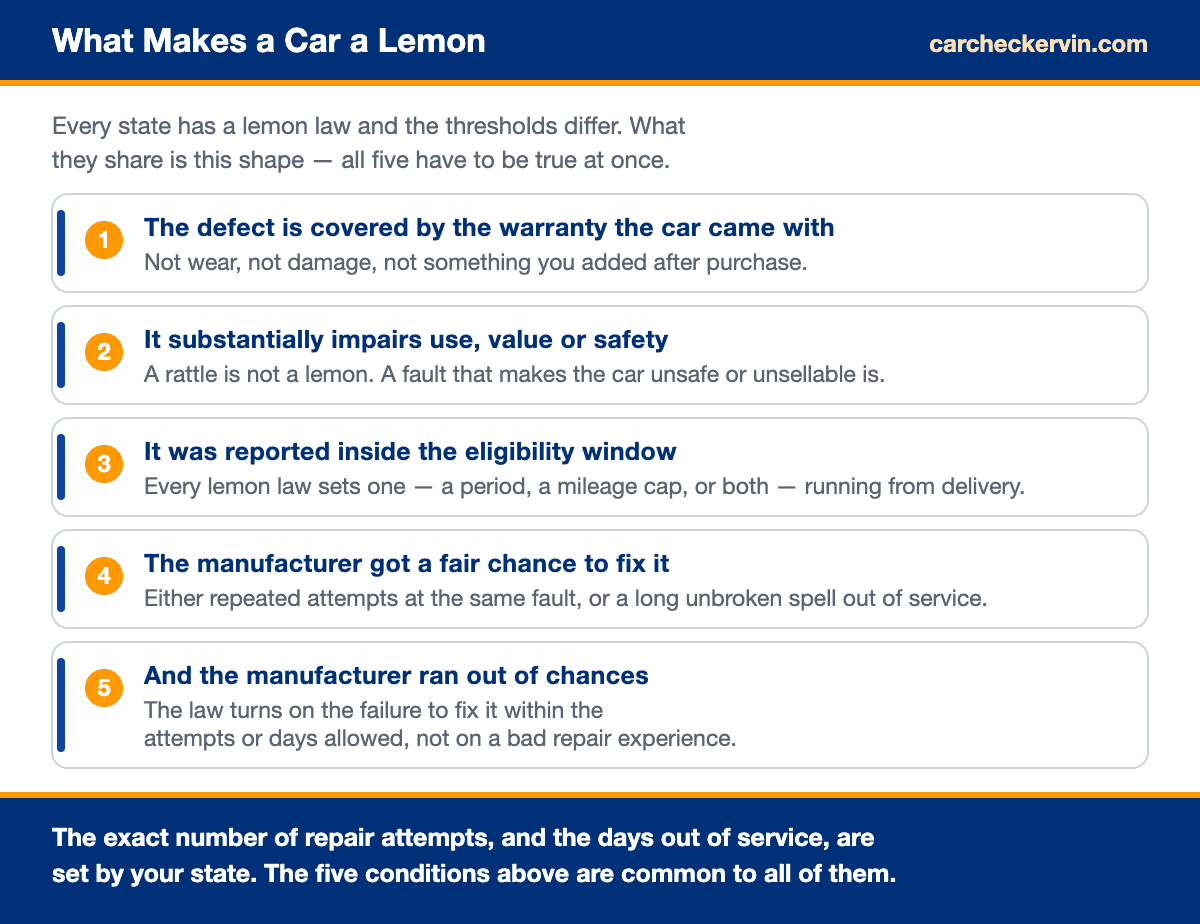
How Washington's Lemon Window Compares to the Rest of the Country
Washington gives you 2 years from delivery, or 24,000 miles, whichever arrives first. That is the same window 16 other states use. 1 state gives buyers longer, and 30 give less. Where you bought the car matters as much as what is wrong with it.
The mileage half of that test is where people are caught out. 21 of the 50 states set no mileage cap at all, so a car can stay eligible deep into six figures. Washington is not one of them — the odometer can end your claim before the calendar does, and a rolled-back odometer can therefore end it early on paper while you still had rights. If the reading looks wrong for the wear, check the Washington odometer history for that VIN before you assume the window has closed.
Used cars are the other dividing line. Only 6 of 50 states extend statutory lemon protection to used vehicles outright, with 3 more offering something partial; Washington sits in the partial group. That is why the title record matters more than the statute for most second-hand buyers: if the manufacturer already bought the car back, the brand on the Washington title record follows the VIN forever, whether or not you personally could file a claim today.
What the Brand Actually Reads As on Washington Paperwork
There is no national wording for this. Across the 50 states there are 11 different phrasings for the same underlying event, and Washington uses “Lemon Law Buyback”. Only 4 states use that exact phrase, so a search for the wording you saw in another state will not find it here. A history report that says “manufacturer repurchase” and a title that says “Lemon Law Buyback” can describe one car.
The buyback brand is also not the only thing Washington Department of Licensing can stamp on a title. The brands that can appear on a Washington record are Salvage, Rebuilt, Destroyed and Flood. These stack: a car can be a buyback and later take a Washington salvage or rebuilt brand on top, and the second brand is often the one a seller talks about, because it has a repair story attached that sounds finished.
Brands are also the part of a car's record that survives a move. Re-titling in a new state is where wording gets lost in translation, which is the mechanism behind title washing — so if the car you are looking at was titled somewhere else first, read the full title history rather than only the current Washingtondocument in the seller's hand.
Buyback Patterns Differ by Manufacturer
Washington's statute sets the thresholds, but the manufacturer decides how quickly it settles, how its warranty is written, and whether it repurchases before a claim is ever filed. Warranty length is the practical part: it sets how long a defect can still be documented as a warranty repair, which is the evidence a lemon claim runs on.
Before Money Changes Hands in Washington
A clean lemon check settles one question. It does not tell you whether the seller can actually hand you the title, and that is the failure that costs buyers the whole purchase price rather than a slice of resale value. If a lender still holds a security interest, Washington Department of Licensing will not move the title into your name — run a Washington lien check on the same VIN before you pay, not after.
If the car is being sold privately, the paperwork is yours to get right. Use a Washington bill of sale that records the VIN, the odometer reading and the date, because a buyback disclosure dispute turns entirely on what the seller told you in writing and when. Then confirm what you will need at the counter to register the vehicle in Washington.
And if all you have is a plate on a listing photo, you do not need the seller's cooperation to start: a Washington plate lookup resolves to the VIN, and the VIN is what every check on this page actually reads. You can screen a car before you ever send a message about it.
Red Flags a Washington Used Car Might Be a Hidden Lemon
No single flag is proof, but two or three together should prompt a full VIN lemon check and a pre-purchase inspection.
A "Lemon Law Buyback" notation that the seller skips over or cannot explain
Repeated Washington service tickets for the same defect inside the 2 years / 24,000 mi window
A short first-ownership period with the manufacturer's finance arm taking the car back
The car re-titled out of Washington within a few months of its first registration
Dealer-only auction history immediately after the original retail sale
An asking price well below comparable clean-title cars in the same trim
Listing photos that avoid the driver-side door jamb and title close-ups
A third-party warranty offered in place of manufacturer certified coverage
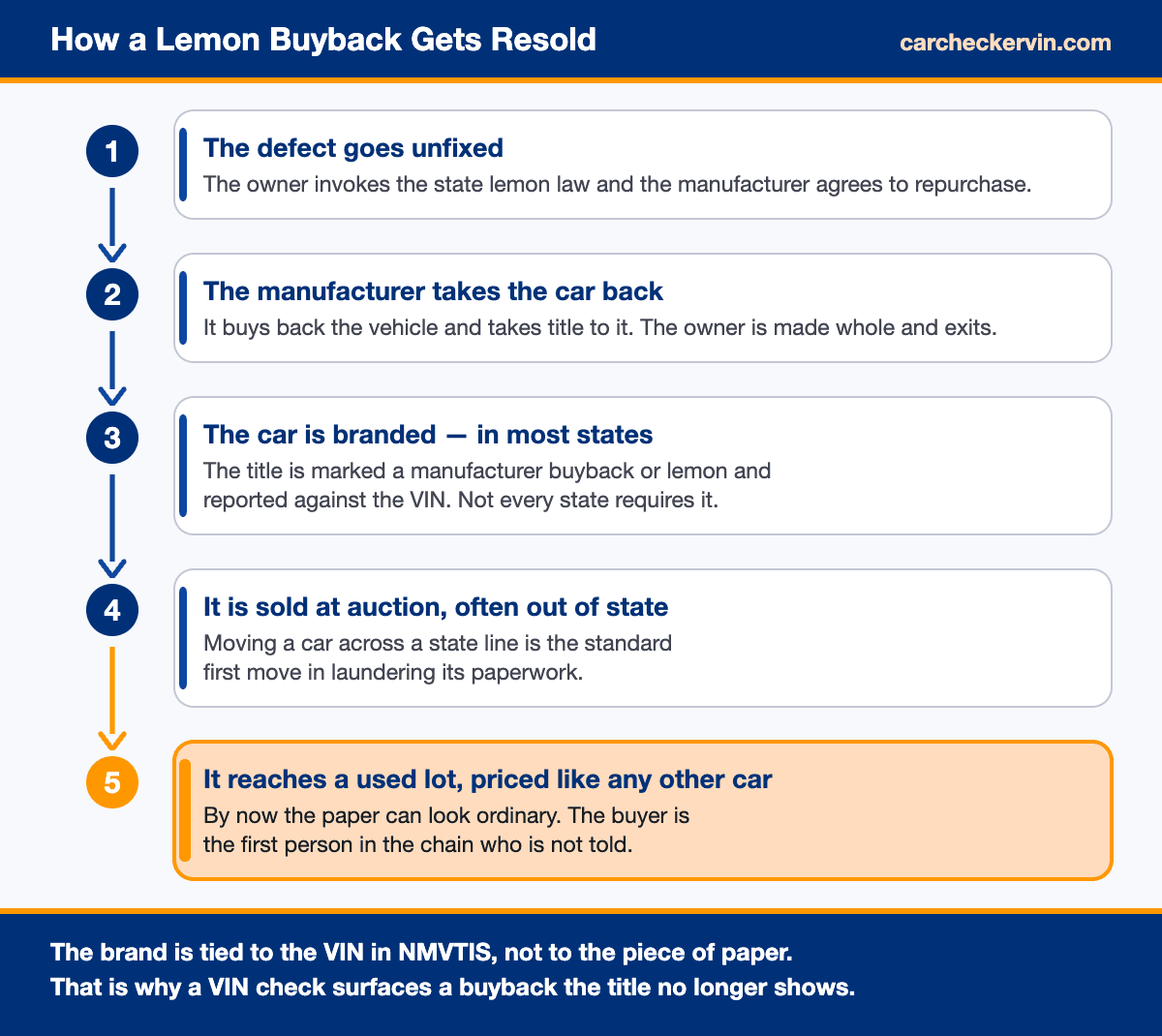
What a Washington Lemon Title Costs You
Even after the defect is repaired, the brand follows the VIN for life and carries real financial weight.
Resale value drops 15-40%
A "Lemon Law Buyback" brand is a permanent valuation discount. Most Washington retail buyers walk away once the brand is disclosed, and valuation guides apply a fixed deduction.
Insurance limits
Many carriers restrict branded-title cars to liability-only coverage and decline comprehensive or collision, the same way they treat salvage titles.
Financing limits
Prime lenders usually decline branded titles. Subprime financing exists in Washington but at higher APRs and lower loan-to-value ratios.
How to Lemon-Check a Car in Washington — 6 Steps
A full pre-purchase lemon screen takes about 15 minutes between your desk and the dealership.
Run the VIN
Enter the 17-character VIN above. We pull NMVTIS, DMV title records, and national auction data in under 5 seconds for any Washington vehicle.
Find the brand
Scan the title-history section for a "Lemon Law Buyback" record or any equivalent buyback or repurchase brand.
Check the window
Washington protection runs 2 years / 24,000 mi. See whether the defect history falls inside that period.
Pull service records
Count repair visits for the same defect. Washington's threshold is 4 attempts (2 for safety) or 30 days.
Verify with the DMV
Confirm the title status with the Washington Department of Licensing before money changes hands.
Get a PPI
Have an independent mechanic inspect the car and target any systems the VIN report flagged.
When Washington Lemon Law Runs Out: Federal Backstop
The Magnuson-Moss Warranty Act
Washington's lemon law is limited to the 2 years / 24,000 mi window. When that closes, or when you buy from a private party, the federal Magnuson-Moss Warranty Act (15 U.S.C. § 2301) can still help in three ways:
- It creates a private cause of action for breach of any written or implied warranty, including powertrain and certified pre-owned warranties.
- It allows recovery of reasonable attorneys' fees, which makes consumer claims economically viable.
- It applies in Washington and all 50 states, filling gaps where the state lemon window has expired.
This summary is informational, not legal advice. Consult a qualified consumer-protection attorney about your situation.
Don't Buy a Washington Lemon by Mistake
Free, instant lemon check sourced from NMVTIS and the Washington Department of Licensing. No credit card. No signup.
Lemon Law Checks in Other States
Lemon laws vary widely from one state to the next. Compare Washington with these other state guides, or see the full 50-state table.
Always check the VIN before you buy
The free preview shows title brands, theft status and open recalls in seconds, and flags whether accident and odometer records exist. The full history is $14.99 — one-time, no subscription.
Washington Lemon Check FAQ
The most-searched questions about Washington's lemon law, buyback titles, and VIN-based lemon detection.
Does Washington's lemon law cover used cars?+
Washington extends limited lemon protection to some used vehicles, typically those still inside the original manufacturer warranty. Outside that narrow window, used-car buyers in Washington lean on the federal Magnuson-Moss Warranty Act and any implied warranty of merchantability.
How many repair attempts make a car a lemon in Washington?+
Under Washington's lemon law, the threshold is 4 attempts (2 for safety) or 30 days for the same persistent defect. A single failed repair can sometimes be enough when the defect is a serious safety issue such as brakes or steering. Washington Rev. Code § 19.118 covers new vehicles for 2 years or 24,000 miles. Limited used-car protection applies to certified pre-owned vehicles sold with manufacturer warranty extensions.
How long does Washington's lemon law protection last?+
Washington covers eligible vehicles for 2 years / 24,000 mi. After that window closes you generally cannot file a new state lemon claim, though the federal Magnuson-Moss Warranty Act may still apply to defects that first appeared inside the warranty period.
What is a Washington lemon buyback title called?+
In Washington a repurchased lemon is branded as a "Lemon Law Buyback". When a manufacturer repurchases a vehicle in Washington, the buyback must be recorded on the title as a "Lemon Law Buyback" and disclosed to the next buyer in writing. That paper trail can still break down once a car crosses state lines, which is why the NMVTIS-sourced VIN record is the more reliable source.
How do I check if a used car is a lemon in Washington?+
Enter the 17-character VIN in the search box above. We query NMVTIS and national title sources for any buyback or repurchase brand, regardless of which state issued the current paper title. Because NMVTIS aggregates records from the Washington Department of Licensing and every other state DMV, a car that was branded in Washington and then re-titled elsewhere will still surface its history.
Are lemon buybacks required to be disclosed in Washington?+
When a manufacturer repurchases a vehicle in Washington, the buyback must be recorded on the title as a "Lemon Law Buyback" and disclosed to the next buyer in writing. That paper trail can still break down once a car crosses state lines, which is why the NMVTIS-sourced VIN record is the more reliable source.
What if the seller in Washington never told me the car was a buyback?+
If a Washington seller failed to disclose a known buyback brand, you may have a claim under the state's deceptive trade practices law, common-law fraud, or the federal Magnuson-Moss Warranty Act. Keep the title, the listing, and every repair record, and consult a qualified consumer-protection attorney. This page is informational, not legal advice.
Is Washington's lemon law window longer or shorter than other states?+
Washington runs 2 years from delivery, capped at 24,000 miles. 17 states share that exact window, 1 gives buyers longer and 30 give less. Comparing states matters more than it sounds: a car bought in a longer-window state and resold into Washington was judged under the rules where it was first titled, and the buyback brand it earned there travels with the VIN.
Does the "Lemon Law Buyback" wording Washington uses appear on out-of-state titles too?+
Only 4 of the 50 states print it that way, so it is close to Washington-specific wording. Across the country there are 11 different phrasings for the same underlying event — a manufacturer repurchase. That is exactly why reading the paper title is not a check: a clerk in another state may have recorded the identical history under wording you do not recognise. The VIN record does not care what any single state called it.
Can a lemon buyback from another state be re-titled clean in Washington?+
That practice is called title washing, and it is what NMVTIS was built to stop. Before the federal database, a branded car could be moved to a state that did not recognise the brand and emerge with clean paper. Today every state title agency reports into the same system, so the Washington clerk sees the prior brand. It still pays to check the VIN yourself rather than trust the document in your hand: washing is far harder than it was, but a title printed before the brand was reported, or one carrying a brand Washington does not itself issue, can still read cleaner than the car's history.
What can I still do if Washington's lemon law window has already closed?+
The state statute is one route, not the only one. The federal Magnuson-Moss Warranty Act has no Washington deadline of its own and reaches any defect that first appeared while a written warranty was in force, which is why keeping dated repair orders matters more than watching the calendar. Washington's deceptive trade practices law is the second route, and it turns on what the seller knew and did not tell you rather than on when the car was delivered. A secret warranty or a manufacturer service campaign covering your exact defect can also extend the repair obligation past the point you assumed it ended. None of that is legal advice, and the timing rules are genuinely fiddly — if the car is a real problem, an hour with a Washington consumer-protection attorney is usually cheaper than the repair you are arguing about.
Does a lemon buyback brand ever come off a Washington title?+
No. A manufacturer buyback brand is permanent — unlike a lien, which is released when the loan is paid, there is no process that clears it once it is recorded. Repairing the original defect does not remove it either, because the brand records what happened, not the car's present condition. That permanence is the reason it is worth checking: whatever the seller has fixed, the record you find today is the same record the next buyer will find when you come to sell, and it is priced into the car for as long as it exists.
One VIN. Every Washington Lemon Brand. Five Seconds.
A "Lemon Law Buyback" record follows the VIN permanently, even when the paper title looks clean. Run the free check before you write a check.
Or get the full VIN history reportRelated VIN Checks
More tools to verify any vehicle's history