Delaware License Plate to VIN Lookup
Start with the plate you can see. Delaware plates resolve to a VIN here at no cost, and the VIN opens the rest: Delaware Division of Motor Vehicles title brands, reported accidents, recorded mileage, and recalls nobody has fixed.
Delaware at a glance
- Registered vehicles
- 0.94M
- State population
- 1.0M
- Issuing agency
- Delaware Division of Motor Vehicles
- Title brands tracked
- 4
Quick Answer
- How can I get a VIN from a DE plate number?
- Enter the DE plate in the CarCheckerVIN lookup on this page — the state is already set to Delaware — and the 17-character VIN comes back with the year, make, and model. From there you can pull the title brands the Delaware Division of Motor Vehicles has on file, plus accident, odometer, and recall history.
- Can a Delaware plate search identify the owner?
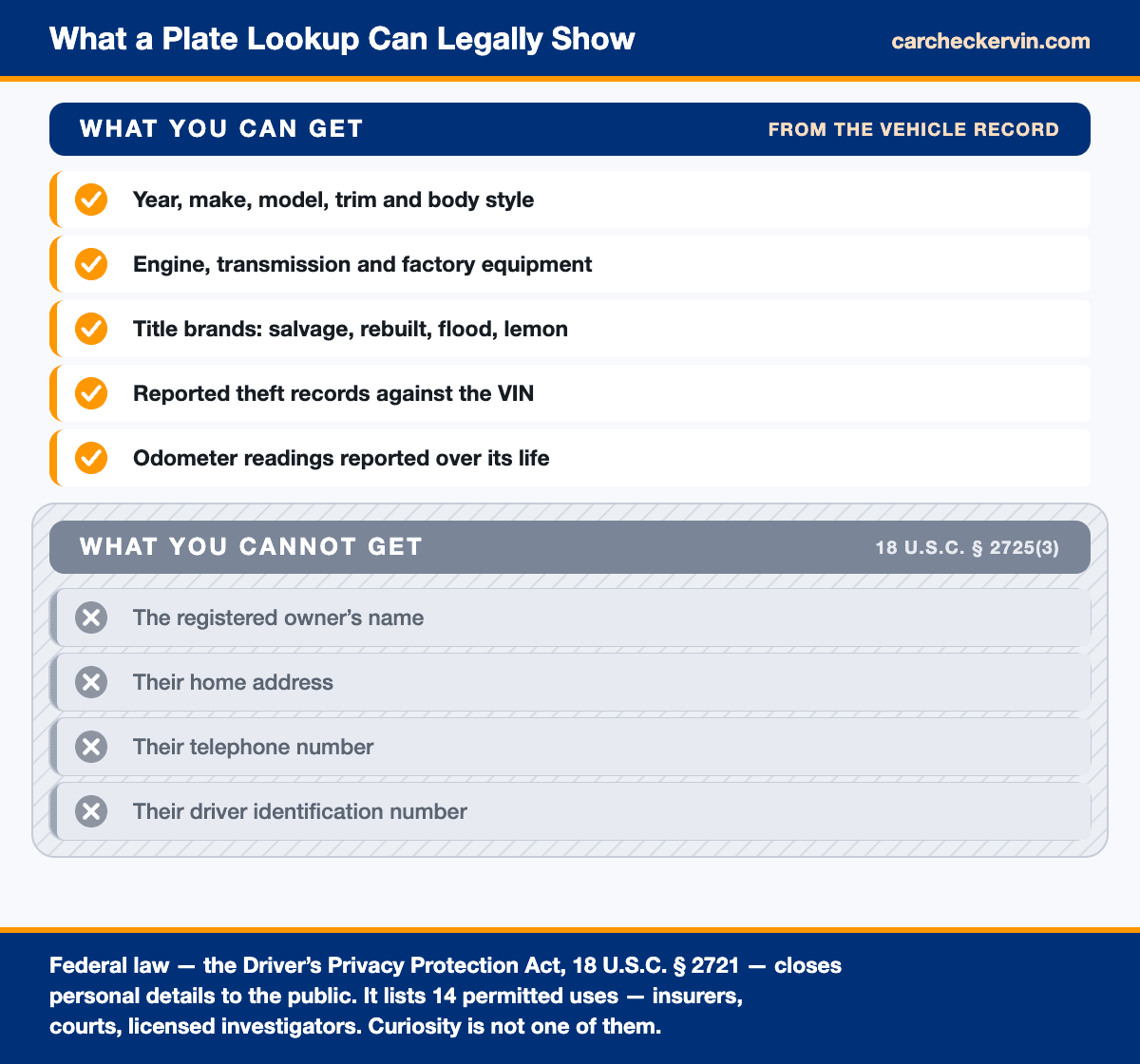
- No. The Driver's Privacy Protection Act settles this at the federal level: a registrant's name, home address and telephone number stay out of Delaware record releases. The answer you get back is about the vehicle — what it is, what its title says, where it has been.
- Why does Delaware registration history matter when buying?
- Vehicles in the six newest model years under 10,000 lbs skip inspection and get a one-year renewal; everything else needs a passing inspection and then gets a two-year renewal. That inspection covers safety items and exhaust emissions.
Four steps from a DE plate to the car's record
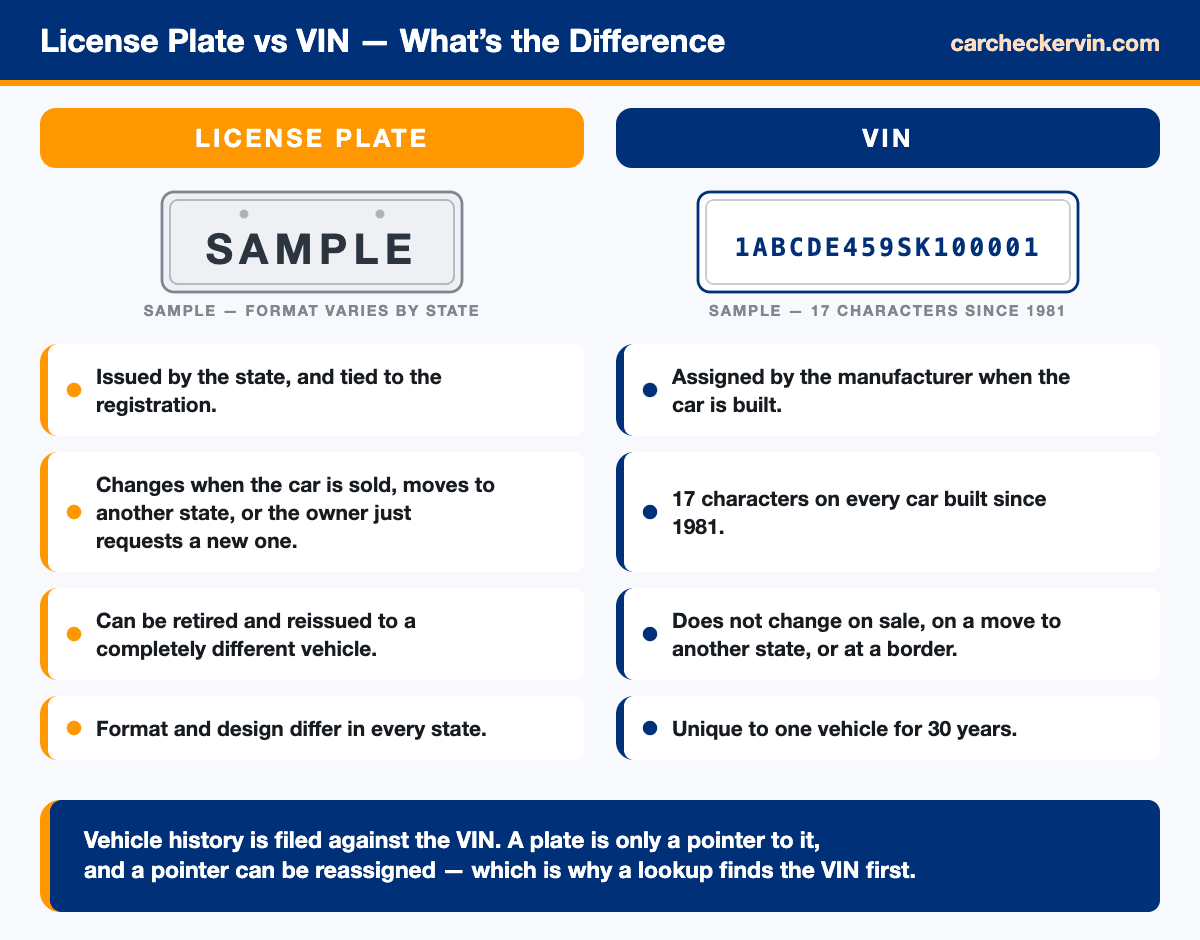
A plate is a pointer, not a record. It is issued by the Delaware Division of Motor Vehicles and stays with the registration, so the useful move is to trade it for the VIN and read the history from there.
- 1Type the plate exactly as issuedNo spaces, no dashes, no stacked characters. If the car carries a Delaware specialty or personalised plate, enter the characters as they read across the plate.
- 2Confirm the state is DelawareIt is pre-set here. Plate serials repeat across states, so a DE plate entered against the wrong state either misses or matches a different car entirely.
- 3Read back the VIN and the basicsYou get the 17-character VIN plus year, make, model, and body style decoded from it. Check those against the car in front of you before going further.
- 4Pull the history on that VINTitle brands, prior states of registration, odometer readings at each transfer, theft flags, and open recalls — the part a Delaware plate alone can never tell you.
Reading the Title Record Behind a DE Plate
The moment you have the VIN, check what the title says. These are the specific brands the Delaware Division of Motor Vehicles can place on a DE record:
- Salvage
- Rebuilt
- Distressed
- Flood
Delaware uses a 'Distressed' brand to flag vehicles with significant non-collision damage.
Registration, Renewal, and What a Delaware Plate Proves
Registration is the thing that lapses, not the plate, and Delaware sets the interval. Vehicles in the six newest model years under 10,000 lbs skip inspection and get a one-year renewal; everything else needs a passing inspection and then gets a two-year renewal. That inspection covers safety items and exhaust emissions.
Registration timing is quietly informative. A car that was off the Delaware books for a stretch, then returned, has a history somewhere else — and that is precisely what a VIN report surfaces.
The schedule above can be amended at any session, so check the official source before it costs you a late fee or a failed sale.
Delaware Plate Transfer Rules, and Why They Skew a Lookup
The seller keeps the tag. Delaware DMV's private-sale guidance is to remove and retain the plate; a low-digit tag sold along with the car needs a separate seller's affidavit (Form MV73). Since April 2025 an owner selling out of state can request to retain the tag online.
One plate, on the rear — 21 Del. C. §2126 requires the number plate assigned to a motor vehicle to be attached to the rear at all times. A duplicate of a valid vanity plate may optionally be shown on the front. (DE source)
That puts Delaware with the 20 states that issue a single plate, against 28 that issue two (2 more do not publish the rule in their own words, so they are left out of both figures rather than guessed at). It matters more than it sounds for a lookup done from a photograph: with no front plate required in Delaware, a car photographed head-on shows nothing to read, which is why so many plate captures come from parking lots and driveways rather than the road.
Personalized plates: Delaware's Vanity Tag Regulation permits up to seven letters and numerals, five on a motorcycle, with numerals sitting to the right of all letters and a hyphen, ampersand or space counting as one character. Following a May 2024 federal district court decision the DMV is no longer permitted to issue new vanity plates, though existing ones remain renewable. (DE source)
Delaware specialty designs you may see on the road
None of these affect what a DE plate search returns. Delaware DMV — Specialty Plates
Always check the VIN before you buy
The free preview shows title brands, theft status and open recalls in seconds, and flags whether accident and odometer records exist. The full history is $14.99 — one-time, no subscription.
Delaware Plate Search or VIN Search?
The Case for the Plate
- A DE tag visible in a listing is often all you can get remotely
- Expired, temporary and dealer plates simply do not resolve
- Single-state scope by design
The Case for the VIN
- Unchanged across every owner the car has had
- Independent of whether the car is currently registered anywhere
- Confirmable against the dash plate and door-jamb sticker
A plate is a starting point in a state with 0.94M registered vehicles and 1.0M residents. Identify the car with it, then read the VIN off the dash or door jamb and check that instead. Run the VIN history report.
Delaware lemon law: Delaware's Lemon Law applies to new vehicles within 12 months of delivery. Buybacks are supposed to be disclosed on the title record, so run the VIN if the history feels incomplete.
Whether a Delaware Plate Still Points at That Car
Every plate lookup carries the same hidden assumption: that the plate is still on the car it was on when you saw it. Whether that assumption holds is decided entirely by state law, and the country splits three ways. In 3 states — California, Hawaii and Minnesota — the plate stays with the vehicle through a sale, so the buyer inherits it. In 46 states the plate comes off the car at the sale. In one stateit is the seller's choice.
Delaware is in the second and much larger group, and that has a specific consequence people rarely think through. Because the plate leaves the car, a plate you noted weeks ago can resolve to a different vehicle today — in the states that let a seller carry the registration across, the plate may now be bolted to whatever they bought next. The lookup is not wrong; the plate simply moved. This is the single strongest argument for resolving a plate to its VIN early and then working from the VIN: the VIN was fixed when the car was built and cannot be reassigned to anything.
None of this makes a plate lookup unreliable — it makes it a starting point. The plate gets you the VIN without needing the seller's cooperation, and from there the record is stable: what the car has been titled as, whether money is still owed on it, and what its odometer has read over time. If the lookup surprises you, the fastest way to tell a moved plate from a misremembered one is to compare the year, make and model it returns against the car you actually looked at.
What to Check Once the Plate Gives You the VIN
A plate answers one question — which car is this. Everything that decides whether the car is worth buying is filed against the VIN it resolves to, and in Delaware those records are separate from each other. The Delaware title record is the first stop, because a brand recorded there follows the VIN permanently even after the car is repaired and resold. If the title reads as anything other than clean, the Delaware salvage and rebuilt-title check is what tells you how serious the damage was.
Two more records routinely cost buyers money and neither is visible on the car. An open lienholder on a Delaware vehicle means a lender still has a legal claim, and a seller can hand you keys and a signed title while the loan is outstanding. The Delaware odometer history matters because a rolled-back reading changes both the price and the warranty coverage you inherit, and the rollback is only visible as an inconsistency across recorded readings.
If the car is newer, it is worth knowing whether the manufacturer ever bought it back — a Delaware lemon buyback check reads the brand that repurchase leaves on the VIN. And before money changes hands, the Delaware bill of sale is what records the transaction, while the Delaware registration process determines what you will need at the counter and how quickly you have to get there.
Who Actually Holds Delaware Plate and Title Data
Every fact on this page traces back to a public record system. Here is where each one lives:
- Delaware DMV — Vehicle Registration — the Delaware Division of Motor Vehicles's own page for DE registration, plates, and titles.
- Delaware plate transfer rule — the DE authority for everything in the section above.
- NMVTIS — run by the Department of Justice, it is where DE title brands are pooled with the rest of the country's.
- NHTSA recalls — tells you whether a recall was issued and never carried out.
Privacy & Legal — DPPA in Delaware
Anyone promising an owner's identity from a DE plate is describing something the Delaware Division of Motor Vehicles is not permitted to release. The Driver's Privacy Protection Act (18 U.S.C. § 2721) confines personal data to specific lawful uses; vehicle history is not restricted in the same way. Registration costs nothing and exists purely to keep DE lookups attributable to someone.
The detailed version, kept in one place: what is and isn't legally available by VIN.
What Only the Delaware Division of Motor Vehicles Can Release
Not every reason to look up a plate is a purchase. Collisions, unpaid liens, insurance investigations and process service all turn on identifying an owner, which is exactly what a public lookup will never return. For those, Delaware has its own procedure.
The DPPA does not close the record absolutely; it closes it to anyone without a listed reason. Fourteen permissible purposes appear at 18 U.S.C. § 2721(b), covering insurance investigation, lienholders, service of process and litigation among others, and it is the Delaware Division of Motor Vehicles — not a data broker — that rules on whether yours qualifies.
Delaware Division of Motor Vehicles publishes its own requirements — the forms, the purposes it recognises, and where to send them — at Delaware DMV — Vehicle Registration. Two situations do not go through that door at all. If you believe the vehicle is stolen, that is a police matter before it is a records matter, and Delaware theft-record checks will tell you whether the VIN is already flagged. If the question is a loan against the car rather than the person driving it, a Delaware lien check reads the encumbrance off the title record without needing anyone's name.
Expect to be identified. A permissible-purpose request names the requester and records the reason, which is exactly the accountability an anonymous lookup cannot provide and the reason the two are not interchangeable. Buyers do not need it; the vehicle's own history covers the purchase decision.
Delaware Plate Lookup — FAQ
Does a Delaware plate search cost anything?+
No payment is needed for the plate-to-VIN step. Register a free account, submit the DE plate, and the vehicle's identification number and basic specs come back right away.
Which Delaware agency issues the plate records?+
That would be the Delaware Division of Motor Vehicles, which holds DE titles and registrations. A lookup queries those records under a DPPA permissible purpose and returns vehicle information.
What does a branded Delaware title mean?+
Delaware uses brands including Salvage, Rebuilt, Distressed, Flood. Delaware uses a 'Distressed' brand to flag vehicles with significant non-collision damage.
When does a Delaware registration expire?+
Vehicles in the six newest model years under 10,000 lbs skip inspection and get a one-year renewal; everything else needs a passing inspection and then gets a two-year renewal. That inspection covers safety items and exhaust emissions. Gaps in that pattern usually mean the car was registered elsewhere for a while. See Delaware DMV — Vehicle Registration for the Delaware Division of Motor Vehicles's current requirements.
Does it matter which plate I read on a Delaware car?+
There is only one to read: Delaware issues a single plate per car rather than a pair, so there is no second tag to fall back on if the first is obscured, and no front number to cross-check it against. 20 of the 48 states that publish the rule do it this way. The characters people transpose are 0 and O, 1 and I, and 5 and S, and one wrong character returns a different vehicle or nothing at all, so photograph it straight on rather than at an angle.
What if the car is not wearing a Delaware plate?+
You can, but you have to change the state first. Plate numbers are only unique inside the jurisdiction that issued them, so the same characters can be live in a dozen states at once — which is why every lookup asks for a state as well as a number. This page pre-selects Delaware; if the tag was issued elsewhere, switch it before you search or you will be reading the wrong register.
Can a Delaware plate point at the wrong vehicle?+
In Delaware the tag comes off at sale, so the number you have identifies a registration, not permanently a car. 46 of the 50 states are the same. If the vehicle sold recently, the plate may have moved on with its old owner and the lookup is telling you about that move. The VIN is the way around it.
The Delaware plate found nothing — what now?+
Four common causes: the registration lapsed, the tag is temporary or dealer-issued, the plate belongs to another state, or the record is too new to be indexed. Ask for the seventeen-character VIN and search that.
Can I find an address from a Delaware license plate?+
No. The federal Driver's Privacy Protection Act (DPPA) prohibits disclosing personal owner information (name, address, date of birth) without a specific permissible purpose. Our lookup returns vehicle data only.
Do I need the owner's permission to look up a DE plate?+
Perfectly legal. The line the DPPA draws is around the individual, not around the vehicle, so a car's history is open to anyone with the VIN or the plate while the owner's details stay shut. That is why dealers, insurers and private buyers all run these checks as a matter of routine.
Should I bother with the plate if I already have the VIN?+
The VIN is the stronger search, so lead with it. Running a Delaware plate afterwards is still useful for one specific reason — it tells you whether the plate on the car is registered to that car. Swapped and borrowed tags are common enough that the check is worth making whenever you are looking at the vehicle in person.
Searching a Plate From Somewhere Else
All 50 statesNo Plate to Hand? Start From the VIN.
Read the VIN off the dash, the door jamb, or the DE registration document, and you can search the full record directly.
Related VIN Checks
More tools to verify any vehicle's history