Mazda CX-9 Years to Avoid — the 2010–2012 and the 2016–2018.
The 2012 CX-9 drew 221 NHTSA complaints, the most of any year, 104 about a brake booster that hisses or leaves the pedal hard. On the 2018, 64 of 128 complaints describe losing coolant, many with a cracked cylinder head.
Found a CX-9 You Like?
Enter its VIN for a free preview of title brands, salvage and total-loss records and odometer readings, then ask about the brakes or the coolant, depending on the year.
Free preview · No sign-up · No owner or personal data
Quick Answer
- What Mazda CX-9 years should you avoid?
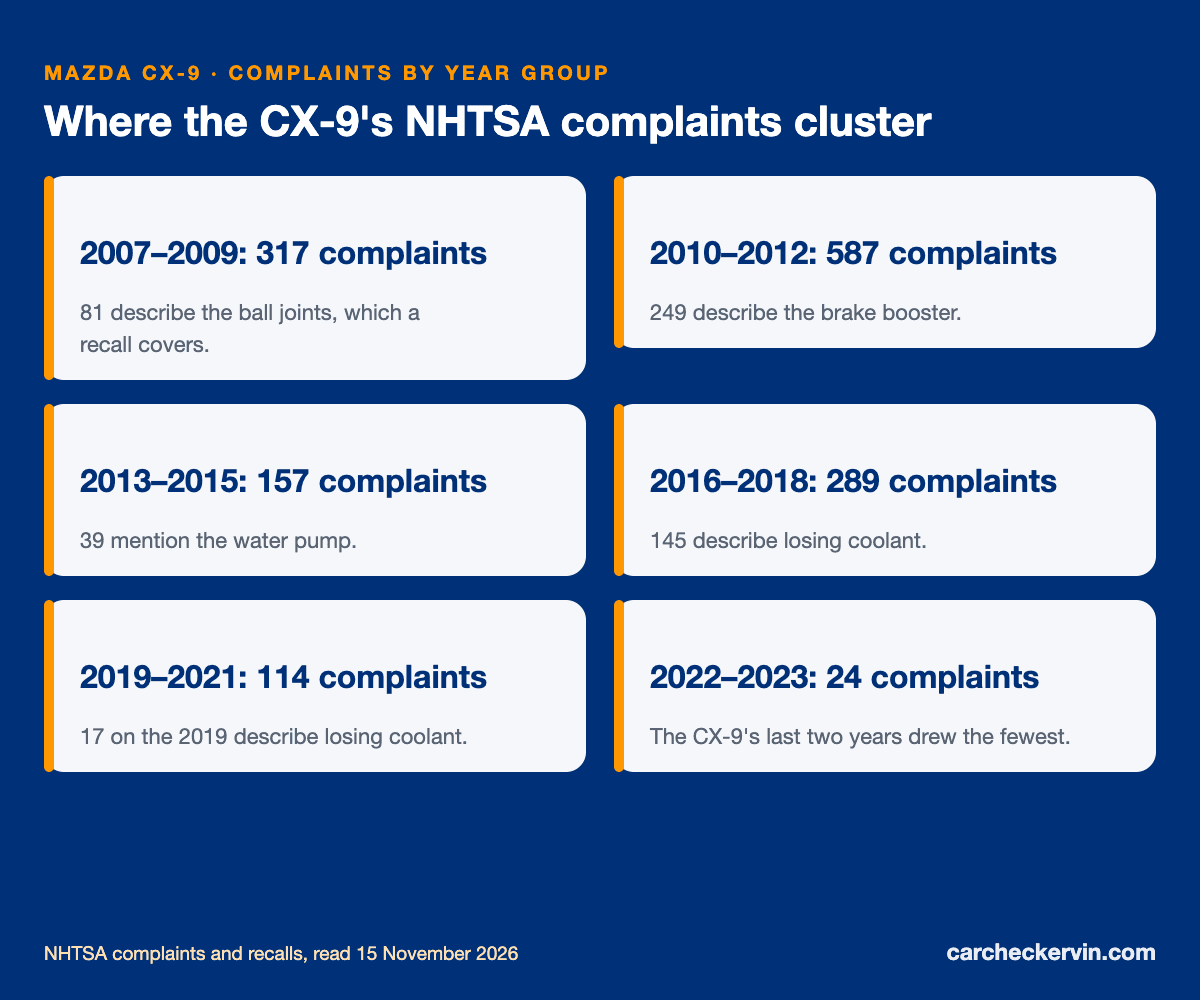
- The 2010–2012 and the 2016–2018. The 2010–2012 drew 587 complaints, 249 about the brake booster. The 2016–2018 drew 289, 145 about losing coolant and 130 naming the cylinder head or head gasket.
- What is the best year for a used CX-9?
- Leaving out years where one fault is a quarter or more of complaints, 2022 (11), 2023 (13), 2020 (19) drew the fewest, all from the end of the second generation.
- Is there a recall for the CX-9 brake booster?
- Not on NHTSA's list as of 15 November 2026. 249 2010–2012 complaints describe a hissing booster or a hard pedal, and some owners mention an extended warranty Mazda offered instead, which has since run out.
Five checks for a used CX-9, by year
The two CX-9 generations fail in different places: brakes and suspension on the first, coolant on the second.
- 1Read the year from the VINCharacter 10 is the model year; a JM3TB VIN is a 2007–2015 CX-9 and a JM3TC VIN a 2016–2023.
- 22010–2012: the brake pedalWith the engine running, press the pedal hard; a hiss or a pedal that stays hard points to the booster.
- 32007–2014: ball jointsConfirm recall 15V451000 for corroded front ball joints was done.
- 42016–2019: coolant levelCheck the reservoir cold; ask whether coolant has been topped up or the cylinder head replaced.
- 5Check title and mileage recordsA salvage brand or a mileage gap shows up by VIN; a cracked head does not.
Avoid: the 2010–2012 CX-9
The 2010–2012 drew 587 complaints, and the service brakes are the component owners name most on all three. 249 describe the brake booster: a hiss from the pedal or a pedal that goes hard.
NHTSA lists no recall for the booster. Several owners mention an extended warranty Mazda offered instead; for some it had run out by the time theirs failed.
Recalls 17V429000 and 19V782000 cover the passenger airbag inflators on these years; 83 complaints on the 2007–2012 cite the inflator recalls.
The 2010–2012 by the numbers
- 195 · 171 · 221 complaints on the 2010, 2011 and 2012.
- 249 about the brake booster.
- No recall on NHTSA's list covers the booster.
- 83 2007–2012 complaints cite the inflator recalls.
Avoid: the 2016–2018 for coolant loss
The second generation, from 2016, moved the CX-9's weak spot to the engine: it is the component owners name most on the 2016, 2017 and 2018. 145 complaints across the three years describe losing coolant, often with an overheating warning, and 130 name a cracked cylinder head or a failed head gasket.
The 2019 continues on a smaller scale: 17 of its 54 complaints mention coolant. NHTSA lists no recall for the coolant loss.
Recall 19V403000 covers a wiring harness on the 2018 that can disable the passenger airbag, turn signals or starting, and 21V875000 a low-pressure fuel pump on the 2018–2019.
The 2016–2018 by the numbers
- 99 · 62 · 128 complaints on the 2016, 2017 and 2018.
- 145 describe losing coolant.
- 130 name the cylinder head or head gasket.
- No recall on NHTSA's list covers it.
Every Mazda CX-9 Model Year Compared
NHTSA complaints and recall campaigns for every CX-9 from 2007 to 2023, the last model year, read on 15 November 2026.
| Year | Generation | Complaints | Crash · fire reports | Recalls | Most-cited component |
|---|---|---|---|---|---|
| 2007 | 1st | 86 | 2 · 1 | 5 | Suspension |
| 2008 | 1st | 172 | 10 · 0 | 6 | Suspension |
| 2009 | 1st | 59 | 2 · 0 | 7 | Service Brakes |
| 2010 | 1st | 195 | 7 · 5 | 6 | Service Brakes |
| 2011 | 1st | 171 | 7 · 3 | 4 | Service Brakes |
| 2012 | 1st | 221 | 9 · 0 | 4 | Service Brakes |
| 2013 | 1st | 68 | 3 · 1 | 4 | Engine |
| 2014 | 1st | 54 | 1 · 1 | 3 | Engine |
| 2015 | 1st | 35 | 1 · 0 | 2 | Engine |
| 2016 | 2nd | 99 | 3 · 1 | 0 | Engine |
| 2017 | 2nd | 62 | 0 · 0 | 0 | Engine |
| 2018 | 2nd | 128 | 4 · 1 | 2 | Engine |
| 2019 | 2nd | 54 | 1 · 0 | 2 | Engine |
| 2020 | 2nd | 19 | 1 · 0 | 1 | Engine |
| 2021 | 2nd | 41 | 7 · 0 | 1 | Engine |
| 2022 | 2nd | 11 | 1 · 1 | 0 | Electrical System |
| 2023 | 2nd | 13 | 3 · 0 | 0 | Chest Clip |
Complaints are unverified owner reports and are not divided by sales.
Other CX-9 Years With a Known Weak Spot
Smaller clusters in NHTSA's records, and the recalls behind them.
2007–2014: front ball joints
Recall 15V451000: the front ball joints may corrode from water getting in. 75 complaints on the 2007–2008 describe them.
2010–2011: transfer case
38 complaints on the two years describe the transfer case or power transfer unit.
2010–2015: water pump
74 complaints mention the water pump, which owners say sits inside the engine.
2018–2019: screens
35 complaints describe the infotainment screen, display or touch input.
2020–2021: second-row seat
Recall 21V750000: on 60/40 bench models the left second-row seat may slide forward in a crash.
2020–2023: the quiet end
The last four years drew 84 complaints between them.
What CX-9 Owners Say
First-generation owners split between SUVs past 160,000 miles with window motors as the main repair, and ones that needed a water pump and a transfer case.
In owners' words (paraphrased)
- 2014, eight years and 160,000 miles: mostly trouble-free apart from four window regulators.
- 2011 at 70,000 miles: the brake booster went at about 50,000, plus a cam solenoid.
- 2013 bought at 110,000: the water pump failed and the engine had to come apart; at 170,000 the transfer case broke and locked the wheels.
- 2012: a transfer case that overheats and burns its lubricant, a $4,000 fix, plus misfires.
- 2010 at 161,000 miles in road-salt country: pretty reliable apart from window motors and a rusted liftgate handle.
- A Reddit owner: a CX-9 engine that died at 130,000 miles.
Checking a CX-9 for Sale?
Enter the VIN for a free preview: title brands, junk and salvage records, total-loss records and odometer readings.
Fewest vs. Most CX-9 Complaints
Fewest covers every year, since the CX-9 ended with the 2023, and leaves out years where one fault is a quarter or more of complaints (2007–2008, 2010–2012 and 2014–2019).
Fewest complaints
- 2022: 11 complaints, 0 recalls
- 2023: 13 complaints, 0 recalls
- 2020: 19 complaints, 1 recall
- 2021: 41 complaints, 1 recall
- 2009: 59 complaints, 7 recalls
Most complaints
- 2012: 221 complaints, 4 recalls
- 2010: 195 complaints, 6 recalls
- 2008: 172 complaints, 6 recalls
- 2011: 171 complaints, 4 recalls
- 2018: 128 complaints, 2 recalls
Recall counts include multi-model campaigns.
The CX-9s Our Visitors Check
Between 1 July 2026 and 11 November 2026, visitors ran 117 different Mazda CX-9 VINs through our free preview, all built in Japan. 44 (38%) were first-generation 2007–2015 models and 72 (62%) 2016–2023.
11 (9%) were 2010–2012s, the brake-booster years, and 23 (20%) 2016–2018s. The single most-checked year was the 2023, at 12 VINs.
CX-9 Complaints by Generation
The first generation (2007–2015) drew 1,061 complaints over nine model years, the second (2016–2023) 427 over eight.
What to Check on a Used CX-9
By year, the faults to look for.
2007–2014: ball joints
Confirm 15V451000; listen for clunks over bumps.
2007–2015: airbag recalls
Confirm the passenger inflator was replaced under 17V429000, 19V782000 or a related campaign.
2010–2012: brake booster
Listen for a hiss and feel for a hard pedal; ask whether the booster was replaced.
2007–2015: water pump
Milky oil or a falling coolant level are warning signs; ask for records.
2016–2019: coolant
Check the reservoir and ask about overheating warnings or a replaced head.
Any year: VIN records
Open recalls, title brands and odometer history.
Reading CX-9 Complaint Numbers
NHTSA complaints are owner reports, not verified and not divided by sales. CX-9 totals are modest, so a single fault can carry a year: on the 2018, 64 of 128 complaints are about coolant.
The fault counts come from searching the words owners used, so they are a minimum. The last two years, the 2022 and 2023, drew 11 and 13.
Related Checks and Guides
VIN tools and the CX-9's rivals.
Where These Facts Come From
Complaint and recall figures are NHTSA's own records; owner experiences are linked so you can read them in full.
NHTSA records read 15 November 2026. Written by the CarCheckerVIN editorial team with AI assistance, from NHTSA's complaint and recall records, our own preview logs and the owner posts linked above; figures checked November 2026. CarCheckerVIN is not affiliated with Mazda.
Mazda CX-9 Years to Avoid — Frequently Asked Questions
Boosters, coolant, ball joints and the last CX-9s.
What is the worst year for the Mazda CX-9?+
By NHTSA complaint count, the 2012 (221), then the 2010 (195) and the 2008 (172).
Which CX-9 years have coolant problems?+
The 2016–2018 above all: 145 complaints describe losing coolant and 130 name the cylinder head or head gasket, with 17 more on the 2019.
Is the 2007–2015 CX-9 water pump a problem?+
It is mentioned in 79 complaints. Owners say it sits inside the engine, so a failure can mix coolant into the oil and the repair is large.
Was there a CX-9 after 2023?+
NHTSA's records end with the 2023, which drew 13 complaints.
Which CX-9 years are covered by the ball-joint recall?+
Recall 15V451000 covers 2007–2014 CX-9s whose front ball joints may corrode.
Will your report show these problems?+
No history report can tell you a booster is failing. Ours lists title brands, NMVTIS junk and salvage records, insurance total-loss records, odometer readings, and auction records with the damage the auction recorded and its photos for the VIN. Recalls are free to check on NHTSA's site.
Test the Brakes or Check the Coolant, Then the Title
On a 2010–2012 CX-9, press the brake pedal hard with the engine running; on a 2016–2018, check the coolant reservoir. Free preview first; the full report is $14.99 and lists title brands, NMVTIS junk and salvage records, insurance total-loss records, odometer readings, and auction records with the damage the auction recorded and its photos.
Complaint and recall figures are NHTSA's public records as read on 15 November 2026; complaints are unverified owner reports. Owner comments are paraphrased from the linked pages. CarCheckerVIN is not affiliated with Mazda. Records in our reports reflect what was reported to our data providers. Our reports do not include police or repair-shop accident entries.
Related VIN Checks
More tools to verify any vehicle's history