NADA RV value? The book lives on. So does the history.
RV values still answer to the NADA name — at J.D. Power's RV guide, by type, make, model and year. What the book can't see is the rig in front of you: flood records, liens and titles travel by VIN, and RVs have those too.
Run the RV's VIN — chassis, coach and records
17 characters in — build, value context, and the flood, lien and title records the guide assumes away.
Free preview · no card, no account
Quick Answer
- Where do I find NADA RV values now?
- At J.D. Power's RV Value Guide— the company that acquired NADA's guide business in 2015 hosts the RV book too, with sections for travel trailers, fifth wheels and motorhomes. The lookup runs by RV type, then make, model and year, with adjustments for mileage and options.
- Does Kelley Blue Book value RVs?
- No — Kelley Blue Book does not provide official RV pricing, which is why the NADA name still dominates every RV valuation search. The practical alternatives are the J.D. Power guide, RV Trader's price guide, and Good Sam's valuator — plus the records check no guide includes.
- Can I check an RV's value and history by VIN?
- Yes — motorized RVs and towables both carry 17-character VINs. A motorhome's VIN follows its chassis maker (Ford, Freightliner, RAM), and the $14.99 NMVTIS-backed report returns titles, flood damage, liens and recalls — the history half that guide values assume and documented rigs get paid for.
Where to find an RV value in 2026
The RV valuation world is small enough to map completely — and one absence explains all the confusion:
| What you're after | Where it is | Worth knowing |
|---|---|---|
| The classic NADA RV book | J.D. Power's RV Value Guide — travel trailers, fifth wheels and motorhomes | Lookup by RV type, then make, model, year — adjusted for mileage and options |
| A Kelley Blue Book for RVs | Doesn't exist — KBB publishes no official RV pricing | That vacuum is why every RV search still says “NADA” |
| Marketplace alternatives | RV Trader's price guide and Good Sam's valuator | Listing-driven views — useful cross-checks on the book |
| The specific rig's story | The VIN — titles, flood records, liens, recalls | No guide includes it; every buyer should |
Every route above prices the model. None of them prices the rig — the one with the resealed roof, the quiet lien, or the flood title two states back. That half travels by VIN.
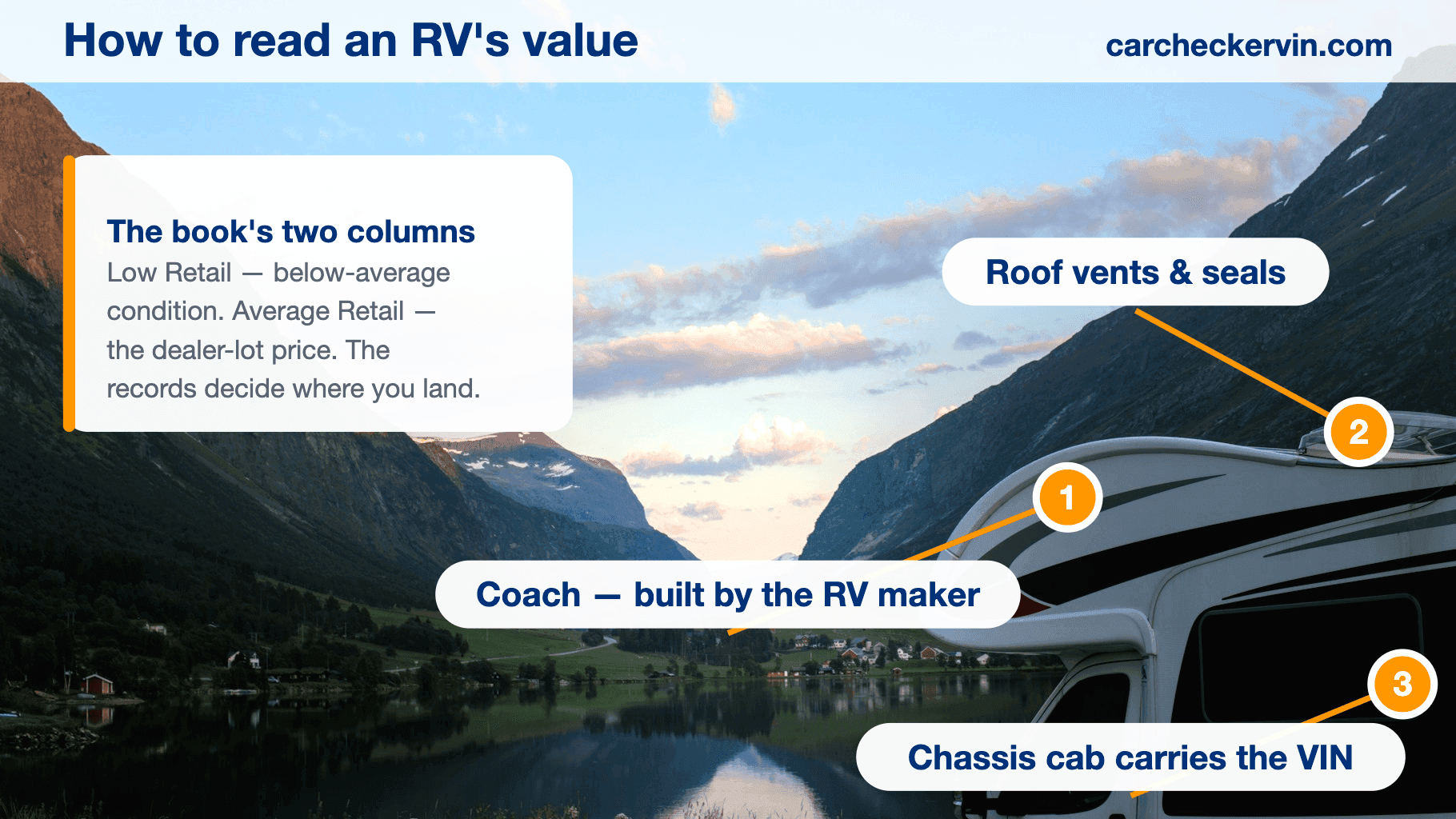
How to read the book — Low Retail vs Average Retail
The guide answers with columns, not a number. Knowing what each column assumes is most of the skill:
Low Retail — the rough one
Low Retail describes a below-average rig: worn interior, deferred maintenance, cosmetic damage. If a seller quotes Average Retail for a camper that smells of winter storage and shows soft floors, the columns are your counter-argument.
Average Retail — the lot price
Average Retail is what buying from a dealership tends to cost — a cleaned, checked, warranted rig on a lot. A private seller asking dealer money without dealer reconditioning is pricing the wrong column.
The records decide where you land
Between the columns sits the negotiation. Documented maintenance and a clean title argue up; missing records, flood flags or a lien argue down — or end the deal. That evidence is exactly what the history report carries.
What moves an RV's number
The guide and the market agree on the levers — every one of them checkable before you drive out to see the rig:
Condition and age
The spread between a cared-for rig and a tired one dwarfs most model-year differences — which is why the book publishes a range, not a verdict.
Documented history
Maintenance records command higher prices — the guide's own guidance. Paper beats promises: a folder of receipts is worth real money at sale time.
Mileage on motorhomes
Chassis miles work like car miles: the book adjusts for them, and the odometer's paper trail is what makes the adjustment honest.
Options and upgrades
Solar, generators, hitches and interior refits move the number — if they're factory-recognized or documented. Undocumented work is just a story.
Diesel versus gas
Drivetrain splits RV values the way trim splits car values — a diesel pusher and its gas twin price like different vehicles.
Season and brand
Spring and summer sell better, and some marques simply hold value. Both effects are real; neither survives a flood title.
Notice the pattern: half the levers are about the model, half are about proof. The model half is free to look up. The proof half is the records.
Check the rig before you price the model
Free preview first: title brands, flood flags and lien records for any 17-character RV VIN — the $14.99 report opens the full file.
One rig, two identities — chassis and coach
RVs confuse valuation tools because they're two products bolted together. The records follow the VIN, so know which VIN you're holding:
Motorhomes: the chassis speaks
A motorhome's 17-character VIN follows its chassis maker — Ford, Freightliner, RAM — not the coach builder on the brochure. Decode it and the drivetrain, year and plant come back; the coach builder's plate lives inside the entry door.
Towables have VINs too
Travel trailers, fifth wheels and campers carry their own 17-character VINs, with the plate typically near the tongue. Titles, liens and brands attach to that VIN exactly as they do on a car.
What the records catch
Title brands, flood damage, active liens and recalls — the failure modes RVs are famous for. A rig that sat in floodwater or secures someone's loan looks identical in photos; it's the file that differs.
Value an RV in three steps
The free half first — the book and the build cost nothing.
Pull the book's range
Look the rig up at J.D. Power's RV guide by type, make, model and year, and note both columns — Low Retail and Average Retail. Cross-check against RV Trader's guide if the model is common enough to have listing depth.
Run the VIN's history
Chassis VIN for motorhomes, tongue-plate VIN for towables. The NMVTIS-backed report returns every state title, flood and brand records, active liens and recalls in under 60 seconds — the half no guide column includes.
Place the rig between the columns
Documented history and a clean file argue toward Average Retail; missing paper and record flags argue toward Low Retail or the exit. Either way you're negotiating from the same two pages the desk uses.
Related RV checks and value tools
The rest of the RV homework, in the same plain terms.
Always check the VIN before you buy
The free preview shows title brands, theft status and open recalls in seconds, and flags whether accident and odometer records exist. The full history is $14.99 — one-time, no subscription.
NADA RV values — the questions people ask
Straight answers, including where the book is all you need.
Is there still a NADA guide for RVs?+
Yes — the values live at J.D. Power, which acquired NADA's guide business in 2015 and hosts the RV Value Guide with sections for travel trailers, fifth wheels and motorhomes. The lookup runs by RV type, then make, model and year, with adjustments for mileage and optional equipment. The name on everyone's lips is NADA; the address is J.D. Power.
Does Kelley Blue Book have RV values?+
No. Kelley Blue Book does not provide official RV pricing — a fact that surprises most first-time RV shoppers and explains why NADA remains the default answer. For cross-checks, RV Trader publishes a listing-based price guide and Good Sam runs an RV valuator; treat them as second opinions on the J.D. Power columns.
What do Low Retail and Average Retail mean?+
They're the guide's two condition brackets: Low Retail describes a below-average rig — worn, deferred, cosmetically tired — while Average Retail reflects what buying from a dealership tends to cost. Private-party deals usually settle between them, and the rig's documentation decides which column it deserves.
How do I check an RV's value by VIN?+
The guide side runs on type, make, model and year — so decode the VIN first to pin those down precisely. Motorized RVs and towables both carry 17-character VINs; our free lookup decodes the build, and the $14.99 NMVTIS-backed report adds every state title, flood and brand records, liens and recalls in under 60 seconds.
Why does my motorhome's VIN decode to Ford or Freightliner?+
Because the VIN follows the chassis maker, not the coach builder. A motorhome is a coach built on a commercial chassis — Ford, Freightliner or RAM — and the 17 characters describe that chassis. The coach builder's own plate is typically inside the entry door. Confirm both when buying; the records ride on the chassis VIN.
Do flood records really show up for RVs?+
Yes — flood damage, title brands, active liens and recalls all attach to RV VINs through the same reporting systems as cars, and water is the RV market's signature failure mode. A dried-out, detailed rig can look showroom-fresh; the record of where it was titled and what was declared is the part a seller can't shampoo.
Is the guide value enough to buy on?+
For a new rig from a franchised dealer, close to it. For anything used, the guide is half the answer by design: it prices the model in assumed condition, while the actual rig carries a file — titles, floods, liens — and a physical state only an inspection reveals. Book, records, inspection: cheapest first, and each one can save you from needing the next.
The book prices the model. The VIN prices the rig.
Guide columns free at J.D. Power — flood, lien and title records for the actual rig in under a minute, for $14.99.
Related VIN Checks
More tools to verify any vehicle's history